Category Archives: Photographs

Fast landscape

The decisive moment exists in landscape pictures too.

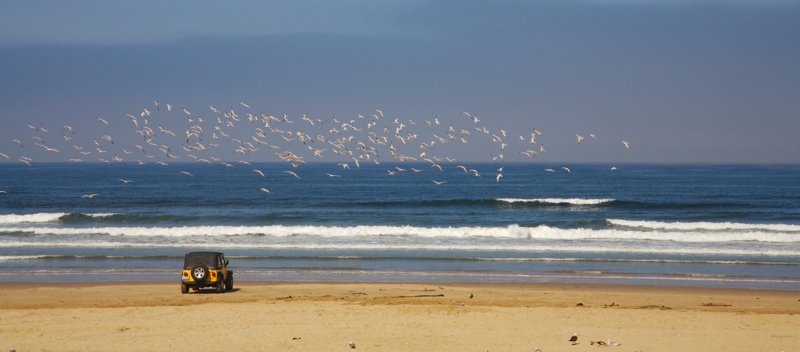
Working on my beach series yesterday I was rambling along Grover Beach and idly eyeing the yellow Jeep wondering if something could be crafted aound it. True, I had noted a flock of some two hundred or so Common Tern minding their own business on the dunes nearby, but thought nothing of it. Fish eaters, these, so likely pretty smart, what with fish being so good for the grey matter. Known to attack marauding humans, too, so I kept my distance. A lovely bird – pure white with a jet black head and yellow beak. Quite the designer’s dream.

I am not, as a rule, the type who composes in the viewfinder, preferring to visualize the scene with my (not so great) eyes then administering the coup de grace with a quick raising of the camera to eye level and a pressing of the button. A legacy of years of street photographing, I suppose. Auto focus and exposure makes that approach even easier than in days of yore.

I found myself wondering about the tranisent lighting effects that can so quickly change a landscape. The times when the clouds open just so and you miss the shot because of some malfunction with the tripod. Landscapes are anything but static subjects.

But this one was, let’s face it, not going anywhere. The waves were rolling in on a fairly predictable schedule and the jolly yellow Jeep was parked. So I just sort of stood there, taking in the view on yesterday’s cool morning, glad I had remembered to pack my wool pullover, for it was but 58 degrees. (14 Celsius for those of you who follow the allegedly Beautiful Game of soccer, where he who gets away with the most fouls, and pays the officials most, wins).

Then for some reason known only to this gaggle of fish eaters a communal take-off took place and the magical moment was just that. A moment. Seconds later the tern had left and the little Jeep had driven off. Who said landscapes are static subjects?

Tern and Jeep. Canon EOS 5D, 24-105mm, 400 ISO.

Hyper-wide candids

When you are that close you become invisible.

Having long been a fan of ultra-wide angle street photography, after many enjoyable years with a 21mm lens on my Leica, it seemed only natural to extend this approach to the realm of the hyper-wide world. That’s the result when using the Canon 15mm full frame fisheye lens on the 5D, augmented by the ImageAlign Photoshop plug-in I have explained in detail before. This plug-in removes objectionable fisheye lens barrel distortion.

The basic premise is that the man in the street has no idea what a fisheye lens does, especially when it come to reducing subject to camera distance if a frame filling picture is required. You can basically be pointing your camera almost directly at the subject and the latter will blithely assume you are photographing something over his shoulder. So proximity confers a level of invisibility unavailable to those using lenses in the 28-50mm range. Use anything longer and you also lose that involved, up close, candid feel.

The small, inconspicuous appearance of the fisheye adds to the stealth factor, an attribute no big honker super-wide zoom can claim. Finally, blanking out all those maker’s advertisements on your camera with some electrical tape makes sure you don’t scream ‘Canon’, or ‘Nikon’ or whatever for the whole world to hear and see.

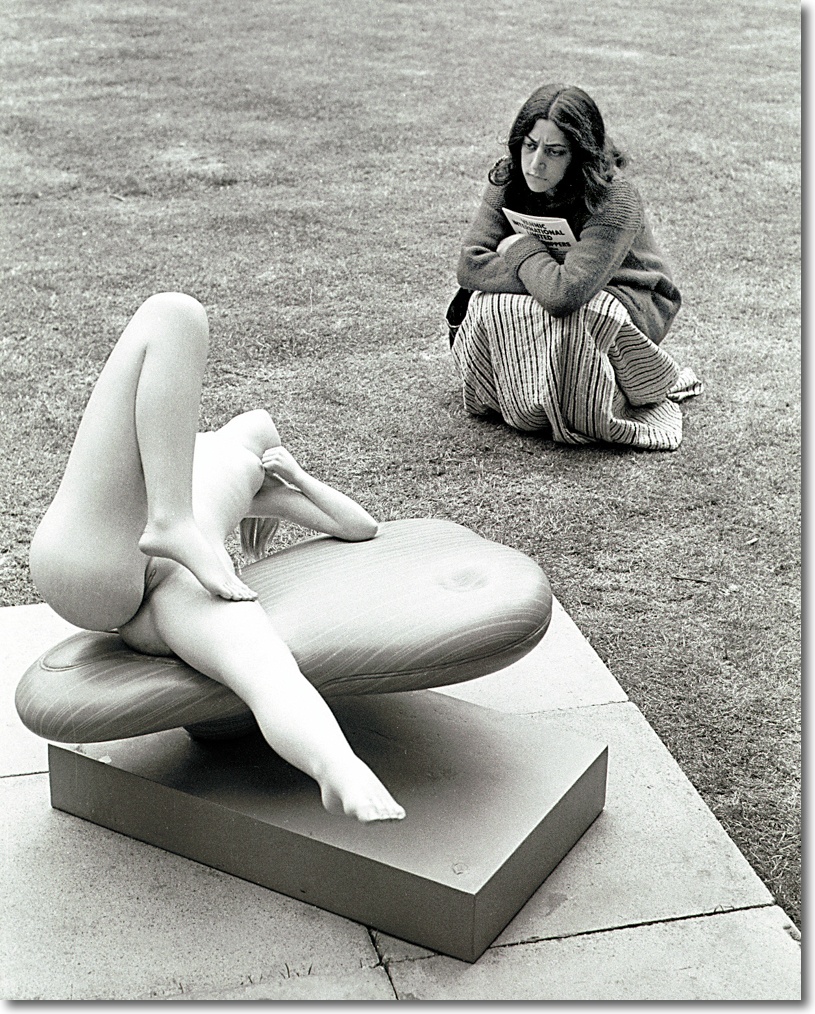
To illustrate, here are four pictures taken yesterday in one of California’s many beach cities, Pismo Beach. The subjects were mostly within 1-2 feet of the lens.


All images taken on a Canon EOS 5D, 15mm Fisheye, Image Align.

What fun! Certainly the extremely wide view does the young woman’s legs no harm in the last picture.

At the beach with Eugene Boudin

The painter who taught Monet leaves an indelible impression.

Eugene Boudin (1824-1898) is more famous today as having been Monet’s mentor than as a painter in his own right.

Yet reading John Rewald’s definitive book The History of Impressionism (unreservedly recommended) some 30 years ago, I found myself drawn to Boudin’s subtle art enough to explore it more. And, as happens, the impression his work made on me must have planted a deep seed for when I started getting serious about taking beach pictures again a couple of years ago I was shocked to realize just how much Boudin’s work had permeated my way of seeing.

His canvases are invariably small and frequently in what we now think of as widescreen – a perfect match for the infinite horizons a beach offers. And while the great English photographer Tony Ray Jones saw the English at the beach in his book A Day Off with a familiar air verging on the satirical (pink skinned Anglo-Saxons rushing out for a spot of sun with handkerchiefs on their heads, the corners knotted just so, trousers rolled up to the knee for a quick paddle, no sunblock in sight), Boudin’s fascination was not so much with individuals as with how people at the beach were part of the greater landscape. His elegantly dressed ladies with parasols speak of an earlier era, true, but their placement in the canvas is what makes the painting great.

Boudin’s vision was not limited to these somewhat formal arrangements. He could really let fly when it came to man made things – take this example:

Even in his desolate landscapes, the magic is there. Subtle, it does not shout at you like some Monets may, and there’s less technical exhibitionism on show.

So here’s a small sample of some beach snaps I have taken in the past couple of years, Boudin everywhere doing his thing with my grey matter. I hope you enjoy them.

Sunhat. Pismo Beach, California, 2004. Leica M2, 50mm chrome Summicron, Kodak Gold 100.

Dune Buggy. Oceano Dunes, California, 2004. Bessa T, 21mm Asph Elmarit. Kodak Gold 100.

Umbrella. Cayucos, California, 2006. Canon EOS 5D, 15mm fisheye, ImageAlign.

High Dynamic Range photography

Not quite as new as it sounds, but much easier today.

Stumbling the ten yards down the main drag from bedroom to office this morning, I tripped on not one but two border terriers. Which is strange as, last I checked, the Pindelski estate was the proud owner of just one of these fine beasts. So either there was some serious hanky panky in the night or something else was afoot.

Now, come to think of it, yesterday was Friday night and it happened to coincide with a presentation of Steve McQueen’s superb film, Le Mans, on the big screen. Anytime one sees a brute Porsche 917 race the gorgeous Ferrari 512 is an occasion for some serious medication to calm the nerves and suffice it to say that the gin martinis were flowing freely.

Which probably accounts for the presence of that second border terrier this morning.

Sitting down at the computer and erasing all those email suggestions that I could not possibly satisfy my woman without a horse’s dose of Viagra, my first reaction was to do something more exciting like paying the bills, but I gave one of the HDR links in a clean email a passing click only to come across this page from Photomatix. When the first thing I saw was their exhortation ‘Increase the Dynamic Range of your Photographs’ I wondered whether this was some sort of spam, and that in fact this was yet another attempt to sell me performance enhancing chemicals. Look, I know I grew up in England where the average male prefers a hot water bottle to a cuddle with his girlfriend, but this was going a bit too far.

Anyway, I scrolled the little wheel on my Genuine Apple Mighty Mouse down the Photomatix page and, well, saw a revelation. What their application does far better than Photoshop can (no surprise there) is to combine three photographs, identical except as to exposure, to create a result with huge dynamic range. You now see the highlight and shadow details that were missing before. The revelatory aspect of this is that the Photomatix software does this with one click, even working on RAW files. All the photographer has to do is take three exposures, 2 stops under, correct and 2 stops over, then let the software work its magic.

Not that this is all that new. Unknown to me I have been an HDR devotee for most of my photographic life. With black and white prints it meant overerexposing, underdeveloping, then printing on a contrasty grade of paper with lots of burning in using the hands over the easel. Then for a long time, having migrated to color film, it was either displaying the slide on a screen using a projector, which confers tremendous dynamic range, or living with prints which either opted for burned out highlights or dungeon dark shadows. Once those slides could be affordably scanned in the 1990s they took on a new lease of life as dynamic range could be restored to some extent with software. Plus, while a computer screen cannot compare to a projected image for dynamic range, it’s a lot better than a print in this regard. The way I would do it is to simply use the Highlight-Shadow slider in PS, later the far better one in Aperture, and bring back the details. For example, take these two snaps of a shaving shop on St. James’s Street in London, taken in 2000 on Kodak Gold 100 negative film:

The original, scanned using a Nikon Coolscan scanner.

With Highlight-Shadow correction applied using Aperture.

There’s life in those old pictures yet!

With more recent pictures, taken using RAW in the 5D, the manipulation range is far greater. In this example, I underexposed by a couple of stops to preserve details in the exterior, then corrected exposure and used the Highlight-Shadow slider in Aperture to balance interior and exterior lighting. The Aperture RAW converter was used.

This suggests that, if I do indeed have two border terriers, one was away at the time this was snapped.

So maybe HDR isn’t so new after all. Indeed, look at what chaps like Canaletto did when lazing around Venice trying to make some coin from his oils:

Canaletto has a go at the Grand Canal

A latter day Canaletto from the Photomatix web site.

It’s little wonder that modern HDR photographs tend to look like oil pantings, as they recreate the great dynamic range that the old masters were creating intuitively. I sort of doubt that Pope Julius II would have ponied up the lira had the ceiling of the Sisitne Chapel been delivered with blown out highlights.

Michelangelo. The Sistine Chapel, 1512.

So Michelangelo was into HDR some 500 years ago. Clearly, he did not use Windows or he would never have finished the job.

In my early experiments with Virtual Reality photography, I mentioned the challenge posed when it came to correct exposure. To permit seamless stitching of the panorama, the camera has to be set on one fixed, manual exposure while all the pictures are taken. To do otherwise is to ask for trouble. The issue, of course, is that means the likely huge dynamic range of a panorama will results in exposure problems in some of the frames. Now it seems that the automated approach offered by products like Photomatix would cure that. True, you have to take at least three pictures for each frame and there’s a little more work to do in assembling the panorama, but cameras like the 5D allow automatic bracketing at two stop intervals – press the button in burst mode and the camera takes three pictures in one second.

So now it looks like my return trip to the redwoods will call for some burst mode under and over photography. More when I have the pano head in my hands. Which probably means my own head will be in my hands shortly thereafter.

By the way, here’s another picture where I used HDR. I wanted a picture of our home theater in daylight, to show the environment and photographs on the walls, but I also wanted the screen filled with a movie picture.

The Home Theater. Canon EOS 5D, 24-105 at 24mm, PS CS2, RAW

I simply exposed for the room, reckoning the fabulous sensor in the 5D would preserve data for the screen image, even if it would be washed out. After converting the RAW file to PSD in ACR, I used the Lasso tool freehand to highlight the screen area then used Levels to bring back the detail. Hey presto!