Category Archives: Leica

All about the wonderful cameras from Wetzlar.

It’s the software, stupid

Software can yield far greater improvements than optics.

For an index of all Leica-related articles click here.

You might fairly accuse me of worshipping at the altar of the gods in Wetzlar when it comes to optics. For the last 75 years of the twentieth century, Leitz Wetzlar, as it was most of that time, created two great cameras – the screw thread Leica and the M3 and its variants – and dozens of the best lenses known to photographers. And while I may have moved away from Leica rangefinder cameras in the absence of a digital option, I have had the rare pleasure of using many of Wetzlar’s lenses on my rangefinder and reflex Leicas.

My first Leica lens was the 50mm Elmar. It’s sole limitation was the boob behind it pressing the button on the M3. Twist the mount counter-clockwise and the lens neatly collapsed into the camera body, passing for what was compact back in 1971 when I got mine. August 2, 1971 to be exact. The 90mm Elmar and a superb 35mm Summaron followed. In each case these were the ‘beginner’s’ option (meaning cheap, by Leitz standards), and only years of hard work later did a Summicron grace the M3. That was the incomparable 50mm Dual Range, the brass mount having last seen duty as the main engine bearing in a Panzer tank. And I’m afraid that mention of any of the dozen others that came and went would be a tedious exercise in the overuse of superlatives. For the M these included the 21mm Asph Elmarit, the 35mm Asph Summicron, later and mercifully lighter versions of the 50mm Summicron, a 90mm Elmarit, Tele-Elmarit, Elmar-C and Asph Apo-Summicron, a 135mm Hektor, Elmar and Apo-Telyt, 200mm, 280mm and 400mm Telyts, and on and on. Each magical in its own way.
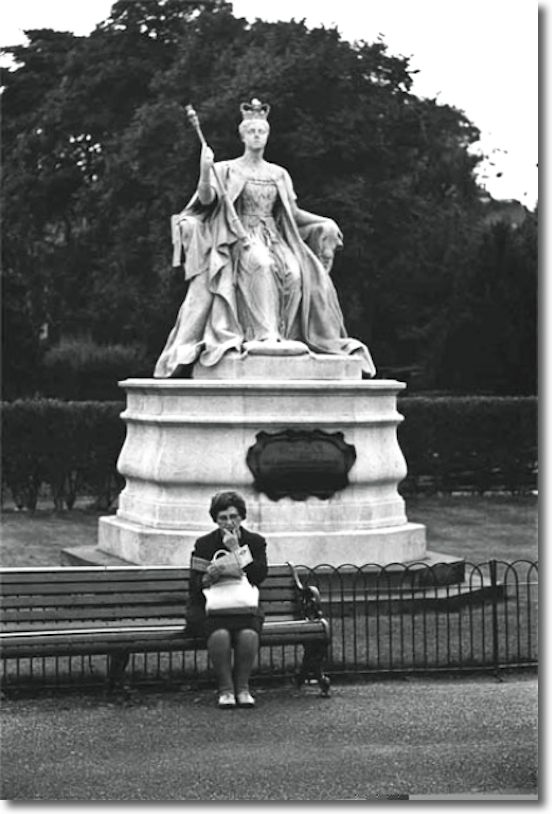
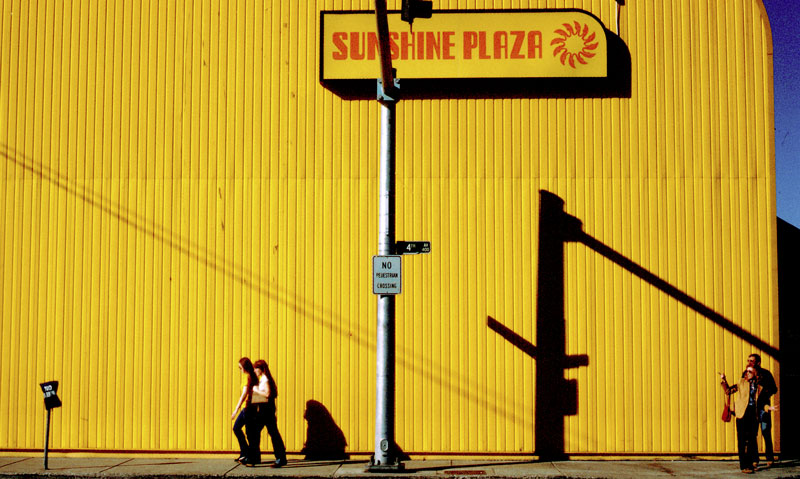
Map reader. 1973. Leica M3, 50mm Elmar, TriX/D76.

For the most part, these lenses were designed the old fashioned way. Hard graft with calculators and logarithmic tables, long hours melting ever more exotic glasses, interspersed with occasional bouts of sheer lunacy. The ‘we made it because we could’ lenses like the original 50mm f/1.2 Noctilux with its aspherical grinds, the NASA commissioned 180mm f/3.4 Apo Telyt R which finally brought the red spectrum in line with the rest of the colors to give an image of startling definition, the fabulous 75mm f/1.4 Summilux (if only you could focus it right – that sort of thing needs an M3 vewfinder!). And while computers played an increasing role in the design of later lenses, the long heritage of optical excellence at Leitz, Wetzlar, West Germany saw to it that they were programmed right. The reality is that if lenses for 35mm cameras can get any better no one will notice as the magicians at Wetzlar had long ago exceeded anything film could resolve.

These thoughts have been coursing thorugh the old brain increasingly as I look at the modern processing workload. Now bear in mind that this is coming from someone who adopted a beginning to end pure digital workflow only earlier this year with a Canon 5D. Until then it was film + scanning, which took over from film + color lab, which in turn had supplanted film + darkroom/bedroom. And what strikes me most is how much software has become a dominant part of picture processing.

Start with the in-camera software that tells the sensor RAW or JPG, maybe with various amounts of contrast, sharpness and other processing included. In to Aperture or Photoshop where chromatic aberration (color fringing) at the edges has to be repaired. Then the barrel distortion has to be removed at the wide end of the zoom. Another tweak and the vignetting is gone. Three aberrations I simply do not recall having to deal with in the days of the Summicron and its brethren. Because if they were present, they were not visible. So on that scale, I suppose, one would rightly argue that Canon lenses simply do not hold a candle to those from Leitz Wetzlar. OK, so you have to laboriously manually focus the Leica lens, and the aperture is manual and the only way to zoom is to walk closer or fall in the water…. But from the sheer standpoint of optics, if I had to bet my life on resolving power and freedom from aberrations, it would have to be Leica every time.

The reality is, it no longer matters. Good software can correct all those problems in seconds. Further, because the digital ‘film’ in the 5D is far superior to the one from Kodak which I used in the M3, the overall result is better in every conceivable way, and it’s mostly due to software. I believe designers are getting the message. Increasingly we are seeing new technologies like image stabilization add more definition than any film based user could hope for, and we are probably very close to the point where very large aperture lenses with vast zoom ranges with minimal bulk are around the corner. The necessary optical compromises will be corrected in the camera with tailored software. For that matter, the lens need no longer be interchangeable as the zoom range will be so large it will accomodate all conceivable needs.

Sceptical? Look at the Kodak P712 digital camera announced earlier this week. The lens is equivalent to 36-432mm (432mm!) with a smallest aperture of f/3.7. F/3.7! The camera costs $499 and weighs probably under one pound. Compare that with the 400mm f/4 DO Canon lens, at $5,200 and 4.3 lbs. And it doesn’t even zoom. Sure, I have no doubt the Canon lens is better, but how long do you expect that to last?

Case in point. My Panasonic LX-1 (click on the entry at right) has a Leica lens that reads ‘DC Vario-Elmarit 1:2.8-4.9/6.3-25.2 ASPH.’ Phew!. Not like saying 50mm Summicron now, is it? To make sure things are not blurred the camera has image stabilization, because some unnamed brilliant engineer at Panasonic thought it up. Auto focus makes sure it’s focused right adding yet more definition to the competitive equation. This lens is like a 28-112mm on a regular camera. At its longest setting it extends 1.5″ from the barrel on the camera’s body.

So, supposing I want a 24-105mm f/2. That would translate to a 5.4mm – 23.6mm lens which, fully corrected, would doubtless be a lot bulkier than the one on the DP. Now throw out the large front element, there to reduce vignetting. Get rid of several of the others there to confer minimal color fringing. And the hell with barrel distortion. Curvature of field and all those insurmountable problems with edge pixels and wide angle lenses? Nonsense. Just bow the edges of the sensor towards the lens as the focal length changes. Flexible sensors? Why not? Zoom? The next generation of sensors will obsolete optical zooming and do it all electronically. About time. Program around all of that with some smart software, fix the image on the fly when saving (or even when viewing if it’s that horrible to look at) and your 24-105mm f/2 zoom is now 1″ in diameter and 1″ long. Wow! So we gradually return to the days of the Box Brownie with its miniscule single meniscus lens, but with an image readily enlarged 12 times or more.

And who will be the genius designing these new ‘lenses’? It won’t be a god the likes of Max Berek or Walter Mandler in Wetzlar. It will be some kid who is really sharp at coding who happens to like a superb picture from the one ounce piece of plastic passing for a lens attached to his camera. The great days of optics are yet to come and their designs will emanate from the keyboard of some unknown master even now getting his lips around the teat on that plastic milk bottle.

Gorilla. 2006. Panasonic Lumix LX1, 6.3mm DC Elmarit Asph, ISO100, image stablizer.
Digital Leica – not!

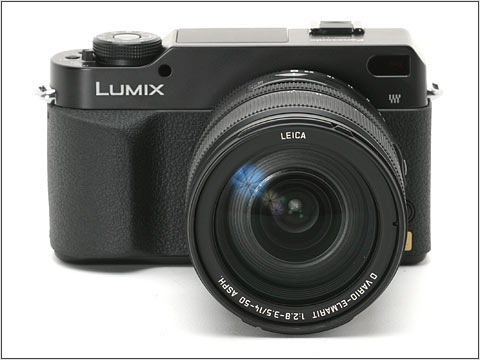
Panasonic disappoints with the L1.

I should preface this by saying I have not used the newly announced Panasonic L1, so it’s really premature to criticize, but a review of the specificationss underwhelms.

I was really looking forward to this camera, hoping it would be the digital Leica all ex-Leica M users like me are waiting for, at a non-Leica price. They will sell for $2,000 with the Leica zoom lens. Not bad.

The disappointing Panasonic L1.

Now the ergonomics look promising. A real shutter speed dial, a pretty exciting Leica lens (alternatively designed by Leica or Panasonic, depending on where you read on the Panasonic web site) with manual zoom and iris controls, and a nice M-look camera body. Throw in image stabilization, a vibrator to shake off sensor dust and a 16:9 widescreen picture option and what’s not to like?

How about a lousy viewfinder? The L1 shares the prism optics of the Olympus E-330, which uses a side flapping mirror (like their Pen F half-frame film camera did some thrity years earlier) and mirrors in lieu of a pentaprism to turn the image right way round. Result? A very dim image. Don’t believe me. Check out the on line reviews.

How about a lousy sensor? Use it above 400 ISO and all is lost in noise. It’s the same sensor used in the E-330. Don’t believe me. Check out the on line reviews.

How about a very small image in the finder? It’s the same optics used in the E-330. Don’t believe me. Check out the on line reviews. And if you don’t know what I’m talking about, just look through a Canon 5D after trying a Rebel or 20D/30D. I have. Night and day. The L1/E330 is like the Rebel in this regard.

As for all that ‘live preview’ nonsense, why did they waste their time? No one needs this in a professional grade camera. And the E330 does it better, if you must have it, for less.

Too bad. I was kind of excited about that Leica lens. Guess we’ll have to wait for the Digital Leica M but, no, I’m not holding my breath. I’m just holding on to my wallet.

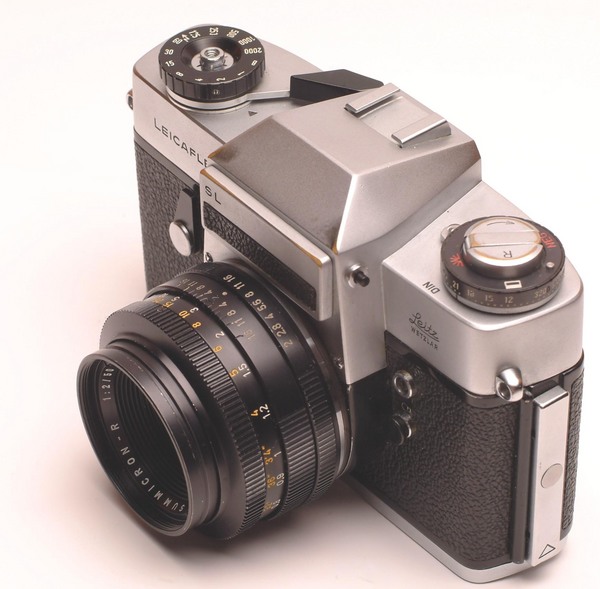
The Leicaflex SL

Simple, sturdy and with great lenses, you can pick up this behemoth for very little

While classic rangefinder Leicas continue to appreciate as doctors, dentists and investment bankers fill their display cases, fine cameras like the Leicaflex SL, which never really caught on, can be had very inexpensively.

I used one for many years, during the period 1977 though 1990, starting with a 50mm Summicron lens, adding a 21mm, a 90mm Summicron for portraits and the superb 180mm Apo-Telyt R for landscape pictures. As good an optic as I have ever used.

Provided you were in no great hurry and didn’t mind the noise, it was hard to take a bad picture with this camera. The camera was big and rather clunky, the wind lever had way too long an arc but the controls were nice and large meaning use with gloves on was no problem.

What I liked most was the semi-spot meter. The excellent microprism focusing circle also defined the exact area of measurement for the meter and was large enough that you didn’t get all nervy the way you do with a spot meter. It was a match needle design, meaning you had to align two needles, visible only in the viewfinder. Adding or deducting a stop for light correction was very easy with the camera at eye level, as the viewfinder displayed the selected shutter speed and was very easy to see with or without eyeglasses.

This was one of the last of the all mechanical cameras which have now largely disappeared, but proved very reliable in all weather conditions. True, the camera had looks only a mother could love but the lenses were superb regardless of focal length.

As Leica has since added all sorts of electronic gizmo connections in its SLR lenses in a futile attempt to keep up with the times, the earlier two cam mechanical lenses can be had very inexpensively. While the build quality never felt up to early Leica M standards (meaning M2, M3 and M4), I had no reliability problems, and the uncluttered viewfinder was a joy to use. A great starter camera for someone getting serious and willing to put up with the shortcomings of film.

Anchorage, Alaska. 1978. Leicaflex SL, 50mm Summicron R, Kodachrome 64

New York City. 1985. Leicaflex SL, 21mm Super-Angulon R, Kodachrome 64

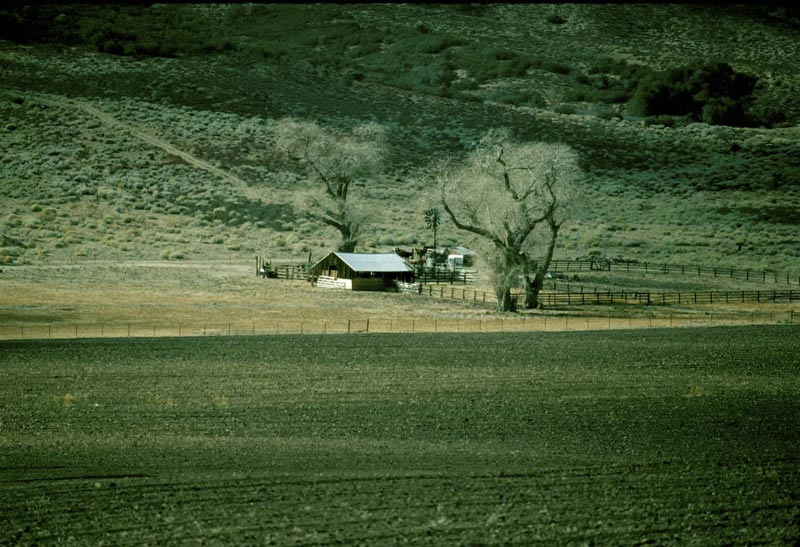
Lake Elizabeth, California. 1990. Leicaflex SL, 180mm Apo-Telyt R, Kodachrome 64

The most fun I ever had taking pictures

Before digital came along, that is!

The seventies were a truly miserable time to be in England. Administrations alternated between the senile Conservatives, devoid of ideas and wedded to the status quo, and the Labor party, its members fuelled by the politics of envy. A weak Conservative Prime Minister, Ted Heath, caved to the blackmailing strikes of the miners. He alternated power with the socialist Harold Wilson who went along merrily with the trades unions funding his party, doing whatever it took to stay in office. Neither ‘leader’ had personal convictions worth a damn.

I had graduated a mechanical engineer from University College, London in 1973 intent on working for Rolls Royce Aircraft. There was only one small snag. The year I graduated Rolls went bankrupt, as ingested birds shattered the innovative carbon fiber turbine blades in its RB211 engine, rendering it useless. The engine was intended for Lockheed’s superb Tristar passenger jet and Rolls almost took Lockheed down with it. Well, the alternative for an engineering graduate who actually wanted to be an engineer was to work for some big government institution or become an academic. Hardly palatable alternatives for one dirt poor, ambitious young man. Realize that this was a country that accorded the sobriquet “engineer” equally to the fellow installing railroad ties and to the chap at Rolls Royce. Still, I suppose the railroad ties did not snap like so much brittle chocolate.

So I decided to emigrate to the greatest country on earth, but there was a small matter of qualifications. The business of America is Business, and I didn’t know a balance sheet from an income statement. Taking advice from a smart merchant banker my mother somehow steered me to, I decided to learn about finance with another degree on the wall. It’s a damnable comment on the English educational system of those times that the very concept of an MBA did not exist, whereas in America it had been around for the best part of a century. It wouldn’t do now, would it, to teach business? Muddling through was the preferred method, preferably aided by good choice of parents.

Well, I had had the privilege of working with Americans as they visited Britain, over on tours from New York or Boston or Chicago, and I learned more from them about business four years firm than in my whole life until then.

The last thing I did before taking that one way flight was to visit Paris. This was in 1977. I had no savings. My most precious asset was my Leica M3 and its 35mm Summaron lens with that clunky viewfinder appendage. So I borrowed fifty pounds from a sister, got on the ferry and next thing I was at Gare du Nord looking for my seedy garret. My first goal was to visit the Louvre, the Jeu de Paume and the Orangerie to feast on three of the world’s greatest art collections. A related interest, of course, was to take pictures, so the M3 and a few rolls of film came along.

There was no draconian security in those days, of course. Photography was permitted everywhere and no one really minded very much. Especially if you were reasonably discreet. The Leica and I were a seasoned pair by now. We had been recognized time and again in the photographic press, culminating with the award of the Photographer of the Year prize by Photography magazine, the leading UK monthly, and, better yet, had been published in Leica Fotografie, the house organ where all things Leitz were good.

To whom did I look for inspiration in those days, photographically? Well, that’s easy. Cartier-Bresson, Doisneau, Kertesz, Brassai. In other words, I was a street photography junkie, though I didn’t know that word at the time …. Make it fleeting, let serendipity arrange the forms just so and click. Leica. 35mm lens. TriX. D76. A combination that had seen thousands of photographers through for years on end.

The Louvre was a magical place back then. I. M. Pei, great architect that he is, had yet to con gullible Parisians with the ugly pyramid that defaced one of the world’s great spaces, much as the Pompidou museum had already done a few blocks away. Care to revisit the latter and see how well it has aged? I don’t think so.

The forecourt of the Louvre before I. M. Pei. Leica M3, 35mm Summaron. TriX/D76.

The first and prevailing sense one had on entering the museum through its vast facade was the smell of oil paint. Artists were permitted, encouraged even, to bring their oils and easels and practice by copying the works of the masters. The lighting was, of course, magic, like only Parisian lighting in the spring can be. And as this was before everyone had money, before equality had raised its ugly head, the museum was far from the zooed place that modern art collections have become. In the words of the philistine American to his wife, with but one hour to catch a flight, confronted with a priceless Italian church to view: “OK, honey, you do the inside and I’ll take the outside”. Drive-by tourism. No, people had more time to savor art back then.

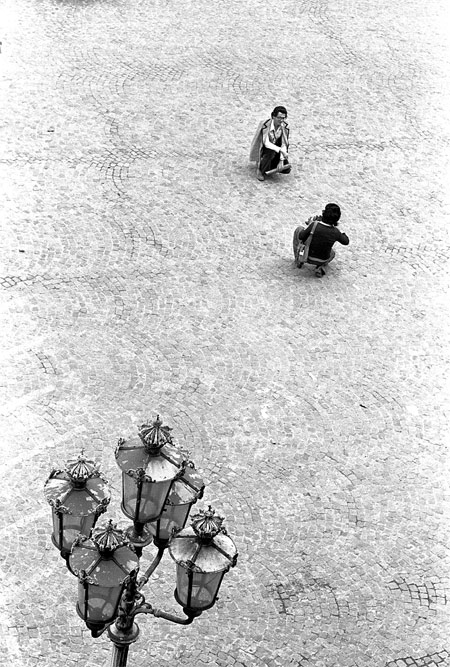
What passed for fashion in the seventies. Mona at the Louvre. Leica M3, 35mm Summaron. TriX/D76.

I forget the details, but suspect that I visited the Louvre on all but one day of the week I spent in Paris. And I also took pictures, the Leica by now a part of me. Second nature.

And until good, responsive digital cameras came to market, that’s the most fun I ever had making pictures.

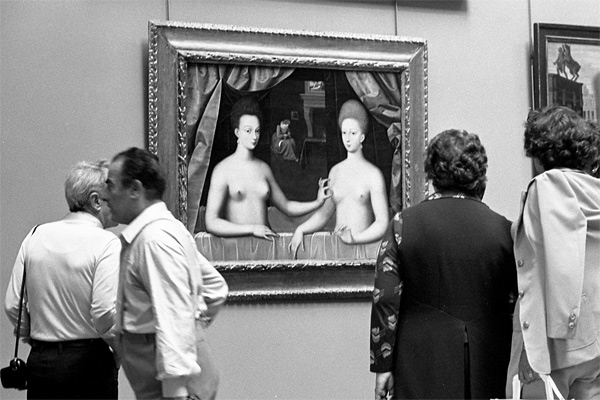
Early porn. Louvre. Leica M3, 35mm Summaron. TriX/D76.

In case you wonder, this painting is of Gabrielle d’Estrees and one of her sisters in the bath, c. 1595, painter (mercifully) unknown. Gabrielle d’Estrees was the mistress of that old Frog, Henry IV. In her hand she holds a ring given to her by the king as a sign of their bond, and her sister is pinching her nipple indicating she is pregnant with the king’s child. Yeah, right. The surrealistic background image is of a servant sewing baby clothes.

Click on the link in the left hand column for details of the book that resulted. That will take you to a written presentation along with my commentary, so you can hear what I really sound like!

Wetzlar goes to Tokyo

Leica or Leicaflex lenses on the EOS 5D

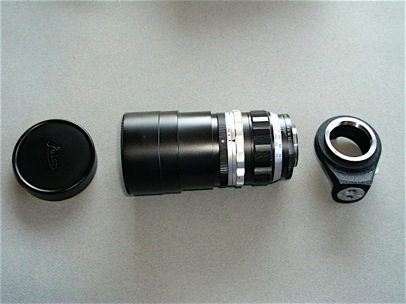
About the time I was ordering the Canon EOS 5D it dawned on me that it would be nice to be able to use my Leica Telyt long focus lenses on the digital body. I have a 200mm f/4 which is quite decent and a 400mm f/6.8, the one with the trombone focus action, which is very good. Both were made for use on the horrid Leitz Visoflex mirror housing for the Leica M body, but I had been using them on my metered Leicaflex SL SLR (now sold) with a Leitz M to R adapter, code 14127. I finaly got around to selling the Visoflex, but it wouldn’t go without kicking and screaming, as the first eBay buyer was a certified retard who decided he didn’t want to pay. How do these losers get through life? Mercifully, eBay recognized this nut for what he is and deleted his slanderous, retaliatory feedback. A small nod in the direction of decency and honesty!

Sniffing around the internet, it became obvious that there was quite a number of adapter manufacturers who promised that Leicaflex lenses could be mounted on an EOS body. Prices ranged up to some $200. I bought one from Kiev Camera in the USA for $50, but promptly had to return it as it had a faulty lens locking pin. The folks at Kiev Camera sent me another one and that one works really well.

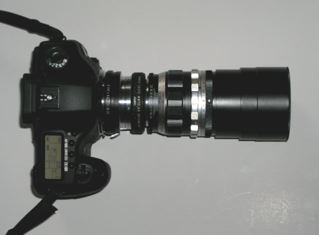
As you can see, the order of events is Telyt lens, M to R adapter and then R to EOS adapter. The 200mm Telyt shown here, being a truly ancient design, also has a Leica screw to Leica M adapter, # 14166. Despite all these adapters, the whole thing feels rock solid once assembled.

While the Telyt lenses are manual, indeed the 400mm does not even have preset stops, use is easy with the 5D on aperture priority. Indeed, that’s the only way you can use it as the camera has no idea what is fitted, as there are no electronics to feed it the information. So you set the shutter and the camera choses the shutter speed. Focusing is also manual, as once again the lack of electronics defeats the focus confirmation light ordinarily seen in the viewfinder. No matter. The standard screen in the 5D works just fine with these long, slow lenses. For this very occasional long lens user the setup suffices, even though Rube Goldberg might be proud of the design! Both lenses preserve full focus to infinity with this arrangement.

You can see some snaps taken with this combination here. For results with the magnificent 400mm Telyt, please click here.

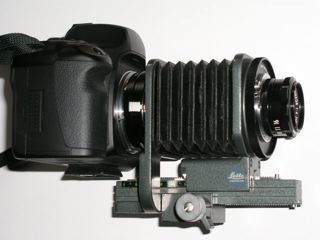
But wait. The plot thickens. In going through all my gear trying to sell anything that was no longer used, I came across a near new El Nikkor 50mm enlarging lens which I had last used in those mercifully long past, dreary darkroom days. That would be 29 years ago. As any Leica user will tell you, sooner or later you end up in adapter hell, as Leitz made adapters for seemingly everything. They must love the art of machining in Wetzlar and, indeed, their adapters are things of mechanical beauty. The El Nikkor uses a Leica thread mount. A few seconds later and it’s converted to Leica M bayonet with an adapter from the dark recesses of the cupboard where all my remaining junk hides. A separate adapter, # 16596 if you must know, converts my old Leica Bellows II, another remnant of the Visoflex years, into Leica M mount. Attach the M to Leicaflex to EOS adapter on the back and you have a free macro lens:

This gives larger than life images and, of course, infinity focus is not possible. Still, have you tried to sell an enlarging lens recently?

A better use is with the superbly sharp 135mm Leica Apo Telyt lens which gives images 2/3rds life size and also affords a far greater lens to subject difference allowing for better illumination of the subject. Nice to give these old warhorses a new lease of life.