Category Archives: Hardware

Stuff

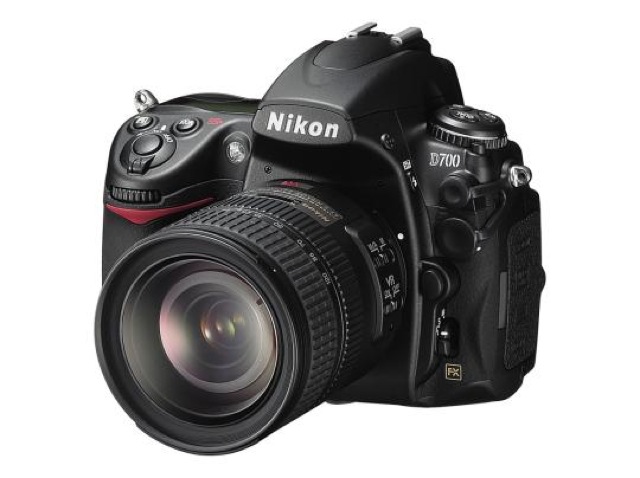
Great news from Nikon

Finally an eyeball-to-eyeball competitor for the 5D.

Nikon has announced a full frame DSLR, the D700, priced at $3,000.

Like the 5D, this model drops the extra battery grip and bazzillion frames per second feature for realistic specifications that will work for all amateurs and all but sports-oriented pros.

It will not be lost on Canon that the D700 has sensor dust removal – the only gripe I have with the 5D. Oh! and a better LCD screen. And a built-in flash.

Will I upgrade to 5D Mark II which will have like specifications? Naaah. I would rather keep using the sensor cleaner and save the $1,500 the upgrade would run me.

Now let’s hope that the forthcoming full frame Sony DSLR (probably with the same sensor they sell to Nikon for their D3/D700 models) will drop the price to $2,000.

Brand awareness

We are all guilty of it.

There’s a car that is one of the fastest in the world. It is exceptionally affordable. It is supremely reliable, has very high engineering standards and comes in red, if you want. It’s possibly the fastest production car made yet the manufacturer cannot give them away because the brand is wrong. It connotes nothing so much as beer-bellied ol’ boys at the ball park on a lazy Sunday afternoon. Not the image you quite want for something that is meant to advertise “I am single, available and sexy”.

That car, of course, is Chevrolet’s Corvette. A Ferrari with like performance and looks (OK, like performance) is five times the price.

A branding failure, no matter how much GM tells you it’s there to reinforce the message of Chevy excellence. I wouldn’t be seen dead in one.

It’s the same with watches. We have all been told a thousand times that a quartz Timex keeps time as well as anything, and that is correct, yet I have two manually wound timepieces in the desk drawer which cost egregious sums to acquire and are anything but accurate, not to mention needing constant, costly maintenance. I wear neither so there they are, waiting for …. I know not what. But the makers, unlike Chevy, got the branding dead right. Low production volumes, word of mouth advertising, scarcity, exclusivity. That’s what makes a brand.

It used to be that way with cameras.

The esteemed brands which shared the qualities of those watches were few. In the ’50s the Speed Graphic (crude and effective) and the Linhof (anything but crude, and equally effective) ruled, but only one was a brand in the sense of this piece. It was not the Speed Graphic.

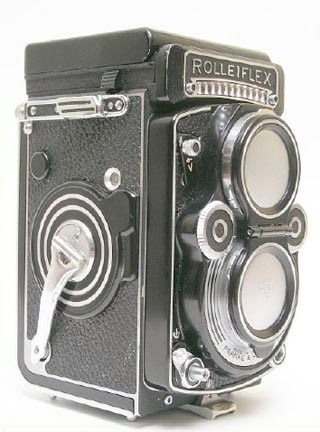
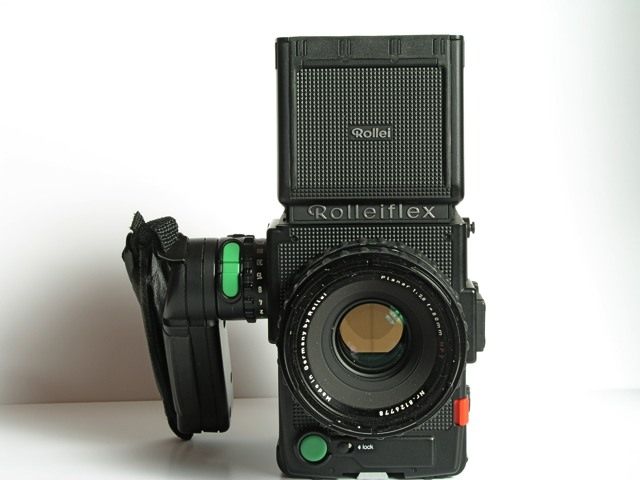
Rolleiflex has always been a brand and remains so to this day. Any number of great photographers used waist-level Rolleis, ungainly as they may be, and some great studio work is being done to this day with their ne plus ultra medium format, single lens reflexes. I owned one of these nuclear deterrents many years (a 6003 Pro) and it was as easy to use as any medium format camera can ever claim to be easy to use. And it was a real Brand. When you locked that Zeiss Planar or Distagon lens on the body you were not the sort of person to be messed with.

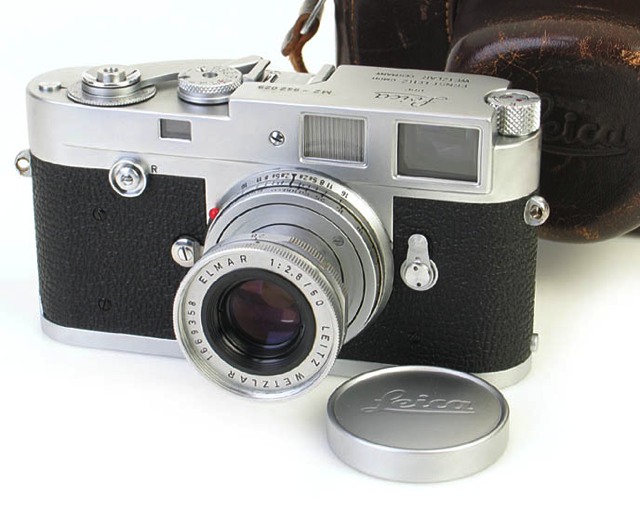
In the ’60s there was really only one 35mm brand. The Leica. Cartier-Bresson used one. That’s all you had to know and no advertisements were needed to remind you of that.

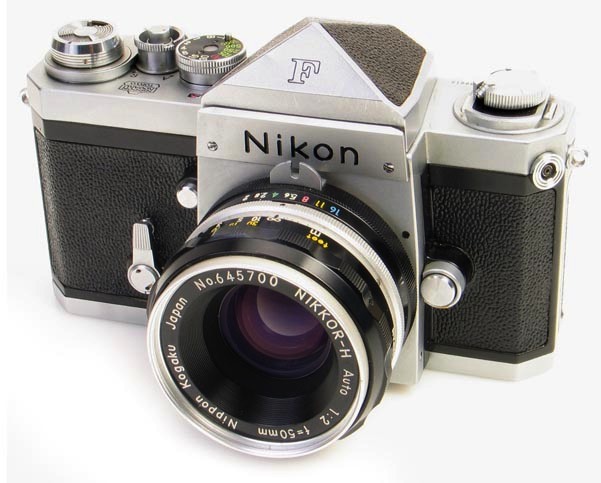
The final years of great brands were the ’70s. A fading Leica gave way to the Nikon F which is to the Leica like Hulk Hogan is to Audrey Hepburn. Neither breaks easily, but one also doubles as a blunt weapon. Thanks to an America which appears yet again to have invaded the wrong country, Viet Nam gave the Nikon F its baptism. Thereafter there were no excuses needed for its Far East provenance. It had become a brand.

Then something funny started to happen to the whole brand idea. Maybe taking a leaf out of Chevy’s book they reasoned “We have the Corvette. Why not make some econoboxes. The brand might wear off.” So Canon, Nikon et al started making genuinely horrid consumer cameras, emblazoned with their name in a prominent, contrasting shade on the front. Now Aunt Maude could make sure everyone knew that she too, like Donald McCullin, used a Nikon.

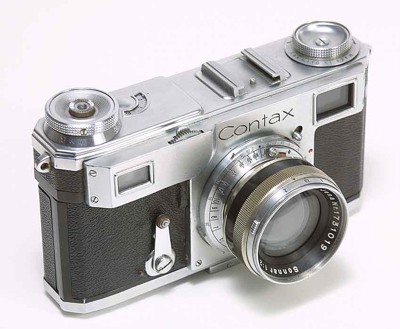
Others came at it from the opposite direction. So desperate was Olympus to be seen that they gave British birdman Eric Hosking several sets of gear to displace his aging Zeiss Contarex. It worked. The former maker of toys was suddenly being taken seriously. Pentax did the same with David Bailey and Sam Haskins while Minolta did it with David Hamilton. More recently, new brands have piggybacked on their reputations in other fields. Ricoh and Casio make great copiers, so why not cameras? Samsung of TV fame? Why, cameras of course. And there’s no need to go on about Sony and HP.

So brand identity, in a strange way, lost its elitist leanings. First, counterculture chic dictated that the rich be seen wearing Swatch watches and using disposable cameras (for their equally disposable photographs). Second, who was to know whether your Leica was the cheapy Panny from China with the red dot, or the more-money-than-sense M8 (probably also from China but they aren’t telling)? Labels, in other words, had obsoleted brands. If you can get millions to buy your Benetton emblazoned T shirt so that you can go motor racing, then clearly the label means more than the brand.

So rather than further rue the demise of Great Brands, let me just let you gaze at some of the finest, most of which I have been fortunate to use and exult in.

Sigma DP1 – pass

Much anticipation leads to a failed product.

My primary interest in the Sigma DP1 was as a street shooter – meaning minimal shutter lag.

Well, I’m afraid they blew it, as the always objective DP Review reports.

Looks like I will be sticking with the Panasonic LX-1 for now.

What a disappointment.

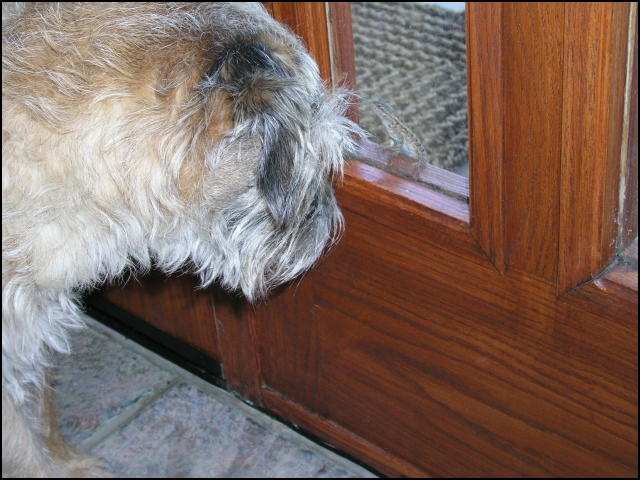
Still, it never hurts to be curious:


Bert the Border Terrier checks out Mr. Lizard.

Let there be light

No half measures here!

My preliminary ramblings about the Canon 100mm macro focused largely on ergonomics with a quick peek at image quality.

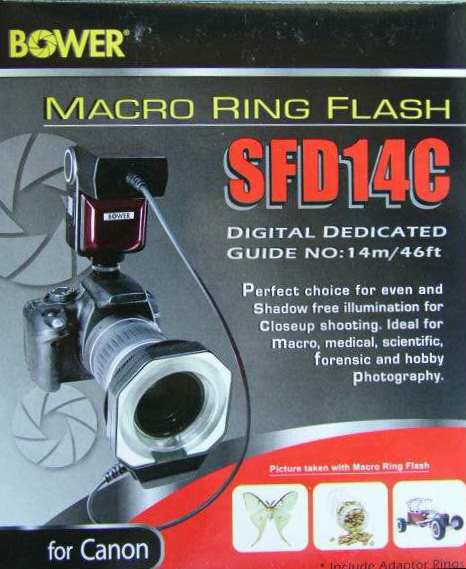
One of the advantages of the 100mm focal length is the doubled – compared with a 50mm – subject to camera distance, making lighting issues easier. But I decided I wasn’t about to do things half way, so I checked into ring light flashes for the 5D. Well, Canon wants over $400 for theirs to which all I could politely say was “No thank you”.

So a quick visit to that repository of thieves, cutthroats and crooks known as ePrey was called for and, lo and behold, simply dozens of ring flashes were on sale. After weeding through the offerings I finally found one which used a real flash tube (rather than poncy, underpowered, LEDs) and, best of all, mated with the ETTL circuitry in the 5D to make just about everything automatic.

$120 and a few days later UPS dropped it off. It comes with three adapter rings, the 58mm one of which fits the 100mm Macro. Look closely and you can see there’s a real flash tube in there:

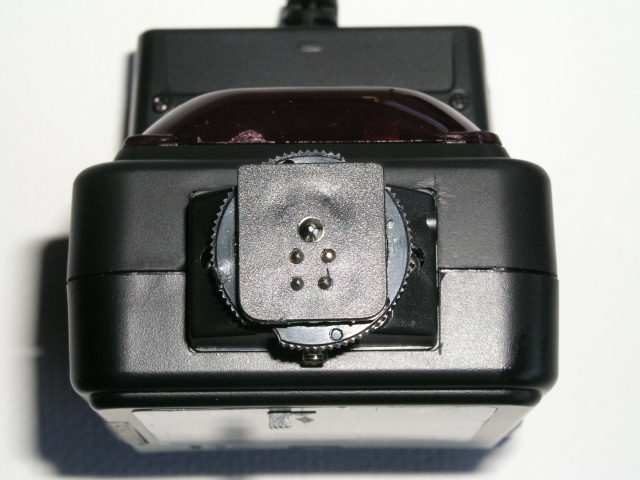
The body takes four AA cells and looks suspiciously like the body of a Vivitar 283 flash gun. Recycling time is 3 seconds with fresh alkaline batteries. The foot has a nice screw retainer and you can see the contacts for ETTL in the base:

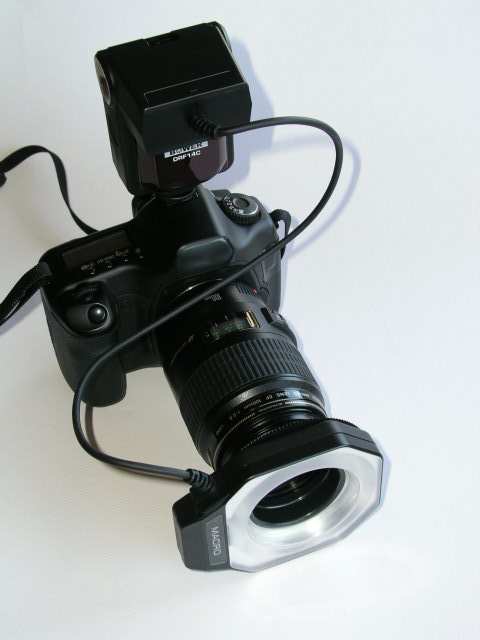
Here’s how the whole thing looks on the 5D – the power supply and tube are incredibly light, weighing less than the lens itself.

Once the base ring, which rotates freely on the flash tube body, is threaded onto the lens, the tube assembly is free to rotate and, if you think about it, that’s no problem. The base ring has nice, coarse serrations for a proper grip and protrudes just above the body of the flash tube – nice.

Use is simplicity itself. ETTL balances exposure between flash and camera automatically, the lighting is shadowless, and all you have to do is frame and press the button. If the flash is in range the green LED on the rear illuminates after the picture is taken to show all is well. It would have been nice if it did this with the first pressure on the shutter release, but, heck, ‘film’ is cheap in the digital age, no?

Suffice it to say that the whole thing works perfectly out of the box, at one quarter of the price of the Canon branded device. OK, so the finish is more GM than Toyota, but at that price, who cares?

And because even our six year old could take sharp snaps with this little combo, here’s one which mixes sharp and blurred, courtesy of ETTL, which has mixed flash and regular light by using a slow shutter speed, adding blur to a subject swaying in the wind. Choice of a low ISO setting compounds the blur.


5D, 100mm Macro, ring flash, 1/100, f/6.7, ISO 100

More later.

Canon 100mm Macro – Part I

Not your father’s macro lens.

For a preamble on macro lenses, please click here.

Over the past five years anytime I wanted to get really close to something meant using my Olympus C5050Z five megapixel digital. Quality is decent, it focuses postage stamp close and framing using the built-in LCD screen is dead accurate. Rack the lens out to maximum zoom and you also get reasonable subject-to-lens clearance for illumination purposes.
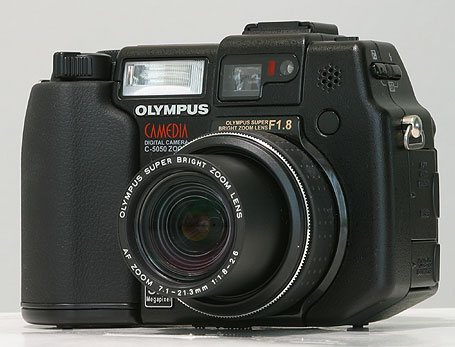
If nothing else, it has been used to list any number of film cameras and lenses on various auction sites, so it has paid for itself many times. Most digital cameras, especially the point-and-shoots, focus easily into what we think of as the macro range, so the Olympus is nothing special in this regard. Handy, though, and easy to use, with auto everything – focus, flash, exposure.

By contrast, here’s my latest Canon lens addition – macro with a vengeance.
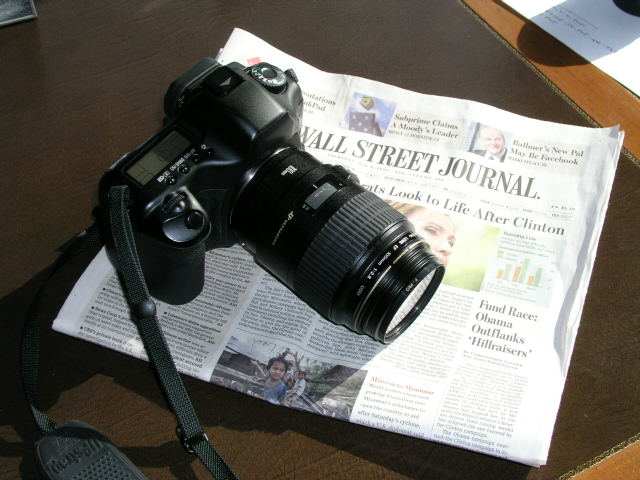

Canon 5D and 100mm f/2.8 USM macro lens, with funding source

With modern multi-coated glasses, charging extra for a lens hood must be as big a scam as ethanol, and I never use one on any of my Canon lenses except on the fish-eye and the 400mm, where they are non-removable. Why? Because they add bulk and make no earthly difference to the picture. And if you have seen the hood for this Canon, you will not want to buy it either. But I do use an UV filter on everything and have recently convinced myself that the German B+W ones are better made than their Japanese counterparts, so I paid up a few dollars more for the real thing. Seems I’m still a sucker for that ‘Made in Germany’ thing. The main reason I use a filter is that I think any decent photographer should throw out all his lens caps.
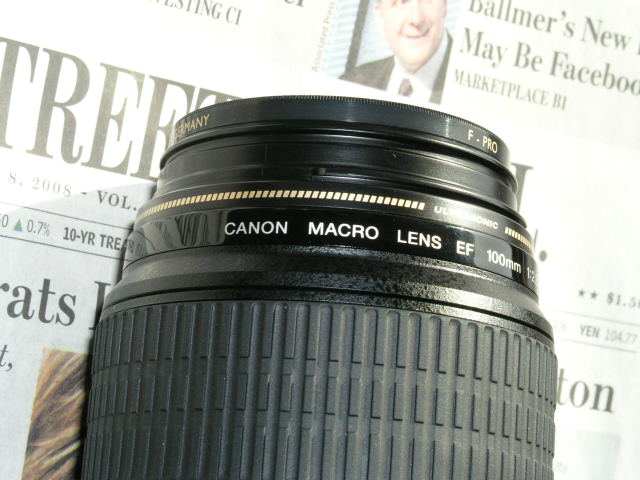

Not a Japanese filter…. As you can see, that Olympus has no issues with getting in close.

Now no one could accuse the Canon Macro of being pretty to look at – not like in Leica Summicron or Contarex Planar pretty – but its inverted cone design speaks of the Bauhaus, function and funky form. Construction is typical Canon prime – meaning good if not ‘L’ quality and a whole lot better than their crappy kit zooms. Best of all, at under $500, if you drop it you are upset but not destroyed. Try saying that about your Leica lenses….

Everything about the ergonomics of this lens is right. The 100mm focal length means you get a nice long subject distance to simplify lighting. You are twice as far away as with a 50mm macro, at the cost of depth of field. The short (about 135 degree) focus throw from infinity to 1:1 (the lens goes down to life size on a full frame camera) is very smooth and full time manual focusing is included if you use autofocus – very handy for a macro lens where small focus adjustments are the order of the day. The bulk and weight of the lens make for perfect balance on the 5D, meaning hand holding is easy.

Best of all, unlike all those macro lenses I illustrated yesterday, the length of this one does not change as it is racked out – meaning that no new obstacle to proper lighting presents itself. And auto exposure means no more figuring of light loss as 1:1 reproduction is approached – a loss of two stops in brightness owing to the extension of the lens from the sensor. That holds whether the lens is made by Canon or Ballspond Roadski optics.

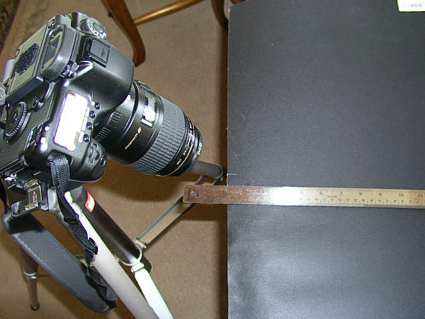
How accurately does the lens focus on the 5D? I am using the center rectangle here which is the most sensitive focus point in the camera’s design. Placing the camera and lens on a tripod on the high tech Pindelski test bench with the camera at 45 degrees to the tape measure, here is the result with the lens autofocused on the line just above the numeral 3 with the lens at full aperture of f/2.8, set at its closest focus distance:

That looks pretty spot on to me.

Not convinced? Here it is much larger:
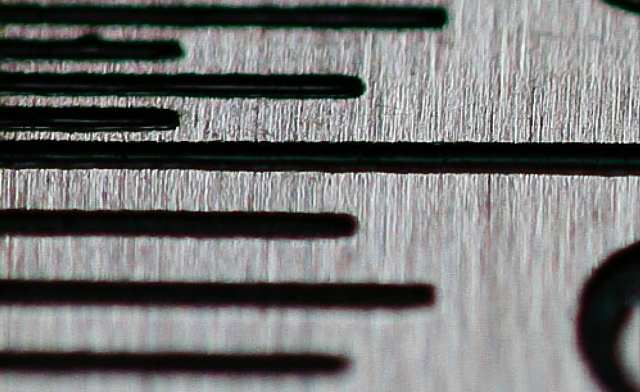
Far better than I could do with manual focus.

Now I am an empiricist by nature, not a test bench nerd, but with a lens whose primary use is for the very close-up subject, a few seconds doing this determines whether the lens is a keeper or not. Clearly, this one is a keeper. Thank you, B&H and thank you, Canon!

The Dr. Pindelski optical test bench? High tech at its best:
Because of the internal space needed to allow those elements to be racked out when focusing close, the 100mm Macro is necessarily quite a bit longer than that greatest portrait lens I have ever used, the 85mm:
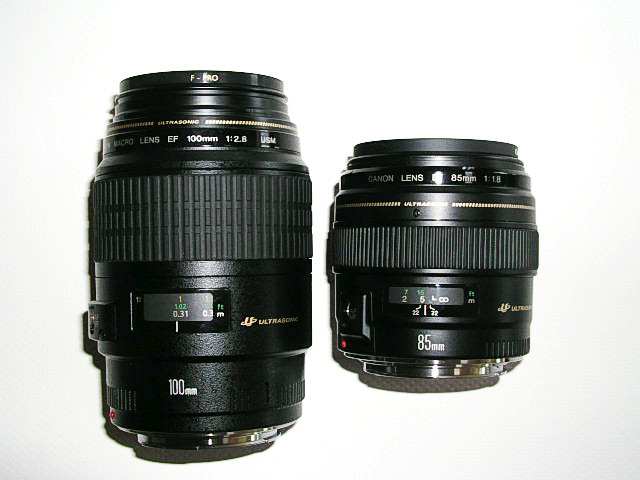

Comparable in weight, the 100mm Macro is much longer than the 85mm. Lens hoods NOT included!

So ergonomics, autofocus accuracy and sharpness are not going to be an issue with the Canon 100mm USM Macro lens.

Focus speed? Simply startling, with little noise. The only time I could trip it up is by focusing at the closest distance then recomposing on a subject at infinity with poorly defined details. The lens would hunt back and forth before locking in. For non-macro use Canon thoughtfully provides a focus limiter switch to prevent this kind of silliness. In practice, I have found that setting the 5D to servo-focus is ideal when this lens is used in the close-up range. This setting makes the lens focus continuously even after the first pressure is taken up on the shutter release button and you can hear the stepper motor working away to maintain the subject in focus. As I said at the beginning of this article, this is not your father’s macro lens.

As I already own the fast 85mm non-macro, I have little interest in using the 100mm Macro lens for any but macro subjects. To do otherwise would be like using an f/1 lens at f/4 – a waste of money. If, on the other hand, this is your only portrait-length lens, then use in the studio should be just fine.

The challenge now is to see whether I can take any snaps remotely up to the technical standards of this optic. Subsequent articles will determine that.

Click here for Part II.