First, the ergonomics
Ergonomics are vital to all effective machine design and nowhere is this more true in photography than with really long lenses. The user is already confronting slow apertures and a high risk of camera shake. A poorly handling lens does nothing to help.
So in this first of two parts (the second will deal with performance) I take a look at my latest Canon lens addition, the 400mm f/5.6 ‘L’ telephoto which I have been using for a while now. And let me start by saying that I have not used a lens of this length with better ergonomics.
First, a few notes on my long lens history. I started with a 280mm f/4.8 Telyt on a Visoflex II mirror housing mounted on my Leica M3. An ergonomic nightmare. The big glass front elements of the lens were so heavy that the brass focusing collar would bind if the front of the lens was not supported. The collar was also very small, the lens had neither auto focus (this is 1975!) or an automatic diaphragm, overall contrast was low dictating the use of contrastier grades of printing paper and, well, it’s a miracle I managed to make any good photos with it.

Hyde Park, 1975. Leica M3, Visoflex II, 280mm f/4.8 Leitz Telyt, Tri X
Later, when the Leicaflex SL came along, it was joined by an 180mm f/3.4 Apo-Telyt R. Great if not superb ergonomics, more than made up for by fabulous optics. This is the lens Leitz designed for NASA for use on space flights. It shows.

Lake Elizabeth, 1995. Leicaflex SL, 180mm f/3.4 Apo-Telyt R. Kodachrome 64
Later, I added a 400mm f/6.8 Telyt which was a fine, if failed, attempt at improving the ergonomics of long lenses. It was very long being a true long focus lens rather than of telephoto design, unscrewed into several pieces and came with a weird shoulder mount (redesigned many times, all awful) which would connect to the base of the lens with the stock for your shoulder, like with a rifle I suppose. So time consuming to set up and so impossible to carry around, I never used this add-on contraption. Focusing was original too, using a sliding trombone mount locked with a small button on the side of the lens. Remarkably effective as long as the slide had fresh grease. The maximum aperture was slow at f/6.8, resulting in a very light lens which was always used at full aperture – not least because the lens lacked even a pre-set diaphragm. Click stops only. It had but two elements and lost definition off axis quickly, but the center was dead sharp and the results satisfying.

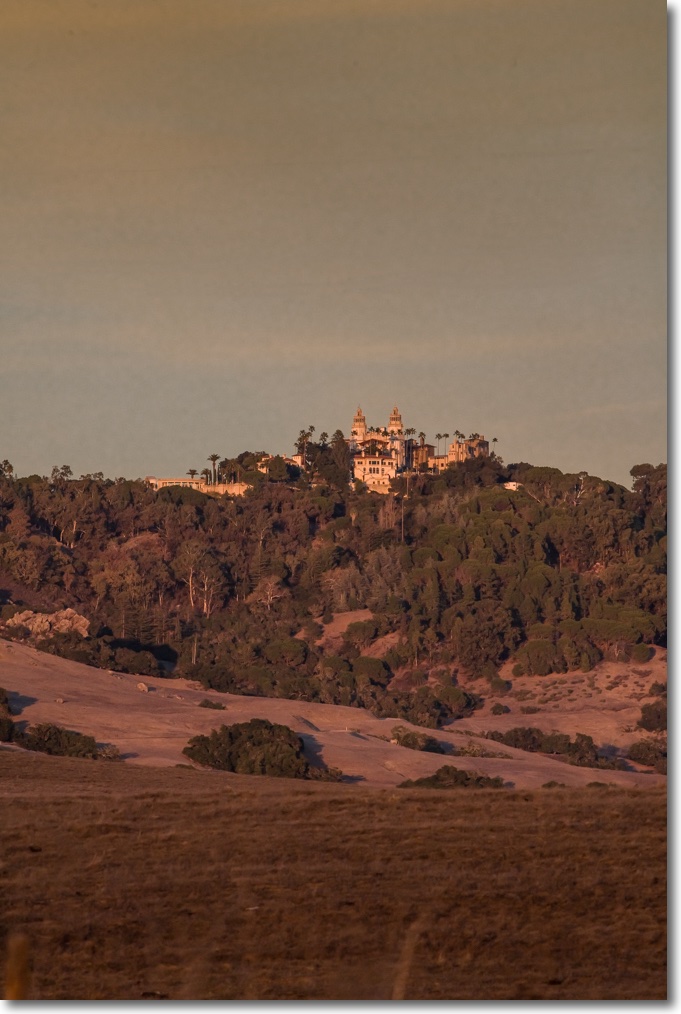
Hearst Castle, 2006. Canon 5D, 400mm f/6.8 Telyt, monopod, ISO 400
But my latest long lens journey bears documenting, if for no other reason than that someone has finally got the ergonomics as right as they can be on something so ungainly. The Canon lens I am writing about has been around for ages and ages, but this is my first experience with a fully automatic 400mm lens.
Who needs a 400mm lens? Well, the fellows at sports events for one. Intrepid wildlife snappers and paparazzi swear by them. I am none of these. However, for landscapes, there is nothing to beat them for drama and impact. And I photograph landscapes.
I sometimes think Canon must have two lens design teams. There are the geniuses who design the wonderful optics and mechanics of their big guns and their ‘L’ glass, and then there are the guys who couldn’t make it in the bean counting department and were relegated to the sub-basement, only to churn out truly awful cheap zooms and ultra wides.
Looking at the long focus lenses in Canon’s catalog, you gets lots of choice in the purportedly better ‘L’ glass – with a 100-400mm zoom, the 200mm f/2.8, two IS-equipped 300mm optics (f/2.8 and f/4), no fewer than three 400mm choices – f/2.8 IS, f/4 IS DO (non-‘L’) and the f/5.6 non-IS. At 500mm there’s an f/4 IS and a 600mm f/4 IS monster rounds out the range. Most of these run well into the thousands of dollars.
Unfortunately this lens adopts the garish cream coloring seemingly de rigeur for the polyster set to whom nothing matters so much as displaying their possessions. Don’t wildlife photographers just hate this? The lens has no IS but is small and light instead, in as much as any 400mm lens can be thought of in those terms. Add a monopod and a quick release tripod plate and you have a very effective combination which can avoid the worst of the shakes. It bears emphasizing just how long a 400mm lens is – any shake is magnified eight times compared to a standard 50mm optic. The grain free nature of the 5D’s full frame sensor goes a long way to beating the shakes by simply cranking up the ISO to 400 or 800. That makes for short shutter speeds.
Why is this the best 400mm I have used from an ergonomic standpoint? Simple. First the autofocus is deadly accurate (when used with the center focusing rectangle in the 5D), it is super fast and no focus collar (Did I get that right? Maybe a little more this way? No, maybe the other way?) twiddling is required. This is a good thing as the longer you have to hold any heavy lens at eye level, the more fatigued and unsteady does your hold become. Secondly the lens is auto aperture permitting full exposure automation. Finally, for its length it’s compact, coming in at 10.1″ long and only 2.8lbs in weight. (Compare with the 16″ or so inches of that f/6.8 Telyt). That weight is perfectly balanced on the 5D and the lens comes with a superbly designed tripod collar – more of this later – and a (not so superbly designed) built-in lens hood. The latter is a pain until you get the hang of it. It’s nicely flock lined and is pulled out and rotated counterclockwise (and counterintuitively) to lock. The front of the hood is cleverly surrounded with a rubber protective ring. Try to collapse it and you quickly learn there’s a right amount to rotate it clockwise before trying to slide it down the barrel. A click-stop or two would have been welcomed here, Canon. New price is some $1,100 but I bought mine mint, if used, for just under $900. Check the used listings – these come on the market periodically and most seem to have had light use. I would definitely avoid pros’ beaters. Mine came with the tripod collar and expertly designed pouch, both standard with the lens.
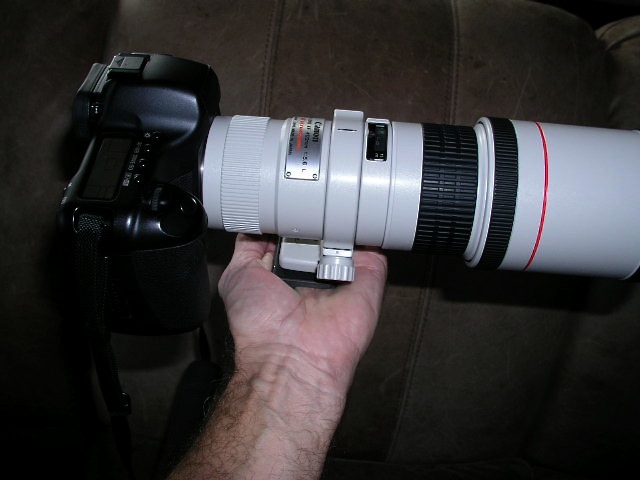
Perfect balance at the tripod mount on a Canon 5D
This flock-lined tripod collar is a true masterpiece. The knob operates a short-throw cam to lock the collar in place after clicking it onto the lens. The click-lock is bypassed on removal by turning the knob CCW then pulling gently. No force is needed to lock the ring and it remains very stable in use. I have fitted a Manfrotto QR plate to the foot for quick mounting on a tripod or monopod.
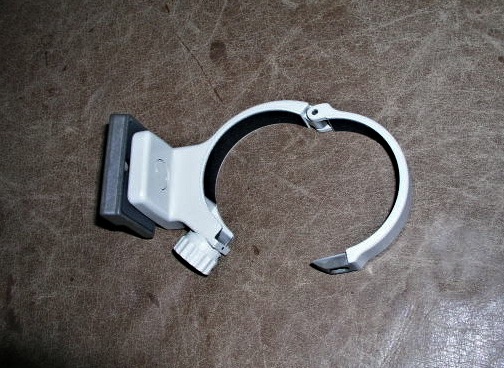
A design masterpiece – the locking tripod mount ring
As an added feature, if you want to use the tripod collar on the 200mm f/2.8 ‘L’ it fits perfectly, so long as you reverse it to clear the camera’s front escutcheon when mounting the lens. This provides a far better mounting point for the front-heavy 200mm lens compared with the one on the 5D’s baseplate. Stress, of course, is greatly reduced also.
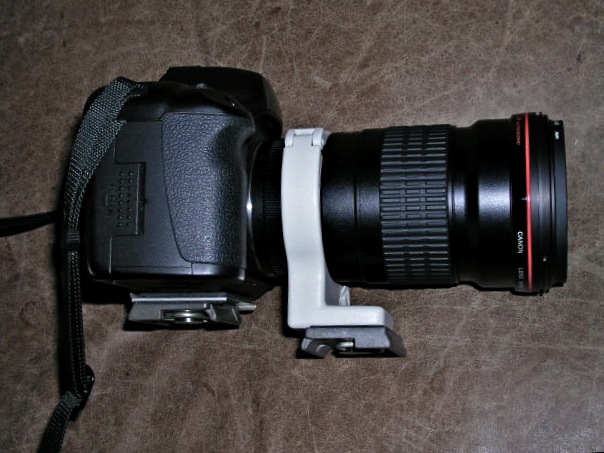
Tripod mount ring mounted on 200mm f/2.8 ‘L’, reversed to clear body
Snugging up the collar is easy with the generously sized cammed knob provided. This is a magnificent piece of engineering design clearly thought through by a real photographer-designer.
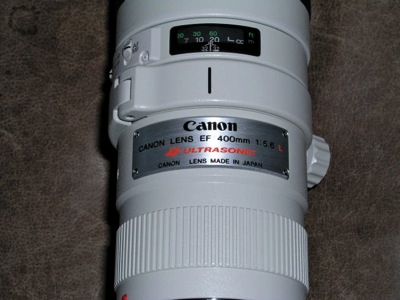
Top view. The ring is snugged up when the line is aligned with the focus indicator
The focus range switch purportedly makes for faster autofocus when set to the narrow range. I cannot tell the difference and simply keep it on the broad range setting. In either case, the focus is blisteringly fast. This is not your grandfather’s Leica Telyt! Given that focus can be locked with a first pressure on the shutter button, I have yet to use manual focus, though it has to be said the focus collar is very smooth and devoid of any of the raspiness afflicting Canon’s garbage non-‘L’ zooms – you know, the ones from the boys in the basement.

Focus range amd auto/manual switches, just like on the 200mm
Canon did not stop there. They did the case right. Instead of some dumb drawing room display tube of shiny leather (thank you, Leitz Wetzlar – ‘Echte leder’ as they used to proudly claim) they give us something in pure vinyl (the better to ward off rain and much harder wearing) with an ingenious velcro plus 2 linked zipper flap design which really works. The case needs a shoulder strap to make sense (buying an oversize camera bag to accommodate this monster does not) but, boy!, does it work!
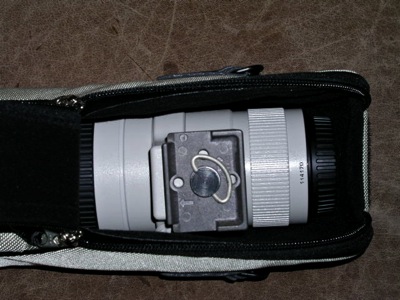
Canon’s bag easily accommodates the quick release plate from Manfrotto
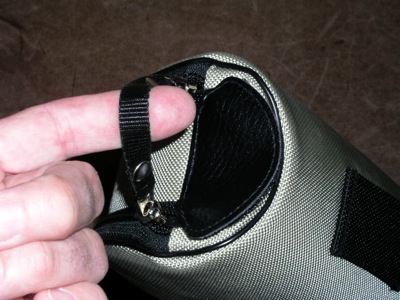
Ingenious double zipper opens velcroed flap for quick lens removal from the LZ1132 case
In Part II I will take a look at performance in the field with some snaps to illustrate. Suffice it to say that if my specimen is typical, you should be rushing out to get this lens if the need dictates.