Category Archives: Hardware

Stuff

Serial failure

The jury has left the building.

It is a good rule in life never to apologize.
The right sort of people do not want apologies,
and the wrong sort take a mean advantage of them.
P.G. Wodehouse, The Man Upstairs

The old saw in banking has it that when you owe your local bankster $1,000, he owns you, but when you owe him $1 billion, you own him.


The last great iMac, the G4. Conceived at a time of great crisis.

It’s a lesson that the Serial Apologizer passing as CEO at Apple has never learned. When the Chinese make an organized propaganda attack aimed at Apple for allegedly poor warranty terms and service – ridiculous however you look at it – what does Cook do? He goes cap in hand to his main provider and apologizes. He has fallen into the $1 billion debtor trap, mistakenly believing that the Chinese own him. They do not. Apple owns the Chinese. Concentrating so much production in the hands of one man – the fella in charge in Beijing – was never a wise strategy, any more than concentrating retail lending in the hands of a few US mega-banksters extending credit based on fraudulent loan docs, the while contending that they are too-big-to-fail,is wise. With such concentration comes the need for courageous and robust leadership. The banksters were far smarter than Cook. They used walk away power and totally pulled one over on Uncle Sam. We own you, they said. Let us fail and you go down with the ship.

What is Cook thinking? That Foxconn will lay-off two million Chinese workers if he tells Mr. Xi where to stick it? Please. Maybe Cook needs to bone up on The Man with No Name. Go ahead, make my day. How about a spot of civilian insurrection, pal, should we walk?

Cook, having set three miserable precedents in his dreary catalog of apologia, is now a pushover for any number of bullies who smell fear and weakness. The right response here was “Go ahead, Mr. Xi. Make my day.” You do not bend over to a despot. Now Cook is stuck with that old military acronym. BOHICA. Bend Over, Here It Comes Again. He probably knows more about that than I want to think about.

Now I’m beginning to pine for that old SOB who was Apple, Steve Jobs. When did Jobs ever apologize for anything? When Dot Mac failed miserably he did not go around cap in hand beating his chest and chanting ‘woe is me’. No. Rather, he excoriated the development team for ‘…. letting down everyone at Apple ….’ then fired the guy in charge. Then he fixed it and we got iCloud.

Great businesses do not run on niceness policies, respect for your fellow-man and gentility. They become great by fostering internal and external competition – remember Jobs’s early hatred of IBM? – and inculcating a ‘cream rises to the top culture’. Successful businesses do not crave love or respect. All expect excellence and have at the core of their genetic makeup a protocol which demands winning. Being nice in competition is for losers. ‘Show me a good loser, and I will show you a loser’ as Vince Lombardi bluntly put it.

As a photographer, I very much want to see the likes of Scott Forstall driving Apple to greatness, even if it means his face appears on many dart boards in adjoining offices. People who threaten a CEO accomplish one of two things. The CEO either rises to greater heights, as did Jobs, or the threat is fired as was Forstall’s fate when Cook decided the usurpation risk was too much to bear. Churchill’s struggles to return to power in the 1930s are an apt precursor, weak leaders in Downing Street forever threatened by the firebrand who was finally only appointed at the moment of greatest crisis. An irritant is a requisite for success, not an obstacle to it.

And that’s what Apple needs today. A leader, an irritant, who is prepared to see that the company is already in crisis and a leader who places scant value on popularity. And one who will fire the losers, not the winners. Starting at the top. What Apple needs is …. Steve.


The last great piston engined fighter. Conceived at a time of great crisis.

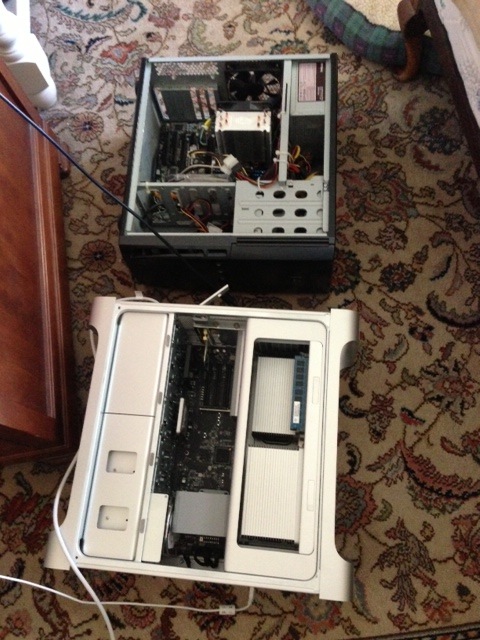
The seed of Apple’s problems lies in the design office and it’s named Jony Ive, the much applauded designer of all that is thin, thinner and thinnest on Cupertino’s drawing boards. Hence the overheating iMac G5. The overheating iMac Core2Duo. The overheating iMac notebooks. The overheating MacMini. The hard and costly to make iPhone 5. The long time to market and to volume production. The high production costs. And Apple’s problem with China is also Apple’s problem with Ive. They have made him so famous, so indispensable, so adulated that instead of owning him, he now owns them. How do you get rid of an icon and Steve’s best buddy? Meanwhile Apple’s innovation is a day late and a dollar over, damned by ridiculous designs when what most buyers want is function, not form. Like the PowerMac and the MacPro. In other words, machines using reliable, cheap PC parts and the best desktop OS in the business. For more, check out ‘Hackintosh’ in the Sitemap.

Excellence in business is not tea and crumpets. It is war. America and Apple used to be good at that. And wars are won by the strong not by milque toasts who make a habit of bending over.

An amusing review

The competition neatly skewered.

Atlanta based music photographer Zack Arias has an amusing review of the Fuji X100S, well illustrated with excellent photography, on his blog. I think my favorite bit is about the two old duffers, Canon and Nikon, sitting in the corner, resentful of the newcomers, and perennially arguing.

Click the image below to go there.


Click the picture.

Mac OS 10.8.3

One nice enhancement.

The best thing about Apple’s troubles – a CEO with the charisma of a sponge, a stock down over 30% from its peak, more cash than it knows what to do with, a tired cell phone offering, a lack of innovation and failure in the TV market – is that these many distractions mean fewer updates of OS X, the OS powering Macs and Hackintoshes. Because, let’s face it, every ‘enhancement’ since OS Snow Leopard (10.6) has been so much fluff and noise. SL (Intel machines only) can still be bought from Amazon for some $40 but will almost certainly not run on the latest Macs. It’s fine with Hacks and offers one huge feature missing from Lion and Mountain Lion – Rosetta, the PPC G3/4/5 emulator which allows it to run any old apps from your PPC days on an Intel Mac or Hack. You know, apps like HP’s DJ30/90/130 color management utility which will not run on anything later and is essential for debugging whatever ails your HP DesignJet dye ink printer.

As I still have a ten year old PPC iMac G4 for DesignJet maintenance, the loss of Rosetta is not such a big deal, so it was with trepidation that I approached the latest minor upgrade of Mountain Lion 10.8.3. What else would now be broken by Cupertino’s policy of planned obsolescence?

When performing the upgrade I did so by downloading the complete (Combo) update from Apple here rather than the incremental upgrade which is what is applied if you upgrade through the App Store. Hackintosh community chat has it that a Combo upgrade is more reliable than an incremental one. I have no idea if that is true, but this approach avoids being forced to upgrade to the latest version of iTunes, an app which Apple has never got right.

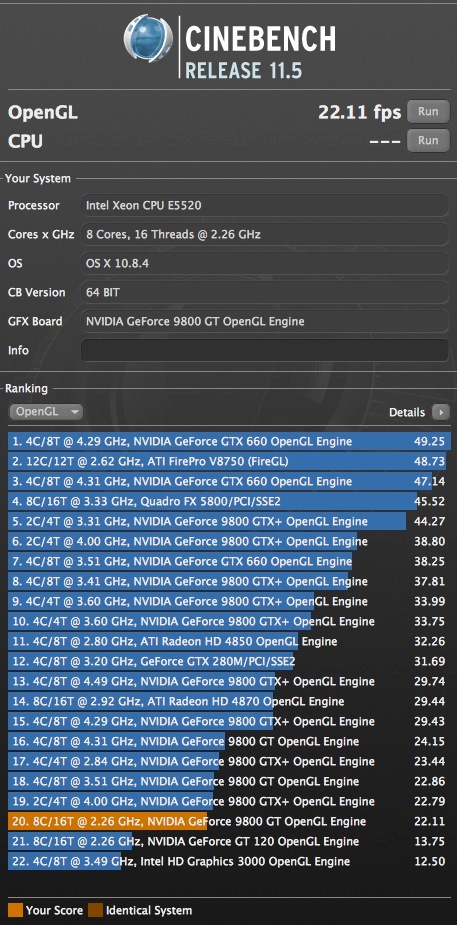
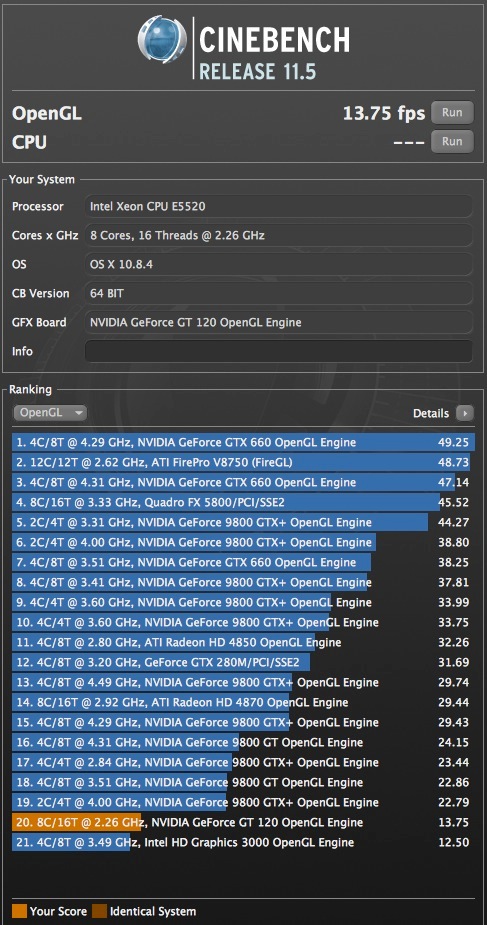
After a week of running I can say it seems fine and there is one significant enhancement. Because one of the new 2012 iMacs uses the nVidia 660M GPU, Apple has had to provide native support in OS X for the nVidia 660 GPU family to run OS X on that machine. The GTX 660 is one of nVidia’s finest bang-for-the-buck mid-range GPUs, with the 660M in the iMac being – yup, you guessed it – a crippled version. The iMac 660M version has but 0.5GB of memory, compared with 2GB (3GB on some EVGA cards in the US for $30 more) for the aftermarket cards. I would bet the clock speed is lower too, heat being any iMac’s bugbear, but cannot confirm this. The Zotac GTX 660 I am using (not the 660 TI) retails for $215, which includes two powerful variable speed integrated fans which are exceptionally quiet. These aftermarket cards all support up to two 2560 x 1600 pixel displays and include HDMI and DisplayPort in addition to DVI sockets. The Zotac board is recommended over the competitors’ if you have limited space in your box. It is considerably shorter, making a major difference to the accessibility of the motherboard’s SATA sockets in my Antec Sonata III enclosure. Non-trivial.

To put the sophistication of these latest GPUs into context, the Intel i7 Ivy Bridge CPU has some 800,000 transistors. The nVidia GTX660 CPU has 2.54bn – three times as many! Little wonder nVidia is making serious progress in the world of supercomputers, where its graphics chips are delivering cost effective performance at state-of-the-art throughputs.

My three monitors remain the estimable Dell 1650 x 1080 21.5″ 2209WA IPS ones, now some 4 years old, because they are easily calibrated and the dot pitch is fine for my purposes. Plus I like the bigger default fonts these deliver. If you use newer 1920 x 1200, 1920 x 1080, 2560 x 1600 or 2560 x 1440 displays, a card like the GTX 660 will easily crunch through graphics which might leave earlier nVidia GT2xx, GT4xx, 98xx or 88xx cards running out of steam.

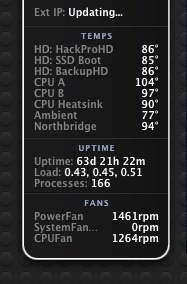
I wrote about updating my HP100 Hack to nVidia’s latest card here and that hardware and OS needed nVidia’s separate drivers to make the card work. Now, with 10.8.3, the drivers come with the OS, so no external drivers are necessary. The benefits are twofold. My Hack is now more stable – looking to be as good as in the Snow Leopard days of yore – and the CPU’s idle temperature has fallen from 104F to 94F. Nice. The start-up problem where 10.8.2 frequently refused to recognize my third display, driven through a DisplayLink USB dongle, is gone. And the i1 DisplayOne Lion colorimeter display profiling software continues to work fine.

The Zotac GTX 660 in the HP100. Lots of room.

The native GTX660 support works for all nVidia cards, whether Asus, EVGA, MSI, Gigabyte (all per chat boards), Zotac (mine), PNY (tested and owned by reader PB) or any other brand. The chips are the same. Once you upgrade your Hack to 10.8.3 you can delete these two lines from your Boot Drive/Extra/org.chameleon.Boot.plist file on your Hackintosh as the presence of native drivers no longer requires the Hack to be informed that a 660 Kepler card is installed (thanks to reader PB for the tip):


The above lines can be deleted.

nVidia also released an update to its CUDA driver, which you can download through the related System Preferences pane, after which you will see this:


Latest CUDA driver.

The System Information->Displays data is also updated to reflect the use of native nVidia 660 drivers:

Let us all hope that Apple remains seriously distracted with its other woes and leaves OS X alone for good and all, instead of adding dumb gesture support, hidden Library directories and poorly implemented voice recognition. They might like to start by fixing the joke that is Siri on the iPhone. I use Google search on my iPhone – it’s everything Siri is not. Fast, accurate, a joy to use for voice search with excellent speech recognition. Even if you speak English, like me, not American!

Rolleiflex 6003

The ultimate medium format film SLR.

Franke & Heidecke had been making twin lens reflex medium format film cameras since 1920 until they decided to compete with Hasselblad with an SLR medium format design named the SLX in 1976. This quickly got a reputation as one awfully unreliable piece of hardware with common failures including the film drive motor and the lens aperture motor. Hasselblad was not about to be replaced as the fashionistas’ camera of choice, a reputation earned over several decades by the Swedish camera maker using Zeiss lenses.

But Rollei kept banging away and by the time the Rolleiflex 6003 Professional was introduced in 1996, the product was close to perfection. One later iteration saw the addition of AF, hardly an essential in this type of body and dictating replacement of all those expensive optics, but the 6003 Pro improved on the dated Hasselblad’s design in every way possible.

The design was Bauhaus modern, the oversized controls on the body and lenses perfectly conceived and the detachable handgrip, which could lock at various angles, was a piece of design genius. It made a clunky studio camera into a fully fledged street operator, albeit at the price of a lot of dollars and avoirdupois. This camera was heavy!

The images below are of (and by) the one I owned.


Large, clear controls. Note the Multiple Exposure dial, lower right.


Bauhaus design influences everywhere.
Beautifully designed and integrated handgrip with adjacent green shutter release.


The collapsible waist-level hood could be replaced with a 45 degree pentaprism.


Rear view. I was always a Kodak man.


Compact, inexpensive film holders could be preloaded for rapid reloading.
Unlike the tortuous film path in the Hasselblad, Rollei did it right.
Fully interchangeable backs were also available.


Easy to use exposure compensation dial. The mirror could be locked-up.
Spot/average metering control on the periphery. Modern flash shoe.


Built-in QR tripod base.


Easily changed focusing screen. I used
an aftermarket Beattie Intenscreen, far brighter than stock.


High capacity NiCd battery could be swapped in seconds and powered the
film motor, the exposure meter and the lens’s diaphragm.
The fuse protects the battery from overcharging.


The controls and markings on the lens were outstanding.
Operation with gloves was very easy.


150mm Zeiss Sonnar portrait lens.


Tack sharp – and massive – 40mm Zeiss Distagon wide-angle optic.


The 45 degree prism finder could be rotated.


Massive – and massively imposing – 350mm Zeiss Tele-Tessar telephoto.


Extension tube showing electronic contacts for the lens.


The outfit in a LowePro backpack.

Where the Hasselblad was created in a mechanical age, the Rollei was clearly a child of the electronic era. Unlike with the Hasselblad, the Rollei had motorized film advance (available for extra on special Hasselblad models, and still as clunky as it gets), an instant return mirror where the Hasselblad had none, and far superior ergonomics. It was an integrated whole, needing no add-on gadgets. The accurate TTL meter was built-in, you could opt for aperture-priority, shutter-priority or fully automatic program modes, single or continuous shooting, spot or average metering and even TTL flash metering on the 6008 variant. There was a full bright red LED status readout of all the vital signs at the base of the finder window and once you attached the 45 degree prism the outfit would really sing at a comfortable chest/eye level. There were two shutter releases – green in the above images – the one perfectly placed for use with the handgrip. Hand held use for close-ups was easy with a couple of extension tubes which conveyed all the information needed to the camera and lens using electrical contacts. Even the aperture was electronically controlled by a linear motor – advanced in its day, now stock in most DSLR lenses.

Hasselblad’s claimed advantage was that all the lenses for the 500C and later bodies had in-lens leaf shutters, the long-lived Synchro-Compur. This purportedly added to the cost of lenses, not that shutterless Rollei/Zeiss lenses seemed any cheaper. Rollei countered by adding selected lenses with leaf shutters, which have the advantage that they can be sync’d with flash at any speed, unlike focal plane shutters, allowing for easier balancing of ambient light and motion blur. Eventually Schneider also offered lenses for the Rollei, just as it did for the Hasselblad, making for a very large lens selection indeed for both marques. If you could afford them, that is. These optics were insanely expensive, not helped by a perenially strong Deutschemark and an overfed and overpaid German worker. Nothing changes.

I used mine with a Nikon Coolscan 8000 film scanner which would take a few minutes to render a 4000 dpi scan for a theoretical definition of 81mp, but in practice with all the variables, the vagaries of film and scanner and so on, it looks more like 10mp on my display using Lightroom.

And that was the Rollei’s undoing. When the 12mp Canon 5D was released as the first full frame affordable DSLR, a first look at the results doomed the Rollei to eBay. The Canon had superior resolution and color rendering, the lenses were outstanding and much faster, the body was a fraction of the bulk and cost of the Rollei and if you wanted 3+ fps, no problemo. But, best of all, there was no need to waste precious time scanning and then retouching the spots and scratches conferred by the film lab. And that was after first waiting to get the film back.

But my, my, what a well designed and fun to use machine this Rollei was. It always reminded me of what Lord Chesterfield said of sex. “The pleasure momentary, one’s position ridiculous and the cost damnable”. I sold my outfit before the penny dropped in the mass market that MF film was dead. A year or two after sale the price of used Rollei MF SLR gear had dropped 70% and Rollei had gone bust. Such is technological obsolescence.

It mystifies me why anyone would buy one today when a like-priced Nikon D600, with lenses a fraction of the cost, will leave the Rollei in the dust in every regard. Further, spares are unavailable and qualified technicians who can fix the electronics are even rarer. Finally, be prepared to procure replacement cells and soldering skills when the dated NiCd battery gives up the ghost. But as a design and display exercise, it’s as good as medium format film cameras ever got.

If you really must get into MF film gear SLRs, I highly recommend a Hasselblad. The bodies are mechanical, aesthetically beautiful to hold and behold, easily fixed and abundantly available. Their dated features are more than compensated by the ease of repair and the ready availability of spares and technicians, even if Lord Chesterfield’s pricing mechanism comes to mind.

As for all you hear about the plasticity and rendering and blah, blah, blah of medium format film, forget it. Pure claptrap engaged in by those with too large an investment in dead tech, now worthless.


Morro Rock from Highway 46. 350mm Tele-Tessar.


Sunrise, Templeton, CA. 40mm Distagon.


Highway 46 at Highway One. 150mm Sonnar.


Starfish, Moonstone Beach. 80mm Planar.


Moss and molluscs, Moonstone Beach. 80mm Planar.


Clams and rock, Moonstone Beach. 150mm Sonnar.


Driftwood. My son calls this one ‘The Snake’ and he was the one who spotted it.
“Daddy, daddy! Look, look! A snake!”
150mm Sonnar – 9+ 17mm Extension tubes.

Fuji X100s

Second time lucky?

Though I bought the Fuji X100 shortly after it became available, by the time it arrived reports confirmed that the software was deeply flawed and the camera was cursed by slow AF. So when it arrived I flipped it for a quick ‘unopened box’ sale and kept the profit.

In the meanwhile Fuji tinkered mightily with the software bugs, things like preferred settings disappearing after a battery change, but the poor AF performance was never really fixed.

Now they are having another go and I am more than willing to give this innovative camera maker a second chance.

The replacement, named the X100s, has the benefit of all the testers – they are known as customers here – reporting software bugs, so that side should be robust. The new version has the same body and fixed 23mm f/2 (35mm FFE) lens and hybrid viewfinder, a 16mp CMOS sensor replacing the earlier 12mp, and adds three focusing features which should transform the user experience. The more important of these is that a phase detection sensor array has been added for fast focusing in decent light – just like the system used by the stellar Panasonic G1 and G3 bodies I own whose AF is fast if not Nikon/Canon DSLR fast. The other two new focus features include an innovative manual focus aid which Fuji calls ‘Digital Split Image’ and focus-peaking. The Digital Split Image works in the EVF finder mode only and splits an unsharp image into horizontal strips. Get it right and the strips disappear. Sort of like a Leica M rangefinder patch on steroids. I’m not that sure that MF makes much sense in a fast street snapper like this but it’s clever and I look forward to trying it. The other MF assist is focus-peaking which highlights the sharp areas in the EVF.

This is the sort of innovation Leica can only dream about and I would be prepared to bet that Fuji will release a full frame version of the APS-C X100s before long. Given that a 35mm lens was what I used on my Leicas 90% of the time it’s not inappropriate to think of this as a Leica killer. The new Leica M and a 35mm Asph Summicron will run you $10,000. I would guess an FF Fuji with a fixed 35mm f/2 lens would come in under $2,000. Fuji will sell all they can make. Hopefully they will make a further follow up with a second body with a 75-90mm fast fixed lens which will make for the ideal outfit. Two small cameras, one wide, one medium-telephoto.

Other good news is that Adobe has enhanced its RAW processor in LR and PS to take advantage of the unusual pixel arrangement in Fuji’s sensor so enhanced image quality should come with the upgrade.