Category Archives: Photography

Luna-Tik

A great gadget from Kickstarter.

I mentioned earlier that I had subscribed to one of the first Kickstarter projects, a machined watch band/holder for a sixth generation iPod Nano, turning the iPod into a neat watch. Kickstarter raises small amounts of capital from interested investors using the web and puts the monies to use in building entrepreneurs’ projects once sufficient funds are raised.

I subscribed to the Luna-Tik watch band project for kicks, and because I had a sixth generation iPod nano lying around largely unused; my iTunes mostly reside on an iPhone when portability is required so the iPod, a gift, remained unused.

A later Kickstarter project I also subscribed to is raising money to publicize the works of a newly discovered 1950s street photographer, Vivian Maier, and I think we can expect many more like this. It’s an effective fund raising mechanism as it can reach large potential audiences of prospects at low cost and make books etc. of the works of photographers affordable, where the cost of a speculative print run would be high and the outcome too speculative. Cartier-Bresson can sell advance print runs. You and I cannot.

The Luna-Tik just arrived and a few words on its form and function follow.

The iPod Nano is an awful device for photo display owing to its diminutive screen size but is just right as a modern, large, macho watch. The two piece alloy case is beautifully machined and the soft rubber wrist strap has a large range of adjustability, meaning anything from our 8 year old to generic American-obese fits. Four recessed Allen head screws hold a hidden inside threaded post and as the latter is not captive – meaning it rotates freely – two Allen wrenches are provided to allow the screws to tighten the casing around the Nano, one wrench acting as a counterhold. A captive inner post would have been a better idea, making assembly easier and requiring but one Allen wrench, but this is a minor criticism. The whole thing took our 8 year old five minutes to figure out and assemble.
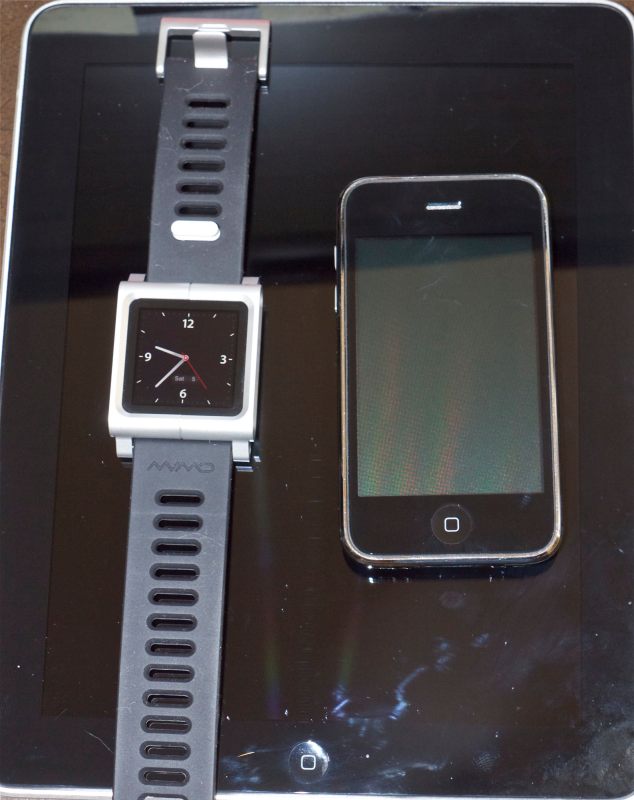
The Luna-Tik and the iPod. The clock face can be changed to a white background in ‘Settings’.
Note the movable strap retainer just above the watch face, set for maximum strap excess for small wrists!

Fit and finish is 1950s Leica quality, meaning beautiful machining and finish, with no sharp edges. The seam is about 5/1000th inch misaligned on mine and you can actually see that in the photo above; there is insufficient play to get perfect alignment before snugging up the Allen screws. A bevelled edge at the seam would have done a better job of hiding the inevitable Chinese mass production imperfection, as well as making the bevel a design feature, much as a bevel is used in the iPad’s frame. My iPad’s alloy frame, for reference, displays a variation in the relative positioning of the glass touch screen of 3/1000th inch around its periphery. For both the Luna-Tik and iPad that’s still a lot better than the fit and finish of all but the best Leicas, the engineering quality standard – meaning M2, M3 and M4 models made 1954-1965, after which quality control went to pot and prices went ballistic. (Earlier screw mount bodies were positively awful by comparison as the many I owned attest).

The generous length rubber wrist strap on the Luna-Tik comes with a movable retainer so that excess strap length can be clipped in position just so. Way superior to the usual loop retainer. Both the iPod’s volume buttons and power switch on one side and the recharging/data port and earbud socket on the other are easily accessible and the whole thing, once assembled, oozes quality and contemporary looks. The ‘watch’ is large, immediately qualifying the wearer as a Formula One groupie.
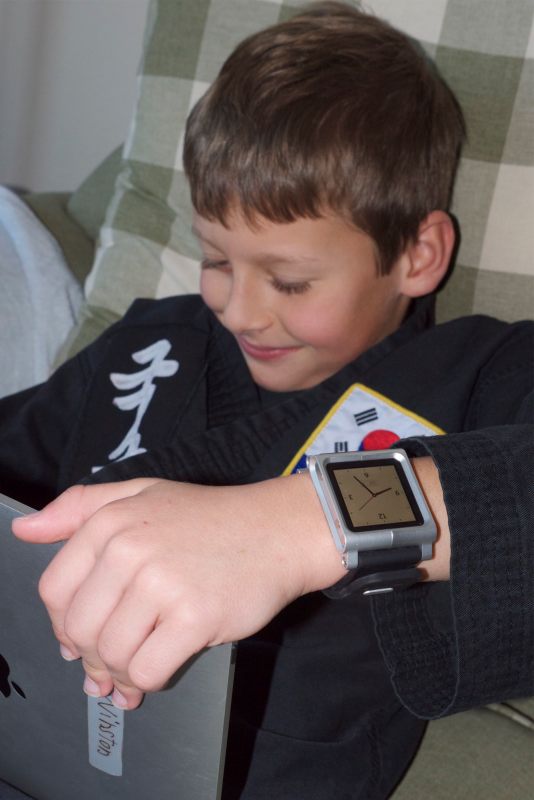
Future Formula One Champion Winston models the Luna-Tik, while racing on the iPad.
The white watch face is on display here. Strap retainer function is just visible.

Congratulations to the inventors at Minimal, Inc, for a great product. If you want one you had better rush as the iPod Nano sixth generation will be replaced soon by this year’s design. There may be cheaper alternatives to the Luna-Tik but I doubt there are any which are better made. There’s a neat informational video here.

This model of iPod was conceived with watch use in mind as it can be set to come up with the analog watch face when powered up. Handy. The inventor is contemplating adding a Bluetooth earphone option which will make for a neat wireless mobile music system.

Disclosure: I own one Luna-Tik, have no interest in Minimal, Inc. and love entrepreneurs.
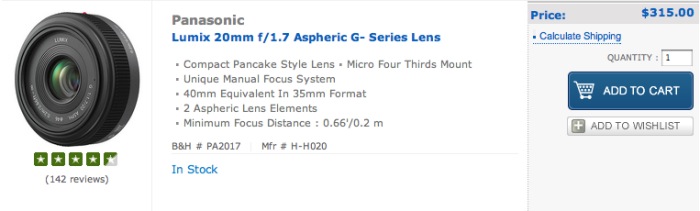
Two bargains from Panasonic

Cheap lenses.

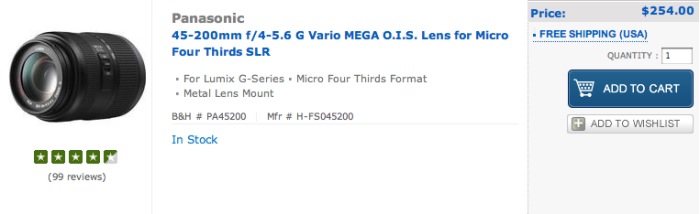
Aficionados of the MFT camera range from Panny (G1/G2/G10/GH1/GH2/GF1) can hardly complain about the prices of two of the most useful lens options – prices are from B&H in the US but doubtless can be matched elsewhere:

I have no special need for the first as the 14-45mm kit lens does it for me, and I wouldn’t use the fast aperture of this neat pancake lens, but I simply love the 45-200mm zoom for its OIS, low weight, small size and great performance.

I forget the prices of these when they were first announced, but suspect the above are much less.

The beauty of the promise of the MFT format is that it seems to me that the sensors will only get better, so these lenses will deliver better results from the next generation of bodies than they already do from the ones currently available.

Click bait

Thoroughly disingenuous.

‘Click bait’ is slang for web content with no substance with but one intention – to get viewers to your site and hopefully have them click through to something which earns you commission, even though the actual posting on your site has no substantive content.

Even quality sites are prey to this poor practice, and one of the worst examples I have seen is DPReview’s ‘Preview’ of the much anticipated Fuji X100. I’m not going to provide a link as the piece is so offensive as to discourage me from routing anyone else there but suffice it to say that, after allegedly handling an early prototype, which they laud endlessly for ‘feel’ and ‘quality” they failed to:

  • Take any pictures
  • Comment on responsiveness
  • Say anything about noise
  • Test the lens
  • Report on the quality of the sensor
  • …. and they even forgot to weigh the thing if, that is, they ever had it.

In other words, a marketing piece, pure and simple. Scandalous. DPReview is owned by Amazon and the latter, which prides itself on respecting its customers, can do better.

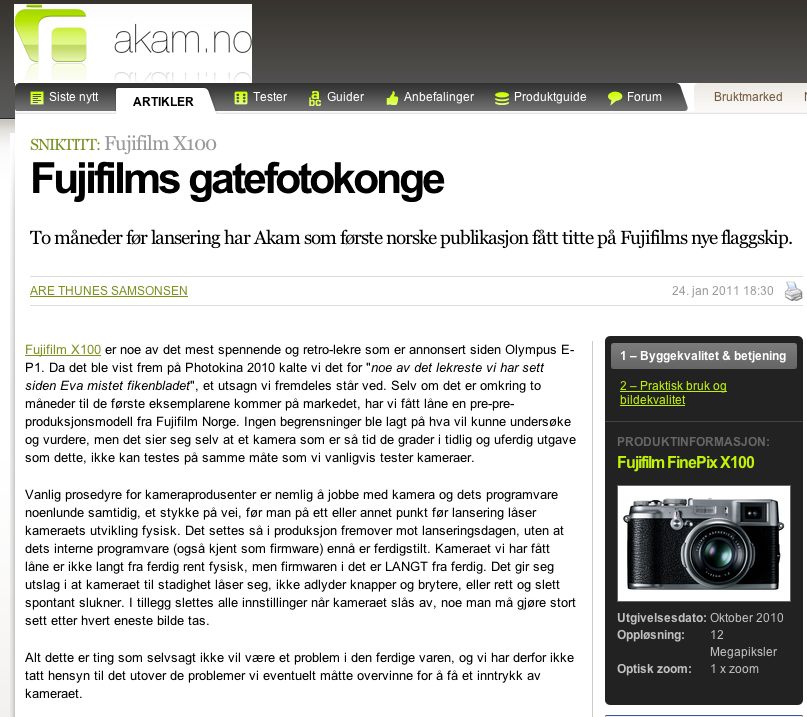
A far superior job (not difficult, given the hurdle posed by DPR) was done by the Norwegian site akam.no which not only got its hands on a very early prototype, but actually took real pictures with the camera and published them. While your Norwegian is likely no better than mine, you can still make sense of the test snaps on their site and suffice it to say that the definition of the lens and the high ISO performance both look very promising. Reading the related discussion at DPR discloses that the camera’s software is at a shockingly early stage of (in)completion, though it’s impossible to tell how old the prototype is. If it’s recent you can forget about seeing this camera on the market until the second half of 2011. The author of the Norwegian piece, Aethius, participates in the discussion which is well worth reading if you have any interest in the X100. He relates, among other things, that the software is so incomplete that the camera had to be restarted after every picture with many menu items garbled or missing! Not what I would call an alpha test model, let alone beta.

Click the picture for the akam.no review.

Aethius relates that this was an official tester from Fuji, his magazine having signed an NDA, which begs the question whether the CIA is in charge of Fuji’s marketing. It would take an organization which cannot distinguish Iraq from Australia to so bungle matters. Let’s see now – pre-release it in a nation where caribou outnumber humans, make sure it’s so buggy as to be scarcely worthy of attention, over promise and under deliver, raise the hype machine to the max practically guaranteeing dismay when the real thing hits retail, and make sure that only the worst things get said about it in the limited test and ensuing discussion. Buggy software, lens corrections yet to be completed and, worst of all for a camera whose primary (sole?) purpose is street snapping, it’s not especially fast or responsive according to Aethius’s comments in the discussion. Way to go, Fuji! Well, I suppose Leica needs the competition when it comes to rolling out buggy and costly hardware.

As for DPReview, you are a dishonorable entrant to this site’s Hall of Shame.

Eddie Rickenbacker’s

For real men.

Real men ride motorbikes, hang out at local bars and think nothing of confrontation and a good fist fight. If that’s your sort of thing, and you believe real motorcycles come from America and Europe, then you owe it to yourself to visit Eddie Rickenbacker’s at Second Street and Minna Street, in the vibrant South of Market district in San Francisco.

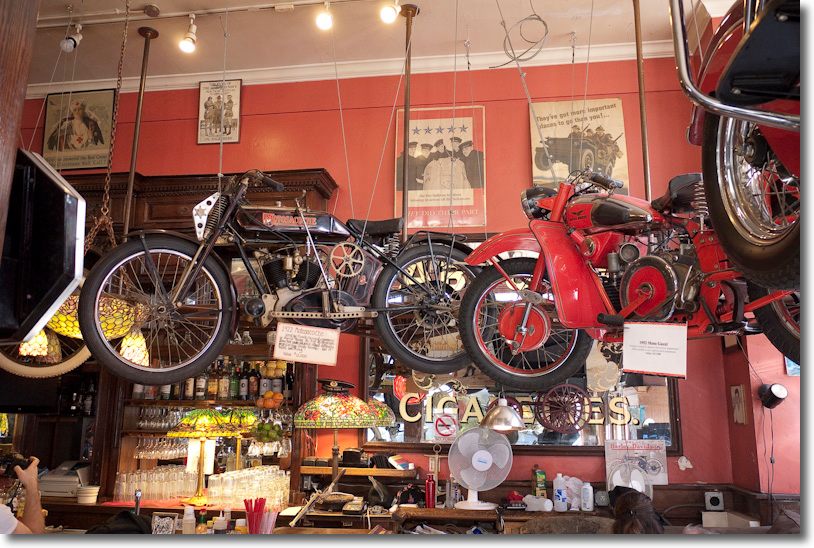
The food is cheap and served in the usual gargantuan American helpings, drinks are inexpensive and the atmosphere is real. A BLT served with fries plus draught beer (get the Racer IPA) will set you back $17 with tip. This is a genuine old place with a long bar on one side, an unkempt set of tables on the other and with friendly help. No fake Tiffany lampshades and Armani wearers here. And did I mention that Norm, the proprietor, who could stand to lose 100 lbs or so, hangs out on a sofa at the end of the bar …. his breathing assisted by an oxygen bottle? Like I said, this is not for the chi chi set. The snaps below will give you a sense of the place.

Located at Second and Minna, SoMA. A post war Triumph is above the entrance.

Classic Indian in the window on Second Street.

A 1922 Motosacoche and a 1952 Moto Guzzi.

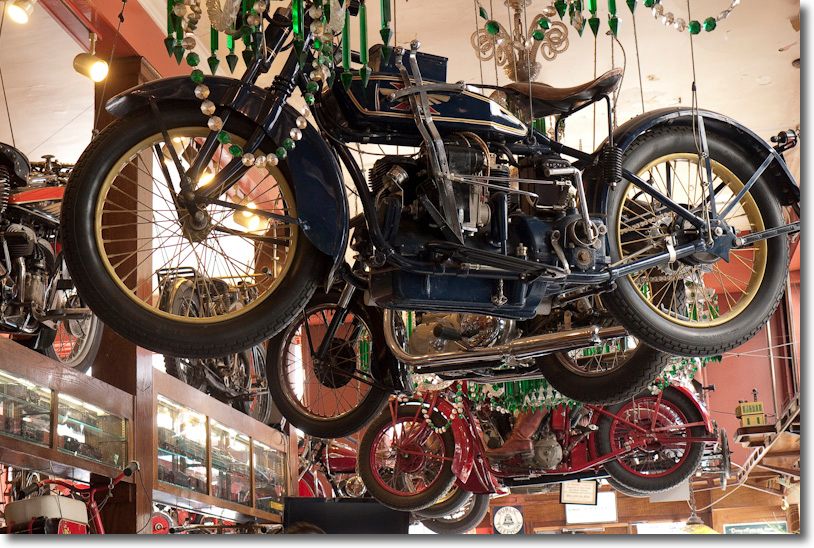
A gorgeous 1920s Excelsior leads the parade of bikes suspended from the ceiling.

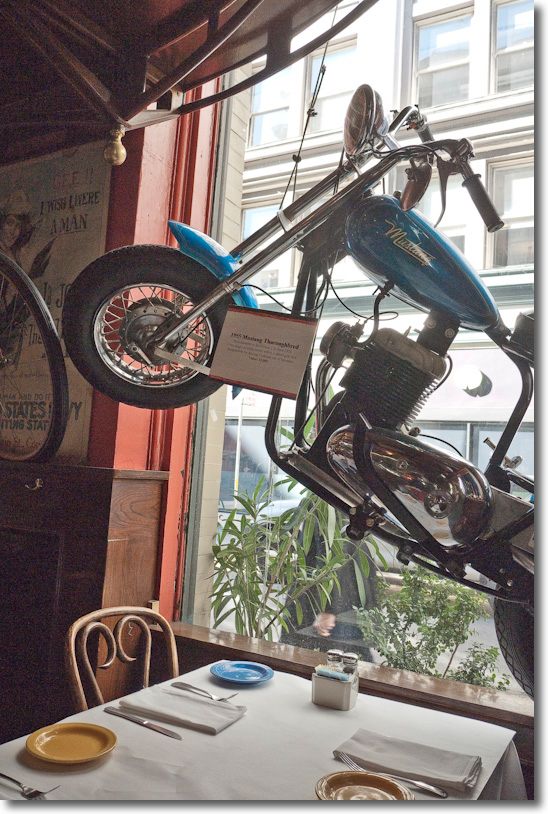
1955 Mustang Thoroughbred.

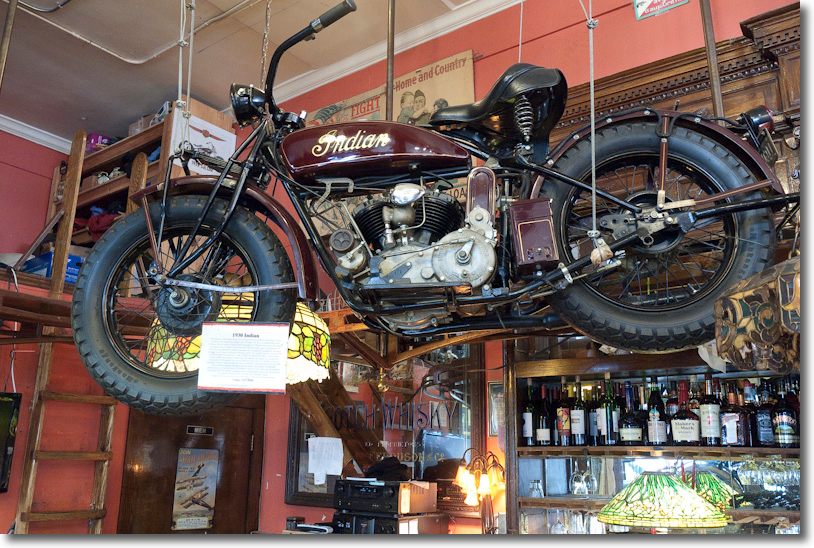
1930 Indian. They don’t make ’em like that any more and if you have
ever tried to kick start one that’s probably a good thing!

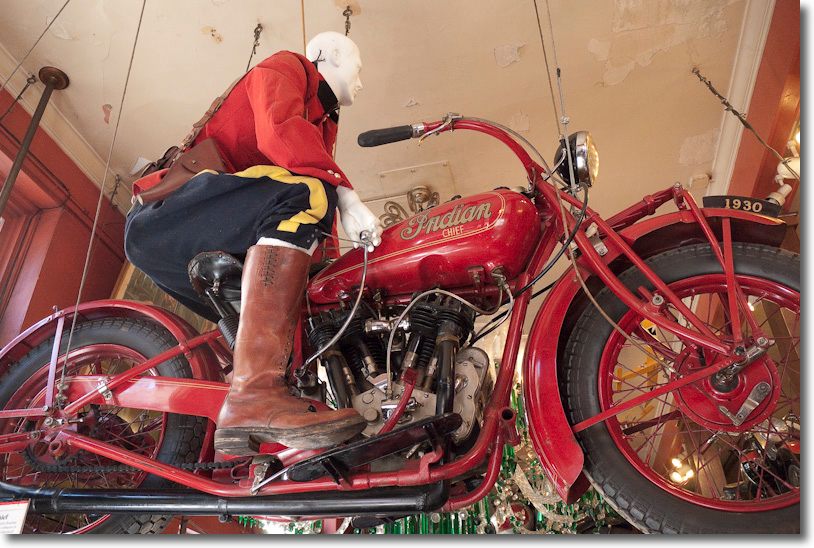
Indian Chief with complex leading link girder front forks.

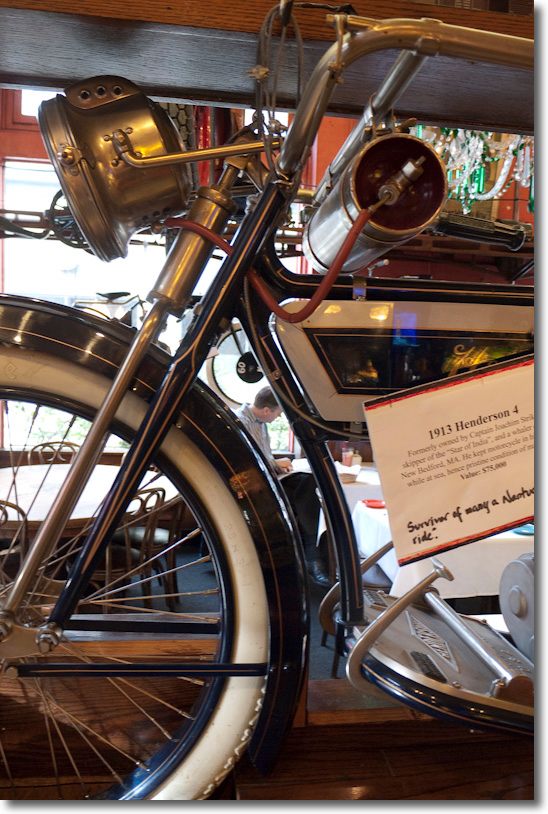
1913 Henderson 4.

The obese proprietor, Norm, hangs out on the couch,
below the Moto Guzzi and a classic Indian, breathing with an oxygen bottle.
The waitress is compiling a food order with his help.

All snaps on the Panasonic G1 with the kit lens at ISO800. Real Men don’t use flash.

Sad update: Norm Hobday passed away February 25, 2011. He is now in the afterworld, enjoying the world of the two wheeled afterlife. All speed, Norm.

Voigtlander 25mm f/0.95 MFT lens

Now that is fast!

Voigtlander (Cosina) has been making lenses for Leicas and a few other mounts for many years. Many of these appear to be derivatives of older Leitz designs and many have garnered positive reviews. For the most part they have been making lenses for full frame 35mm cameras so it was quite a surprise to see them come out with an MFT lens for the Panasonic and Olympus MFT bodies.

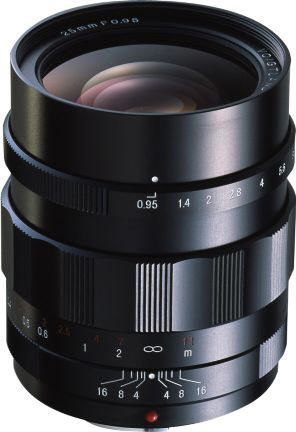
The Voigtlander 25mm f/0.95 MFT lens.

You can see more at Stephen Gandy’s Cameraquest site. Retailing at $900 in the US, the lens is sold out with new supplies expected in a month or so. There are some excellent pictures taken by Andrew Fildes using the Voigtlander on an Olympus E-P2 body here and in addition to being a fine photographer, Andrew has taken almost all the snaps at f/0.95 so you can get a sense of the depth of focus at full aperture. To put the aperture in perspective, the depth of field of a 25mm f/0.95 lens is identical to that of a 50mm f/1.9 on a full frame body, so it’s like using an f/2 lens wide open.

A couple of warnings. The lens is huge compared to regular MFT optics, it’s heavy as it’s all metal. It has zero automation. As regards aperture that’s hardly an issue. If you buy an f/0.95 lens you aren’t going to be using it at f/8. On the other hand, the lack of focus automation strikes me as a big negative in street work owing to the time delay from manual focusing, and you will have to focus fairly carefully on nearer subjects to make sure things are sharp.

By contrast, the fortcoming Fuji X100 with it’s 23mm f/2 lens will have a depth of field equivalent to an f/4.5 50mm lens on a full frame body, so the Voigtlander has two stops less depth of field than the Fuji at maximum aperture. That’s significant and noticeable. Andrew Fildes’s pictures show the DOF well and it’s rare that you get a real photographer showing off gear so well. DPReview may be the best technical review site for hardware but it’s the very last place on earth you are going to go to for quality photography.

I have bought gear from Gandy in the past and he is honest and easy to deal with. He has been in business for ages.

New Panasonic fast standard lens:

Panasonic is rumored to be announcing a 25mm f/1.4 lens (50mm FFE) with full automation in February, and that sounds like a far more practical alternative to trying to manually focus the Voigltlander behemoth. The Panny will have the same depth of field as a 50mm f/2.8 on a full frame camera and sounds like just the ticket if the Fuji X100 disappoints. I rather miss out-of-focus backgrounds with the G1 owing to the smallish maximum aperture of the kit zoom. I would guess the price will be $700. There’s already a 25mm f/1.4 Leica Summilux for regular 4/3rds cameras at $900 but it’s bulky and not in keeping with the compact MFT design concept. The 20mm f/1.7 Panny is another option worth considering for the street snapper, at a fraction of cost of the X100.