Category Archives: Photography

Breaking up

35mm film just does not cut it for big prints.

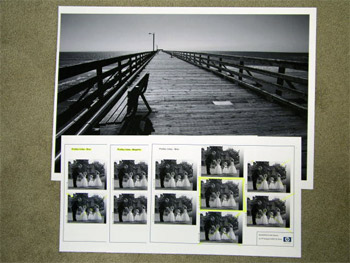
I finally finished framing the last of the fifteen photographs for the walls of the home theater – a converted garage, I should add, lest you think I have hit the jackpot. A large room, some 700 square feet, it offers lots of wall space even after the big screen installation. All of these are 13” x 19” ink jet dye prints made on the fine Espon 1270, with the delays in framing resulting solely from the incompetence of the local art store (Michaels) which stated they could not get me more 22” or 28” frame pieces because it’s a popular size. No kidding. So I finally ordered the remaining ones from Documounts, an estimable business that wanted my money and charged half as much. They also provided all the mats and boards for the pictures and a local glazier cut the glass to fit. All told, a 22” x 28” mounted, matted and framed print, with a nice ebonized ash frame, ran some $60, or one third of the amount charged by the main street framing place.

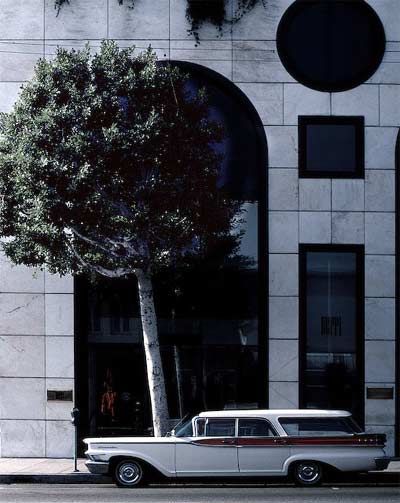
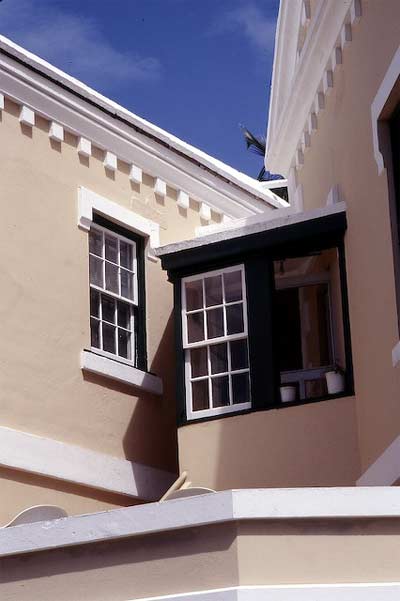
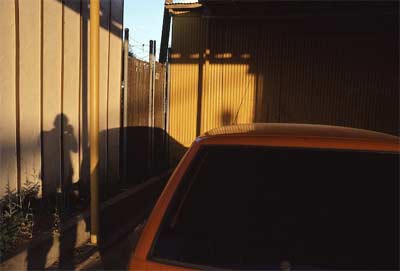
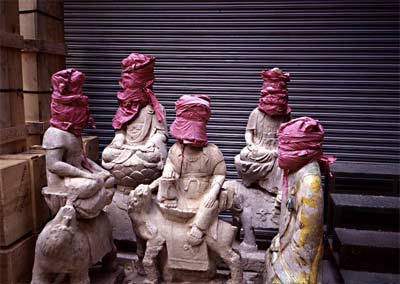
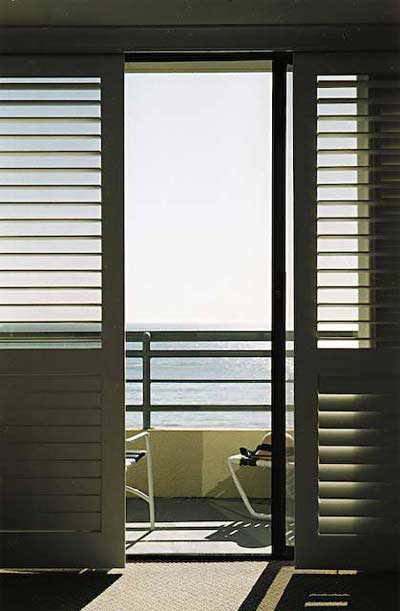
So there I was last night wondering which movie to watch, while debating the day’s events with that vicious guard dog and breed standard, Bert the Border Terrier, seen above. The goal of the picture project, I reminded Bertram, was that all the snaps must have been taken within the last twelve months. No recycled inventory of past successes. Change or die. And, in the event, every last one of these snaps was taken within a few miles of our home in central coastal California. There are traditional landscapes, strange surreal beach scenes, and the occasional peeling old wall sign. Acting as tour guide for Bertie, whose attention was enhanced by the promise of a cookie, I recited the story of each for him.

By the by, I found myself thinking about the equipment used to take these pictures. First, the realization dawned that almost every last piece of ‘front end’ gear used has now been sold, given the compelling advantages of the full frame sensor in the digital Canon EOS 5D at these print sizes. Second, of the fifteen pictures, eight were taken on medium format, six on large format (4” x 5”) and just one on 35mm.

Now it wasn’t planned that way. What ended up on the walls had to have visual merit, but it also had to be critically sharp. The reason is that viewers do not respect the rule book that says you should step back when looking at a large photograph. Not a bit of it. The larger the picture, the closer they seem to want to get. Now each of these film originals had been accorded the highest quality processing. The negatives were correctly exposed, film was developed by a great pro lab in Santa Barbara (one of the few that does not play a game of soccer on the beach with your wet negatives) and the originals had been scanned on the highest quality dedicated scanners at 2400 dpi (large format) to 4000 dpi (medium format and 35mm). No grain or dirt reduction software was used to preserve definition. These technologies may be smart, but there’s a trade off. Post processing was done on my iMac G5 whose screen has been colorimetrically (or whatever you call it) balanced using a Monaco EZ Color Optix thingummyjig. You know, the puck you dangle on your screen to measure colors while mumbling incantations to various deities. Bottom line? Color on the screen matches color on the print.

The result is that you cannot tell the large format prints from the medium format ones, but you most certainly can tell the one done on 35mm. Not that there’s anything wrong with the definition in the latter. Using a well calibrated Leica M2 and a 35mm Asph Summicron, that original had, without a doubt, the benefit of the best performing camera/lens combination ever. The Summicron lens is simply breathtaking in its ability to resolve fine detail with great contrast. No, it’s the film that damns the print. You see, if you adopt the ‘stick your nose in the print’ viewing method, the 35mm original clearly shows the film beginning to break up at this print size. There is a hint of grain and, in landscape pictures with much fine filigree detail, that’s a no-no.

Which leads to the inevitable conclusion that for large prints, which are my goal, abandoning 35mm was the right thing to do. Up to 8” x 10”, decent technique and a top class scanner, meaning a dedicated film scanner not some cheesy flatbed, will get you fine prints from 35mm. Anything larger, forget it. Or, if you like the 35mm format with all its advantages of lens choices and compactness, well, Canon has a digital camera for you. By comparison with 35mm film, the full frame digital prints I have made recently are simply night and day when it comes to resolution and detail, and my technique remains unchanged.

The only way around this issue for ‘35mm film only’ photographers is to make sure you don’t show your work head to head with medium format or full frame digital. If you do, all your protestations about making great big prints from a small negative will be so much dross. If, on the other hand, your goal is display on a computer monitor, well, a Holga will do.

Speaking of which, if you like Holga-sized pictures, you can view the ones in my home theater here.

Choices

They will always be limited at the top.

Reading the other day that Konica/Minolta had given up making cameras I started getting worried that we are headed for a world with too few choices when it comes to manufacturers of photo gear. Competition improves the breed, after all. Then a few moments of reflection suggested that maybe there never has been more than a very small handful of choices when it comes to the best of the best. What the pros use.

At the start of the second World War, your choice was 35mm or medium format. Sure, large format has been around for a hundred or more years and soldiers on today, but it’s hardly a product with what you would call critical mass. In 35mm it was the world of the rangefinder – meaning Leica or Contax. The Contax had it all over the Leica, more sophisticated in every way, but damned by a fragile shutter mechanism. Leica countered with a great shutter and maybe the worst viewfinder/rangefinder yet invented. In medium format there was no choice. It was Rolleiflex or nothing. Now little about twin lens reflex design makes sense, but it worked, had great lenses and a negative big enough that even the average duffer could make a decent 8″ x 10″ print.

In film the choice was greater – Kodak, Agfa, Ilford, Perutz, Adox – all made great monochrome emulsions and Kodak, of course, was working on Kodachrome. Two violin players, the Leopolds – Mannes and Godowsky – were locked in a lab by the boys in Rochester and emerged a couple of years later with Kodachrome, rated at all of 12 ASA. Just in time for the film to be used by Nazi photographers to record Hitler as he set about destroying the great race whence these two geniuses of chemistry came. If the Leica was the greatest camera of the century, and it was, then Kodachrome owns a similar place in the world of film. Kodachrome was simply fabulous. Without it 35mm color photography would not have blossomed the way it did.

In the early fifties Leica finally made the single greatest 35mm camera of all time. The M3. Learning from the Zeiss Contax that integration of the viewfinder and rangefinder into one eyepiece might just be a good idea, and that making the thing bigger than a pinhole could be a selling feature, they added a wonderful, sharply delineated rangefinder rectangle and those projected, illuminated, nay, electric, field of view frames that left you in no doubt whatsoever as to what your lens was seeing. And you could use that viewfinder in almost non-existent light, focusing and framing with the utmost confidence, taking your picture with the near silent whisper of the Leica shutter. They didn’t stop there. They crafted what remains the greatest 35mm lens made. The 50mm Summicron which remains, to this day, the standard all Japanese manufacturers aspire to. This pairing was a high point in engineering aesthetics and optical design.

The M3 and its descendants lasted in the pro’s gadget bag through the mid-sixties when machismo dictated long lenses and brutal looks. The former to avoid the bullets, the latter to state unequivocally that your camera could double as a weapon in time of need. The smart people at Pentax may have invented the instant return mirror, but the Nikon F was the camera of the Viet Nam generation. Its brute good looks, augmented by the equally masculine finish of the lenses, said you were the Real Thing. Pentax was not to be outdone, however. They started painting their cameras black and had the smarts to give a few to a London fashion photographer par excellence named David Bailey. In stark contrast to the stodgy, patrician, epicene Beaton, wedded to his Rolleiflexes and his Royal sitters, Bailey rocked. He was a real man. Pentax pushed it. They ran one of the greatest camera ads ever. It showed a beaten up black Spotmatic, brass wear spots everywhere, with just three words. David Bailey’s Pentax. Wow! Here was a guy slogging it out in the studios of London with all those dolly birds and clearly having every bit as tough a time of it as the fellows in Nam with their Nikon Fs. Years later, Bailey admitted he had taken sandpaper to his Spotmatics and rubbed the paint off at strategic locations. It got him a lot of dates. Not bad for a few bob and a couple of minutes of elbow grease, huh? So in the ’60s your choice in 35mm was Nikon or Pentax.

David Hemmings played Bailey in Antonioni’s wonderful movie ˜Blow Up”, though his weapons of choice were a Nikon F and a Hasselblad. Change in the medium format world was slower than in the frenetic corner known as 35mm. At least you finally had a choice. It was no longer just a clunky twin lens reflex Rolleiflex. Why, the Hasselblad, scarcely more competent, said you had arrived. Because you could afford it. OK, so the viewfinder was lousy and the mirror did not return after you pressed the button, but good marketing saw to it that you did not notice.

Enter the seventies and eighties and Canon began to get noticed. They could not compete with Nikon or Pentax for charisma, those marques having earned their stripes in the hellish fields of Viet Nam and Carnaby Street. So they had to sell something else. And that something was technology, backed with abundant capital. Fast, small motors to move the film? Of course. Coreless linear motors to focus the lens? Naturally. Fast sensors to provide autofocus? Absoluement. Eye controlled focus? Well, we did it just to show that we could. Suddenly the competitors were rocked by this Japanese copier-making powerhouse with seemingly infinite resources, and they have been playing catch up ever since. But the old rule prevailed. In 35mm your choices were few at the top. Canon, Nikon, and maybe Pentax.

In medium format, the old guys were still at it. Rollei came out with a camera that four people bought, the SL66. Its huge mass and focal plane shutter which hated working with studio flash made sure that no one bought it. Zenza came out with something even worse, the Bronica, which jammed as soon as you looked at it. They had taken the worst of the Rollei and made it …. worse. Working photographers preferred proper flash synchronization and bought a Hasselblad. Rollei fixed that deficiency with their wonderful 6000 series of medium format SLRs, but it was too late. Traction had been ceded to Hasselblad. The Hasselblad may have been horribly unreliable but it was glamor personified. Plus it shared Rollei’s great German lens providers. An entry ticket to the world of Madison Avenue. So, like a Jaguar owner, you bought two hoping that one would survive while the other was in the shop.

Then in the ’90s, digital arrived. No matter that the first efforts were comical in the extreme. Digital was Now and the old protagonists, Canon and Nikon, were at it again, followed by a somewhat breathless Pentax. The latter had one thing the two others could never understand. The word ˜elegance” is part of Pentax’s genetic make up, a concept that never graced the worlds of Nikon and Canon. Olympus gave Pentax some competition when it came to chic design but let’s face it. What self respecting, red blooded American male was going to be seen with his wife’s camera? David Bailey’s Olympus? I don’t think so.

So, once again, choice was limited. Sure, you could have flirtations with minority brands like Minolta or Konica, but it was always rather comical to see the poor photographers using this gear. Like the people who were buying Saabs, hoping they would be sufficiently different that the downright horribleness of their choice would qualify them as eclectic, independent, thinkers. Wrong. They just didn’t get it.

Meanwhile, digital completely bypassed the medium format boys during this decade, and they will never recover the lead established by the big Japanese houses. When full frame digital beats medium format film, why would you blow $15k on a digital back for your Hassy when you could get a couple of Canon’s best bodies for the same coin and have something reliable to boot?

Leica? While issuing quarterly denials of impending bankruptcy their apparent goal is to sell only to Japanese collectors and tax exiles in Geneva. So you can’t have one. Settle for a Rolls or Bentley instead.

Film, meanwhile, had gone the way of Contax and Yashica and Konica and Minolta. The choices in color were now down to just two – Kodak and Fuji. The latter may have done a number on the former, taking away market share daily, but it’s all history now. Neither will be making color film by the end of the decade.

So there never have been that many choices at the top. Today it’s Canon or Nikon. Pentax for those willing to be different. And for medium format it’s Hasselblad digital, but who knows how long that will survive. And no one needs film.

A ten year digital device

The Epson 1270 printer

When it first appeared on the market six years ago, the Epson 1270 color dye ink jet printer was the first consumer priced printer which could make large – meaning 13” wide and up to 44” long – prints with high quality and repeatability. I bought mine new in March, 2000 for $539.05 and proceeded to produce hundreds of color and monochrome prints with it. First in 8” x 10”, later in 13” x 19” sizes, which makes for a nice 22” x 28” wall sized matted, framed result.

I’m not writing this because the Epson has given up the ghost. Far from it. The only reason that I know exactly when I bought it and how much I paid is that I just resurrected the original shipping box from the attic and found the sales invoice in there. You see, the Epson will soon be making its way east to my nerdy friend whose current printer is limited to 8” x 10”, and he know and loves the quality this machine is capable of, reliably producing at 13” x 19” prints.

Ink remains easily available, even if all the colors are in one cartridge and the Epson’s software is about as good at predicting the ink levels as the Federal Reserve is at predicting inflation. Which is to say it gets it in the ball park but don’t stake your life (or next print) on it. Epson sold a lot of these wonderful printers and given the profit margins on ink sales you can bet fresh ink cartridges will be available for a long time.

Conservatively, I’m guessing that the 1270 has at least another four good years left in it, which makes for a ten year life in a digital age where products are seemingly obsolete days after hitting the market. Epson made the 1270 obsolete soon after I bought mine and eventually switched to pigment based inks with claims of great longevity. Didn’t worry me one bit. I have framed originals which are six years old and they look as fresh as the day they were made. I simply do not display them in full daylight eight hours a day.

One of the great appeals of the Epson 1270 was that its use of dye based inks, despite their reputation for fading, resulted in a color print quality very similar to that obtained with the old Cibachrome process. This was, for most, not something to be undertaken at home, as the temperature margins of the chemicals were narrow to put it mildly and their toxicity comparable to the effluent from Chernobyl. What Cibachrome gave you was a wonderful depth of color albeit at the expense of high contrast, so it matched up nicely with milder emulsions like Kodachrome II and, later, Kodachrome 25 and 64, provided your exposure was spot on. Paired with that old grain hound GAF/Ansco 500, Cibachrome was a dream. It was a strict teacher, but get the exposure right and the dynamic range was there for all to see.

The only reason the 1270 is moving on is that I find I want to make 16” x 20” and 18” x 24” prints more often, and if that does not sound like much of a change the latter size is almost twice the area of 13” x 19”. That’s a lot bigger when it comes to visual impact.

So B&H Photo has an order from me for a Hewlett Packard DesignJet 90 (they are backlogged, suggesting the secret is out) offering dye based inks which, miracle of miracles, are allegedly fade resistant. I toyed with the idea of the Design Jet 130 model which goes up to 24” wide, but concluded that prints that large were pretty much the exception rather than the rule for me, so common sense prevailed over machismo.

Truth be told, I am a tad apprehensive about the new printer. Not that installing the thing worries me – heck, with an Apple iMac it’s just one more ‘Plug and Play’ exercise. No, as a long time user of HP’s 12C calculator (a device now some 25 years old!) my wariness results from my all too great familiarity with HP’s instruction manuals. Hewlett Packard was always an engineer’s company, run by and for engineers, with the brief exception of a disastrous, mercifully brief, time under a chief executive who confused her posterior with her elbow daily, while spending far too much time on the former in the corporate jet. Now that the company has returned as an engineering powerhouse, I’m afraid that the same people who wrote the manual for my 12C calculator will have been involved in the book for the DesignJet. They or their kids.

On the other hand, like all good engineers, they probably believe that instructions are for losers, so the first thing I propose to do when the machine finally arrives is to pitch the instruction book. Worked with the HP 12C and Reverse Polish Notation was never an issue for this Pole. Any descendant of a proud nation that can charge Panzers on horseback needs no instruction book. And it doesn’t hurt that I have an honors degree in Engineering earned before the days of ‘open book’ exams.

Goodbye Epson. You delivered beyond any rational expectations.

A break in the storm

More than just a rainbow

Name any of the world’s great democracies and the chances are that you will find its happy residents indulging in the cocktail hour before dinner. America, Britain, France, German, Australia, Brazil – all favor this pastime which many regard, myself included, as the very touchstone of civilization.

Then look at those dour nations who struggle with the very idea of ‘one man, one vote’; God forbid ‘one woman, one vote’ for many do not even allow women the freedom of the ballot box. The Saudis? They don’t drink. The Russians? They do nothing but drink. The North Koreans? Please….

So after a day of truly wretched weather which saw thunder showers every few minutes interspersed with brief rays of sunshine, the thought of the daily libation was very much on my mind as I made my way to the freezer with its gin every bit as cold as the glass next to the bottle. Just before opening the refrigerator I glanced to my left and there it was. A superb rainbow gracing the old estate – clear sky to its left and threatening clouds on the right. Now you should know I’m pretty much blind without my glasses but that didn’t stop me from rushing to the office to grab the 5D, nearly damaging myself on that insouciant boulevardier Bertie the Border Terrier en route, and exiting stage left at a rate of knots that would have given pause to the staunchest of Olympic competitors.

Forget the old wives’ tale that landscapes are a stationary subject. Not a bit of it. Give the elements five seconds and, likely as not, the effect is gone. So throwing caution to the winds I banged off a couple of snaps even though what I saw through the viewfinder was mostly a ghastly blur, trusting to the gods and the Canon’s automation to get things more or less right.

I rushed back in at scarcely lower a pace and placed the card in the reader. Locating my glasses gave confirmation that all was right with the technology from Canon HQ, but when I loaded the picture into Photoshop and snapped it up to 100% original size (that’s some 30″ x 45″ on a print with the 5D’s full frame sensor) it became clear that the otherwise denuded tree on the right was replete with more birds than you could shake a stick at. The small picture here scarcely does it justice but a few moments later as I sipped the soothing elixir, the magic lighting long gone, I could not but help reflect on this wonderful bit of serendipity.

After the Purge

Equipment then and now.

I took a few moments to take stock of how my equipment has changed over the past quarter as a result of the move to full frame digital.

Before:
3 Leicas (IIIG, M2, M3)
1 Leicaflex SL for long lenses
1 Bessa T for the 21mm Elmarit
21, 35, 50 (3), 90 (2) and 135mm Leica M lenses
200 and 400mm Leica Telyt lenses
Rollei 3.5F
Rollei 6003
40, 80, 150 and 350mm Rollei lenses
Rollei extension tubes
Mamiya 6MF when I didn’t want to drag the Rollei about
50, 75 and 150mm Mamiya lenses
Crown Graphic 4” x 5” with 90, 150 and 210mm lenses
Canon 4000 35mm scanner
Nikon 8000 medium format scanner
Epson 2450 large format scanner
HP DJ90 large format printer

After:
Canon EOS5D
24-105mm Canon lens
1 Leica M3
35, 50 and 90mm Leica M lenses
200 and 400mm Leica Telyt lenses adapted to the Canon
Crown Graphic 4” x 5” with 90, 150 and 210mm lenses
Epson 2450 large format scanner
HP DJ90 large format printer

Quite a reduction in clutter! The original goal, recall, was to get medium format quality without the bulk and complexity. The 5D came though with flying colors on that front, equalling or exceeding medium format quality at 30″ print sizes, while making pictures possible that would never have been taken on film, thanks to Image Stabilization and a sensor which renders grain free ISO 400 images.

Now I’m keeping the Leica M3. Not rational, I know, but it has been a dear friend for more than thirty years and we are not ready to part company. Yet. However, it seems appropriate to focus on the need for the 4″ x 5″ gear. If you can actually expose the film in this beast, large sharp prints are trivial, owing to the enormous size of the negative.

So I compared 30” prints from both and, interestingly, there was little to choose. It seems easier to get a broad dynamic range from negative film than from digital, the latter needing more attention to exposure. Like using slide film. My large format Kodak VC160 negatives are scanned at 2400 dpi on a well tuned Epson 2450 flat bed scanner, using Silverfast Ai software. Doubtless drum scans would be even better but after waiting for two weeks for the film to be processed, I’m not about to wait two more for the scans.

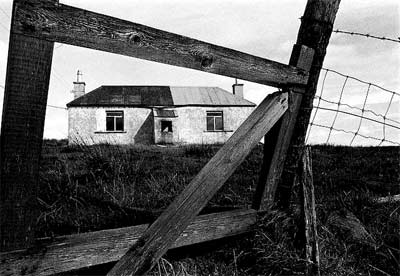
For what are very similar scenes, the technical details could hardly be more different. Here’s the 4″ x 5″ picture:

This was taken using a 210mm Rodenstock Sironar lens, probably 4-8 seconds at f/22. A massive Linhof tripod was used for stability. That lens is similar to a 75mm on 35mm. Setup time to take the picture was some five minutes. Processing was by Calypso Labs in California – an outfit that literally needs to clean up its act, judging from the amount of dust on the negative. The scan on the Epson took approximately 20 minutes. The file is 250 mB (!). Unsharp masking in Photoshop was 45/1/0 – in other words not a lot.

Now compare this with the Canon EOS 5D snap taken a week later.

Here I can disclose the technical details with certainty – they are part and parcel of the file. The shutter speed was 1/15th with the camera hand held on a monopod. ISO was set to 400 to allow a faster shutter speed. That’s a nice attribute of the Canon – ISO is used to control shutter speed. Up to ISO 800 grain is simply not an issue. The lens was fully opened at f/4 at a focal length of 40mm. Setup time was maybe 10 seconds. So the lighting was identical – 1/15 @ f/4 @ ISO 400 is nearly the same as 4 seconds @f/22 @ ISO 160. The original most certainly did not need any dust retouched, and I did not have to wait weeks for the negative to come back. The file size is 73 mB. USM in Photoshop was 250/3.2/0 – much more than with film and reflecting Canon’s own recommendation that the user starts at 300/0.3/0 to overcome the softening effect of the anti-aliasing filter in the camera.

So as a landscape camera the 5D excels. Meanwhile the Crown Graphic is on probation. There will be rare occasions where something larger than 30″ x 40″ may be called for (I cannot immediately recall ever having made a larger print) in which case a drum scan and a professional printing house would be required, with goodness knows how long a lead time. That is, of course, if color film in this size is still made when the need arises.