Category Archives: Technique

Really Large Prints

Big is good.

Something wonderful can happen when the print is much larger than seems reasonable.

Apropos my toe in the water of large format photography, I found myself in a gallery of photographic prints in one of the many charming coastal towns near my estate in central California. A pleasant ride some 25 miles away on Highways 46 and 1, especially on a fine German motorcycle, no excuse is needed for a trip on a summer’s day.

This particular gallery is home to the work of just one photographer, with content limited to the Large Landscapes of the great American West. Now I do not particularly care for his work, hence my reticence in identifying the spot. However, befitting the grandeur of those vistas, the prints on display are truly huge, as large as anything seen outside the world of the delivery trucks used by the supermarket chains, replete with 10 foot high tomatoes.

What makes the prints apparently larger than they really are – sizes range up to 40″ x 60″ – is that the gallery space is fairly long and narrow, making it difficult to stand far back enough to make the whole thing in. Thus, you are forced in close. After the first shocked reaction at the sheer size of the prints, one starts to realize they are really quite effective in conveying some of the grandest landscape anywhere. California, Arizona, New Mexico, Nevada – this is landscape writ large. Who knows what Wagner might have been inspired to write were he a Californian….

There is a mixed reaction of techno-shock – My Goodness, those things are Sharp! – and the deafening sound of early warning bells – How Gauche! – to so over-enlarge a photograph. Large format photography is at work here.

Now the old estate is amply provided with large expanses of walls the better to display art. True, you are more likely to encounter a Seurat or Degas sketch on its walls, maybe some noodlings by Matisse, a Rothko here and there, but that’s in no way a commentary on the world of the photograph. Show me a good one and up she goes. Amazingly, I found myself revisiting the gallery in question several times, once with my three year old whose power of appreciation and observation I value greatly.

So what do these very large prints have to teach us? Simply this. They are involving. Once you get over the shock of their sheer size, you find yourself drawn into the landscape. You are one with it. You step back, pushing against the opposite wall to try and grasp the whole. You step in and wonder at the fine filigree of leaves and branches and grasses which define the whole. You ruminate on the wonder that is nature.

Anyway, this experience a few months ago, spurred in no small part by my boy’s repeated ˜Wows” in the gallery, caused me to make an upgrade in the default print size I adopt when showing my work to friends. For as long as I can remember that has been 8″ x 10″. Why on earth 8″ x 10″? Lethargy. Laziness. Lack of original thinking. Because they make it that way. Because it (used to) fit the print washer. Because the ink jet handles it easily. Because the computer is fast processing it. Because mats come in the right size inexpensively. Because frames are available anywhere.

Ice Cream. Mamiya 6. A Really Large Print.

So for the past few months I have disciplined myself to make one 18″ x 24″ print every day. My excuse is that that’s as big as my printer will make. Not large by the standards of that gallery but Boy, oh! Boy, you should see the look on friends’ faces when you hand them one.

Go ahead. Keep it! Now you have a memento, not just a photograph. And is that not why we take pictures? To make something lasting?

Try making some Really Big Prints really soon. Once you get over the technical challenges maybe you too, like my three year old, will say Wow!
Crop it Good

You hear this sort of thing a lot from academics and pseudo-intellectuals. The Alfred Rosenbergs of the photography world. Sadly, unlike Rosenberg, they remain alive to propound their mealy mouthed tripe in an earnest attempt to earn what modest living their lack of intellect affords them. It goes something like this:

“No great photographic artist every crops his originals when printing, knowing that true greatness in a photograph can only be attained when the original visualization is rendered truly and uncompromisingly on photographic paper. To crop is to destroy the integrity of the creative process.”

Often this codswallop will be followed by a reference to Cartier-Bresson whose prints are so intellectually honest that they often include the surrounding frame of unexposed film. What art. What genius.

What utter rubbish.

Given that the sole purpose of an art photograph, as opposed to a commercial one, is to provide aesthetic satisfaction for the viewer, it is irrelevant whether the spectator sees all of the frame or just a slice. The only thing that matters is that the photograph works.

Look at any picture. Crop it with your hands or your mind’s eye this way and that.

Now pretend that you never saw the full frame original. Who is to say that any of the crops is better or worse? The reality, of course, is that the photographer should crop for effect and choose the best possible crop to display his art work.

The academic rule is even dumber when you think that the same effect can be largely accomplished by simply placing a longer lens on the camera. I print it full frame using a 90mm lens on the camera versus cropping from the original taken with a 50mm lens. No difference, maybe except for definition and grain. But the first picture is sacred as it is uncropped, whereas the latter is garbage as I broke a cardinal rule of academia.

All of which goes to confirm that Those Who Can, Do whereas Those Who Cannot, Teach.

Crop away. Keep cropping until it looks good or move onto the next original. And if you really want to fool them, why not can add a frame depicting the unexposed film, with film manufacturer of choice, in Photoshop. How intellectually dishonest of you.

Take fewer pictures

How many times have I read exhortations by ‘teachers’ of photography that the aspiring photographer should take more pictures, use more film, carry more digital storage?

I always flash back to my mother telling how she once met George Bernard Shaw (1856-1950). In 1938 she had been passing a few idle weeks at the Dorchester opposite London’s magnificent Hyde Park (the park remains magnificent but, alas, the hotel is now owned by Arabs whose kin are the only ones affluent enough to stay there) and on one occasion had the good fortune to meet the humorist and playwright. She described him as tall, gaunt and very distinguished looking. In addition to being a great writer he was also an enthusiastic photographer. Their meeting always reminds me of his light hearted remark to the early British photographer Alvin Langdon Coburn that “Technically good negatives are more often the result of the survival of the fittest than of special creation: the photographer is like the cod, which lays a million eggs in order that one may reach maturity.” That was in 1906. The year my father was born.

Since that time, the typical number of pictures available to a photographer has grown from one (plate cameras), to twelve (the Rolleiflex), to thirty-six (the Leica) to, who knows, several hundred or thousand with a high capacity digital card. So in a hundred years, the camera’s capacity has grown by three orders of magnitude. Sadly, the quality of the average picture has not.

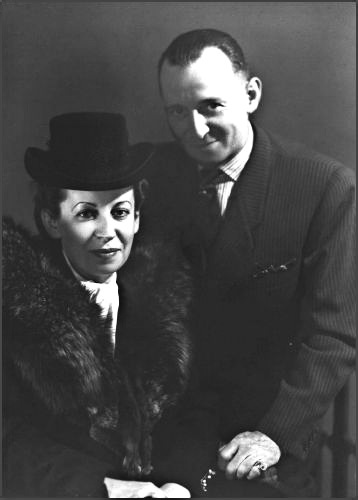
Why is this? Take a look at your old family albums. They probably contain pictures taken 50, 70 or maybe even one hundred years ago. Note that the earlier the picture the better the composition and execution. Chances are those were taken in a studio setting. Your great great grandparents had donned their finest clothing and the whole sense of occasion, of having your picture taken, of making an effort to get it right, enhanced the results immeasurably.


My parents in 1937. Studio photograph.

The view was the same from the other side of the lens. The professional taking the picture knew he only had one chance. He studied his technique, made it a constant (not mindlessly changing between this lens and that, film A, B or C, developer X or Y) and delivered every time. He put considered effort into every picture.

I believe we would all do far better, wasting less time and materials in the process, were we to follow suit. Less equipment and less film correlate inversely with the quality of the results.

So I challenge you. Get to an area you know and have photographed a few times, armed solely with one roll of film or one low capacity digital card. That might mean as many as 50 pictures for those used to a thousand or twelve or fewer to those used to carrying sufficient supplies for a couple of hundred. My version of this is a Rolleiflex with a fixed lens and just one roll of film – 120 in my case, meaning twelve pictures, as the camera will not even take 220. Thank goodness.

A more extreme variation, in my case dictated by the fact that so far I have only 2 film holders, is to take your field or view camera armed for just a handful of shots. Heck, the sheer bulk of the thing pretty much dictates this sort of economy. My two film holders allow me a scant four shots.

Now take your pictures. Think hard again when setting up the picture. Think harder before pressing the button. Take some time over each photograph.

Take a look at the results.

See how not only are most of them good, note also that the absolute number of successes far outweighs your machine-gun days?

Take fewer pictures and they will be better pictures.

Throw away your lens cap and case

How many times have I heard “I keep a lens cap on at all times to protect my precious lens” from photographers?

Sadly, for many this is more than literally true, the loyalty to the lens cap being so great that the user finds he frequently takes pictures of the inside, having forgotten to take it off!

Oh! you say, but I only keep my cap on when the camera is in its (never ready) case or camera bag. Even worse. Why on earth would your lens need protection stored in the safety of your (largely inaccessible) bag?

If you must have protection for the lens, place a clear glass filter over it. Then you can clean that with abandon using your shirt tail, handkerchief or tie, given that you will never have those precious lens cleaning tissues available when you need them. Then, after five years of hard use, throw away the filter and buy a new one. It has cost you $10/year and never gets in the way of a picture.

On a related topic, throw away the silly case your camera came with. Its sole purpose is to present one more obstacle to the taking of pictures, while simultaneously destroying the lovely feel of an unclothed camera held in bare hands. Plus, of course, film changing becomes a nightmare as you unscrew the camera from its case, nearly drop it as it is now untethered and promptly forget to properly tighten the screw when done. Another trip to the repair shop.

Liberate your thinking and your approach. Throw away your lens cap and that silly case and attach your strap of choice to the camera, where it belongs.

Photography is not a group activity

An enterprising Toronto-based photographer whose first name is Matt (he seems too shy to disclose his full name) took on the courageous, maybe quixotic, task of starting a web-based photography magazine named Photoblogs Magazine (May 2010 – now defunct). While I think the web is a great place to display pictures and try out new work on a broad audience, it lacks the permanence and sheer tactile feel of a good book.

You pass your bookshelf and grab that Harry Callahan book, wondering at just how he made that image which came to mind the other day. You switch on your computer and, by contrast, it’s a mixture of work (I stare at one of these things all day trying to make a living) and fear (Will it lock up on me again?) And with the present state of the art, the printed image leaves the electronic one in the dust.

Not least of a web publisher’s problems is how to get his site known in the vast sea of noise that is the world wide web. On the other hand, go to a good newsagent or bookshop and the handful of magazines publishing good photography are there, easily accessed and eagerly thumbed, without any fear of overload.

Still Matt should be respected for his efforts and I wish him well.

A few weeks ago I had the good fortune of being asked to be the first ‘Spotlight’ featured photographer in Matt’s magazine. The approach is that the photographer is asked five questions and his responses are then published with a few of his pictures. Well, strangely, even though my responses to the questions asked were exceptionally terse, sadly only four made the published page (or screen, if you prefer).

The unpublished question and answer were:

Q. With whom do you like to photograph most?
A. When it comes to taking pictures, one person is invisible, two are a crowd.

My response was rooted in the deeply held belief that photography, whether street candids or the great vistas of the American west, is a lonely pastime. You simply cannot go with another photographer, both set up your cameras in similar locations, and not be plagued by the thought that you are standing in the Kodak Picture Spot recording a Kodak Moment. The photographer must be free, whether to mutter aloud to himself and complain about the light, lean this way and that in the search of the perfect perspective, or wait for hours for just the right moment. Another photographer is a powerful distraction in all these activities.

Maybe the worst manifestation of the group approach so beloved amongst those with no individual thoughts or totally lacking in imagination, is the photo workshop. Given that technique can be learned from a book, and the art of seeing is either something you have or do not, what possible purpose can the workshop serve, unless it is to fill the pockets of the sponsors and the film stock of the participant with near identical images? Ok, so it’s fine for learning technical stuff, but it will not teach you to see. You can either see or you need to try another hobby. It’s a binary issue.