Trying the new MacBook Pro – 2009

OK, but not a buy

I stepped by the local Apple Store yesterday to play with the 13.3″ $1200 new aluminum MacBook Pro.

Here are my reactions:

Positives:

  • Rolls Royce look and feel
  • Super sharp, bright screen – excellent for photo processing
  • Easily user upgradeable for more RAM and bigger HDD without voiding the warranty
  • Price – great value at $1200
  • Excellent Nvidia 9400 graphics card
  • Backlit keyboard
  • Fast CPU

Negatives:

  • Glossy screen with no matte option
  • Black keys – not my thing
  • I suspect the aluminum case will dent whereas a plastic case will bend and spring back
  • Store employees were unclear whether it will drive the 30″ Cinema Display (the 15″ and 17″ models will but they have an enhanced 9400/9600 card – I checked the system profile on all three models). Subsequent checking on the Apple site confirms that the 13.3″ model will drive the 30″ Cinema Display (though there may be issues with other makers’ dual DVI monitors) at full 2520 x 1600 definition
  • Still too heavy – my netbook (no DVD drive) is 2 lbs lighter at 4.8lbs, but you have to hack it to run OS X

I will wait for the ($700?) Tablet which should be out by 2010, presumably with a touchscreen like the iPhone but with a much faster CPU than used in that device. However, if your current Mac is dying or you have finally decided that your time is worth more than the time sink that is Windows, this would be a great starter machine with the ability to drive very large displays.

The Race Track improved

Dykinga was good. Edwards is better

There’s a magical place in Death Valley, Arizona and it’s called the Race Track playa.

Jack Dykinga illustrated it in his magnificent book which I reviewed a couple of years ago. Simply stated, stones of substantial mass move, magically, yet no one has ever seen this occur. I choose not to dwell on the reasons. Some things are simply magic. The Race Track is one of those.

Why not leave it there?

Well, because a fine photographer whose work I have been privileged to mention here on occasion, has done it better.

Rod Edwards, a UK professional, is that photographer and he has taken Dykinga’s work to a higher level in his rendition of that phenomenal place in Death Valley.

I have been unsuccessful in monetizing my QTVRs, much as I have tried. I would take my iBook around various wineries in central California and show them to proprietors, only to be met with blank stares. Indeed, when I had my one man show I considered including a couple of big screen TVs to better show them off, sound effects and all, but gave up on the idea based on those self same stares.

However, to Edwards’s credit, he has persevered and has been justly rewarded with a commission from Britain’s National Trust – an institution which you can best learn about from the wonderful writings of James Lees-Milne, a magnificent conservator and writer about the early years of the NT. Simply stated, the National Trust is charged with the preservation of the UK’s architectural and cultural heritage – a rare good use of taxpayer monies.

No need to dwell further on the subject – just click on the picture below.


Rod Edwards’s Race Track

Update August 27, 2014: The mystery of the moving stones has finally been solved and you can read all about it here.

Elitism

Guilty as charged!

I am an unashamed elitist, a status too often mistaken for snobbery. The two are unrelated. To misquote Wilde, the snob knows the price of everything and the value of nothing. The elitist, by contrast, focuses solely on value. Scratch an elitist and you will find an engineer.

I was struck by this realization when thinking of the choices I have made in machines over the years. Before we get to cameras, let’s look at some other daily possessions and the brands involved.

In the kitchen you simply cannot beat GE appliances. Not some fancy marque name, just your basic GE (and still made by GE as their disaster passing for a CEO failed to sell the home appliance division). Bog reliable, no instruction book needed and parts easily available when they do eventually break. But let’s face it, they rarely do. The GE fridge is the very touchstone of reliability.

With the mundane behind us, let’s focus on the essential. Motorcycles. For as long as I can remember I have ridden BMW motorcycles. Air cooled twins, water cooled flat threes and fours, oil cooled twins, faired, naked (the bike, not me), carburetted, injected, with or without sidecar, fast, slow, I loved them all, but only my first – a 1975 R90/6 air cooled boxer – remains, and is much loved. It had style where the others had function. Riding that old BMW reminds me that it’s the journey, not the destination, which matters.

In watches, I would love to tell you that I have always worn a Patek, but that would require that I had done a far better job of choosing my parents. Let’s face it, Polish refugees who had the poor sense to choose England over America as the land of the future – we are talking 1947 here – for their kids aren’t going to be troubling the Nobel Committee any time soon. Econ. 101 was plainly not on my parents’ curriculum. Add a curious predisposition for keeping their wealth in a Polish bank despite six – 1933-1939 – years’ warning that maybe moving the lot to Switzerland might make sense, their belief in the League of Nations and in the power and goodness of America saw them lose the lot to the invading hordes. So, to cut a long story short, I can claim to have worn nothing but a Patek since 1996. For nigh on twenty years, every time I was about to get one, the price had risen that bit faster than my disposable income. Well, it inspired me to try harder, I suppose.

I was a long time woodworker. Relaxing like nothing else, very challenging (metalwork is child’s play by comparison) and a perennial source of dissatisfaction. You can always do better. And I say ‘was’ because the onset of tendonitis – meaning my wrists hurt like hell when stressed – dictated disposal of my tools and conversion of the woodshop to a home theater. But I did keep one or two for the odd occasion and they all say Makita or Panasonic on the body. The Japanese make lovely, well adjusted and light tools which take an incredible beating and remain in perfect order. By contrast American tools – they used to be made here – try to impress with weight and the heck with the fit and finish. De Walt and Porter Cable have a lot to answer for when you look at just how shoddily the average American home is put together. As for the cheap and cheerful Chinese imports, whether from Taiwan or PRC, well you get a kit which has to be repaired and tuned before it works. Not a great use of valuable time.

Though I’m lousy at it, I do enjoy cooking and the pots and pans have always said All Clad. You can bury me with those. Good weapons too, in the event of a burglary. The chef’s knife is a Sabattier because if you want to cut well, use what the world’s most food obsessed nation swears by. Leave the guns to the Germans.

And speaking of Germans, when it comes to cars, few would disagree that the best cars made from 1975 through 1990 came from Stuttgart. Mercedes had the market cornered in execution, quality, longevity, resale value and safety, and Americans – me included – were happy to pay a premium for the three pointed star. Sure, the budding Andrettis swore by Porsche, the gold chain set by BMWs and techies by Audis, but Mercedes was the car for the rest of us. Masochists, by the way, opted for Jaguars. Then, two momentous events changed everything in 1990. The accountants took over Mercedes Benz and dictated that cars need only last two years. Greedy, over-leveraged Americans no longer bought cars, they leased them for two years then traded in for the latest variant. So, as leases were only 2 years long, no one cared if the knobs, dials and button failed on Day 731. It was someone else’s problem. The other event, which the dumb Germans made light of, was Toyota’s entry with a new luxury brand aimed directly at Mercedes. The Lexus LS400 introduce in 1990 cost 25% less than the top of the line Mercedes and outperformed it in every regard. My last Mercedes was the 560SEL, maybe their most glorious sedan creation and my first Lexus which I drive to this day is a 2000 LS400. MPG? How about 14 vs. 27 on the freeway. Horsepower? 238/290. Comfort? Identical. Noise? Lots/none. Repairs: Constant/none. So Lexus was this elitist’s choice.

Computers? Apple. If you have to ask, you just don’t get it.

Home electronics? It really doesn’t matter. Nearly everything made is dead reliable and dirt cheap – premium prices generally add never-used features. So brand no longer matters. No one buys a Sony because it’s a Sony any more, as Sony is finally learning. This is the Era of Price.

Furniture? Unless you are into antiques, see ‘Home electronics’ above. I despair at how good cheap imported furniture is (as do the last two remaining US manufacturers in North Carolina) and how much better than even my best woodworking efforts.

Long time readers will experience no surprises when it (finally!) comes to photography.

Cameras :

Ultra small: Then nothing, now Panasonic LX1
Small: Then – Leica M, now Panasonic G1
Medium: Then Rollei, now Canon 5D
Large: Then Crown Graphic 4×5, now fughedaboutit

Printers:

Then Epson, now HP – because it does big prints using dyes, which I love and they don’t fade like the old Epson’s dyes.

Tripods:

Then Gandolfi, now Linhof

Lenses:

Then Leica and Zeiss, now Canon (how I wish Leica would fully automate their wides in a Canon DSLR mount!)

Studio light: Then Novatron, now Novatron (proudly and very well made in Dallas, Texas – at least mine was)

So, there you have one elitist’s choices. Notice how the photographic ones need no explaining, telling their own story. It’s when you get to kitchen tools that you are forced to expound at length, it seems.

Contacts

A forgotten technique

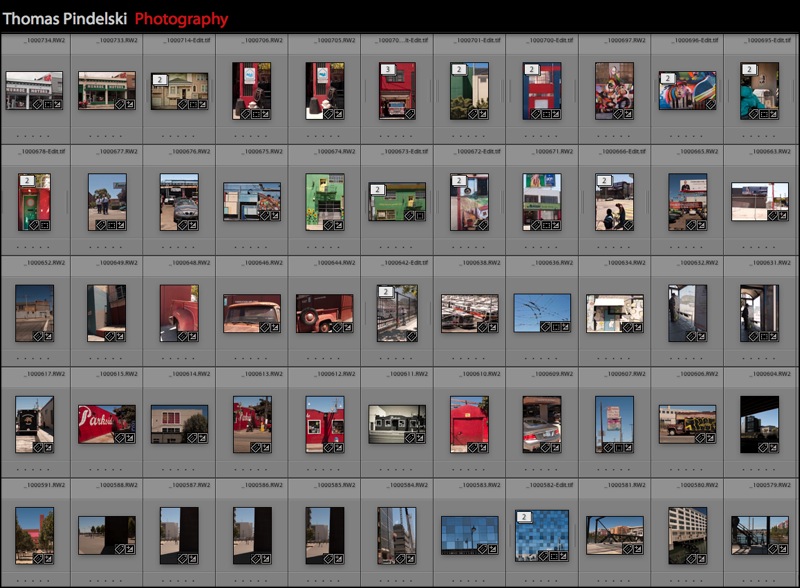
One of the more fun aspects of the drudge that used to be darkroom work was making a contact sheet of your 35mm film roll. Arraying 36 snaps on one sheet of 8″ x 10″ paper made for easy selection of the winners.

It’s a forgotten technique as now we bang away, a million snaps a minute, and then examine everything on a computer screen. Every bit as valid but far less contemplative. And easier to miss a good one amongst all the noise.

Here’s a contact sheet from the great humorist with a Leica, Elliott Erwitt:

And here’s the one he chose:

You can enjoy more of this sort of great learning experience by subscribing to the Patek Philippe magazine.

Into the Storm

Worth watching out for

When HBO made the movie The Gathering Storm in 2002 they set a standard which surely will never be surpassed. Albert Finney as the Churchill of the Wilderness Years and a superb Vanessa Redgrave as Clementine simply live the roles. It does not hurt that much of the movie was filmed at Churchill’s Kent home, Chartwell. Ugly bugger, but we can forgive it that. Get the movie for Richard Loncraine’s direction and Finney’s towering performance.

Now HBO will soon be airing the sequel, Into the Storm and it looks no less promising.


Brendan Gleeson as WSC and Janet McTeer as Clementine Hosier

The publicity snap (I can’t figure out who took it) is not especially appealing – the best they can do is a plain grey background? – so let’s hope the movie will be better. It premieres May 31, at 9 p.m. in the US. I don’t receive HBO so will have to wait until the DVD comes out!

Update October 13, 2010: Just watched this with the other Winston, our son, and all I can say is “See it”.