Architectural photography

An under-appreciated field.

For an index of all my book reviews click here.

While I cannot remember a time when I did not think about photography on a daily basis, an interest in architecture did not seriously take seed until the age of 29. That was the year I moved to New York City. While its inherent bias on the editorial pages sadly infects the news reporting in the New York Times, no such favoritism was evident in the writings of Paul Goldberger and Ada Louise Huxtable. Their topic was architecture.

Before I knew it I was attending lectures by prominent architects, fascinated by the melding of big business, art and massive budgets with all the related logistical complexity which is what results when you try to build in New York. I mean, look at the realities. Those seeking to do you harm include the Mob (concrete to this day costs 20% more in NYC than anywhere else), the City of New York (relatively cheap to buy, after the Mob is accounted for), Albany, Washington and just about every other government apparatchik you can think of. The only difference between the Mob and the government is that the latter wrote the laws. If you can make a tall building in Manhattan you can make one with impunity anywhere.

Absorbing Huxtable’s and Goldberger’s teaching I cemented my relationship with architecture by visiting Chicago for the first time. Simply stated, Chicago’s finest buildings are to Manhattan what Ferrari is to GM. But New York’s winters were tough enough, thank you, so it wasn’t as if I was about to move there, much as I love the people of the mid-west. And those writers’ teachings made an indelible expression. Give me those charming moments of partial consciousness that define falling asleep and, likely as not, you will find my mind straying to New York City architecture.

You can say an awful lot about a building by measuring your desire to touch it. Not metaphysically. Walk up to it and touch it. And for me there were always three which made that distinguished cadre. The Flatiron Building. Philip Johnson’s AT&T. And Seagram. Johnson again.

So bad did this habit become that I made a point of walking past the last two on the way home just to be able to brush them with my fingertips. Maybe some of the magic would rub off?

No secret that I would make special efforts to entertain clients at lunch in the Four Seasons at the plaza level of Johnson’s Seagram masterpiece. From there I could gaze at the no less wonderful Lever House, airily perched on stilts on the west side of Park Avenue. It was my privilege to watch AT&T grow from my 40th floor office in the so-high-tech Citicorp Center, sloping roof for solar panels and all. Still not installed last I checked. Like the corporation, the architecture was crass, vulgar and ethically challenged. AT&T was so beautifully made that you just had to touch it. And they had that Apollo chap in the lobby, all gilded, with massive transatlantic cables draped about him.

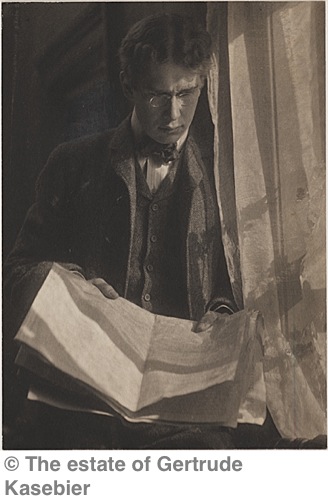
As for the Flatiron, forget about all those schoolboy statistics about it being the tallest, the first with a steel frame, the first with elevators, etc. All you had to know was that Stieglitz had photographed it in 1903.

I was lucky to be reminded of all of this by the loan of a book on architectural photography from a friend. There, on page 113, Stieglitz’s masterpiece of the Flatiron is annotated thus:

Stieglitz’s ethereal view of the Flatiron, taken with a hand-held camera, typifies the Pictorialist approach to architecture.

That got my attention. I am of that school, after all. And here is that snap:

The book is Building with Light by Robert Elwall. American architecture is remarkably well represented (the author is the Curator of the British Architectural Library) with not a trace of condescension, and the whole 240 page tome is a breathtaking survey of architectural photography from the early nineteenth century through today. (Note: Architectural photography has not improved in the last 150 years).

Some of my favorite images are, unsurprisingly, from California residential architecture. Shulman and Neutra are amply represented as they adapt the new international style to a smaller scale. The photography changes too. What was once formal documentation is now pure pictorialism. It’s the effect of the building, not its technical detail, that fascinates.

Sieglitz would be proud.

All of which gives me two suggestions. First, get the book if buildings speak to you. Second, stay tuned for some of my architectural pictures ….

Photography podcasts

Choices are growing.

There are more and more photography related podcasts, all free, available in the iTunes store, for viewing on your computer, iPod or TV. I watch these on our TV using an AppleTV to download them. Some are in ‘enhanced’ mode, meaning you can see pictures as the sound track runs.

Simply go to iTunes->Podcasts and search for Photography as shown above. Quality is all over the place, but it’s easy to filter down to what you like after hearing an episode or two.

There are also more Photoshop podcasts than you can shake a stick at:

There is now so much material out there that whether you are seeking to learn a new application or simply looking for creative ideas, there is no shortage of choices.You can download a free copy of iTunes for either Macs or PCs from Apple.

Canon sensors and the 5D

Old but still topical.

I came across these two on my hard drive – both white papers were released by Canon about the time of the 5D’s debut and still make fascinating reading.

Download either PDF by clicking the pictures below.

Both are fairly lengthy, with the first having an especially interesting discussion of the development of CCD and CMOS sensors, clearly explaining the differences.

Why publish this now when the 5D is about to be updated and obsoleted? Because if you can live with the modest maximum framing rate and the absence of dust removal, I believe the 5D lightly used market will be flooded with cameras from upgraders and will, as a result, offer an enticing opportunity to enter the world of full frame imaging at a very attractive price. If your print size is limited to 24″ x 30″, you cannot go wrong with this body and sensor – just don’t use Canon’s truly execrable cheap zooms on it. A good sensor deserves the best glass – primes if you can swing it as no zoom compares to a like prime for definition and overall performance. Plus most of Canon’s primes are far cheaper than their L zooms and are generally superb – I use the 20mm (not so superb), the 15mm fish eye, the 50mm f/1.4, the 85mm f/1.8 and the 100mm macro. The last four are as good as anything I have used at any price and run $300-400 new, with lots of used bargains out there.

Five criteria

What really matters when choosing a camera?

Twenty years ago I used three cameras most of the time.

A Leica M3, a Rollei 35 and a Rolleiflex 3.5F. You could not find three more different pieces of equipment, with fitness for purpose dictating that there should be three rather than one.

While I’m not that sure about the level of objective analysis which went into the buying decision, now that I think it through there were just five criteria dictating the choice of each. Those same five criteria apply today, though now I manage to get by with two cameras rather than three.

They are:

  • Speed
  • Bulk
  • Noise
  • Definition
  • Price and it’s bedfellow, fear.


British and proud of it, 1976. M3, 35mm Summaron, TriX.

It’s useful to keep these in mind when making the buying decision.

Speed means speed of operation. Back then the Leica was the street shooter without equal. A flip of the thumb advanced the film, the shutter was quiet (if not as whisper quiet as blinded Leica worshippers would have you believe; for that listen to a twin lens Rolleiflex), lens changes were fast and you were generally unobtrusive thanks to the blisteringly fast manual rangefinder focusing.

Bulk is an issue if you travel a lot and for that the Leica, small as it was, was simply too bulky. That’s where the Rollei 35 came in, with its collapsible lens, silent shutter and barely larger than a film cassette or two. Mine traversed the world many times and served me well, after the obligatory breakdown out of the box. Rollei’s Singapore craftsmen had yet to learn about quality control.

Noise and unobtrusiveness go hand-in-hand for the candid photographer, so the Leica’s quiet shutter did the trick.

Definition and freedom from grain became issues with any Leica enlargement greater than 8″ x 10″. For large smooth areas of sky or skin you had go to the next negative size, which came with the Rolleiflex 3.5F, maybe the finest camera ever to leave the factory of Franke & Heidecke. 16″ x 20″ (that was ‘big’ back then) was no problem with the Rollei TLR.

Price and fear are bedfellows. The Leica was expensive, the lenses more so, and you were always scared of getting mugged, whacked or otherwise resented or abused. Once the Japanese SLRs took over the 35mm market the fame of the Leica – and hence the ability morons had to recognize it – faded and with it the Fear quotient. But it was always there. Not for one moment did I care if someone pinched my Rollei 35 and the 3.5F was pretty much a studio camera.

These thoughts came to mind in discussions with a friend whose Canon Digital Rebel finally gave up the ghost and for which an urgent replacement was needed. Now this friend does the occasional wedding – surely there can be no field of photography more greatly imbued with the fear of failure – yet reliability simply did not come up in our talks, any more than it features in the list above. Bottom line is that all the better cameras from the big names are reliable in all but combat conditions. Rather, the focus of our discussion was on noise. You simply cannot have a DSLR machine-gunning away in a quiet church where a sacred ceremony is underway. When all was said and done, my friend opted for Canon’s 40D which would both take her existing Canon lenses and offers a ‘silent mode’ in Live View whereby the mirror is moved out of the way and the LCD becomes the viewfinder. Not ideal as LCD viewfinders are genuinely awful, but when you hear how quiet the shutter is in this mode you might well conclude that the trade-off makes sense.

When buying my 5D I was much more studied about what I wanted than in days past. And because I no longer wanted to mess about with clunky medium format gear, I wanted the best possible definition out of a smaller package. On the other hand, I realized that small size was not consonant with that dictate, so my choice was pretty much limited to full frame digital. Further, I wanted my wide lenses wide, not cropped. Cropped sensors have improved greatly since then but 30 months ago the difference between Canon’s cropped and full frame sensors were significant, not least in their ability to hide noise at higher ISO settings. One look at the definition of the images, aided by some good, realistically priced lenses from Canon, suggested that the 5D could replace both 35mm and medium format film, and such proved to be the case. The ease of use of a 35mm SLR with the definition of medium format film. Sweet. I bought one. It was only one of two full frame DSLRs available, the other being Canon’s very expensive 1Ds.

And I was no longer particularly fixated on street snaps which, in any case, had become much easier to make as cameras became ubiquitous. No one cared if you pointed a camera at them.

So my priority order for the Five Criteria had changed.

Originally it was as listed above. Now it was:

  • Definition
  • Noise
  • Price and it’s bedfellow, fear.
  • Bulk
  • Speed

Definition was A Number One and Price now mattered – it irked me to have so much capital tied up in a hobby and I resolved to avoid that when changing equipment. Fear was not an issue – I stick black electrician’s tape over the obnoxious ‘Canon’ logos and go on about my unobtrusive way. Noise still mattered. The 5D is hardly ideal but it beats a Pentax 6×7 or a Rolleiflex 6003/6008, which sound like one of Krupp’s finest when they go off. Bulk worked out well. The 5D is not small but any time you get medium format film quality in a 35mm SLR package, buy it and run. Price never mattered. It’s not that I’m Rockefeller but judicious buying and a disciplined approach to life makes the price shock that much less noticeable. This is one of my key interests after all, not a passing fling. And as with Porsche drivers, you get two kinds – those who love the gear and those who can drive. I’ll let you decide which camp I am in.

But I still need two cameras. When it comes to something pocketable which can go anywhere I use the Panasonic LX-1. Sure, it has lots of limitations (needs a viewfinder, shutter lag, grainy/noisy images) but so did the Rollei 35. But it more than suffices in those times when you simply cannot haul the 5D around.

My two cents worth of advice suggest that you make a like list prioritizing your needs then choose the camera which is the best match. Forget about brands. The major makes offer so much choice that it does not have to be Canon or Nikon – just choose something that scores most on your short list of essentials. That way the noise of brand loyalty (a dumb idea if ever I heard of one) is silenced. And do not discount the idea of more than one camera. Horses for courses and all that.


Antiques, 2006. 5D, 24-105L, IS on, 1/30, f/6.3, ISO 200. Processed in Lightroom.

Cutting your losses

As in getting emotion out of the equation.

As a money manager and investor one of the key disciplines I adopt is one of cutting my losses. For the most part if a stock hits a predetermined drop off the highest price I have owned it at – this may be after a few days or few years of ownership – it is unceremoniously sold. The old saying that ‘buy-and-hold’ is the only long term investment strategy capable of success is bunk. Great for twenty year bull markets, like the one that just ended, but dumb as they come otherwise. (Money managers love it as it annuitizes their management fees from the boobs who buy in). Imagine, you lose 30% in a quarter on a position but you gut it out and hold on. It may take you five years or more to recover those losses, garnering you a 0% return over that period. The disciplined seller, meanwhile, has limited his loss with a trailing stop percentage order at 7-10%,moving on to better things.

A disciplined exit strategy is consonant with success in all areas of life. How many of us know people who have remained for far too long in an abusive relationship but dare not venture into alternatives? Years of happiness lost. The sell discipline applies as equally in emotional as in financial matters.

When it comes to photographic hardware I believe the same applies. Unless you absolutely love the whole processing/retouching/slow turnaround cycle of film, for example, you are simply crippling your competitiveness compared to the guy with a good DSLR.

And lest I am accused of not following my own advice, let me clarify things.

For over thirty years – from 1973 through 2005 – I used one or more of these:

Yesterday’s news

While I tinkered with SLRs this worked for me and, in truth, if the optimal mix of quality lenses, a rugged body (well, reasonably so) and fast response was sought, the rangefinder M Leica was the only way to go.

Then, of course, digital came along and once sensor design settled down even those with poor eyesight (like me!) could see that film quality had not just been surpassed, it had been blown away. Add a 5 minute processing cycle as opposed to a seven day one and that was all she wrote. Time formerly spent on scanning, retouching, filing and on and on now became time wasted. And, like you, as every day shortens my life expectancy by 24 hours, why waste time?

So, a tad late in the day, I decided to apply my stock management philosophy to my photographic hardware. The goal was not so much to realize the best exit price for obsolete hardware – film cameras – though that is a nice side effect, but rather to maximize productivity through the use of modern technology, which is what technology is all about. Your time is worth far more than your hardware, so resale value is not the driver here. Anyone looking for long term appreciation from obsolete camera gear is probably waiting for the second coming, too. Could be a while.

Those Leica Ms, myriad Wetzlar lenses (all superb), a Leicaflex, Rolleis galore, a Mamiya or two, a couple of Pentaxes moved on. Paperweights. Digital had arrived and it was mature. Instead I spent some time learning how to properly profile my screen so that what I print matches, I moved to the very efficient Lightroom after struggling with the abomination that is Photoshop, paid up for a really great large format dye printer (the HP DJ90) and got on with the merry job of making pictures.

Today’s gear – ready to be dumped at a moment’s notice if need be

Do I miss all that great gear from the last throes of the mechanical age? Sure. You use the same Leica for 30+ years and tell me you don’t miss it. But the old Wall Street adage prevails, for it remains one of the great truths:

“If you want loyalty, get a dog”.

And my dog had better watch out. He crosses me and he’s outta here.