The Man who was Never Caught

Cycling pays.

Only the most naïve think that professional sports are clean. I’m at the other end of the spectrum, depending on that old rule which applies across all fields of human endeavor:

“Go where the money is”.

Or, stated differently, I would bet that nearly all professional sports are rigged. Whether it’s the obvious – like professional wrestling – or the less so – like baseball and American football, there’s simply too much money at stake to attract the virtuous. Those icons of American entertainment are rigged, you say? Surely not.

Well, check out the most famous baseball game ever (generally referred to as “The Shot Heard Around the World”) or the New England Patriots’ more recent cheating. Rigged.

At least I take comfort in the knowledge that the only sport I actively follow – Formula One – is totally rigged. The guy with the best stolen secrets and the biggest pocket book wins every time. So at least we know where we stand. It makes the entertainment that much better when you are realistic about its parameters.

Which brings me to cycling. After weightlifting it’s hard to think of a more corrupt sport. I very much doubt that any winner of the Tour de France has been ‘clean’ in the sense we think of that description. It’s just that some are smarter than others. And boy, is there money in it or what?

That showcase of displays of wealth, Architectural Digest, profiles one such famous cyclist’s home in the current issue. Go to the home theater and there are his seven TDF jerseys, signifying an unbeaten winning streak. And one good thing about AD is that the interior photography is pretty interesting from a technical perspective, even if the displays of money on the walls leave me cold. And to show you just how much money there is in the game, the famous cyclist’s home is on the cover, no less.

The photography is great. The home of The Man who was Never Caught.

If you like good interior photography – thought some HDR might help occasionally – pick up a copy of Architectural Digest. Just don’t look for the pure of heart inside.

Update August 24, 2012:

Well, Mr. Armstrong can now continue his work as a paid spokesman for Pfizer.
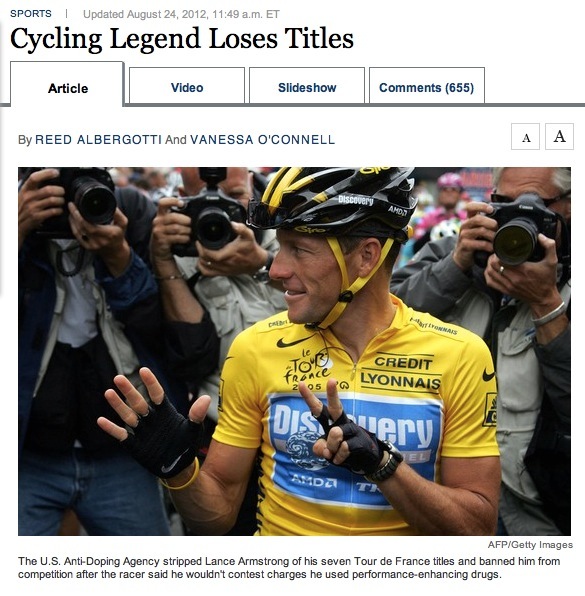
Guilty as sin. Zonker Armstrong ceases denials.

Patrick Demarchelier

And the diva.

Take a look at the engrossing movie The Devil Wears Prada and you will hear the Meryl Streep character (an amalgam, one imagines, of the two great Vogue editors of recent times, Anna Wintour and Diana Vreeland) ask on several occasions “Can we get Patrick?”.

I cannot remember a time when Patrick Demarchelier – yes, that Patrick – was not famous. With just cause. Click here and you will see what I’m writing about. Pair this superstar photographer with a true, like-they-used-to-make-them, superstar actress whose looks match her acting skill, and you have Hurrell’s Hollywood recreated. Angelina Jolie is a Star in the old sense of the word. Sure, there are the bizarre tattoos (self expression, if you ask me) and all those adoptions (how many starving kids have you saved recently?), but, heck, that’s just modern times. There’s no denying the woman’s acting skills, her commitments to charity ($8mm donated in 2006 alone), and for lady readers, the hunk that passes for her soul mate. Did I mention that she’s gorgeous?

Thanks, Mr. Demarchelier, for making life that much happier for this fan.

Attention spans

Blame Google.

The Atlantic, an East coast monthly magazine focused on political science (arguably as big a contradiction in terms as ‘military intelligence’) has a beautifully written article in the current issue titled ‘Is Google Making us Stupid?”. On the cover they spell it ‘Stoopid’ which seems more apt. The thrust of the piece is that Google and its ilk have forced us to reduce our attention spans to the point where the writer says he can longer read a book. He exists solely on news snippets. Sad.

But there’s more than a smidgeon of truth in this piece. Deal with anyone these days, not just young people – anyone – and chances are you will find that attention spans have indeed fallen. Communicate in monosyllabic grunts and you get what you want. Ask politely and make some small talk and you are switched off by the listener. Efficiency has relegated decorum to a back seat.

But you and I are guilty, too. You are reading one thing on the screen then ‘ping’, the machine announces an email and you dutifully jump into email at the computer’s bidding. What you were reading fades forever from memory. I can only hope that you were not reading this when that email arrived ….

Do the same symptoms affect photography? I think the answer must be a resounding ‘Yes’. As one example look at the demise of the photographic print. Why pay for something large, static and unwieldy when you can zap into it with a few clicks and look at it for 2 seconds on that miserable screen attached to your computer? You move on, the image as forgotten as that article interrupted by the email ping. You tell yourself that you are using time effectively where, in fact, you are wasting it horribly by flitting between incomplete tasks, nothing learned.

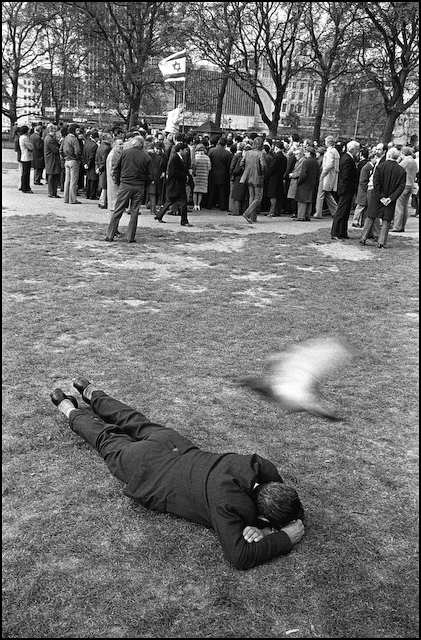
Here’s a snap I took back in the ’70s – unconsciously reflecting the surrealism of Cartier-Bresson with whom I was besotted at the time:


Speakers’ Corner. Leica M3, 35mm Summaron, TriX/D76

Appearances apart, there was very little unplanned about this picture, whose goal was to show political isolation and passivity. The flag’s position is no accident – I waited for the moment; the chap on the grass was in no hurry, after all. The London pigeon was a stroke of luck (missing from the other snap of the same subject taken that day), it’s true, and maybe adds to the overall effect, but the point of the picture is not readily grasped in a two second glance. It rewards thought.

Now open your favorite news magazine and this is what you will see:


Today’s news snippets

These are actually incredible events, all three. The nation’s highest court has just slapped down the President on constitutional grounds (you or I would be in the slammer for like behavior), yesterday’s prima ballerina at a leading Wall Street brokerage is now no more and the guy in charge of our largest bank has just closed the business he got over $150mm for a year ago en route to the executive suite of the buyer. All major, earth shattering, news events yet most will scan the above , shrug and move on. There are lessons here about hubris, corruption, power, politics, perception, strategic skill and on and on. So much to be learned. Yet the word on Wall Street has it that “…the broad at Lehman got whacked”. No analysis. No opinions. Just the facts, ma’am. No time for discussion. Get to the bottom line.

And while I grew up on Wall Street and have mostly good things to say about it (Greed is Good) I rue the days before Google for they seemed, to me, a more civilized time. Back then you repaired to Harry’s Bar after a tough day for conversation and conviviality. Now you get on the Internet. We no longer pause to sniff the flowers, we merely ask the price.

So does that obsolete the wall mounted photographic print? For many, I’m afraid the answer is ‘Yes’.

But they are not my audience and, if you read these columns, they are not yours either, for I cannot imagine my world without the luxury of time to stop and gaze at a beautiful photograph.

There goes another $50,000

Who wrote this claptrap?

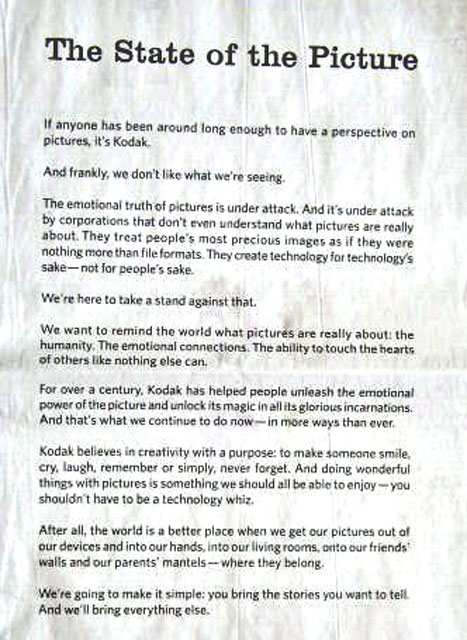
Sometimes you have to think that anyone can make a living in the great country that is the USA. After all, Kodak just paid some fool in advertising to blow $50,000 of their rapidly disappearing shareholder’s equity to run this monumental piece of garbage in today’s Wall Street Journal:

Let’s pause to analyze what is wrong:

  • The audience demographic is completely wrong
  • There’s not a product in sight
  • There is no message
  • When you read that “The emotional truth of pictures is under attack”, you quickly conclude that the best use for this page is as a barf bag

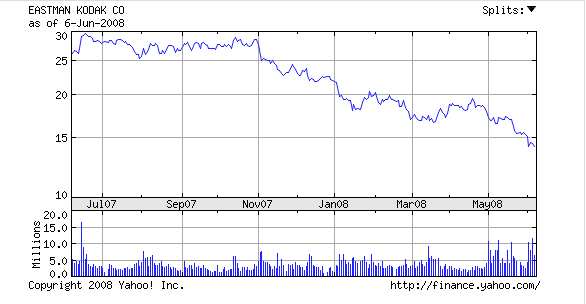
You can only agree with the second paragraph. As have the markets:

But worst of all, Kodak, what on earth was wrong with that brilliant little ditty you paid copywriters for a hundred years ago? It goes something like this:

“You take the pictures. We do the rest”

Simple. Magic. Still works well. Saves ink and shareholders’ money, too. Shame on you, Kodak.

Photography books and wine

Sampling books is much like drinking wine.

I make it a habit, as summer approaches, to pick a photography book from the bookcase for relaxation on the patio in the afternoon. What struck me as rather funny the other day is that I found myself perusing the shelves much as a wine drinker might select a wine for dinner. Now it’s true that I grow Zinfandel grapes, but I rarely drink wine. Just not my thing, even if the grapes make for prize winning wines. So I really cannot pontificate how a wine drinker makes his choices as I have little idea, but I found that I was consciously thinking what genre and emotional pallette I wanted when it came to book selection.

With the perfume of jasmine in the home, thanks to the lovely plants on the patio, I migrated to a book of flower pictures. Plus I’m getting into the whole macro thing.

And a fine choice it was, with no hangover.

If you would like to see my complete library of photo books, click here.

By the way, I never buy new photo books, only remaindered ones. No idea where they got the pricing data but I seem to recall paying well under $20 for this one.


Star jasmine on the patio. 5D, 100mm Canon macro, ring flash, 1/45, f/19, ISO 200