Scenes in San Francisco.
The master is everywhere to be seen.
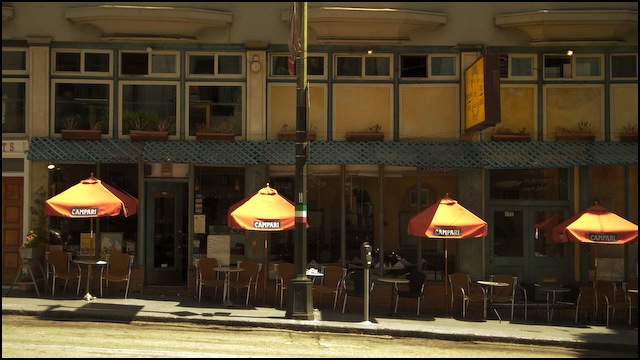
Columbus Avenue, San Francisco. Lumix LX-1,1/160, f/4, ISO 80
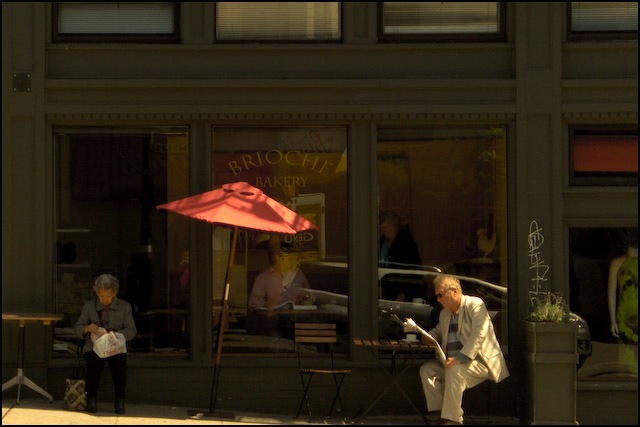
Columbus Avenue, San Francisco. Lumix LX-1,1/500, f/4.9, ISO 80
Scenes in San Francisco.
The master is everywhere to be seen.
If only ….
Which of us (us as you are a photographer if you are reading this) does not rue the what might have been?
You know, the moment that you missed.
The other day I found myself on one of those picture perfect days in America’s most beautiful city, camera in hand, and there it was. The picture.
But, boob that I am, I missed it.
Too old, too slack jawed, too slow.
I would love to blame the gear. Shutter lag, poor auto exposure, blah, blah, blah.
But age or equipment is no excuse.
Because, dear reader, I have been missing great snaps since I first held a camera. And the curse of it is that I can remember every one of those misses. Far more so than I recall the successes.
And while my interests in photography are fairly catholic, meaning genre is neither here nor there, it’s street photography that brought me to this wonderful place and it was a street snap that I missed.
My excuse is that I was simply in the wrong mindset for street work. Upset about this and that. Distracted. None of this conducive to street snaps.
In the studio you bang away and sooner or later get it. Still lives always behave. Landscapes are tricky but lighting generally gives you a second or two. But street snaps are the most unforgiving of taskmasters. Miss one and it never comes back. It is gone. For ever. Except in your mind’s eye, which vision you can share with no one.
But that only means I will be back. I’m no quitter. But I am upset.
The city? Why, San Francisco of course.
So, much as I hate to do so, I’ll share one of the also rans with you.
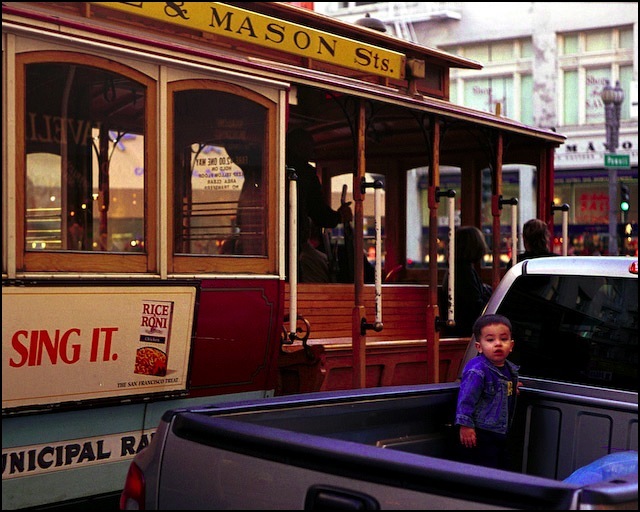
A painting that would not exist without photography.
In 1980 I had just moved to New York. Dead broke. But that didn’t stop me from making my first visit, the first of many, to the Museum of Modern Art on West 53rd Street with but one goal in mind. To see the greatest anti-war painting ever created.
When Franco’s fascists recruited the Nazi war machine for a trial run in killing innocent civilians in 1937, it was a photograph in the Times of London that spurred a famously apolitical painter to action.
Even the isolationist Times, which was the appeasement mouthpiece of British Prime Minister Chamberlain, couldn’t hush the story up, and was forced to run pictures of burning buildings and general mayhem in the paper.
Pablo Picasso saw the pictures and read of how one quarter of the town’s 7,000 inhabitants perished in a couple of hours.
After the bombing, April 26, 1937
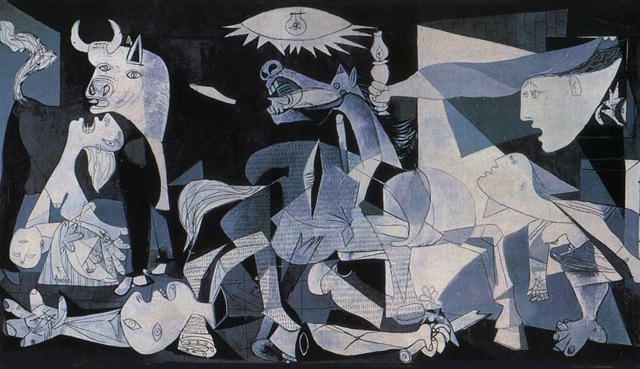
June, 1937. The Picasso.
MoMA did a pretty poor job of displaying the work, given its enormous size – some 23 x 11 feet. Only later did they add space but, by that time, Guernica was gone, back in Spain where it belongs. Picasso had sent the painting to New York for safe keeping until such time as Franco died, a happy event which finally took place in 1975. MoMA tried mightily to hang on to the piece – it was, after all, a huge money maker for them – but lawyers prevailed and it moved back home in 1981. Sadly, Picasso, who died in 1973 saw neither the death of the tyrant or the return of his work.
It remains the single greatest anti-war work ever and, had it not been for those photographs in the Times, may never have been painted.
Picasso, ballsy as ever, spent the war years in occupied Paris, with postcards of his master work in his apartment. When the Nazis harassed him, asking “Did you do this?” he replied “No, you did”.
Make yourself comfortable.
A little bit of nothing spottted a while back.
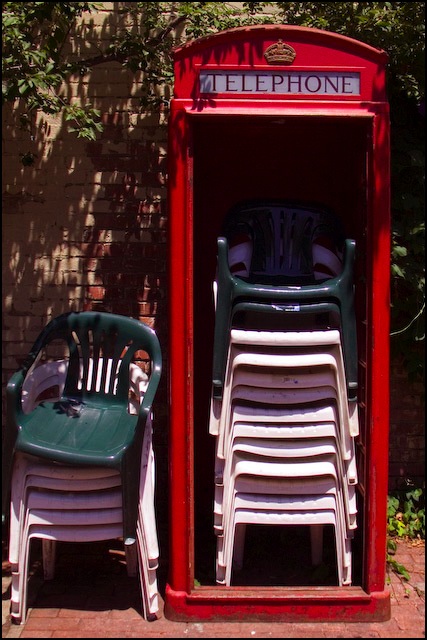
I read that the UK is selling off these telephone boxes, another sign of questionable progress. Hopefully affluent American collectors will save these – after removing the ads for call girls (how appropriate) from the interior.
No, it’s not in Lens Work
All those free magazine subscriptions I am enjoying, courtesy of too many frequent flier miles on Delta, are beginning to be a mixed blessing.
First, two of the original twelve never arrived, yet Delta’s computer wrote me a polite note explaining they were no longer offering those, but please choose three more to make things hunky dory.
Then Condé Nast, whose splendid ‘Portfolio’ I am enjoying immensely, wrote with a free subscription to ‘Preservation’, a National Trust piece, and it is proving to be every bit as enjoyable. The current issue has a fine illustrated piece on Route 66.
So I’m seeing some fine photography in all of these, with none better than that found in Elle and Harper’s Bazaar. The latter is especially noteworthy for the cutting edge of their photographers’ work. Take a look at Peter Lindbergh’s superb portfolio of Julianne Moore in the current issue, interspersed with the great classical paintings (Modigiliani, Klimt, Schiele, etc.) which inspired the piece. It really seems that a high percentage of the newest, most exciting work is to be consistently found in fashion magazines – something I have been seeing since 1960 as a subscriber and well before that when perusing back issues at the local library.
Once place where you will rarely find good pictures is in photography magazines. Pseudo art for pseudo photographers invariably, of course, in tired old, over-processed black and white, masquerading as ‘art’. Large format, a beer belly and the obligatory artist’s beard are de rigeur for these pretenders, known largely only to those obsessed with gear and processing. It has to be black and white, you know because the people on display are clueless when it comes to seeing. They need the benefits of abstraction which monochrome confers, so limited is their skill and imagination. Why do these technicians – for they are rarely much more than that – always look to me as if they could use a good bath?
For more, just check in to Pseuds Corner.
Finally, once done, I have to schlepp all the magazines I’m done with to the curb every Tuesday, for recycling. Boy, do I miss the time when we just chucked stuff out and the hell with recycling and the sanctimonious green lobby driving around in SUVs (invariably emblazoned with a ‘Keep Tahoe blue’ bumper sticker). At least I tear out the really good work first as my nod to the environment.