Beaton in the Sixties

Book review

For an index of all my book reviews click here.

Taken in moderation, a sip here, a nibble there, these sixties diaries of Cecil Beaton are a blast to read. A sort of cross between the National Enquirer and the Tatler. Indiscreet, vicious, bitchy, funny, warm spirited, mean, generous, spiteful, the full panoply of human emotions, both good and base, is on parade for all to see here. And Beaton is rarely without his camera, conjuring up some new piece of fluff for all to enjoy.

If you like this sort of thing, and I wouldn’t put it on the recommended reading list without at least some prior exposure to his earlier, less gossipy writing, it’s a fun way to spend an afternoon.

Vision

Hoppé got it right


Carmel, CA. M2, 35mm Asph, Gold 100, processed in Aperture

“The task of the artist is to develop his powers of perfection and sympathy, to bring a new vision of beauty and spiritual strength to a mechanistic age. This cannot be done in a darkroom or laboratory.”

E. O Hoppé, A Hundred Thousand Exposures. Focal Press, 1945.

The problem with P&S cameras

Bottom line is, they all suck

Having just read another thoroughly depressing review of yet another Point & Shoot offering from a major manufacturer on the estimable DPReview.com, I have to wonder.

This one claims to be a top of the line offering. DPReview begs to differ, concluding that the camera has slow focusing and poor image sharpness, not to mention no RAW mode, a clunky interface and useless zoom range. It’s priced at some $350.

So why do these major manufacturers, and they are all guilty – Nikon, Canon, Olympus, Pentax, etc. – persist in turning out such execrable equipment?

A recent move by Canon to drop RAW from its P&S cameras may be a clue. The few of these cameras that have half decent lenses would likely embarass the costlier DSLRs from these same makers for half the price. So the consumer gets to suffer on the altar of product differentiation.

That’s a shame, so I suppose it’s little wonder that the much anticipated Sigma DP1 P&S will likely cost closer to $1000 than $300; on the other hand, you get a half decent sensor for your money. If the camera focuses fast, has low shutter lag and a decent lens – not something Sigma’s history of truly frightful lenses makes me too positive about – my $800 is waiting.

That’s if we will ever see this icon – it was last announced that the camera would be available 5 months ago.

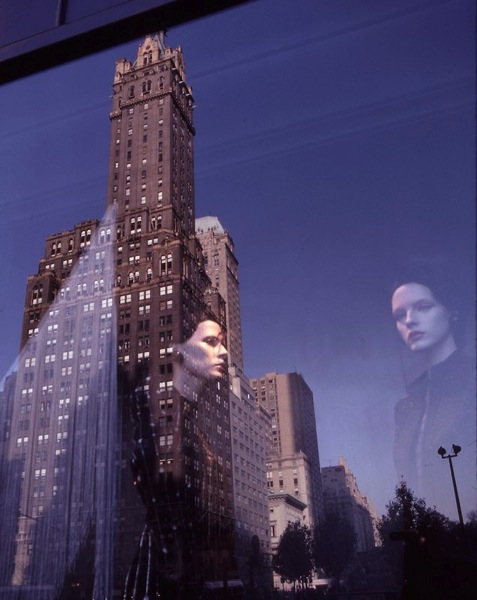
About the Snap: Bergie’s

Bergie’s


Date: 1984
Place: Fifth Avenue and 58th Street, New York City
Modus operandi: Looking at store windows
Weather: Gorgeous
Time: 11:00 am
Gear: Pentax ME Super, 28mm Takumar
Medium: Kodachrome 64
Me: Gorgeous location, superb architecture, the poshest store in New York – what could be better?
My age: 33

For many years two of the finest women’s clothing stores in mid-town Manhattan were catty corner (English translation: Diagonally opposite) one another on Fifth Avenue: Bonwit Teller at 56th Street and Bergorf Goodman at 57th.

Bonwit’s no longer exists, pulled down in the middle of the night in 1981, before the City could place a restraining order on him, by that crass vulgarian, Donald Trump. With it went those gorgeous sandstone friezes that decorated the facade. In its place we got the gauche Trump Tower, replete with glitz to attract Eurotrash.

Bergie’s (no one calls it Bergorf Goodman), on the other hand, survived, and thrives on The Ladies who Lunch to this day.

I could never pass either store on my walk to work from my luxury high rise apartment (meaning infested rat trap) on 56th at Eighth, to what was then the Citicorp Center on Lex and 53rd, without stopping to gaze in their windows. And what windows they were! Never less than perfectly arranged, the best of European designers’ work was to be found there. St. Laurent, Givenchy, Ungaro, Marc Bohan (then at Dior). No, not Tommy Hilfiger. The polyester set could shop elsewhere.

This particular day I had detoured north of 57th and was making my way west along 58th Street, a rather mysterious passageway betwen Bergies and The Plaza, with that nice cinema near Fifth which remains there today. Having long been fascinated with the great school of 1930s American high rise architecture – perhaps best seen in Chicago – I was really looking forward to eyeing the Pierre and the Sherry-Netherland, in much the same way that one might a beautiful woman. Much to look at and dwell upon. A feast for the eyes and senses. A corner here, a bit of mystery there, never has architecture been so much fun.

Just before turning right on Fifth I glanced up at Bergie’s window, the one fronting onto 58th Street and there they were – the two grand hotels of New York City. But the real magic happened when those two ladies joined the reflection in Bergie’s window.

Can you say ‘click’?

Note: On this occasion I was using my ‘disposable’ Pentax ME Super rather than the M3. New York streets were seriously dangerous at this time and the theft of the cheap Pentax would not stir the soul as deeply as were I to lose my precious Leica. In the event, that preciously engineered and very compact Pentax turned out to be a wonderful street worker during my New York years (1981-87), only finally moving on when the LEDs in the viewfinder started to play up. Needless to add, it was never stolen.
About the Snap: Keep Left

Keep Left

Date: 1982
Place: Lexington Avenue, New York City
Modus operandi: Wandering around the streets aimlessly
Weather: Gorgeous
Time: 10:00 am
Gear: Leicaflex SL, 21mm Auper-Angulon R
Medium: Kodachrome 64
Me: Enjoying this little bit of whimsy
My age: 31

Until modern Western quality control techniques were imposed, you could pretty much bet that anything from China was going to be schlocky when it came to execution. And that didn’t just go for their consumer goods. The Chinese applied the same low standards to their businesses and buildings, as this snap attests.

All of this is made so much the funnier when I relate that, at the time I took this, the newly opened representative office of the Bank of China in New York was a client of mine. I was advising them on installation of financial management systems which was sort of tricky when their default approach was to stuff the branch full of Chinese workers who spoke no English and showed remarkable facility with the abacus. Who needs IBM mainframes?

Anyway, after struggling with this insanely frustrating client for months (these people redefined, in 1982, resistance to change, and just hated to pay their bills) I felt I owed them one, and here it is. The missing letter in their cheap signage had been like that for ages, though I constantly pointed it out to the manager of the office. As you can see, the Chinese’ sense of style and decorum leaves a lot to be desired.

Only a very wide angle lens could capture all of this scene’s elements, and the 21mm Super Angulon R, for all its ridiculous bulk, was as good as they got in those days. The Leicaflex SL remains at the zenith of mechanical SLR design, with easily the best manual exposure meter I have used. It remains a fine and affordable user for those who like film, and comes with the best viewfinder you will find on any SLR, film or digital.