A mural tells all
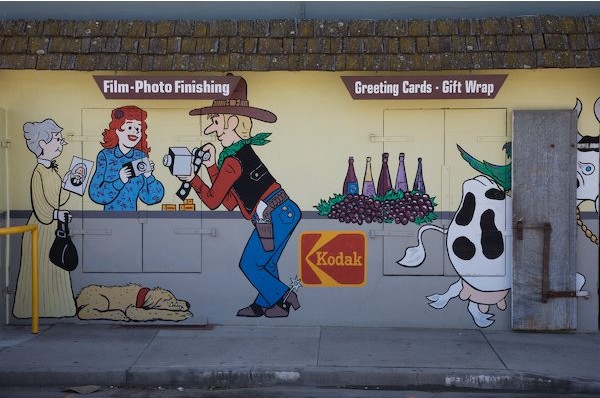
Well, it’s not the dog. He went digital ages ago and is tired of waiting for the filmies.
As for the cow, she just got her prints and they were full of scratches and dust.
A mural tells all
Well, it’s not the dog. He went digital ages ago and is tired of waiting for the filmies.
As for the cow, she just got her prints and they were full of scratches and dust.
Book Review
For an index of all my book reviews click here.
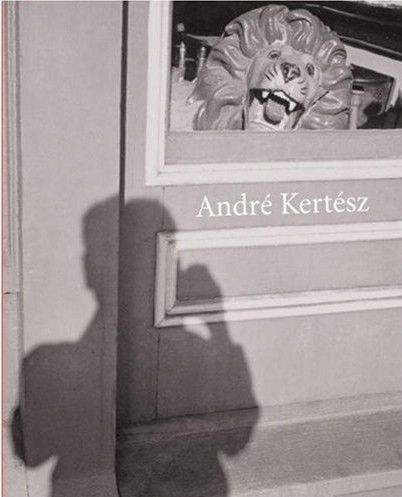
With a Hungarian expatriate about to win the French elections – not hard when you are running against an idiot who never read Economics 101, meaning an opponent whose cure for unemployment is to create half a million new government jobs – it seems appropriate to focus today’s journal entry on a Parisian expatriate photographer who also happened to be Hungarian, none other than the great André Kertesz. Kertesz at least had the good sense to leave Paris before the forces of evil took over, a similar sitiuation to that prevailing today in the world’s most gorgeous city. The difference this time is that a more insular America is not about to bail out a country cursed with the muddle headed socialism of fifty years of the Fifth Republic. Like the worthless doorman in my New York apartment of days yore, the only thing most French workers seem good at is walking around, hand outstretched, palm upwards.
The Paris of Kertész’s day was a better place.
This large format 302 page book, available from Amazon, is not cheap but as, to my amazement, I had no definitive Kertesz monograph in my library, I paid up the not inconsiderable price of entry and have to say it was worth every penny.
The book has its frustrations – the difficulty of finding the right illustrations to match the text, the sheer pig headed idiocy of reproducing miniscule prints of his early work sorrounded by acres of white – are the two worst. However, the narrative, broken into the three main periods of Kertesz’s life, is priceless, something you will rarely encounter in any art book. Special note has to be made of Sarah Greenough’s writing in her two essays which address his formative years in Hungary (1894-1925), and the key years in Paris (1925-1936). Erudite, deeply researched and incredibly informative yet never condescending, it’s art writing at its very best.
Anyone growing up with black and white photography – which means largely people my age and older – cannot have but been affected by Kertesz’s work. His unusual compositions, original points of view and tightness of framing all make for compelling imagery.
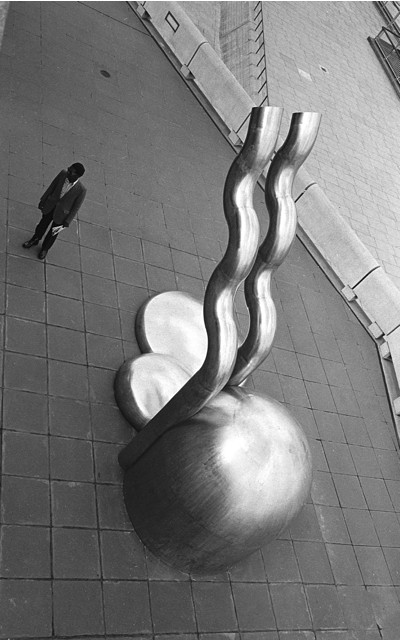
Kertész by Pindelski, South Bank, London, 1973. Leica M3, 50mm Elmar, TriX
I cannot count the number of my early images I made by looking up or down at severe angles – Kertész’s influence at work.
A key book for any photographer’s collection.
Starting them young
I unleashed our son Winston with his new camera on an unsuspecting world. Not before Winston had tested the shockproof design by dropping his new toy on the floor. It survived. Bravo Olympus! A few moments after arriving home the snaps were processed in Apple’s estimable iPhoto and the best is below.
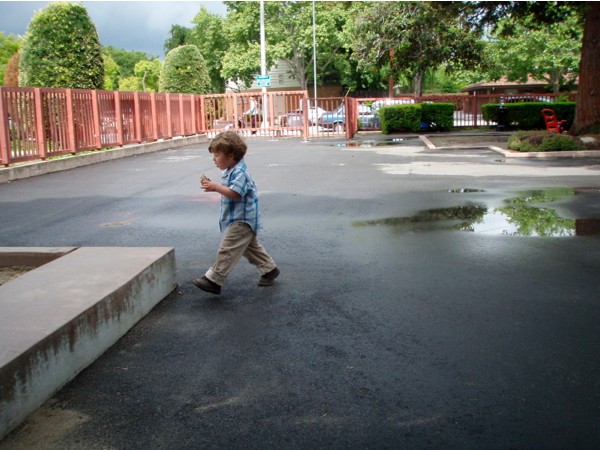
Well, let’s face it, the boy has what it takes. The modernist composition, the action aspect, the sparse use of color …. it’s all there.
Winnie had banged off no fewer than 270 exposures! Whoa! Winston is five and has already taken more pictures than I did in my first ten years with a camera. I started late – at 7 years of age.
It was intriguing to see how he instantly took to the LCD screen for composition – something I find pretty much unusable. There’s the video generation for you.
Anyway, our boy will be spared the insane tedium of film/processing/scratches and has gone ‘straight to digital’. Lucky man. I can’t think his first book is too far off.
St. James’s Park
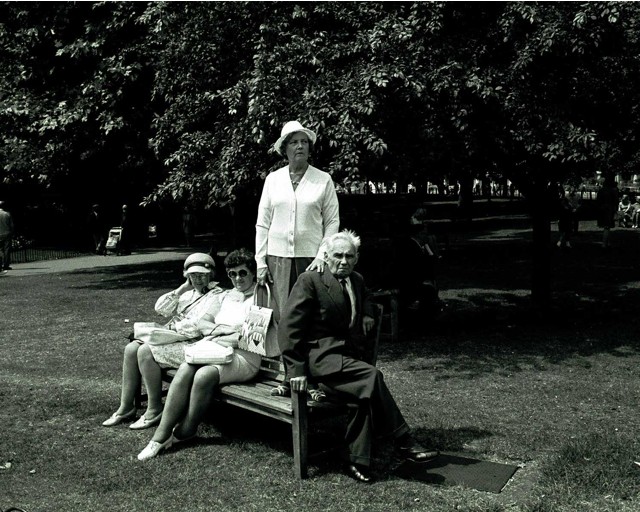
Date: August, 1973
Place: St. James’s Park, near Pall Mall, London
Modus operandi: Still awestruck with the sheer felicity of my Leica M3
Weather: One of those London summer days that says ‘Perfect’
Time: 11:00 am
Gear: Leica M3, 50mm Elmar
Medium: Kodak TriX
Me: Crikey!
My age: 21
When it comes to the great parks of the world, the list is not long.
Criteria? Mystery. Charm. Style. Class. Like a Rolls Royce. A pleasure to visit time and again.
On my short list, most are pretty old, and I suspect that’s no coincidence.
The first must, of course, be Central Park in New York. No finer tribute exists to the successful integration of city and country. A very special place. No New Yorker has to go far to go to the ‘country’.
Second is Parc Monceau in Paris. Statues. Perfect design. Gorgeous finish. Paris at its very best.
And a very close third, and easily the safest of all, is magnificent St. James’s Park in London. At its North East corner the tourism and grandeur of Trafalgar Square. Yes, the one with the National Gallery with Botticelli’s ‘Portrait of a Young Man’ which I have always wanted to pinch. To the East, Horse Guards Parade and the Foreign and Commonwealth Office (what?) and the Treasury. Well, if you are going to count other people’s money, you might as well do it with a nice view. And at the South West corner, Buckingham Palace. In other words, the locale is not too shabby.
As a young lad in London, just graduated from University College, London with an engineering degree (though, in truth, I spent most of my time in the British Museum and at the Courtauld Collection), and about to embark on a career in finance (have you checked English engineers’ salaries?), all seemed well with the world. Still enjoying my taxpayer subsidized Underground Pass, many a happy afternoon would find me in Mayfair and St. James’s Park. After all, I reasoned, if you want to get rich, it cannot hurt to hang out where the rich do.
And it was one of those idyllic days that caught me rambling through St. James’s Park attracted, like a bee to pollen, by the sound of the Guards’ marching band making its way down Pall Mall to Buckingham Palace.
Yet even my poor peripheral sight caught the Ladies on the Park Bench. And Old Jock, of course. Clearly I wasn’t really fast with that Leica yet, as three of the four spotted me.
Anyway, I hope you like this gentle appreciation of all that is good and great about England – its people, their eccentricity and this fabulous meeting place.
Does it matter
Hot on the tail of yesterday’s gripping piece extolling the virtues of camera supports, whether monopods or tripods, it ocurred to me to make one more experiment to see if the slapping rise of the mirror in the 5D has any effects at longer shutter speeds. To magnify things further, I placed the 200mm f/2.8 Canon L lens on the camera and mounted the latter on my super sturdy Linhop S168 tripod. You can see the cantilever braces between the legs and center column here – note the latter is retracted for maximum stability.
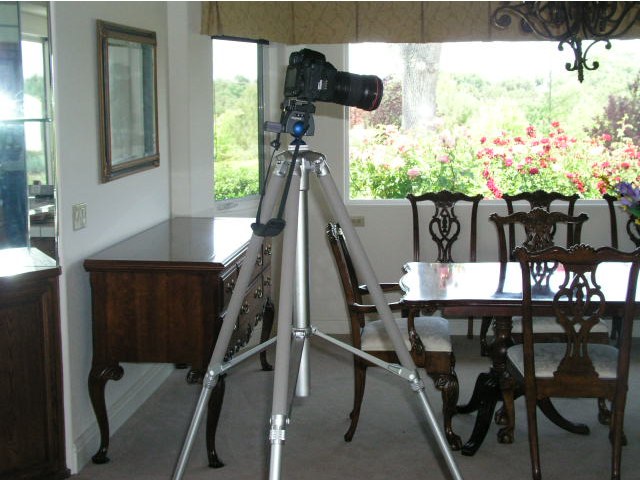
My mechanics professor would be pleased with those cantilevers and I, as a photographer, think it’s the only way to make a tripod sturdy without excessive weight. He used to lecture extensively on Euler struts and how light and strong could live together with proper design – someone at Linhof was listening. Leonhard Euler, who died in 1783, got it right first time around and his math is taught to all budding mechanical and civil engineers to this day.
I chose a different picture in the book, just for fun, as no benefit accrues from using the same one. To take human shake out of the equation I released the shutter using Canon’s plug-in and wildly overpriced RS-80N3 wired remote control. Cable Release to you and me.
All pictures of the target were processed in Aperture.
I once more used 1/8th at f/5.6; 1/8th is very slow (like 1/2 second with a 50mm lens) but not so slow that any vibration from mirror slap becomes too low a percentage of the exposure time, if you get my drift. In other words, any camera vibration will be a significant component of the total exposure time.
Here’s the full frame snap – once focus was set I switched to manual focus to prevent any changes:
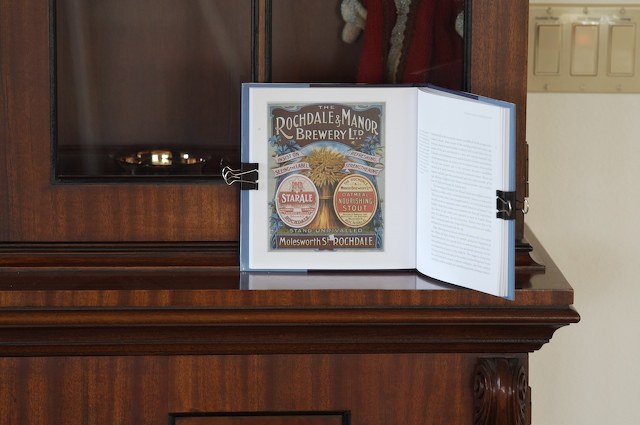
The enlargement ratio in the following snaps would yield a 40″ x 27″ print. No sharpening has been added.
Here’s the result with normal mirror operation:

While the difference is not great, the picture taken with mirror lock-up is a tad sharper – look at the contrast of the lettering.
And here’s the one with the mirror locked up using Custom Function #12 in the Canon’s menu system:

By the way, the anti-aliasing of the image in the 5D dictates that sharpening be used for best results. In the following rendition of the ‘no mirror’ snap, above, I have used Aperture’s Edge Sharpen with the variables for Intensity/Edges/Falloff at 0.70/0.22/0.57 – slightly more modest than the defaults of 0.81/0.22/0.69 suggested by Apple’s settings. As you can see, the absence of grain (at ISO 160, as before) and high resolution from the superb Canon 200mm lens makes 40″ prints from the 5D a piece of cake. You are looking at a JPG conversion from Aperture. In reality, a print from the RAW file will be sharper with no artifacts.

Maybe a ‘Medium Format is Dead’ piece is required to go along with ‘Black and White is Dead’ and ‘Film is Dead’?
Now Canon, when the 5D Mark II is released, can you please assign the mirror lock-up feature to a mechanical button, the sort humans like, rather than to a blasted choice in the myriad selection of Custom Functions on that silly little LCD screen? The fact that the latter is unreadable by landscape photographers outdoors does little to help, in addition to the insane complexity of actually finding the function.