The power of RAW

RAW offers a vast range of adjustments without destroying image quality

Here’s a case in point where RAW originals really make sense.

I was traipsing along through the charming side streets of Burlingame in the Bay Area of San Francisco when this neat wall sconce presented itself. Now I did have Bertram the Border Terrier straining at the leash in the other hand, so I did a pretty lousy job of holding the camera level. Add the high contrast of the scene and I knew some post processing would be de rigeur.

Here’s the original – if this was a film scan it would be pretty much past saving, the highlights comprehesively blown out (not hard to do with digital!), the perspective badly in need of repair, everything tilted.
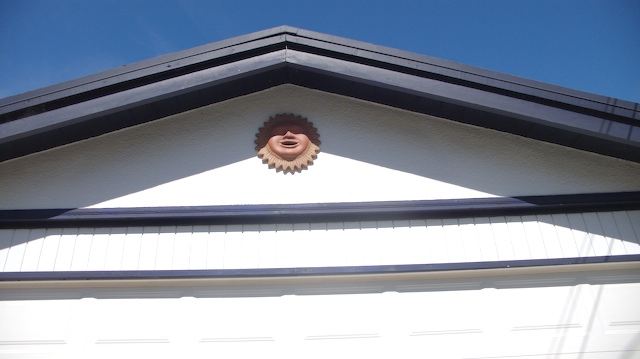

Wall sconce. Lumix LX1, RAW, 16:9 format

Rather than recount the adjustments made in Aperture at length, here’s a snapshot of what I did:
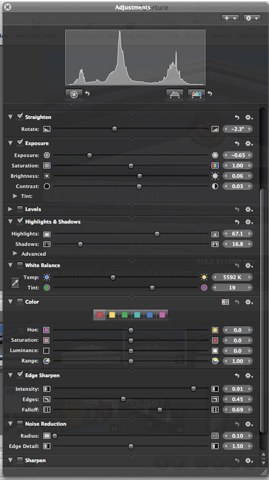
I also had to roundtrip the file from Aperture through Photoshop, where I fixed the lens distortion and perspective, tilting the top of the picture towards the viewer to correct for the low angle from which the picture was made; Aperture does not (yet) provide these adjustments.

And here is the result:


Cropped for 4:3 format

The highlight details (look at the textured stucco wall finish) have been nicely recovered with a combination of the Exposure and Highlights sliders. While Aperture does not support Lumix LX1 RAW, I used the workaround explained here to give me the full range of RAW adjustments.

The ‘repaired’ version will scale nicely to an 18″x24″ print, something you would not dream of doing with the original.
Formula One – Bravo Honda!

Can you think of a better use for photography?

Now it’s no great secret that I graduated from the same college as Colin Chapman of Lotus Cars fame – University College, London. Indeed, while I shared the education of Mechanical Engineering with that inspired genius, I never practised as an engineer. Not only was I far from Chapman’s class, it was just too hard a way of making a living, and too fraught with risk. In my case, I suspect, that risk would have gestated in the guise of serious injury to users of my designs. No, the engineering world became a safer place for my absence from it.

However, none of this in any way dilutes my interest in one of the only two sports I care about (the other is cricket), which is Formula One auto racing. The near senseless pursuit at vast expense of solutions to problems no one ever imagined has a certain perverse appeal, I must admit. Sort of like an expensive woman. You know you should know better. But you get involved anyway. When it comes to photography and Formula One racing, it has largely been a desert strewn with forgettable detritus. How many snaps of cars at speed and babes in tight tops do you really want? OK, I can do with fewer of the ones of cars at speed.

With the honorable exception of photographers like Jesse Alexander, little great photographic work has been done in this sport, despite the fortunes expended on motor drives and extreme telephotos. However, watching the 2007 season opener in Melbourne, in the fair land known as Australia, I was captivated by the new Honda car, which is devoid of stickers and sports a magnificently applied picture of the earth. The picture is from Honda’s web site, God bless them.

It gets better. Honda has offered to pixelate the names of the first two million donors on the car, so that you can honestly say you support the racing effort. And the money goes to saving the world. That’s a twofer. Rest easy, the boob who was one heartbeat away from the presidency a while back isn’t going to be stealing it, as he is not involved. Anyway, he’s too busy with cinema ticket sales.

I have always greatly enjoyed the huge pictures of produce on those delivery trucks and now Honda has gone one better.

250 ASA

Huh?

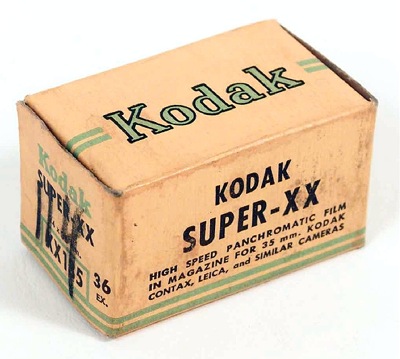
Who remembers Kodak Super XX film?

I loved it as a kid – it was the predecessor to TriX, though I used it long after it was discontinued. That would be in the 1970s. The main reason I used it was that Kodak still made it in bulk 35mm rolls for cinema use, so you could pick up fifty or a hundred feet (the latter good for over 700 snaps) for a song. It’s speed was 250 ASA, the grain sharp and tight, like TriX and the speed could be easily pushed to 500 ASA with a bit of extra time in the developer.

And 250 ASA (or 25 DIN to the Europeans amongst us, the Britain of my youth, of course, not being a part of Europe any more than it is now) was a speed that was just right. Not so fast that you had to stop down excessively, but fast enought to permit short, blur free shutter speeds. Your lens, as often as not, was set at f/4 or f/5.6 where pretty much every lens is at its best, and affords just the right degree of background blur to liven things up a bit.

DIN? Deutsche Industrie Normen or something. Only the Germans could concoct a system so perfectly ridiculous that you had to be a Doctor or Professor (which every German is, of course) to understand it. You see, it was a logarithmic system such that an increase of 3 represented a doubling in speed. So 24 was twice as fast as 21, which happened to be 100 ASA. As for 25 DIN being 250 ASA, well, let me tell you that much time with a scientific calculator was needed to figure that one out, my memory of logarithms not being what it once was. Go figure. Still, it kept enough consumers confused for long enough that camera stores (remember those?) thrived. A confused consumer is a repeat customer, often as not.

So, in a strange flashback to days of yore, I find myself setting the ISO (what?) on my Canon 5D to 250, often as not. Right there between Regular (100) and Fast (400). Then of course there is Very Fast (800), Super Fast (1600) and Bloody Fast (3200). Come to think of it, why don’t manufacturers simply mark the speed dials S, R, XX, F, VF, SF and BF? Now those I can understand.