Printer profiles and root canals

There’s little difference.

When making a couple of test prints for my son’s annual birthday picture I realized that the prints were coming out far too cool toned compared to the screen image.

Oh! boy!

Something had changed – whether my screen had aged or my HP DesignJet 90 printer has changed, or the Commies had got to it …. or some combination of these calamities.

While a colorimeter is a nice tool, you can profile your screen almost as well using Apple’s built in profiler, accessed in System Preferences->Displays->Color->Calibrate:
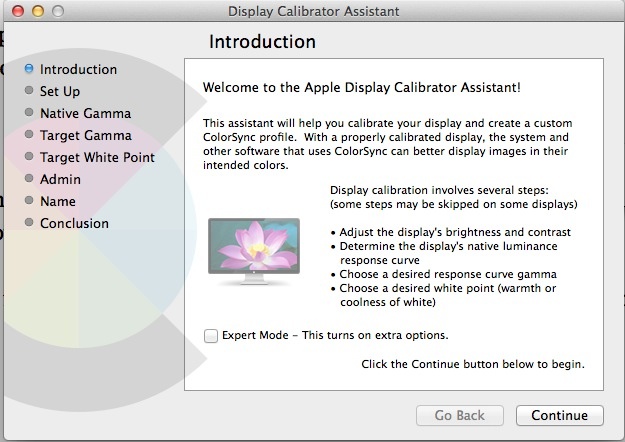
I find a target white point of 6000K gets me the closest screen-to-print match in my environment. Yours will differ.

Then I loaded the latest, updated drivers from HP. It always pays to have the latest drivers for your paper of choice.

What is surprising about this process is how much the perceived colors of your print will vary as you walk around the house with it. My display space is in a corridor with warm, incandescent lighting, so I have to balance skin colors to be right in that location.

They say that to evaluate a sound system use the voice or piano for calibration because we all know how those should sound. Well, for prints, use a human being whose skin color you know.

The results are worth it:
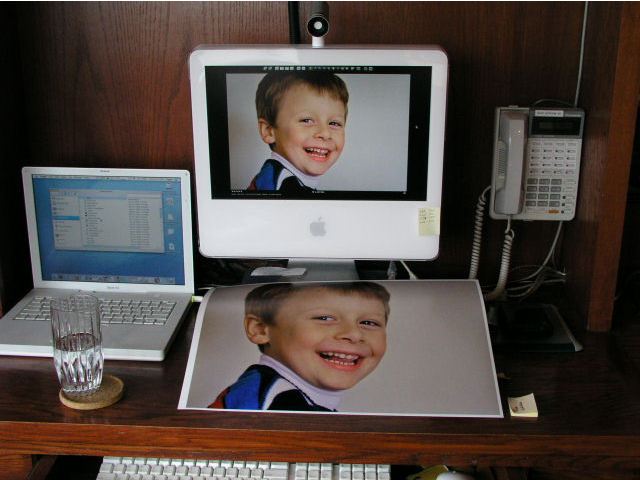
Some day computers screens and color printers will come with built in colorimeters (the latest professional models from HP now have these built in) so that this sort of thing becomes less of an agony, obviating the need for test prints. Stated differently, printer profiling with the current stage of desktop computer technology compares unfavorably for fun with a root canal.
Time for a Canon 5D upgrade

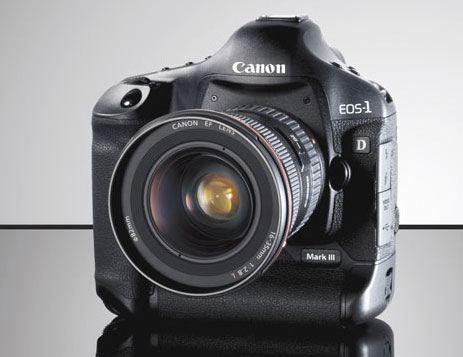
Canon releases the 10 fps EOS -1D Mark 111.

Canon’s announcement of a new 1D Mark III, a 1.3x cropped sensor professional grade camera begs the question when the 5D Mk II will become available.

There’s not a lot wrong with the 5D. What the camera does need is dust removal for the sensor (for whatever reason, the 5D seems especially prone to attracting dust to its sensor) and an LCD screen that can actually be read outdoors. The 5D does not need a larger screen or one with more definition. Rather, it needs a legible screen. And you can forget live preview (something Canon added to the Mark III, allowing screen ‘chimping’ before the picture is taken – pros need this feature? Really?). Just make the bloody thing useable outdoors.

Still, with the 5D’s price as firm as it is – probably the result of robust demand and no full frame competition at this price – I’m not holding my breath for an upgrade any time soon. That still leaves us with the best full frame digital camera (the only one, in fact) available at an (almost) reasonable price.

That Canon wonder lens again

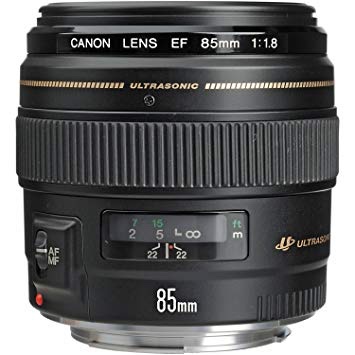
The 85mm f/1.8 may just be the bargain of the century.

OK, admit it. At least some of you thought “Any lens is good stopped down” when you read this piece. Fair enough.

So here is a little bit of nonsense, taken at dusk yesterday, with some rather quirky statistics. ISO 50 as I want to force full aperture use, and 1/2000th for the same reason. Aperture? Why, f/1.8 of course, for all those of you thinking “F/1.8 can’t be any good for $350”.

Wrong!


Canon 5D, 85mm f/1.8, ISO 50, 1/2000th @ f/1.8

Annie Leibovitz

Finally, she does it right.

I have avoided reference to Annie Leibovitz’s photography in this journal, finding her work so over the top and in such poor taste that the less said the better. She is very much of the “put a famous face in a ridiculous situation and fame and fortune follows” school. That doesn’t make her work good photography.

So it give me considerable pleasure to relate that the annual VF Hollywood Issue (March) has a 33 page film noir portfolio of her latest work which is an absolute cracker.

As I mentioned before do not buy this magazine for its editorial views unless you are one of those poor, foolish conspiracy theorists who believes the administration is responsible for all the ills of the world while solely interested in enriching itself. No, you are not going to find rational, objective political analysis anywhere near the pages of Vanity Fair – the content is by loonies for losers.

But you will find cutting edge photography which inspires and teaches – not a bad reason to subscribe.

Rush out and get the March issue and you will see some great photography by Leibovitz, meticulously directed and with lots and lots of top notch actors posing in the pictures – the likes of Amy Adams, Ben Affleck, Jessica Alba, Pedro Almodóvar, Alec Baldwin, Adam Beach, Jessica Biel, Abigail Breslin, Jennifer Connelly, Penélope Cruz, Judi Dench, Robert De Niro, Robert Downey Jr., Kirsten Dunst, Aaron Eckhart, James Franco, Djimon Hounsou, Jennifer Hudson, Anjelica Huston, Rinko Kikuchi, Diane Lane, Derek Luke, Tobey Maguire, James McAvoy, Helen Mirren, Julianne Moore, Jack Nicholson, Bill Nighy, Ed Norton, Peter O’Toole, Sylvester Stallone, Sharon Stone, Kerry Washington, Naomi Watts, Forest Whitaker, Bruce Willis, Patrick Wilson, Kate Winslet and Evan Rachel Wood.

Quite a list, huh?

Cheap and good

You don’t have to pay ridiculous Leica prices for Leica quality.

All the talk in yesterday’s column about Canon’s superb 85mm f/1.8 lens got me to thinking about how lens technologies have changed in the fifty or so years since the Canon was first designed – good designs do not die!

Multicoating was added maybe twenty years ago, brass gave way to alloys and then machined focusing helixes gave way to nylon gears and miniscule stepper motors in the lens mount. Materials got lighter and cheap aspherical surfaces (resulting from casting rather than polishing) became the norm is more specialized lenses. Exotic high diffraction glasses of yesteryear became commonplace.

So how is the user experience when comparing what I think is the finest portrait lenses ever made, the 90mm Leica Apo-Summicron Aspherical with the much less costly Canon at not much more than one eighth of the cost!

You would think the handling experience of the Leica optic on an M body would blow anything out of the water, and you would be close. The compact lines and very short throw of the focus collar on the Apo make for a sweet handling lens. All Leica Ms handle the 90mm focal length well when it comes to viewfinding, the result being that the M with the Apo is a sweet package.

Now the Canon is light for its bulk which surfaces the old prejudice that it cannot be durable. Time will tell. A surprising benefit of this bulk is that the camera and lens are very comfortable to hold, especially when oriented vertically which is the norm for most portrait pictures. Hand held the Canon has it all over the Leica in this orientation. Add the vertical grip and things probably improve further.

Then it comes to focusing and here, again, the conclusion is surprising. Nothing beats a Leica M3 rangefinder for manual focusing in the poor light of a studio environment. Nothing except for the 85mm Canon on a 5D with focusing on the central rectangle only. The old trick of focusing on the eyes then quickly recomposing was simple enough with the M3. With the 5D it’s a dream. Camera up, part depress the shutter button, recompose, click. Takes about a half second once you get into it. And it’s so dead right every time you begin to wonder how you lived without it. Depth of field is a scarcity in the portrait studio so focusing errors are cruelly revealed. Especially when you like to make 18” x 24” prints like I do.

So the new world of electronics and micromotors and LEDs and contrast sensors and on and on really has left the old world of mechanical-everything behind. Charming as that world seems, it no longer offers the best tool for the job.