When all else fails, change your logo

Fuji takes a page out of the Kodak playbook.

Here’s the business philosophy statement from Fuji’s web site:

“We will use leading-edge, proprietary technologies to provide top-quality products and services that contribute to the advancement of culture, science, technology and industry, as well as improved health and environmental protection in society. Our overarching aim is to help enhance the quality of life of people worldwide.”

Yet Fuji, when it’s not busy making the world a better place, continues to call itself Fujifilm and seems to think that changing its logo – like the folks at Kodak did recently – will cure all that ails it. Still, I suppose a 95% share of a dead market sounds good to some bean counter somewhere.


Fuji’s thrilling innovation – a new logo

Well at least they were honest. The red bit they added speaks to the results of their film division and looks about to fall off.

Where do businesses get these money wasting ideas?

This just in from Reuters

Better get rid of that black and white film in your refrigerator, racist pig.

From Reuters today:

“Reuters reports this morning that a PlayStation Portable billboard campaign featuring a black-and-white photograph of a lady in powder-white makeup and clothing, grabbing the face of a darkened black lady, is being discontinued by Sony in the Netherlands. Apparently, there were complaints that the imagery – which was designed to show ceramic white, the new color of some PSP models, as competing with jet black – had racist overtones.

…The ad campaign riled California Assemblyman Leland Yee, the National Association for the Advancement of Colored People (NAACP) and a youth civil rights education project called Sojourn to the Past.

Those critics condemned Sony’s use of the racially charged photo to sell a product and said it recalled an age and time when black people were portrayed in minstrel shows.”

Anyone found using black and white film will be pursued by the Bicultural Interdiction Group Offfice Trackingforce (BIGOT), a joint arm of the US and EU governments, and will be subject to prosecution. BIGOT has also requested that all image software manufacturers revise their applications to remove any ‘convert to monochrome’ capabilities, owing to the racially charged nature of such conversions. Those refusing to comply will be subject to penalties which will include being forced to listen to jazz music eighteen hours a day as part of the cultural assimilation process, in addition to the usual monetary fines.

Separately, Apple Computer is expected to voluntarily agree to discontinue both the black and the white versions of its new MacBook laptop computers and will henceforth issue these clad in grey and pink only, the latter for homosexual and lesbian consumers.

Diane Arbus – fake.

A cruel, exploitative photographer without a shred of decency.

Diane Arbus, of course, is famous for having killed herself at the age of 48 in 1971. Since then, this unknown photographer’s work has sky rocketed in fame and value. Proving that nothing so much enhances the value of your work as suicide.

Which is not the same as saying that her photography is either good – it is not – or genuine. Indeed, few photographers have produced more shamefully contrived work than Arbus, which qualifies her instantly for the Hall of Fakes.

Arbus was smart. She cottoned on to the fact that the photographic intelligentsia was buying It, It being her cruel, exploitative view of a world seemingly filled with monsters, freaks and the deformed. There’s not another photographer who so cruelly mocks his subjects, distorting them this way and that, ridiculing them at every turn, without the least indication that she had either a heart or a conscience. It’s as if one of those poor fools who photographs beggars on the street suddenly acquired a taste for the bedside manner of the IRS and proceeded to put it to work in the local mental institution with a camera as a weapon.

Her work, then, is the antithesis of class, of decorum, of decency.

But face it. The intelligentsia, the taste makers, goodness help us, believed the exact opposite of what her pictures represented. Where there was poor taste, they saw insight. Where there was cruelty, they saw sympathy. Where there was depravity, they saw honor. Or said they did. She got away with it, until her lack of conscience eventually caught up with her, culminating in a miserable ending of slashed wrists and a drug overdose.

The best example of her fakery is perhaps seen in the contact sheet of the seemingly crazy child holding the hand grenade. Robert Frank, you cannot help thinking, would have pounced on this subject as an example of American depravity. Anything to knock the country that is his adopted home. At least his picture would have had some class. But taking a look at Arbus’s contact sheets you see, to your amazement, that this is in fact a very ordinary little boy playing with a toy. It’s just that in this one accidental shot he is grimacing just so and the whole thing takes on a look of insanity. A sweet, ordinary child, rendered crazy for the ages by the lying, dishonest vision of a supreme fake.

Don’t believe me? Then let me quote her for you and you be the judge:

“Freaks was (sic) a thing I photographed a lot. It was one of the first things I photographed and it had a terrific kind of excitement for me. I just used to adore them. I still do adore some of them. I don’t quite mean they’re my best friends but they made me feel a mixture of shame and awe. There’s a quality of legend about freaks. Like a person in a fairy tale who stops you and demands that you answer a riddle. Most people go through life dreading they’ll have a traumatic experience. Freaks were born with their trauma. They’ve already passed their test in life. They’re aristocrats.”

You can find her garbage on the web as I’m damned if I’m reproducing it here.

May we not see her like again.

Fast landscape

The decisive moment exists in landscape pictures too.

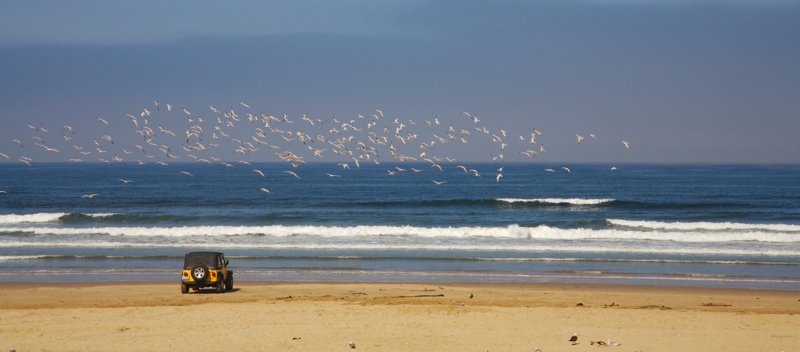
Working on my beach series yesterday I was rambling along Grover Beach and idly eyeing the yellow Jeep wondering if something could be crafted aound it. True, I had noted a flock of some two hundred or so Common Tern minding their own business on the dunes nearby, but thought nothing of it. Fish eaters, these, so likely pretty smart, what with fish being so good for the grey matter. Known to attack marauding humans, too, so I kept my distance. A lovely bird – pure white with a jet black head and yellow beak. Quite the designer’s dream.

I am not, as a rule, the type who composes in the viewfinder, preferring to visualize the scene with my (not so great) eyes then administering the coup de grace with a quick raising of the camera to eye level and a pressing of the button. A legacy of years of street photographing, I suppose. Auto focus and exposure makes that approach even easier than in days of yore.

I found myself wondering about the tranisent lighting effects that can so quickly change a landscape. The times when the clouds open just so and you miss the shot because of some malfunction with the tripod. Landscapes are anything but static subjects.

But this one was, let’s face it, not going anywhere. The waves were rolling in on a fairly predictable schedule and the jolly yellow Jeep was parked. So I just sort of stood there, taking in the view on yesterday’s cool morning, glad I had remembered to pack my wool pullover, for it was but 58 degrees. (14 Celsius for those of you who follow the allegedly Beautiful Game of soccer, where he who gets away with the most fouls, and pays the officials most, wins).

Then for some reason known only to this gaggle of fish eaters a communal take-off took place and the magical moment was just that. A moment. Seconds later the tern had left and the little Jeep had driven off. Who said landscapes are static subjects?

Tern and Jeep. Canon EOS 5D, 24-105mm, 400 ISO.

Cropping is just a tool

If someone tells you you should only print the full frame of your negative or digital original – run – don’t walk, away.

You hear this sort of thing a lot from academics and pseudo-intellectuals. The Alfred Rosenbergs of the photography world. Sadly, unlike Rosenberg, they remain alive to propound their mealy mouthed tripe in an earnest attempt to earn what modest living their lack of intellect affords them. It goes something like this:

“No great photographic artist every crops his originals when printing, knowing that true greatness in a photograph can only be attained when the original visualization is rendered truly and uncompromisingly on photographic paper. To crop is to destroy the integrity of the creative process.”

Often this codswallop will be followed by a reference to Cartier-Bresson whose prints are so intellectually honest that they often include the surrounding frame of unexposed film. What art. What genius.

What utter rubbish.

Given that the sole purpose of an art photograph, as opposed to a commercial one, is to provide aesthetic satisfaction for the viewer, it is irrelevant whether the spectator sees all of the frame or just a slice. The only thing that matters is that the photograph works.

Here’s a snap I took in one of the great public squares of Paris. Yes, you can check the dimensions – all of the original 24mm x 36mm of the negative is faithfully preserved.
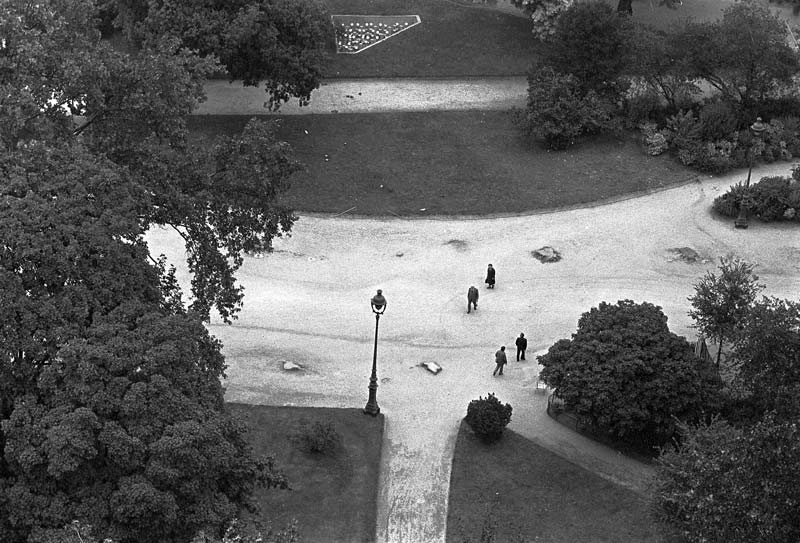
Crossings. Paris 1977. Leica M3, 35mm Summaron. TriX/D76

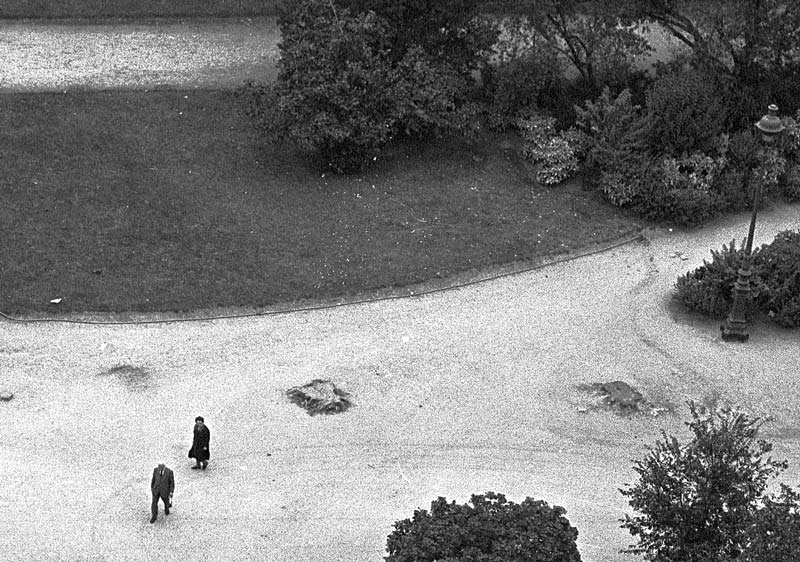
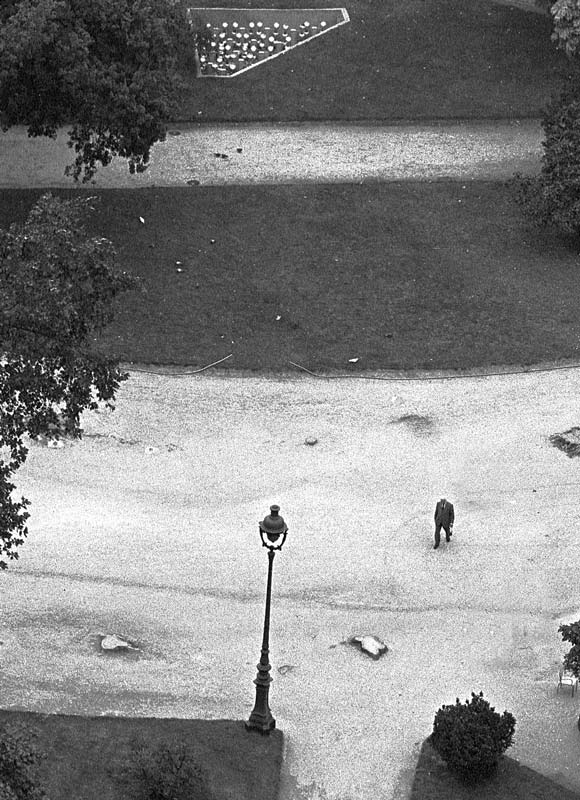
Three crops follow.
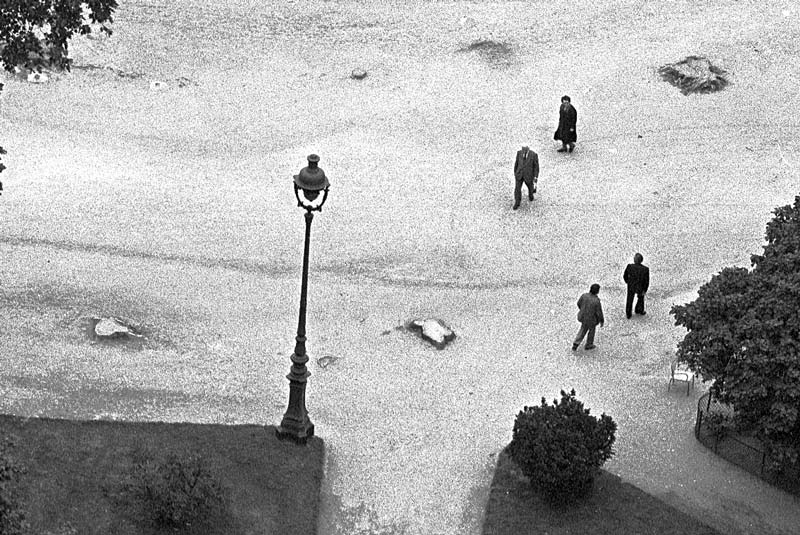
In the third crop I also removed three people in Photoshop. Just didn’t like the way it looked.

Now pretend that you never saw the full frame original. Who is to say that any of the crops is better or worse? The reality, of course, is that the photographer should crop for effect and choose the best possible crop to display his art work.

The academic rule is even dumber when you think that the same effect can be largely accomplished by simply placing a longer lens on the camera. I print it full frame using a 90mm lens on the camera versus cropping from the original taken with a 50mm lens. No difference, maybe except for definition and grain. But the first picture is sacred as it is uncropped, whereas the latter is garbage as I broke a cardinal rule of academia. Doesn’t work, does it?

What with all that burning, dodging and special chemistry he used, you wonder how Ansel Adams ever got past these academics. They probably mistook darkroom technique for great photography. In one respect you can think of Adams as the Greatest Cropper of all. How different is cropping, after all, from selective exposure in the darkroom? Both have as their intent the removal of unwanted features or effects. So, for that mattter, why not remove things, as I did in the third crop above, to make the result better?

All of which goes to confirm that Those Who Can – Crop, whereas Those Who Cannot – Teach.

Crop away. Keep cropping until it looks good or move onto the next original. And if you really want to fool them, why not add a frame depicting the unexposed film, with film manufacturer of choice, in Photoshop. How intellectually dishonest of you.

You will be in good company. The great photographer Brassai thought nothing of using one original to craft two or three pictures.