Shutter lag

It takes the Wall Street Journal to surface the issue

Not only is America afflicted with some of the world’s worst television – from situation comedy to news reporting, though it’s often difficult to distinguish the two – it can also lay claim to having the worst newspapers. As often as not, these mistake editorial opinion for news, so you end up reading some leftie’s opinion about put-upon losers as news reporting. Write enough of this sort of thing and you get a Pulitzer Prize.

In the digital photography world, the worst reporting involves avoidance of mention of a near universal problem in modern cameras. Shutter lag. The time it takes between pressing the button to recording the image. Read any number of reviews of digital cameras and chances are you will see no mention of this defect. I can only guess that this is either because of conflicts of interest (journalists accepting bribes in the form of free equipment or pushing advertising in their magazine) or because the reviewer hasn’t the faintest idea how to take a photograph.

So it was welcome news indeed to open the Wall Street Journal this morning – a fine newspaper which keeps its opinions on the editorial page – to see an article on shutter lag, of all things. They quoted some poor schnuck who blew big coin on a digital camera to record the whales on his Mexican vacation, but managed to record only sterile images of the sea, the leaping whale having just departed owing to shutter lag. What’s interesting about the piece is that it takes a business newspaper to disclose a design defect which makes most digital cameras worthless for all except maybe landscape photographers and realtors. Let’s face it, neither is exactly dealing with moving subjects. Earlier reporting by the Journal confirms that the primary use of digital cameras hasn’t changed from that for film cameras, meaning pictures of one’s family. Especially of the kids. Ever tried to catch that fleeting moment on your baby’s face with a modern digital point-and-shoot camera?

The Journal gets it wrong in saying this is a digital camera problem, citing the good old days of fast film cameras. As the latter developed more automation – focus, exposure and so on – shutter lag was already beginning to raise its ugly head. Simple cameras like rangefinder Leicas and better SLRs never had the problem, and it was one of the major causes for concern I had when waiting to go digital. With the Canon EOS 5D there is no shutter lag, but then you should expect no less from a camera that runs close to $5,000 with a decent lens attached. I was more than aware of the issue having used an Olympus C5050Z for three years or so, and learned early on not to use it to photograph anything that moved.
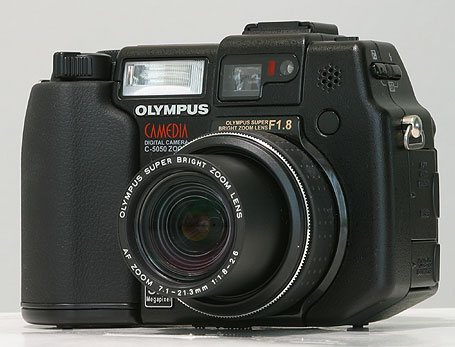
The Olympus C5050Z – a very competent camera for static recording, but useless for moving subjects because of horrid shutter lag

So it’s satisfying to report that Panasonic cured the issue in a point-and-shoot digital in the LX1. Unfortunately, they made two boo-boos. First, they never advertised this ‘feature’ which I discovered after much research. Second, they have just discontinued the camera. So if you want a fast, small digital point-and-shoot, now is the time to get an LX1. Read more by clicking on the ‘Leica DP’ entry on the left.

Meanwhile, kudos to the Wall Street Journal for good reporting.
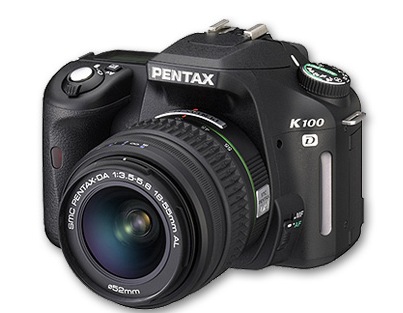
Pentax does it right

How vibration reduction should be done

I have made no secret of my admiration for the camera designers at Pentax, having owned a Pentax ME Super and a Pentax 6×7 over the years.

The ME Super was my New York street camera during the years 1980-1987, when I lived in what was then a pretty dangerous New York City. Not caring to lose my Leica M3 to a chain snatcher, I acquired an inexpensive ME Super and a couple of lenses – a very compact 20mm ultra-wide, a 28mm wide and that miniscule 40mm ‘Pancake’ standard. A sweet outfit, with the added benefit of exposure automation.

The 6×7 represented my first foray into landscape photography and while it went off like Dirty Harry’s Magnum when you pressed the button, there was no arguing with the quality of the negatives that resulted.

The other day I was thinking about changes in camera design which made things so much easier for today’s picture taker. Small 35mm cameras, greatly improved film emulsions, ever better lenses and that sort of thing. But clearly digital imaging was the watershed that made everything much faster yet, to my mind, vibration reduction has saved more snaps from the reject bin than any feature since automatic exposure and focus. If your goal in life is big prints, then the old saw that the slowest shutter speed should be no slower than the reciprocal of the focal length for hand held pictures is simply wrong. You think you can get shake free pictures with your standard lens at 1/50th second good enough for an 18” x 24” print? I don’t think so.

I don’t know who came up with the idea of vibration compensating mechanisms and circuitry in still cameras – the Steadicam for film makers, after all, has been around for some 25 years, famously used by Stanley Kubrick in ‘The Shining’ in 1980 – but I was very conscious of its availability in some Canon lenses when I sprung for the EOS 5D. Most importantly, the ‘standard’ lens I chose – the 24-105mm ‘L’ – has this feature and it adds wonderfully to definition. Canon says it’s good for three shutter speeds slower than normal, meaning that the modest f/4 maximum aperture of the lens is not as limiting as you might think.

Similarly, my Panasonic LX-1 comes with Panasonic’s version of vibration reduction in a very compact package and Nikon has offered the feature on some of its more exotic lenses for a while. However, with both Nikon and Canon, the execution is not well thought out when it comes to their interchangeable lens cameras. The problem is that the vibration reduction circuitry is part of the lens, not the camera, meaning only certain lenses have it.

It took a smart designer at Pentax to finally get this right. His answer? Simple. Build the circuitry into the body, not the lens, which they have just done with the newly announced K100D.

In this way, any lens, however adapted to the camera’s body, benefits from this wonderful feature, and you don’t have to double up on lens bulk as no lens contains any related mechanisms or circuitry. Now is that clever or what?

Not really luck

You make your luck. It doesn’t just find you.

I pride myself on knowing the charming town of Burlingame in the South Bay of San Francisco pretty well, so imagine my surprise the other day when a passer-by asked her for directions to the ‘English Village’.

It turns out that this is a collection of fifteen or so homes just around the corner from where she was at the time. Small homes, some 1500 square feet each, but each with an impeccable garden and lots of mock Tudor style.

So it didn’t need much encouragement on my part to leash up that wild beast, Bertie the Border Terrrier, and ankle around to said location. And, it has to be admitted, the place oozed charm like a politician looking for campaign donations, albeit with a lot more class. Needless to say, that little gem the Leica DP was in my trouser pocket, so it was a moment’s work to catch some nice details:

Round the corner and there’s another one:

And a third:

The old admonition to Always Carry a Camera fell into disuse with this photographer as nothing this small was this good until now. Even the Leica rangefinder was not small enough to permit this cavalier attitude. Once you have one of these modern digital gems, however, there really is no excuse for not carrying it with you at all times.

Recapturing the Leica spirit

The ‘go anywhere’ Leica DP does it

I mentioned in my earlier columns on the Leica DP (click the caption in the right hand column) that this camera was a rational digital replacement for the film-based rangefinder Leica, not only because image quality was comparable, courtesy of the Leica lens fitted, but also because its small size (much, much smaller than an M with a 35mm lens fitted) and near silent shutter (nearly imperceptible if the built in ‘clack’ is switched off and dramatically quieter than the M) allowed it to be taken pretty much anywhere without arousing suspicion.

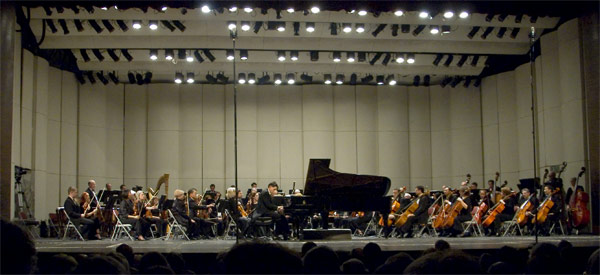
In the true Leica ‘available light’ spirit, here is a snap taken the other day at a south San Francisco Bay area American Music concert of Thomas Hansen performing Gershwin’s Rhapsody in Blue. The camera was set to its full aperture of f/2.8 at the widest lens setting of 28mm with ISO at 400 and using the RAW format:

Earlier, the intermission had yielded this passing snap:

I couldn’t help thinking that this sort of thing is a throwback to the early Leica days when available light photography was all the rage. By the way, the camera does such a great job of automatic white balance control that no color temperature adjustments had to be made to these images. The built in vibration reduction is good for two shutter speeds, so f/2.8 becmes an effective f/1.4.

Controls and confrontation

Say what you think. Dissemblers are losers.

In the old west, men used to settle their disputes with six shooters on Main Street. Justice went to the fastest. A cruel system, true, but one devoid of the greatest plague which subsequently infested this great land.

Lawyers.

But it’s not the lawyers who are to blame. Like any whore, they exist solely because the demand is there. Growing mightily since those Wild West days, Americans have lost the guts for confrontation. Instead, they started retaining agents, lawyers, to do their arguing for them.

These agents, of course, speedily recognized they were on to a good thing and before you know it you had class action shakedown experts (pay me now or pay me later) and the tort bar.

What, of course, accounts for this sad state of affairs is a lack of parental guidance. “Believe what you say, tell the truth, and be prepared to fight for it” gave way to “Here’s the number of a good lawyer”, as if the use of “good” and “lawyer” in one sentence were not one of the greater contradictions in modern English usage.

What made me think about this was an article in the Wall Street Journal the other day explaining how on line photography hosting services were employing people to try and screen out pornography. Now this must rank right up there with the comical attempts of the Chinese and Singapore dictatorships to control access to the internet. Evidently, there are teams of poor schnucks at hosting sites charged with reviewing tens of thousands of pictures daily to censor out the bad ones. Others have adopted computerized approaches to try and recognize offensive material. Snag is, a bare bum is, apparently, very much like an apple pie to these programs, so Aunt Minnie’s latest creation goes in the trash heap with the Playmate of the Month.

God, America and Apple Pie….and Playmates.

A moment’s reflection leads to the conclusion that third party censorship is wrong. Again we have delegated control to agents rather than taking responsibility for our own actions. Where the solution to the problem rests is with proper parenting. Teach the child was is good or bad and you no longer need some culture Czar to make your decisions for you.

Which translates, rationally, to a means test for parenting. When you have a child you make a significant commitment for 15 to 20 years to another human being. Our society has concluded that you need certification to own dangerous things (guns, cars) but cares not who has a child. A means test for parenting would take care of many of the problems in our society. Fascist you say? Ask a parent whose child has been murdered by a drunken driver or a drive-by shooter.

An extension of this theme, as it affects photography, was suggested by a friend the other day. It doesn’t hurt that she is also a fine photographer. That means I pay more attention to her writings. I had sent her an intriguing piece, compiled by experts, on the state of the art in digital camera sensors, thinking it was interesting to see how quickly digital has surpassed film in every respect. She wrote back to the effect that all this technological splitting of hairs has little to do with taking good pictures.

Of course that is right. Digital or film, it’s just a means to an end. I happen to be a digital convert simply because the time from snap to print is shorter, and I have one day fewer left on earth than I did yesterday. That makes digital better for me. Maybe not for you.

But to complete the circle back to the thrust of this piece, which is all about self determination and courage in one’s beliefs, she goes on to suggest that maybe there should be a means test for aspiring photographers. If all you propose to do is take pictures of garbage well, sorry, you cannot buy this camera.

I pretty much despise censorship in all its guises, yet make an exception when it comes to parenting. So I may be talking out of both sides of my mouth. But I must admit to giving my correspondent’s thought more than passing consideration because so much of what passes for photography out there is pure, unadulterated garbage.

Were we to be more outspoken about this, more willing to correct the inept and expose the frauds, in other words if we had more guts, well maybe photography standards would rise across the board.