The most fun I ever had taking pictures

Before digital came along, that is!

The seventies were a truly miserable time to be in England. Administrations alternated between the senile Conservatives, devoid of ideas and wedded to the status quo, and the Labor party, its members fuelled by the politics of envy. A weak Conservative Prime Minister, Ted Heath, caved to the blackmailing strikes of the miners. He alternated power with the socialist Harold Wilson who went along merrily with the trades unions funding his party, doing whatever it took to stay in office. Neither ‘leader’ had personal convictions worth a damn.

I had graduated a mechanical engineer from University College, London in 1973 intent on working for Rolls Royce Aircraft. There was only one small snag. The year I graduated Rolls went bankrupt, as ingested birds shattered the innovative carbon fiber turbine blades in its RB211 engine, rendering it useless. The engine was intended for Lockheed’s superb Tristar passenger jet and Rolls almost took Lockheed down with it. Well, the alternative for an engineering graduate who actually wanted to be an engineer was to work for some big government institution or become an academic. Hardly palatable alternatives for one dirt poor, ambitious young man. Realize that this was a country that accorded the sobriquet “engineer” equally to the fellow installing railroad ties and to the chap at Rolls Royce. Still, I suppose the railroad ties did not snap like so much brittle chocolate.

So I decided to emigrate to the greatest country on earth, but there was a small matter of qualifications. The business of America is Business, and I didn’t know a balance sheet from an income statement. Taking advice from a smart merchant banker my mother somehow steered me to, I decided to learn about finance with another degree on the wall. It’s a damnable comment on the English educational system of those times that the very concept of an MBA did not exist, whereas in America it had been around for the best part of a century. It wouldn’t do now, would it, to teach business? Muddling through was the preferred method, preferably aided by good choice of parents.

Well, I had had the privilege of working with Americans as they visited Britain, over on tours from New York or Boston or Chicago, and I learned more from them about business four years firm than in my whole life until then.

The last thing I did before taking that one way flight was to visit Paris. This was in 1977. I had no savings. My most precious asset was my Leica M3 and its 35mm Summaron lens with that clunky viewfinder appendage. So I borrowed fifty pounds from a sister, got on the ferry and next thing I was at Gare du Nord looking for my seedy garret. My first goal was to visit the Louvre, the Jeu de Paume and the Orangerie to feast on three of the world’s greatest art collections. A related interest, of course, was to take pictures, so the M3 and a few rolls of film came along.

There was no draconian security in those days, of course. Photography was permitted everywhere and no one really minded very much. Especially if you were reasonably discreet. The Leica and I were a seasoned pair by now. We had been recognized time and again in the photographic press, culminating with the award of the Photographer of the Year prize by Photography magazine, the leading UK monthly, and, better yet, had been published in Leica Fotografie, the house organ where all things Leitz were good.

To whom did I look for inspiration in those days, photographically? Well, that’s easy. Cartier-Bresson, Doisneau, Kertesz, Brassai. In other words, I was a street photography junkie, though I didn’t know that word at the time …. Make it fleeting, let serendipity arrange the forms just so and click. Leica. 35mm lens. TriX. D76. A combination that had seen thousands of photographers through for years on end.

The Louvre was a magical place back then. I. M. Pei, great architect that he is, had yet to con gullible Parisians with the ugly pyramid that defaced one of the world’s great spaces, much as the Pompidou museum had already done a few blocks away. Care to revisit the latter and see how well it has aged? I don’t think so.
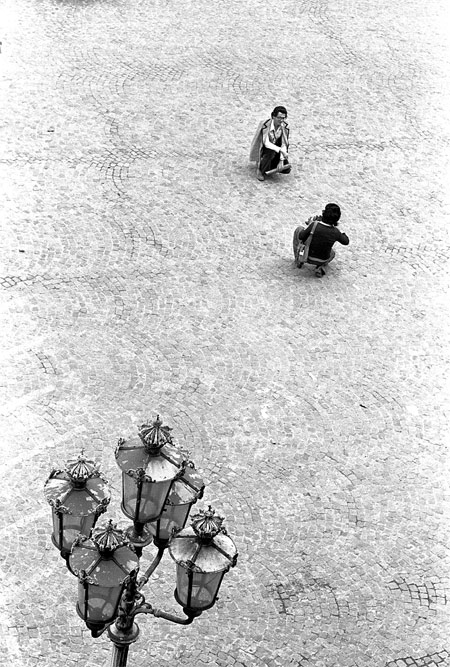
The forecourt of the Louvre before I. M. Pei. Leica M3, 35mm Summaron. TriX/D76.

The first and prevailing sense one had on entering the museum through its vast facade was the smell of oil paint. Artists were permitted, encouraged even, to bring their oils and easels and practice by copying the works of the masters. The lighting was, of course, magic, like only Parisian lighting in the spring can be. And as this was before everyone had money, before equality had raised its ugly head, the museum was far from the zooed place that modern art collections have become. In the words of the philistine American to his wife, with but one hour to catch a flight, confronted with a priceless Italian church to view: “OK, honey, you do the inside and I’ll take the outside”. Drive-by tourism. No, people had more time to savor art back then.

What passed for fashion in the seventies. Mona at the Louvre. Leica M3, 35mm Summaron. TriX/D76.

I forget the details, but suspect that I visited the Louvre on all but one day of the week I spent in Paris. And I also took pictures, the Leica by now a part of me. Second nature.

And until good, responsive digital cameras came to market, that’s the most fun I ever had making pictures.
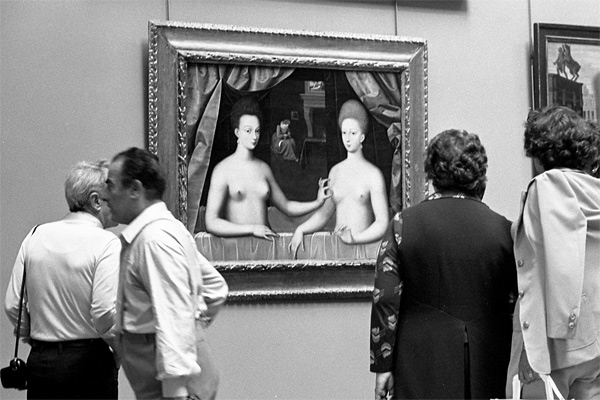
Early porn. Louvre. Leica M3, 35mm Summaron. TriX/D76.

In case you wonder, this painting is of Gabrielle d’Estrees and one of her sisters in the bath, c. 1595, painter (mercifully) unknown. Gabrielle d’Estrees was the mistress of that old Frog, Henry IV. In her hand she holds a ring given to her by the king as a sign of their bond, and her sister is pinching her nipple indicating she is pregnant with the king’s child. Yeah, right. The surrealistic background image is of a servant sewing baby clothes.

Click on the link in the left hand column for details of the book that resulted. That will take you to a written presentation along with my commentary, so you can hear what I really sound like!
Fun with the B&H catalog

Everything under the sun in one big book

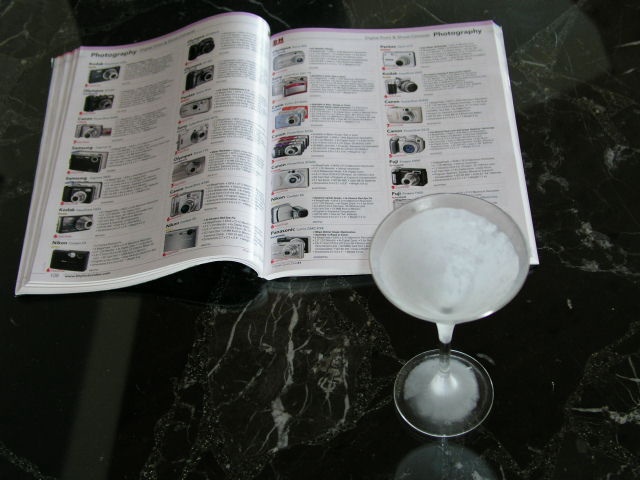
Say what you may, a notebook computer cannot hold a candle to a book when it comes to browsing. Spill your cocktail on the former and you have just had a $2,000 drink; spill it on the latter and you come back to read a slightly crinkled copy tomorrow. Make the cocktail a gin or vodka martini and your carpet will never know the difference.

So when B&H, that estimable New York City business, sent me their big book of photo and related equipment, it was rather fun to browse it in book form rather than searching for something on a computer. Best of all, with a book you come across things you would never think of browsing for at a keyboard, because it would simply never occur to you to look for them.

I suspect B&H sent me the book because I blew all that cash on the Canon EOS 5D a while back, and more power to them. I cannot think of another business with such integrity and client service, and I’m not even Jewish!

So what interesting items are of note browsing these 322 pages? Well first of all, kudos to the team that puts this monster together. With some 15-100 items a page you are talking a lot of work here.

There are sections on everything from Audio/Visual, Computers, Lighting, Photography of course, Podcasting(!), Portable Entertainment (meaning iPod mostly), Satellite radio (where you can get to listen to potty mouthed smut and pay for it), Hard Drive storage, Surveillance Video (honest!) and many more. Here, in no particular order, are some items that caught my eye:

Stupidest, most over-priced item: Easy – page 128. A company named Visible Dust is asking $90 for an ‘Econo Sensor Brush’. No kidding. $90 for a brush. And that’s for the ‘Econo’ model. The Real Thing is $135. Go to the local art store, get a nice camel hair brush, soak it in your vodka supply to clean up any grease, and you have the same thing for $5. A fool and his money…. If things go really badly at the old estate I think I might start selling these. Mine will be the Organic CCD Rendition Improver with French Vodka Enhancement for a mere $75, or a Special on three for $125. The Special would include a bottle of Grey Goose (“A lifetime supply of brush cleaner for you and everyone else in your county”).

The thing no one needs: Page 129. The Zeiss Ikon rangefinder body for film at all of $1,617. True, it makes the Sensor Brush look cheap.

The camera you thought they didn’t make any more: Page 135. A Linhof 6×9 view camera, no lens, for $7,964. Probably made in China, anyway. You can get two EOS 5Ds for that price and have money left for a couple of top notch Canon ‘L’ lenses. Plus your snaps will be sharper.

The truly funky: Page 172. The Sea & Sea marine housing for the EOS 5D, a tad pricey at $2,600. Keeps things dry, I suppose, but what do you do about flash?

The ‘I wish I had one’ item: Page 190. The QT Quick Truss system. No, not for hernia, rather an electric roller system to move your studio backgrounds into place. A bargain at $1,839 for the biggest size, some 11′ square. OK, so maybe it is for hernia after all.

The $300 a fyard tripod: Page 165. $900 gets you the Gitzo Giant which elevates to all of 91.3″. Now that’s tall.

A close runner-up to Visible Dust: Page 267. How about shelling out $290 for a Tecnec LED clock/timer, with 4″ high digits. Let’s see, you can get 20 of those at Target for that amount.

The greatest bargain: Page 286. $22 gets you 50 JVC blank DVD, or 235 gigabytes of storage.

The ‘What were they thinking of?’ award: Piece of cake. Page 305. A gorgeous pair of Leica binoculars, watertight to 16.4 feet (no, not 16.5). $1,795. Ok, not chump change, I grant you, but we are talking Leica glass and my much older Trinovids testify to the sheer pleasure of using such an instrument. But wait. The description goes on to say “Elegant Black Leather”. In a waterproof binocular? Please….

Biggest choice in one category: Well, there are no fewer than some 150 digital cameras listed, from a 3 mp P&S to the mighty Canon 1DS Mark II N with its 17 mp.

“The item I was happiest to sell” winner: Page 143 – the Nikon Super Coolscan 9000 ED film scanner, for $1,900. A horrible use of dollars and desk top space. Hasta la vista, baby.

The “Haven’t you heard of full frame digital, bozo?” award winner: Page 143. The grandly branded Hasselblad Imacon Flextight 848 Drum Scanner, for $14,995. Yes, $14,995. It’s not made by Hasselblad, it’s not a drum scanner, and what the hell is your time worth anyway?

The “No one told me the sixties were over” champ: Page 162. The Cokin #201 Multi-Image filter. Pass the bong.

The gooks only special: Page 213. The Sony Indoor Pendant Mount Housing with Power, the better to hide your spy camera in. $330 for a box and cover. Just don’t ask the CIA for installation instructions. They pay $5,000 for theirs, yet still manage to place them on the wrong continent.

The “What the heck does that do?” gadget: Page 246. The Electrosonics Digital Hybrid Diversity Receiver. Sinister. No price listed. Could this be the answer to getting all those losers off the street in the interests of diversity rather than survival of the fittest? Naah. Probably another CIA budget boondoggle. “Hey, Joe. Check this out. I can get dirty pictures on it even in this lead lined room”.

The “I wish I had one even though I have no earthly use for it” gadget: Page 258. The Sound Devices Portable Digital Recorder with Time Code for $2,375. Shades of John Travolta in ‘Blow Out’.

And I’m just getting started. Anyway, it beats watching some dope read the 6 o’clock teleprompter, laughably masquerading as ‘The News’, while making $15mm a year and being revered by all as an Influential Voice. Reading a Teleprompter….

A real workout

A real live ‘shoot’

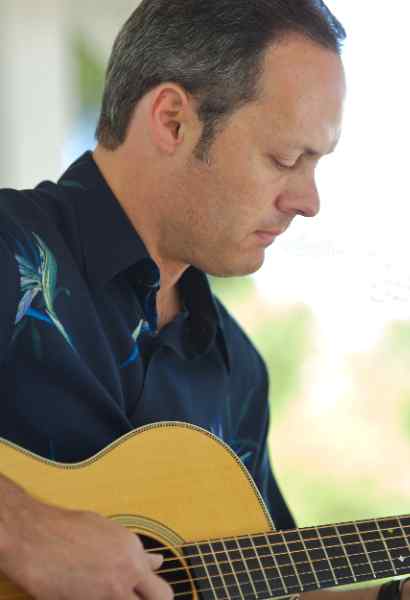
Marty Paris is not only a friend, he is also a fine acoustic guitarist. So when Marty asked me to take pictures at his open air concert this weekend I was glad to oblige, though somewhat apprehensive about the high contrast lighting issues this opportunity would present.

I would like to tell you that I took ‘just the EOS 5D and a couple of lenses’ for the ‘shoot’ (ugh!) but then I only have a couple of lenses, so that’s what I took!

The group, comprised of two guitarists, a vocalist and a drummer, would be playing at the town square in Templeton, near my home, in the shade of the bandstand. A charming throwback to all that was good and great in Norman Rockwell’s America. People gambolling about with children and dogs. A hot dog stand. Sunshine and oak trees. Church steeples at every corner with the fire engine poised in case of emergency.

All well and good, but the bright sunlight meant blown out backgrounds from the huge contrast between lighting on the performers and the park setting. So I decided to make virtue out of necessity and used the Canon 200mm f/2.8 ‘L’ lens (what a piece of glass!) mostly at f/2.8 to blur the background and give the pictures that studio look. Hardly the controlled environment of a studio, but the best I could do. The 5D was set at 400 ISO which resulted in short shutter speeds, mitigating the absence of the wonderful IS feature in the 200mm lens. Canon, are you listening? And prior experience with the 5D had confirmed that ISO 400 is grain free at any realistic enlargement size. Try that with color film!

I used that inspired little belt-mounted back up gadget, the exotically named Hyperdrive, to dowload full CF cards from the camera, alternating the one in the Hyperdrive with the one in the 5D. I ended up taking some 350 RAW pictures or some 6 cards’ full, and if you think that’s a lot, words fail me when trying to explain how many reasons there are for a bad picture in this environment. Clutter everywhere, closed eyes when they should be open, background noise, and on and on.

It took some 25 minutes to load Aperture from the Hyperdrive when getting home and, owing to Aperture’s superb user interface, only another three hours to cull the pictures down to the 85 best. That includes deletion of bad pictures, exposure correction and the occasional crop or straightening of the horizon. The only snags I ran into were that Aperture locked up on me twice when downloading from the Hyperdrive (no images were lost) and would take up to 20 seconds to load an image for processing. My iMac G5 has the modest Nvidia Radeon 6600 graphics card which is the major cause of the slow loading of an image on the screen. Then again, the iMac costs $1,500 rather than the $5,000 it would take to get a full blown Mac with a posh video card and Cinema Display. I can wait a few seconds for a picture to load at that price difference.

85 is a lot of photographs to end up with but the goal was to give each performer twenty or so pictures to choose from. You can see the snaps here.

Some practical notes from this little assignment. I set the focus sensor in the 5D to the center rectangle. I was not about to trust the camera’s system to guess optimum focus at f/2.8 with the 200mm lens when depth of field can be as little as an inch or so. I would generally take an exposure reading (using center weighting) from the concrete floor of the bandstand and lock it before composing, then locking focus with a first pressure of the shutter release on the performer’s eyes prior to final composition. This is all very fast once you get the hang of it. Despite all this I got the exposure wrong in several pictures, but RAW is so forgiving that correction in Aperture was easy without any noticeable quality loss. In particular I find the Highlights & Shadows slider in Aperture far superior to that in Photoshop as it produces far more realistic results and introduces far less noise into the image.

The slide show was generated using Aperture’s web creation function and this took far too long compared to using iPhoto. Some three hours. Apple really needs to speed this up.

The next morning I made four 13″ x 19″ prints on the HP DesignJet 90 plus five CDs with the slide show, and they were at Marty’s door by noon. I was trying to emulate what, say, a wedding pro might be faced with in delivering timely results to his client. The workflow above was encouraging in two respects. The percentage of overall time spent on processing compared to photography was relatively low and the processing experience was markedly stress free. So the 5D + RAW + Aperture + HP DesignJet proved to be a powerful and effective set of tools.

Was my ‘client’ pleased? Well, there were a lot of gurgling noises on the phone when he called back, so you be the judge. Now maybe I can get him into my studio.

The designer as star

It’s great to see the designers of innovative producets credited

Panasonic will soon release their L1 interchangeable lens SLR to market. The camera is notable for a couple of things. First, there’s the compact Leica M ‘look’, owing to the flat top, the result of using a mirror and prism design pioneered by Olympus in the brilliant Pen F half frame some thirty years ago. Second, the continuation of the Panasonic-Leica collaboration with the Panasonic vibration reduction system integrated into the ‘standard’ Leica zoom lens.

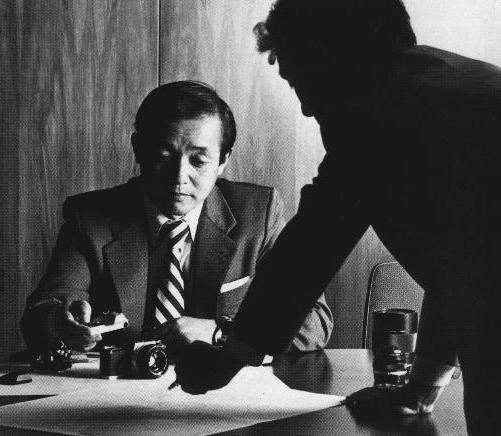
The last time I remember this sort of thing was when the inspired designer of the jewel-like Olympus Pen F and OM1 cameras, Yoshihisa Maitani, was featured prominently in advertisements, also some thirty years ago.


Maitani.

The Leica DP – Part V

Noise Ninja does a number on high ISO noise

A kind reader suggested that Noise Ninja from PictureCode might be a worthwhile product for cutting ISO 400 noise produced by the sensor in the Panasonic LX1 (or Leica DP as I prefer to think of it, once modified with a proper optical viewfinder).

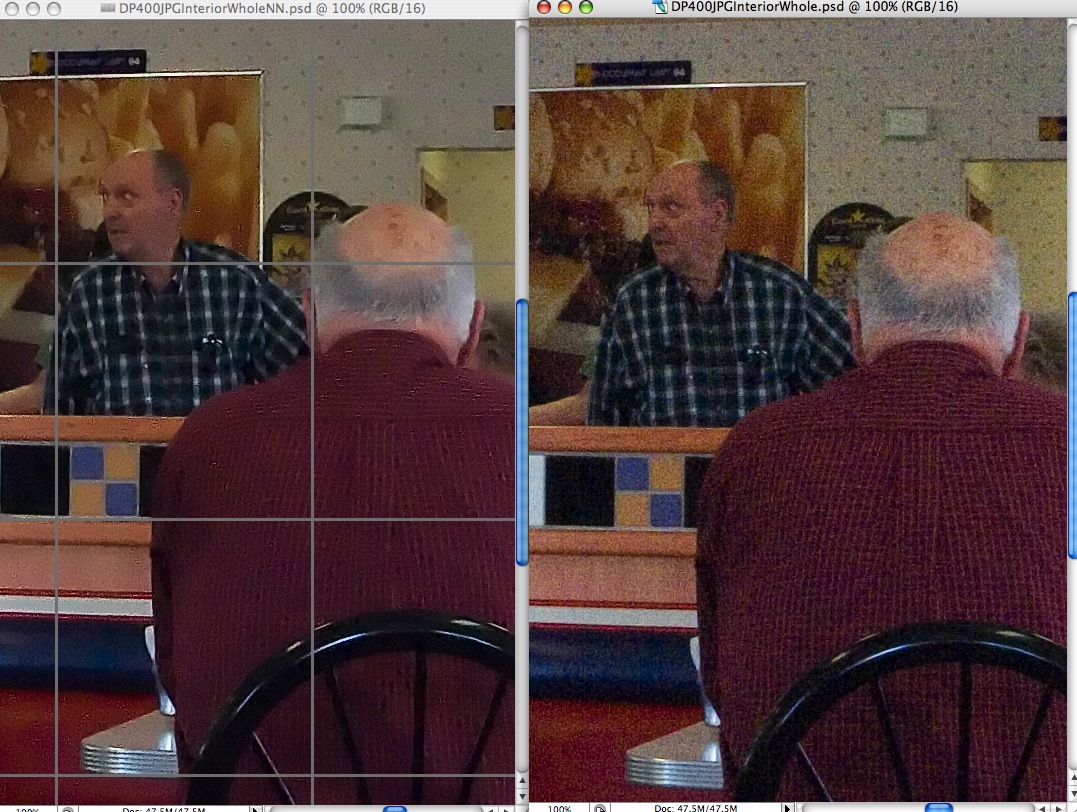
I downloaded the Photoshop CS2 plug-in and gave it a shot. PictureCode has a long listing of profiles created for many different cameras, so I downloaded that also, not really feeling up to a lot of messing about with the product’s myriad sliders, and this is what I got – the Noise Ninja version has the grid pattern as I have yet to buy and register the product:

This is the 400 ISO interior snap taken in RAW mode, best quality. While there are trade offs – look at the loss of detail in the red pin-striped shirt, you can dial in just enough noise reduction to get the color artifacts out – the standard profile might have overdone things a bit. Again, these are the size of 22” x 39” prints, so less noise reduction would be needed in regular sized prints.

Noise Ninja strikes me as a useful adjunct in the toolbox for the occasional image where ISO 400 is used indoors. Remember that the OIS vibration reduction system in the camera is good for two shutter speeds, making your ISO 100 equivalent to ISO 400, so it would be a fairly rare image that needed ISO 400.

More interestingly, Noise Ninja also has profiles for film and scanner combinations, so those plagued with noise in small 35mm negatives now have a useful tool to look to.

Rather cheekily, PictureCode provides a canned profile for the Canon EOS 5D; cheeky as the sensor in that camera has exceptionally low noise properties already.

I’ll take a look at vibration reduction, what Panasonic calls OIS, in Part VI.