Canon 200mm f/2.8 ‘L’ lens

Finally, a replacement for the magnificent Leica Apo-Telyt-R

Mention of the fabulous Leica Apo-Telyt-R lens in my column on the Leicaflex SL the other day prompts mention of its replacement which I have been using for a few weeks now on the Canon EOS 5D.

Available during the period 1975-98, the 180mm f/3.4 Apo-Telyt was one of the first Apochromatic lenses available for 35mm cameras, meaning there was no color fringing to be seen no matter how big the enlarged print. It was a surprisingly compact lens, weighing in at 1.65 lbs with its built in lens hood. Full aperture definition was as good as that at any other aperture, meaning superb, or as good as your ability to hold it steady.
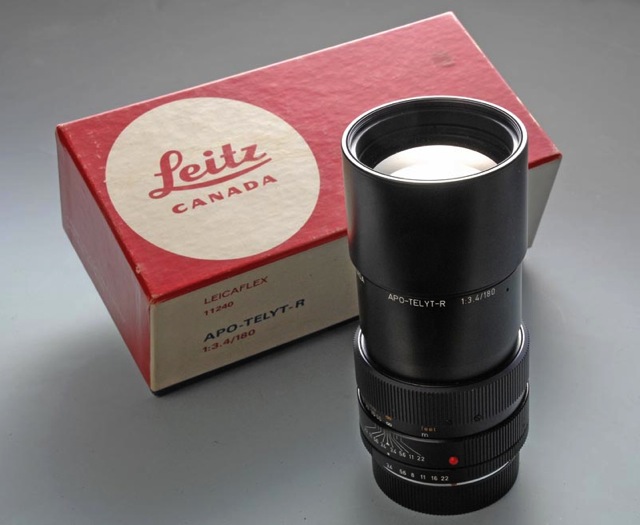

The fabulous Leitz 180mm Apo-Telyt R

While cursed with yet another clunky lens hood (why on earth did Canon abandon the earlier sliding lens hood? Another Canon lens hood in the garbage can), the Apo’s replacement on the EOS 5D is Canon’s superb 200mm f/2.8 ‘L’ lens. The ‘L’ lens adds the benefit of automatic focus, to boot. As I sold the Apo-Telyt in a moment of foolishness a few years back, I have been using the fully manual Leitz 200mm f/4 Telyt on the 5D where it works well, but you have to stop down and focus manually. A legacy of my Leica M/Visoflex housing days. Closest focus with the Canon is down to 4.9 feet (compared to a rather poor 8.2 feet for the Apo-Telyt) and can be limited to 8.2 feet in the interest of faster performance when the close-up range is not needed. Weights of the two lenses are 1.65 lbs for the Apo and 1.68 lbs for the Canon, meaning the latter uses plastics where possible as it has automatic diaphragm and focus motors to conceal in its somewhat bulkier body.

Automatic focus speed on the 5D is simply startling. So fast you don’t even think of it, though I have taken the precaution of limiting auto focus area selection to the center focus rectangle in the interests of accuracy. There’s not much depth of field at 200mm and f/2.8! The only thing missing is vibration reduction. Now that would be nice to have!

Consistent with my commitment not to get loaded down with gear, I purchased a small cylindrical soft case for the lens which attaches to my belt and, because its overall dimensions are similar to the 24-105mm f/4 ‘L’ , when one lens is on the camera the other makes its home in the belt case. Each is fitted with a clear UV filter, so only a rear cap need be used – I would dispense with that also, but the rear lens element on the zoom is too exposed to take that risk, given my proclivity to thumbprint everything.


The Canon 200mm f/2.8 and 24-105mm f/4 lenses. The zoom (right) is at its longest setting.

Why a prime lens rather than another zoom? Two reasons – weight and maximum aperture. Performance is less of a concern given the high optical standards of Canon’s ‘L’ lenses. I really do not need focal lengths between 105mm and 200mm and the 5D’s sensor allows image enlargement in this intermediate range without compromising definition. Further, any lens with a half-decent maximum aperture that zooms beyond 200mm is impossibly bulky. On the very rare occasions I need something longer I have my 400mm f/6.8 Leitz Telyt to fall back on.

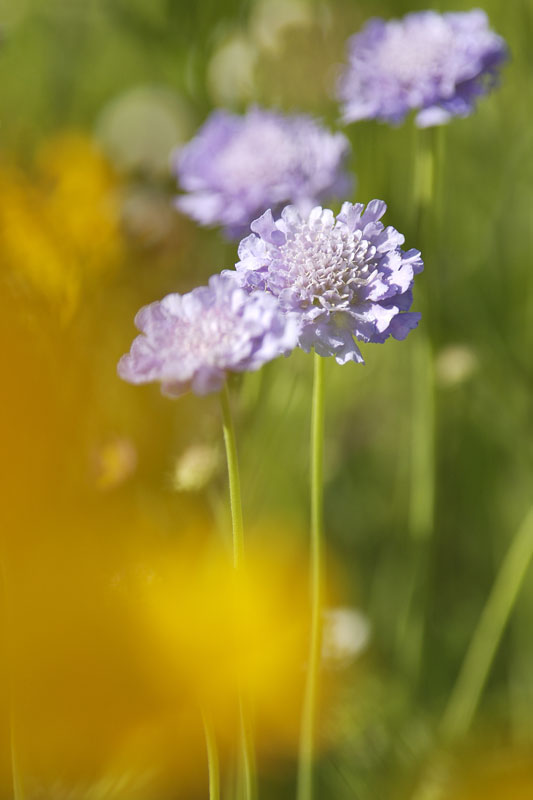
The 200mm is a fine landscape lens, compressing perspective and focusing on essentials.
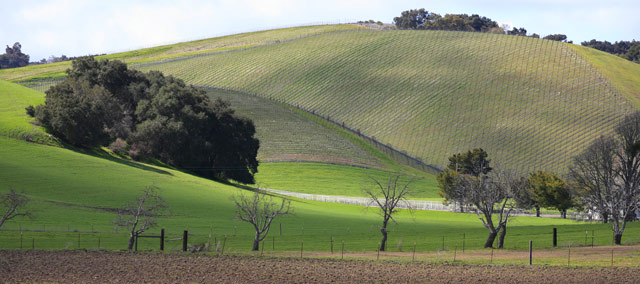

Canon EOS 5D, 200mm f/2.8 ‘L’, probably at f/5.6.

Best of all, as ‘L’ glass goes it’s positively a bargain, and chump change compared to the Leitz lens which it so ably replaces.
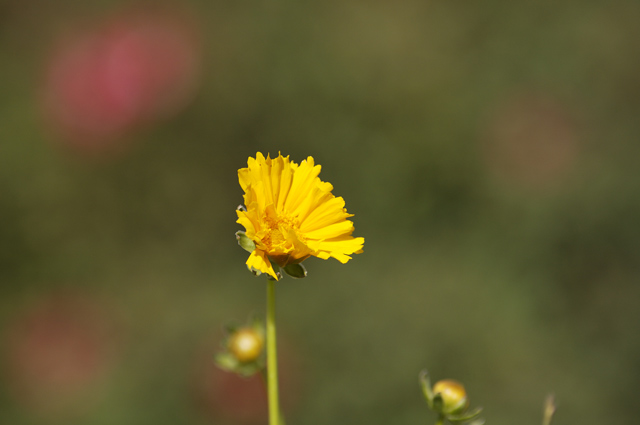

Canon EOS 5D, 200mm f/2.8 ‘L’, at f/3.5. No problem with background clutter!
Looking at pictures

You can’t beat natural light

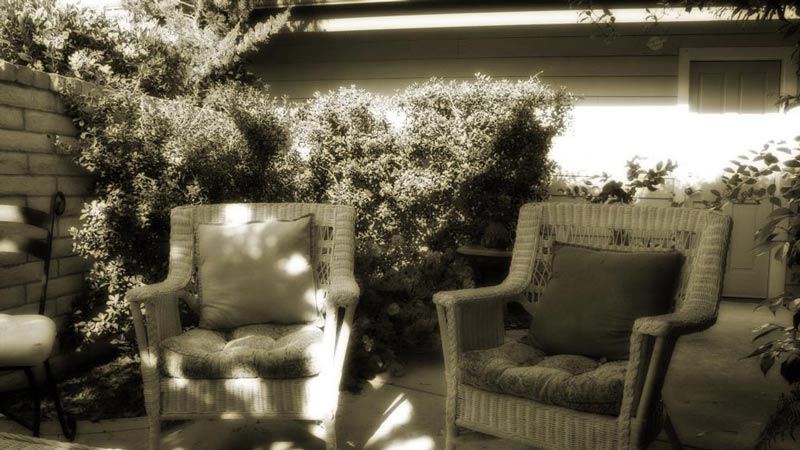
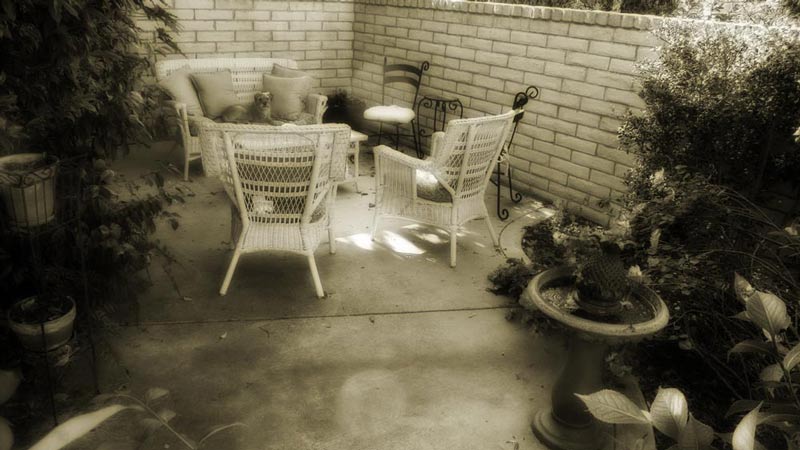
As we look forward to six dry months in central Caliornia, it’s nice to have a sheltered outdoor spot to look at pictures on those long, warm summer evenings.

This little walled patio on the north side of our home was a complete mess when we moved here a couple of years ago. As the US Government has yet to craft a method of taxing sweat equity, I set about fixing it up to make a pleasant enviroment to better enjoy the occasional book of pictures. The only taxes involved were iniquitous sales taxes which, wherever they may go rest assured it’s not to fix the local roads and freeways, which resemble those of a third world nation.

No matter. Get rid of the horrible hot tub that so spoiled this lovely spot, add a few rose bushes and magnolias, some mulch, a small fountain to set the tone and a few pieces of wicker furniture from the far east and you have the makings of a fine outdoor reading room. The tub was sold to a neighbor and the proceeds invested in what you see here. Throw in a Border Terrier and things are nigh perfect.

Yesterday evening I was leafing through Michael Kenna’s work in the beautifully printed ‘A Twenty Year Retrospective’ and couldn’t help but remark on how the prints looked so much better in the warm outdoor light. His photographs are reproduced in a gentle sepia which adds greatly to the overall feel. Kenna has a strong, consistent style and while the book credits him with works in many US public gallery collections, you would probably expect to find it on the wood panelled walls of classier business institutions like private banks and financial advisors.

Anyway, with all that sepia going on, I grabbed that little jewel, the Leica DP, and took a couple of snaps to illustrate this piece. A few seconds with Photoshop saw the RAW images converted to TIF files whence two more clicks saw monochrome conversion and sepia toning.

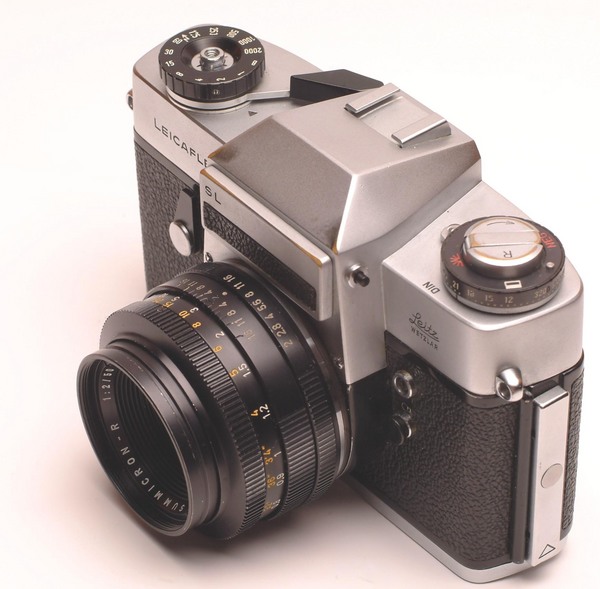
The Leicaflex SL

Simple, sturdy and with great lenses, you can pick up this behemoth for very little

While classic rangefinder Leicas continue to appreciate as doctors, dentists and investment bankers fill their display cases, fine cameras like the Leicaflex SL, which never really caught on, can be had very inexpensively.

I used one for many years, during the period 1977 though 1990, starting with a 50mm Summicron lens, adding a 21mm, a 90mm Summicron for portraits and the superb 180mm Apo-Telyt R for landscape pictures. As good an optic as I have ever used.

Provided you were in no great hurry and didn’t mind the noise, it was hard to take a bad picture with this camera. The camera was big and rather clunky, the wind lever had way too long an arc but the controls were nice and large meaning use with gloves on was no problem.

What I liked most was the semi-spot meter. The excellent microprism focusing circle also defined the exact area of measurement for the meter and was large enough that you didn’t get all nervy the way you do with a spot meter. It was a match needle design, meaning you had to align two needles, visible only in the viewfinder. Adding or deducting a stop for light correction was very easy with the camera at eye level, as the viewfinder displayed the selected shutter speed and was very easy to see with or without eyeglasses.

This was one of the last of the all mechanical cameras which have now largely disappeared, but proved very reliable in all weather conditions. True, the camera had looks only a mother could love but the lenses were superb regardless of focal length.

As Leica has since added all sorts of electronic gizmo connections in its SLR lenses in a futile attempt to keep up with the times, the earlier two cam mechanical lenses can be had very inexpensively. While the build quality never felt up to early Leica M standards (meaning M2, M3 and M4), I had no reliability problems, and the uncluttered viewfinder was a joy to use. A great starter camera for someone getting serious and willing to put up with the shortcomings of film.

Anchorage, Alaska. 1978. Leicaflex SL, 50mm Summicron R, Kodachrome 64

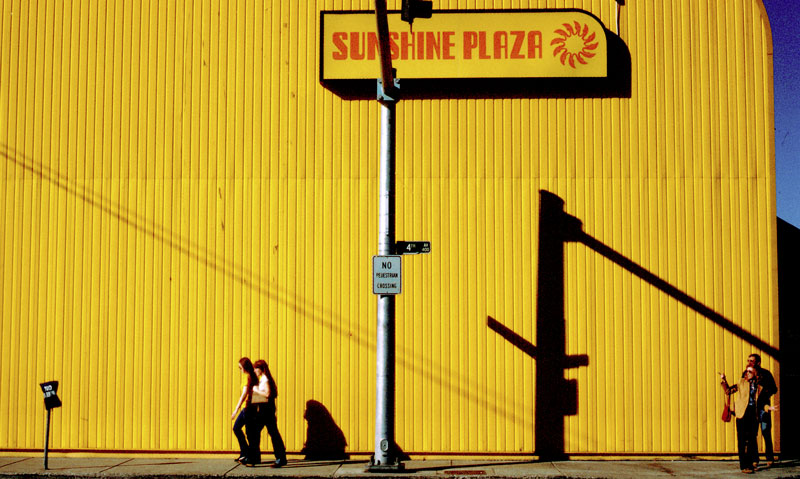
New York City. 1985. Leicaflex SL, 21mm Super-Angulon R, Kodachrome 64

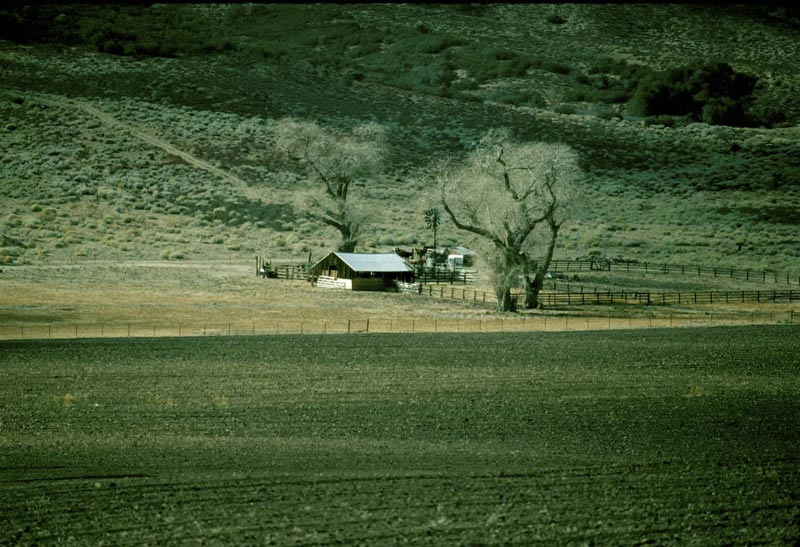
Lake Elizabeth, California. 1990. Leicaflex SL, 180mm Apo-Telyt R, Kodachrome 64

The Leica DP – Part VI

Vibration reduction at work

The Lumix LX1 uses two motion sensors, one for vertical and the other for hoizontal motion. These feed the opposite of any motion they detect to the lens assembly to reduce the effects of definition-robbing camera shake on the image. Panasonic calls it ‘Mega OIS’ which sounds rather grand, no? A related benefit is that with the two shutter speeds thus gained – meaning you can use 1/15th where 1/60th was safe before – is that ISO 100 becomes in effect ISO 400, with attendant benefits on reduced sensor noise; as I illustrated earlier, the camera’s sensor is somewhat noisy at ISO 400.

Sceptical?

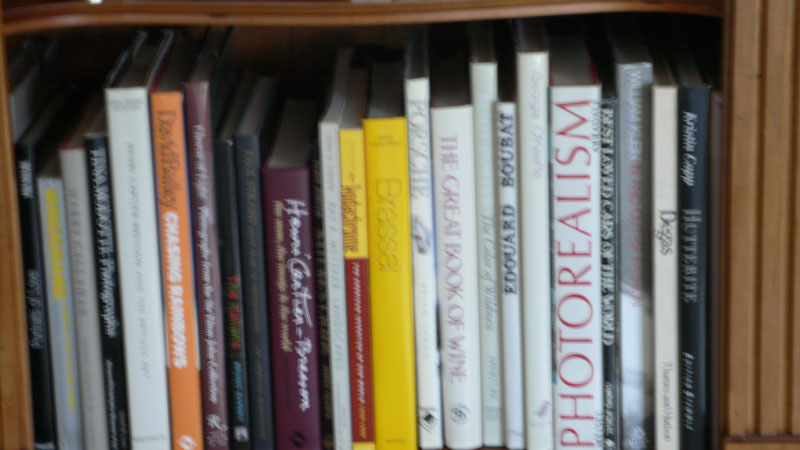
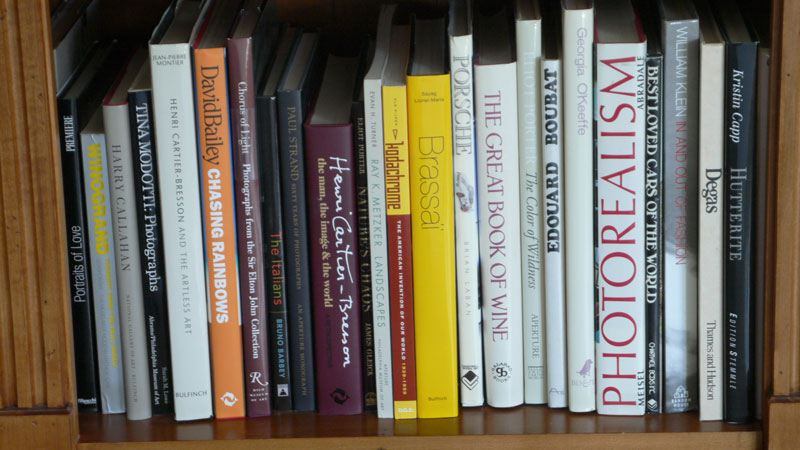
Here are two pictures, taken seconds apart, of one of my bookshelves, hand held, taken at the longest lens setting (to emphasize shake) and 1/4 second at ISO 100. Care to guess which one had vibration reduction switched on?

I use Mode 2 OIS, meaning the OIS is switched on the moment the shutter is pressed; I have no need of Mode 1 – on all the time – as I use my glued on 28mm Voigtlander optical viewfinder to compose, not the LCD screen. And as the camera always starts with the lens at 28mm no matter where it was when switched off or powered down, there is no risk of using an optical viewfinder not matched to the lens.

This wonderful vibration reduction system will add more quality to a picture than any amount spent on expensive glass without this feature. I like to think that my 28mm f/2.8 Lumix Leica lens has just become an f/1.4, which, in effect, it has. Anyone with a 28mm f/2 Leica Aspherical Summicron on their Leica care to challenge me at 1/4 second? 13″ x 19″ prints at two paces. And by the way, your competing camera and lens will have cost some ten times the price of the Lumix LX1. Too bad. Someone steals your rig and you have a problem. They can’t steal mine unless they requisition my jeans, because that’s where this little jewel resides.

Oh! and did I mention the widescreen capabilty you see above?

In the flower garden

Modern equipment makes photographing things very easy

I have a love hate relationship with my garden. With a couple of acres of flowers, lawns and trees it would be disingenuous to say that upkeep is trivial. Far from it. And it’s not something you can delegate to one of the local butchers who poses as a ‘Landscape Maintenance’ expert. If the fellow cares to turn up at all, it’s hung over and wanting to discuss the inane arcana of some sporting event, likely as not. His equipment will almost certainly suffer one of its many routine breakdowns and he seems to think that his high school education, or lack thereof, makes his time worth $100 an hour. Bloody hell, it took me fifteen years in school and ten in the work place before I made that sort of money. So you can understand when I gag at the thought of this person and his like earning $200,000 a year. This sort of thing simply has to stop. Thank goodness for all those fine Hispanic immigrants keeping prices down. Indeed, on reflection, I have learned ten times more from the Hispanics who help me with the vineyard than I have from Whitey who buys my crop and makes it into wine. Plus their $10 per hour rate sounds about right to me.

The result is that I look after my own garden. One hour every morning and one every evening keeps things shipshape and puts one more psychoanalyst out of business, which can only be a good thing. But the work can be hard and the frustrations are many, mostly involved with fighting a collection of moles, weeds, ground squirrels and various other invaders seeking to lay things low. Just like real life, I suppose. The majority is comprised of unproductive hangers on.

Working on the garden is very much like managing money. Short term decisions may yield quick results but overall quality and returns are invariably compromised. Good work done today repays the effort a year or two down the road. So now I am beginning to reap the benefits of much missionary work invested in the garden over the past two years. Walking around the estate of an evening, Border Terrier in tow, the prevailing emotion experienced in surveying the results is one of simple, unalloyed joy. Unlike photography, however, the tools used for gardening really have changed little over the centuries. Sure, we fat, lazy Americans use power tools wherever possible, but when it comes to planting or weeding, good old fashioned sweat equity is the only investment that yields returns.

Every year about this time I make a few pictures of the garden and place them on our family web site. This serves a couple of purposes. First, it allows the historian in me to survey rates of progress. Second, it helps with overall design, as a picture viewed in the cold light of day on a computer screen tends to make for more objective assessment than a casual ramble around the property.

No, I am not about to bore you with images of flowers. For the most part, pictures of flowers and babies are things to share with your childern’s grandparents, not with those friends with the pained, slightly impatient smiles. But banging away the other day with the EOS 5D with that superb 200mm ‘L’ lens, I couldn’t help thinking how wonderfully accommodating modern camera technology has become. There are so few technical things to think about that all one’s concentration can be devoted to the task of composition. No need to worry about focus, camera shake, exposure, film choice or processing.

So before I knew it I had a couple of film rolls’ worth of snaps of the blooms in the garden on our web site, each sharp as can be and exposed just so. Now try doing that with the equipment available some twenty years ago. Of course you could do it just as well, but you would have to use a great deal of film to get the same results. And you wouldn’t have those for several days. And how exactly would you propose to have no grain in your 400 ISO film snaps, especially when you need all the film speed you can get to guarantee short shutter speeds in the prevailing breeze? The same breeze that makes the estate the haven it is on a warm California evening.

Young people coming into the photography avocation today are very fortunate not to have to struggle with all that gobbledegook about technique. Just bang away and learn from your mistakes – that’s a far faster learning method than anything in a book on technique. A fast feedback loop, if you like. And would my modern pictures be any the worse had I not spent 40 years using film? No, not at all. The learning of those years can be condensed into days with good modern equipment.

Canon EOS 5D, 200mm at f/3.5, ISO 400, hand held in the wind, probably 1/2000th or less