Good Photographs and Car Accidents

Good photographs are like car accidents. Most happen close to home.

At first that sounds trite but a moment of reflection on the simple mathematics of travel discloses that most of our lives are spent close to home. We spend more time in the garage starting the car and waiting for the door to open than at any other point of any journey. Over many trips, a greater percentage of time is spent one mile from home than two. Travel five miles and you have to travel mile one. Travel a thousand and you still travel mile one. And so on. That is why most car accidents occur close to home, because that is where you spend most time.

That, too, is why most good photographic opportunities are close to home. The harried tourist, trying to find his way around Paris with a guide book, poor French and the ever helpful Parisian to guide him, arrives at the Eiffel Tower stressed and late. He is also tired, having lugged his gear a considerable distance in search of that once in a lifetime snap, aware that the chances of revisiting this location are remote. So to add to the newness of the environment are the additional pressures of failure (“I only have one chance to get this right”), time pressures (“Must not miss that flight”) and equipment concerns (“Did I pack that ultra-wide lens?”). The lighting is new, the length of daylight is new, the feel of the place is new. In other words, there are so many environmental changes that the chances of taking a well thought out, skillfully composed photograph are remote. As remote as the location.

Now compare that to the situation back home. You know the area within a five mile radius of your home like the back of your hand. If you don’t, well then you lack the curiosity to be a photographer. You have photographed it often, seeing new things every time, looking through ever more inquiring eyes, varying the time of day and enjoying various weather conditions. It matters not whether home is the Bronx or Brighton, there are as many photographic opportunities close to your home as anywhere else. No, there are more because you have time to see and think, luxuries not available to other than the most affluent tourist who can afford a month’s stay at a remote location of choice.

When I compiled my book Street Smarts, most of whose content is comprised of street shots in London in the mid-1970s, it dawned on me that over ninety percent of those pictures were taken within five miles of home. These were areas I knew and loved and had visited many times. The wonderful words Alan Jay Lerner placed in Henry Higgins’s mouth in My Fair Lady come to mind:

I’ve Grown Accustomed to Her Face
She almost makes the day begin.
I’ve grown accustomed to the tune
She whistles night and noon.
Her smiles, her frowns,
Her ups, her downs
Are second nature to me now;
Like breathing out and breathing in.
I was serenely independent and content before we met;
Surely I could always be that way again and yet
I’ve grown accustomed to her looks;
Accustomed to her voice;
Accustomed to her face.

And that is exactly how I thought of the London I was photographing. Our relationship was a continuum, having good days and bad, great weather and foul, exhilaration and despair.

And that, whether you love your location or hate it, is how, I suggest, you feel about it too.

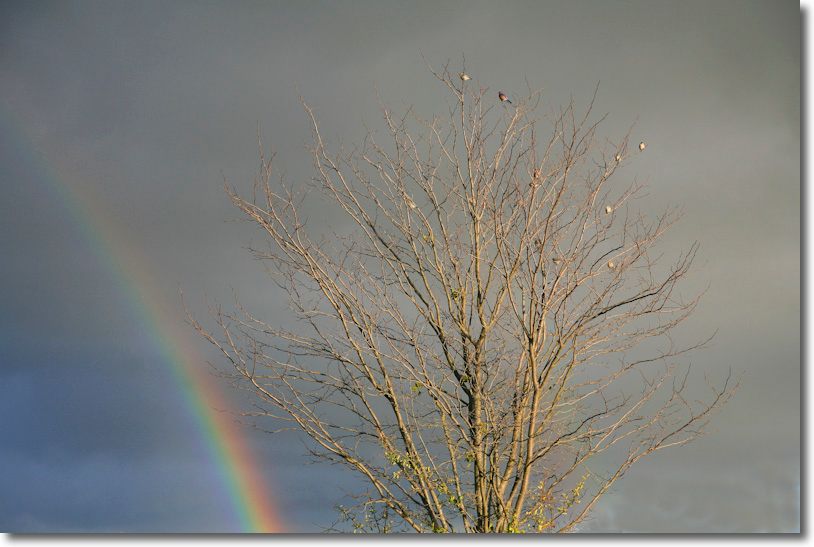
So the best pictures are to be found on your doorstep as no one knows it as well as you. The following snap is of an olive tree on my California estate, outside the window on my left as I write. It was taken last November from my front porch, with the photographer splendidly attired in paisley pajamas and that dashing terry cloth robe which gives me the looks of a movie star. A foul morning, foggy and damp. But second nature to me now.

The best photographs are to be found close to home.

Forget Technique

My learning experiences with my newly acquired large format Crown Graphic 4” x 5” camera have reminded me what a bore technique really is when it comes to photography. Or, more accurately, the job of learning a new technique. The most intrusive aspect of this learning experience is that it really gets in the way of taking pictures, and the more I find myself thinking about technique the more distracted my picture taking becomes.

I suppose there are many analogies to the bother that is technique in everyday life. Driving a car smoothly, making a perfect mortise and tenon joint in two pieces of wood, learning your way around some new piece of software. Heck, remember the first time you made love? Your major concern was not enjoyment. It was technique, assuming you were sober enough to remember anything. In these, and innumerable other examples, once technique is mastered, enjoyment begins. So I tend to see technique as an obstacle to enjoyment or, in creative pursuits, to creativity. Which is the same thing.

I started taking pictures and being serious about it – meaning I wanted to produce good work – when I got my first Leica at the age of eighteen. Up to then picture taking had been nothing more than dilettante dabbling. In realizing that fewer variables made for less to worry about, I standardized on one lens (well, it’s all I had in any case), one make of film (TriX) and one developer (D76). Over-exposure, I quickly learned, was the death knell of definition, underexposure playing havoc with shadow detail and dynamic range (though we didn’t call it that in those days). So the first technical lesson was to get the exposure more or less right. Then memorizing which direction the controls had to be turned to focus and adjust exposure was critical. As my avocation was street shooting, no time could be spent thinking about these. Finally, the chemical darkroom (ugh!) required learning how to black the room out properly, get the foul, smelly chemicals at the right temperature (68F in frigid London was not always that easy) and then exposing the paper properly. Of course, unlike modern digital back ends, making two identical prints was more a case of luck than judgement, but after a while, and not a few sheets of wasted paper, 8”x10” prints started to roll off the old Gamer enlarger like GM makes cars, if maybe not as quickly. At least the quality was better than Detroit’s.

It really showed in the negatives. A few years ago when I got my first decent negative scanner and printer I could see how the early monochrome work got consistently better, the success rate higher, after the first few dozen rolls of film. In those days you submitted pictures for publication as prints in the mail, so they had to be good prints. A good print, it seemed, put you in the 10% pile immediately – the non-rejects. Those many years later, learning ’darkroom’ technique again, as applied to those old TriX negatives, was trivial compared to what the chemical darkroom called for. You could scan at high or low definition but a simple, high resolution unmanipulated scan allowed you maximum flexibility in Photoshop. Sadly, the scanning software could not apply its dust and scratch reduction to the silver based originals, reminding me how bad my drying technique for film had been all those years ago. At least retouching was now a one-off prospect, and not something to be done on each print. Can you imagine a worse use of your time than retouching dust and scratches? I cannot.

I have not had a chemical darkroom for over 25 years now. First, I realized that I was adding no value to my pictures by developing my own film. So I let labs do it. Their volumes assured consistency and the better ones guaranteed quality. Never mind black and white, think of the complexities added when you process color. There is simply no earthly justification for processing your own film. Period. In other words, I delegated that aspect of technique to those more competent than I. And as my time saved was worth more to me than the incremental cost of delegating the task, I made money into the bargain. Not bad.

Then in the 1980s through the mid-1990s, before scanners and printers became affordable, I delegated all my printing to labs also. Same reasons. Just a question of finding one you liked. No one, but no one, has ever asked me whether I printed a picture myself or whether a lab did it. Except, that is, for equipment geeks, whom I try to avoid at all costs. truth be told, something was lacking in the prints however, for dodging and burning was not something easily delegated. But mostly the results were good enough.

Then, when really good printers and scanners became available for home use, I could recapture the creative side by doing my own scanning and printing using Photoshop with just those tweaks to the image I wanted. After learning the technique (if, indeed, anyone can ever claim to have learned Photoshop), control was reestablished over the creative process. For some, back end manipulation is 90% of the creative process. Ansel Adams for example. Mediocre photographer, great darkroom technician. For others, back-end technique is 10% of the process. I’m at the 10% end, mostly. But the point is that the technique, once learned, is subsumed to the creative process. The technique, in other words, becomes invisible and ceases to be an obstacle, as it has become second nature.

When I got my first wide carriage printer, I set the simple technical goal that any scanned original – whether 35mm or medium format, and now large format – would yield a sharp, 13” x 19” print of broad dynamic range, by default. Not by accident.

So as I find myself struggling to master the new aspects of technique of large format photography, I am making strenuous efforts to make these techniques second nature. Some are trivial. It is, for example, very difficult not to take a very sharp picture. A 4” x 5” negative does not need much enlarging! Anyone can make huge, crisp prints from large format originals. Hardly something to set as a goal. But loading those blamed film holders, packing that heavy gear, messing with swings and tilts and clumsy controls, and not letting all that process get in the way of seeing, that takes some learning.

So my advice to you is the same that I follow – work hard, work fast to get that technique down so that it becomes second nature, then forget about it and get on with the creative side. Your pictures will immediately be better and it will show. And don’t let anyone tell you it takes years to learn this or that aspect of technique. It does not. Those who would tell you otherwise are trying to safeguard their not so precious secrets. Avoid them.

My second 4″ x 5″ photograph. Technique is getting there….

More large format adventures

I finally got the first 4”x5” negatives back from the processor and began making some 13” x 19” prints. Amazingly, I had managed to load the film in the right way around and all the exposures, using my highly refined Modified Zone System (see June 25, 2005, below), were spot on. It probably did no harm to use negative film with its enhanced latitude for error even if the orange masked-negatives are harder to evaluate than transparencies.

My first reactions on getting the 13 negatives back was shock – those are really large pieces of film – and satisfaction when I saw just the very high level of definition they possessed. The mask in my flat bed film holder is actually 3.7” x 4.7”, so a 13” x 19” print works out to an enlargement ratio of only 4x so it’s hardly a surprise to see that sharpness and detail are the order of the day.

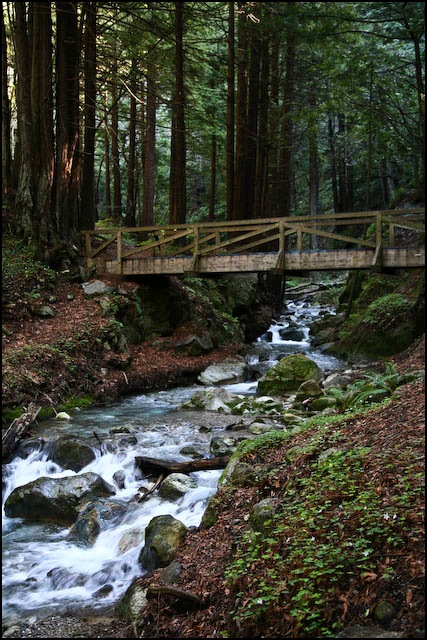
On my first outing I had taken just four pictures, constrained by the fact that the Crown Graphic camera came with just two film holders. One of those four was double exposed. Don’t ask. What with all the rushing water and beauty of nature going on, I couldn’t hear the shutter trip so tripped it….again. Now if I had been using a Holga or similar toy camera the result would have immediately qualified as Art, but I instead consigned it to the round file.

On my second outing I had taken 12 more pictures, using the six additional film holders I had since acquired. Well, that turned out to be 11 pictures as I had inserted one of the film sheets incorrectly and had to pull the holder out of the camera without its dark slide, the latter proving impossible to replace. There I am, standing in the middle of the street, struggling with a sheet of film, more than a tad over-exposed, hoping no one was witnessing this debacle. Indeed, I found out that I have to do a good deal more practicing with film loading as a couple of my other shots were less than centered on the sheet. However, the film is so much thicker than 120 roll film that handling it is a joy and no cotton gloves are needed as it does not buckle when held by the edges.

Scanning on my flatbed was very simple, if slow, at 2400 dpi – I reckon that will give me the requisite 300 dpi at an 8x enlargement ratio, which is a print sized no less than 32” x 40”. Now that is really large! I found there is no need for a glass film holder, once more thanks to the high rigidity and flatness of the negative. The scans in PSD or TIFF format come in at 280 megabytes, give or take, and that takes a while to load on the computer.

Over the past week I had finally bitten the bullet and decided to upgrade my outstanding Apple iMac G4 (the one that had locked up once in thirty months on, you guessed it, a Microsoft Excel spreadsheet) to an iMac G5. A colleague had reported how his dad was loading large files in no time, so it wasn’t just the mildly enhanced CPU speed at work – Apple must have done something to upgrade image processing. By way of comparison, as 250 megabyte medium format scan which would take 90 seconds to load now loads in 10 (yes, 10!) and all related actions – like rotation, levels, sharpening, etc in Photoshop are similarly faster. The time savings really add up, for 90 seconds is too short to leave the computer to do something else and too long to be fun.

Once I took a hard look at the scans I could see that the four element Schneider Xenar lens – probably single coated given it’s 40+ years in age – is a tad prone to flare into the light, so I will have to watch that, but covers with high resolution to the edges of the frame, although I should add that I have not used any swings or tilts to really test edge definition.

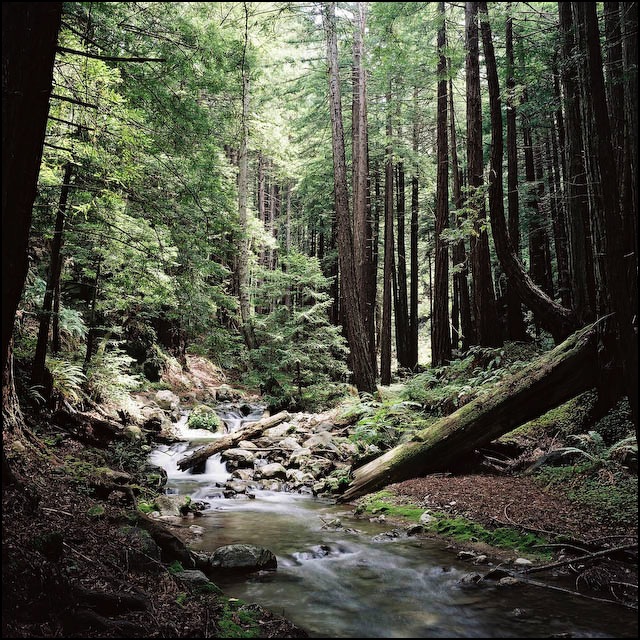
Anywhere, here is a much reduced version of my first every 4” x 5” photograph in one of the magnificent redwood forests off Highway 1 in California – 4 seconds at f/32 if you must know:

On my second outing I had decided to use the Crown as a hand held rangefinder camera and while this occasioned more than one questioning look from passers by (they did at least give me generous space on account of my presumed lunacy), it turned out to be wonderfully engineered for just this purpose, even if film changing is a bit of a challenge if you only have two hands. The New York street photographer of the 1940s, Weegee, knew what he was on to.

Here’s the first hand held shot in one of those many broken down old towns in central California:

So, all in all, this Crown Graphic experiment has all the makings of a beautiful friendship, once I learn to load those film holders correctly.

Is it enough if you just enjoy it?

It was the height of the tech boom. 1999. A close friend of mine, maybe the person I care more for than anyone I know, had hit it big. He’s a modest man, not given to self-aggrandisement. But he had had a tough childhood, he had married the woman of his dreams relatively late in life and he had had made a son of whom he was justly proud, even though the making had come rather late.

So for the first time, he had said ‘What the heck!. I’m going to get a beautiful place, the better to see the wife and child grow’. And because the wife, at her not-so-tender age had expressed an interest in the piano, something very close to my friend’s heart, why, he went out and got her the very best he could afford, to be installed in the place of honor in his splendid, new estate in America’s most hallowed zip code. Not only was this piano imported directly from Germany but it came replete with the maker’s signature, no less.

I will never forget the look of sheer delight on his face the day it arrived. ‘Thomas’ he called excitedly, ‘You have got to see this thing’. Now while my friend was endowed with something akin to perfect pitch, he couldn’t play a note if you paid him. But he knew the instrument of his choice was capable of great things. Indeed, the sound was beyond compare. My friend had invited a classical pianist to put the instrument through its paces and some four of Chopin’s Nocturnes later you new that heaven was close indeed.

For a while there after that magical evening I lost track of him and his wife, the pianist in the making. He survived the fallout in the markets in 2000, moved on to better things and took the wife with him. Then we happened to bump into one another again and wiled away a pleasant evening over a couple of bottles of Napa’s finest with the food prepared just so.

“She cannot play to save her life”, he said, once well into his cups. “Come now”, I responded, “let’s not be so cruel. After all, you cannot fault the effort she puts into the thing”. For try she did. Twice weekly lessons, endless practice, scores by the….well…score. If effort correlated with results, the woman would have surpassed Horowitz. Sadly, she was proof of just one more example that you cannot put in what God leaves out, and that fateful evening, my friend had realized the truth of the matter, cruel as it may be. His piano was nothing more than a piece of beautiful furniture. It was a Leica in a glass case. There to be admired, but if the aesthetic senses of the world were to be saved, never to be used.

So is it enough if you just enjoy it? Does it matter that you have spent the earth and accomplished nothing except, maybe, a blip on the manufacturer’s bottom line. Do you grin and bear it and say, well, I tried?

The economic reality, of course, is that without consumers like my friend there would be no economy. Ferrari owners who cannot drive. Steinway owners who cannot play. And Leica owners who cannot take a photograph. But it is not fair to denigrate these folks. They are, after all, a source of cheap supply of the world’s finest equipment to those of us who dare not, or cannot, buy it new.

An exchange of shared values

The UPS driver was getting used to the routine.

Every Friday there was a delivery to the estate from B&H in New York. Place your order for film or paper or printing inks on a Sunday and the following Friday, as sure as the Government wants your money every April 15th, UPS arrives at your door with the supplies.

A First Class Business selling First Class Products delivered by a First Class Business.

Now this little haven in the undiscovered central coast of California, has much to recommend it. Beautiful landscape, vineyards as far as the eye can see (not least the few acres of Zinfandel we pride ourselves on, affording isolation from all and sundry, and looking gorgeous in the process) and fine, honest Americans.

So we got to chatting, every Friday, our UPS man and I. There’s something about UPS that encourages that sort of relationship. FedEx doesn’t have it. Too harried, no time for civilized discourse. The grandly named United States Post Office obviously does not. Are you going to trust someone who takes your tax dollars? But no one refers to the UPS man. It’s always our UPS man.

So after a few months of this routine, and after copious quantities of Portra, Gold and Epson paper and inks had been delivered, it was natural to graduate to first name terms. I’m Marty. Hi, I’m Thomas.

And thus it went for a few more months. Ice is hard to break and these UPS chaps have it in their veins in abundance. As is well known, every one wants a UPS man of their own.

Then, the other day, Marty opens up with “I’m giving a concert at Castoro this Sunday at 3 p.m.”

Let me start by saying that Castoro makes the second best zinfandel on the Central Coast. Needless to add, Chateau Winston, named after my son, a.k.a. the family abode, is superior. Both reside in that small area of paradise known as the Templeton Gap, west of Highway 101 and south of Highway 46. The world’s best Zinfandel grapes make their home there.

Before I could ask ‘What do you play’ Martin Paris proferred a CD with a picture of him on the cover, acoustic guitar and all. Without thinking, after profuse thanks, I offered that I was a photographer and could I please inscribe a copy of my book for you? The thought of commerce did not remotely enter my head. After all, it hardly needs saying that playing classical instruments or taking art photographs are two of the least commercial enterprises on this God’s earth. So we made an exchange. Marty’s Spanish guitar playing, all of his own compositions, is simply wonderful. His generosity of spirit and basic sense of American decency unsurpassed. My book of picture is….well, you be the judge.

So we exchanged good wishes. Marty signed his CD “Thomas – All My Best” and I reciprocated with “For Martin – with thanks for the beauty you have brought us”.

This little episode, seemingly insignificant in the grand panoply of life, brings us back to the central beliefs of these essays. Show your work and you will be rewarded. The rewards may be psychic rather than financial, but they are deep and lasting.

Publish a book. Now. Have something to exchange.

The vines doing their thing on the estate, framed by a cottonwood.