2005 – taking stock.

So what was accomplished, photographically speaking?

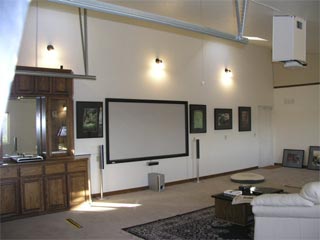
I was hanging some of my Really Large Prints the other day in the new home theater I had built – it’s actually a converted garage – which gave me pause to ask “What did you accomplish last year”?

As a matter of course I make it a practice to write down what I did right and wrong in managing money during the year for, while the lawyers keep reminding us that ‘Past performance is no guarantee of future results’ I tend to hew to Churchill’s variant which has it that ‘Those who deny history are doomed to repeat it’. In re-reading these self critical pieces over the years, recurring patterns of erroneous behavior are identified and, hopefully, remedied.

So to take a like approach to photography seems to make better sense as my driving goal is to take better pictures.

But what does ‘better’ mean? Those which get exhibited? Sold? Hung? Probably a mixture of all three. If you don’t show it you will never know how good you are. If you don’t sell it you are a commercial failure which may be good or bad. If you don’t hang it why on earth are you taking pictures in the first place? And while ‘exhibit’ takes increasingly new guises – books, cell phones, computers, the internet, a well framed picture hanging on the wall remains the touchstone of photographic display.

Well, what about the successes? Listing these first makes it easier to enumerate the failures.

I published my book Street Smarts, containing 100 monochrome pictures taken in London and Paris in the seventies. It taught me how hard it is to get all the material together, how difficult it is to get it all submitted and looking just so, and how impossible it is to sell a book of pictures. This is the ultimate vanity project – you may feel good about doing it but don’t expect to make money. Best of all, this allowed me to get all that monochrome content well and truly out of my system and free me up from the legacy overhang of being a ‘street’ photographer. That genre is done, for me at least.

I got rid of a bunch of excess gear that was just collecting dust, and I’m not a gear collector. Now I’m down to one 35mm system (Leica M), two 6×6 systems (Rollei 6003 and Mamiya 6) and one 4×5 system (Crown Graphic). I fancy the clunky Rollei 6003 will hit the block in 2006. Too much gear still!

I learned lots about 4×5 when I picked up my 50 year old Crown Graphic and a couple of extra lenses for a song. What a blast to use and negative quality that remains unsurpassed to this day.

I started this blog which forces me to put down in writing what I am thinking about the world of photography. Write it down, the old rule has it, and it’s serious. Talk or think about it and it’s noise.

I got selected for a one man show – due in 2007 – at a local gallery after showing the director my prints. That felt really good as it confirmed that I have the drudgery of printing/mounting/framing down to where it no longer intrudes in the creative process. It felt even better to know that someone else liked my work. And no, she did not ask me what camera I use. And, best of all, all the pictures were New Work, not recycled old stuff.

I started a Photoblog and came away with mixed feelings. The positive is that there’s lots of great work out there. The negative is that most of what’s out there is sheer, unmitigated garbage. I also learned that my dated use of film as a recording medium is incompatible with the ‘picture a day’ pressure in the Photoblog world, so I stepped back and now post one a month, if that. Feels better until digital matures and all that film equipment can go to a collector at some ridiculous premium to what I paid for it. Thank God for the Japanese – where would the used Leica market be without them?

I built my home theater which comes with one huge photographic advantage. Lots of display space.
I confirmed, if ever confirmation was needed, that the products of the Microsoft Corporation are one of the biggest frauds ever pulled on the consuming public and remain blissfully happy with my iMac three years after making the switch. No downtime, just speed to get the drudgery part of the photographic process done. Bottom feeding tort lawyers continue to sue cigarette and hamburger vendors. Wrong place to fish. When will they realize that Microsoft has killed more people than these twin evils combined? Just think of all those coronaries at the keyboard of a Windows PC….

I learned, as age encroaches, that many tasks are best delegated to those better skilled to do them. Processing, framing and so on. I add no value here.

I re-immersed myself in books about art and photography and tried hard to sharpen my vision.

Hmmm. Not a bad list. Feeling pretty good. OK then, what about the not so good bits?

My vision still lack clarity. Thematic approaches to photography make sense. The ‘always carry a camera’ thing is meaningless. Carry it with a mission and you get somewhere. I tried to apply this last year by focusing on three themes – The Fading Past (old wall signs), The Beach Creatures (driftwood at the beach) and The California Forests (I’m quite useless at these but keep trying).

I would like to become technically better with the 4×5 format for it has so much to offer. Maybe it’s just in the nature of things, I tell myself, that the equipment is clunky and a mess to use.

I would like to delegate all printing of Really Big Prints as it’s simply a waste of time when others can do it better and you are messing about with the yet again clogged ink jet printer at home. And I’ll bet the cost is comparable. Got to find a good printer for 2006.

I cannot consistently take good pictures. Maybe that’s because I do not do it enough or maybe it’s the unexplainable nature of the creative process. Sometimes you can do it, mostly you cannot. I do know that machine gunning for pictures is anathema to me and only results in a drop in quality so some other mechanism is needed. One thing I have found that works is to scout out a location without a camera, pre-visualize it – then come back later with the equipment. That seems consonant with my working style.

And, finally, I am still very keen to go all digital, but have yet to find a camera which does it for me.
Delegate the drudge of routine printing

American ingenuity never ceases to amaze.

Every year about this time our family – my wife, our son, the dog, the cat and I – engage in a nerve trying ritual.

The annual Christmas postcard picture.

For years now we have been taking this picture on the nearest point and shoot digital camera which falls to hand as the probability of catching all five cast members with bright smiles, good expressions and open eyes is …. well about as likely as that of finding a politician with integrity. Not impossible, but difficult, to say the least. So we place the camera on a tripod, gather together and bang away. Twenty tries usually does it. This year it was twenty one. Digital, of course, with its instant feedback, ensures we get something useable without having to wait for the film to come back from processing and going through the whole ordeal again.

Now, the picture taking part of the process, I must admit, is far from the most trying. The tough work begins when it comes to printing forty or fifty hard copies to mail to all and sundry. As I ordinarily use my wide carriage Epson printer for large prints which end up mounted and framed, making 4” x 6” postcard-sized ones is sheer agony. You can bet that the print nozzles will be clogged, rendering all and sundry in shades of purest magenta on the first pass. Then, after wasting much time and ink using the self-cleaning cycle (only a marketer could have thought up that misnomer), I try to recover that template I made for Photoshop years ago which places four prints on one sheet. Well, of course, it’s either missing in action or the annual software upgrade has rendered it useless again. Then when I get that bit sorted, I invariably run out of ink.

But then what would you expect? Take one of the very worst designed applications, a study in user torture named Photoshop, and pair it with the least friendly consumer gadget since the VCR – the home printer – and you have a recipe for frustration and failure.

So, this year, I said No More. I had come across an advertisement by one of the large drug stores in the West, Walgreens, which said you could upload your snaps and then elect to have them printed and ready in sixty minutes at a store of your choice. So we uploaded the annual snap (number 21 of 21!) to the local Walgreens, after first downloading their software which, believe it or not, even came in a version that works with computers preferred by human beings rather than geeks. I mean, of course, Apples. And not sixty minutes later, an email arrived asking that we drop by to pick up the prints. No, they don’t deliver. Not yet, anyway.

So we took the boy and the dog for a stroll down the road and there they were. Fifty beautiful 4” x 6” prints, perfectly exposed with those wonderful skin tones the home printer only dreams about, processed in a Fuji Frontier machine right there in the store. Total cost? $8. Yes, 16 cents apiece. Now had they been using a Kodak machine I would have gone elsewhere, as the second worst run American corporation (the prize goes to GM by a considerable margin) is not even capable of making a reliable machine or supporting after market service in a timely manner. So unreliable are the Kodak machines, and so poorly supported, that even the Wall Street Journal noticed after the large Target store chain threatened to return all its machines and going with Fuji if service did not improve. At my local Target, the Kodak machine is typically down 40% of the time.

The point of this piece is that while film may indeed be dead, the commercially made print is alive and kicking.

When I originally wrote the Film is Dead piece, I posted it on Photo.net to gauge reactions. Some fifty emails later, many laced with obscenities and personal attacks, I had in fact confirmed that Film must be Dead, otherwise why would so many deny the facts in ghetto language? It is troubling, though, that these purported aesthetes never graduated from grammar school.

Since that time, America’s second worst run corporation has restated earnings (they don’t even know how much they are losing), laid off thousands more employees (if all else fails, blame the worker – right out of the GM play book), has discontinued monochrome printing paper (excuse me, silver gelatin to those who still use it for cheap effect or is that marketing again?) and obsoleted (‘rationalized’ in MBA speak) most of its color film offerings. And that was just in one fiscal quarter.

So while film, which I still use for serious work, is on the way out, shortly joining the wax cylinder and the LP record as an avocation of the lunatic fringe, the genius of American capitalism, that prime mover of this great nation of hustlers, remains alive and kicking by making easy printing from digital originals a trivial matter.

I for one, while Walgreens and Fuji did their thing, got on with other more fun things this year rather than wasting time with the execrable Photoshop interface and the ink jet printer.

So go ahead and send your casual digital snaps to the local drug store – just make sure it does not use a Kodak machine if you want your prints back any time soon.

Irving Penn again

The man was a God, but why the pretentiousness?

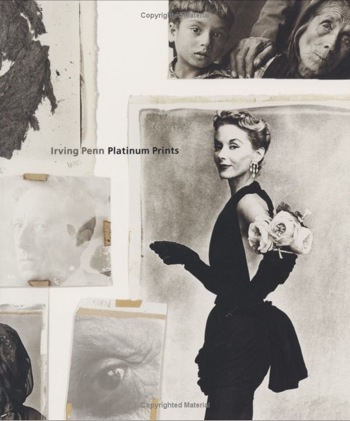
Proving yet again that there’s no money to be made in Art Books, I splashed out the princely sum of $31.50 on “Irving Penn Platinum Prints”. This book had no expense spared at the altar of authenticity.

Now before you accuse me of being unduly critical, a quick check of my earlier piece on Penn’s fine book “Worlds in a Small Room” may be found here.

The man, clearly, is a God in the history of twentieth century photography.

So when I decided to blow serious coin on “Platinum Prints” it was not without foreboding. I have always eyed anything which purports to apply Secret Sauce to a common or garden process with deep suspicion. And, sadly, skepticism was more than justified in this case.

Yes, the famous pictures are all there – that old fraud Picasso, the future Mrs. Penn (well, at least the guy was straight, or it was one hell of a cover), that great black and white Vogue cover of the mesh vail, the Harley Hell’s Angels disguised as Greek gods, the mud people, Cecil(y) Beaton, all those neo-Sander portraits of horny handed sons of toil, those foul/smelly/gorgeous cigarette butts. In other words, Penn’s finest. No question, the reproduction quality of the prints is beyond criticism.

Then, over that height of civilized existence, the evening vodka Martini, I chanced on the back cover of the book only to see the following solemn inscription: “Over the years I have spent thousands of hours silently brushing on the liquid coatings, preparing each sheet in anticipation of reaching the perfect print. Irving Penn”.

Phew!

So the guy:

1 – Despite working for Vogue with all its resources, values his time so little that he has to make his own prints. Something a trained monkey can do reasonably well.

2 – He elects to waste thousands (thousands – do you believe that?) of hours in a darkroom rather than share more of his great vision with the world.

3 – An exotic process is clearly involved. Do I smell snake oil?

I yield to no one in my admiration for Irving Penn. Unlike his fake contemporary, Richard Avedon, Penn had an eye for what he believed in, not for what would sell. He was the Real Thing.

But then he has to go and tell the world that he is using some inane, archaic process to make his prints. They are no better for the fact that he wasted thousands of hours on them, and that means they really are awfully good. Buy the book, disregard the blurb.

Just because the printing process is complex does not mean the print is a good picture. Thank goodness Penn’s work transcends the nonsense this book propounds.

Best and Worst

During the past few weeks of getting a handful of really large prints mounted, matted, glassed and framed, I have come into contact with many photographic material vendors, good and bad. While a few experiences hardly make for a statistically meaningful sample, here are mine.

The Good:

B&H (http://www.bhphotovideo.com/) – though a huge company, which generally implies an uncaring attitude with those responsible hiding behind lawyers – the level of service and timely delivery from B&H is simply the best. I am on the West coast and it would be harder to be further away from their New York headquarters. But place an order on Sunday night and, sure as clockwork, it arrives the following Friday by UPS Ground. On site web ordering is superb, perpetual inventory tells you when an item is out of stock and on the couple of occasions I have had to reurn items, I was treated with courtesy (OK, New York courtesy, which is a little different) and my issue resolved timely. Simply the best.

Documounts (http://www.documounts.com/) – this is where I bought acid free mats and mounting board. They cut the mats to order and you can specify 1/32” accuracy for the cut out. My large order was prepared in seven days and at my California home, shipped from Oregon, three days later. The accuracy of cutting is beyond any criticism as was the professional packaging (just enough to keep everything safe without making it impossible to open). Mounts and mats are purely fungible – you want Nielsen Bainbridge archival, Google it and go for the lowest price. However, I could not find another vendor that does custom cutting and the price is competitive. A 22 x 28” mat with an 18 3/16” x 12 3/8” cut out (that’s how my Epson ink jet printer sizes a 13” x 19” nominal print) runs $24.33, including backing board and transparent protective sleeve for unframed display. Yes, you could cut these less yourself, mess with all the waste and blunt blades and equipment and on and on, but that suggests you should be in the mat cutting business rather than taking photographs.

Drytac Mounting Tissue (http://www.drytac.com/) – bare bones, two day delivery, no fancy packaging, but if you want dry mounting tissue fast and well priced, you cannot beat this supplier.

Poor Richard’s Press (www.poorrichards.com) – the local central California printer I used for my business cards and marketing brochures. Despite the down market name (something I told them they really need to change to attract the high margin carriage trade) the service I received from Paige Chamberlain in the Atascadero office was beyond compare, Do you know which way the address panel on a tri-fold should face to avoid having the thing get snarled up in the US Post Office’s machinery when the mailing is processed? Paige does. Throw in 30 minutes of free marketing advice, fast feedback on what I did wrong in the brochure, and email upload of changes and you have a business that wants your business. I like that.

Inkjetart (http://www.inkjetart.com/) – a business from which I have bought Epson and Lyson supplies for years. Easy web ordering, fast shipping and no sales tax, as it’s in Utah and I am not. As a general principle, anything which can withhold money from the greedy and incompetent in all branches of government is a good thing and a principle I hew to strongly, having done more than my bit to grease the pockets of the losers in Sacramento and points east. It doesn’t hurt to know that Utah is the second most beautiful place in the west. After California.

Amazon.com (http://www.amazon.com) – yes, here’s another public business that cares about its customer. It’s where I bought my LaCie hard drives for storing all those scanned photographs. Quick delivery, always timely, always honest.

LaCie (http://www.lacie.com/) – I have five of their external Firewire Porsche design hard drives for my iMac. Two 250 gB for the photographs, two 80 gB for my music (all CDs have now been sold after ripping these to the drives using Apple’s iTunes – even PC unfortunates can get to use this superb application, in between rebooting now and then) and a fifth 80 gB as a back-up boot drive in case the internal one in the iMac blows up. A great product, unobtrusive, quiet and, when one arrived with a noisy bearing, replaced immediately no questions asked. Thank you LaCie for helping me sleep well at night, knowing my data is safe. Heck, I might even forgive you that dumb French name.

MacConnecction (http://www.macconnection.com/) – this is where I bought the iMacG5 to replace the iMac G4, needing the greater front end speed for loading those 300 mB files – 15 seconds vs. 120 on the G4. They are in New Hampshire which, in addition to housing one of America’s very best business schools in the guise of Amos Tuck, also meets the fundamental test of not giving my money for support of the crooks in Sacramento and their variously deviant constituencies in San Francisco. Two day delivery was just that and phone service was courteous and well informed.

Newegg (http://www.newegg.com/) – where I got the additional memory for the iMac G5. Thanks, Apple, but $200 vs. $400 for the additional effort of undoing three screws is the sort of remuneration rate I can live with. One of the ‘sticks’ (that’s what we hip dudes call memory, you know) I ordered was the wrong type (my fault) and exchange was easy with no questions asked.

Wow! That’s a lot of very good experiences – big ticket and small cost items represented. I wish I did have an interest in these businesses and could tell you that my recommendations are conflicted. Sadly I do not.

The Bad:

But, of course, there has to be a stinker, and this one’s a real Gorgonzola.

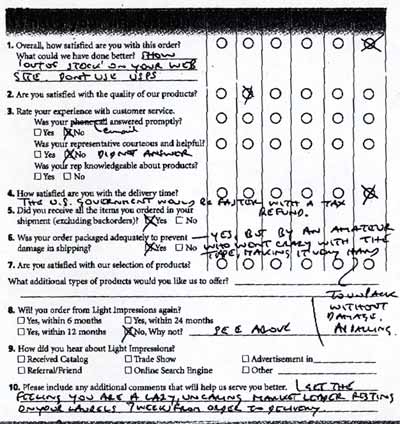
It’s called Light Impressions (http://www.lightimpressionsdirect.com), or Dark Depressions as I have come to think of them. Suffice it to say that a simple test order for five mats (standard sizes, not custom – quite why they accepted the order when they did not even have the goods in stock in the first place I have yet to determine) took seven weeks, cancellation of my payment, unreturned emails, and, when it finally arrived, was wrapped by some druggie in the sub-basement who determined that using two miles of Scotch tape should do the trick. Try to open that without damaging the fragile contents. To add insult to injury, these yo-yos use the USPS for deliver, who in typical fashion, managed to hold the package in their Bell, California center for two weeks. Presumably they then found it behind the radiator in the back and deigned to ship it. Another business giving my money to the government. And before you tell me that the USPS is a private corporation, dear reader, who do you think will be on the hook when they go bust?

Anyway, just to complete the picture, here’s the feedback form I sent Dark Depressions when I finally received the goods – a cross in the right hand column qualifies the vendor for the IRS Bedside Manner Award:

But there’s good in such bad experiences. Dark Depressions’s pretty catalog, shipped with the mats, clued me into lots of neat framing tools and supplies which I can find elsewhere on the web at 20% less.

Pseuds’ Corner


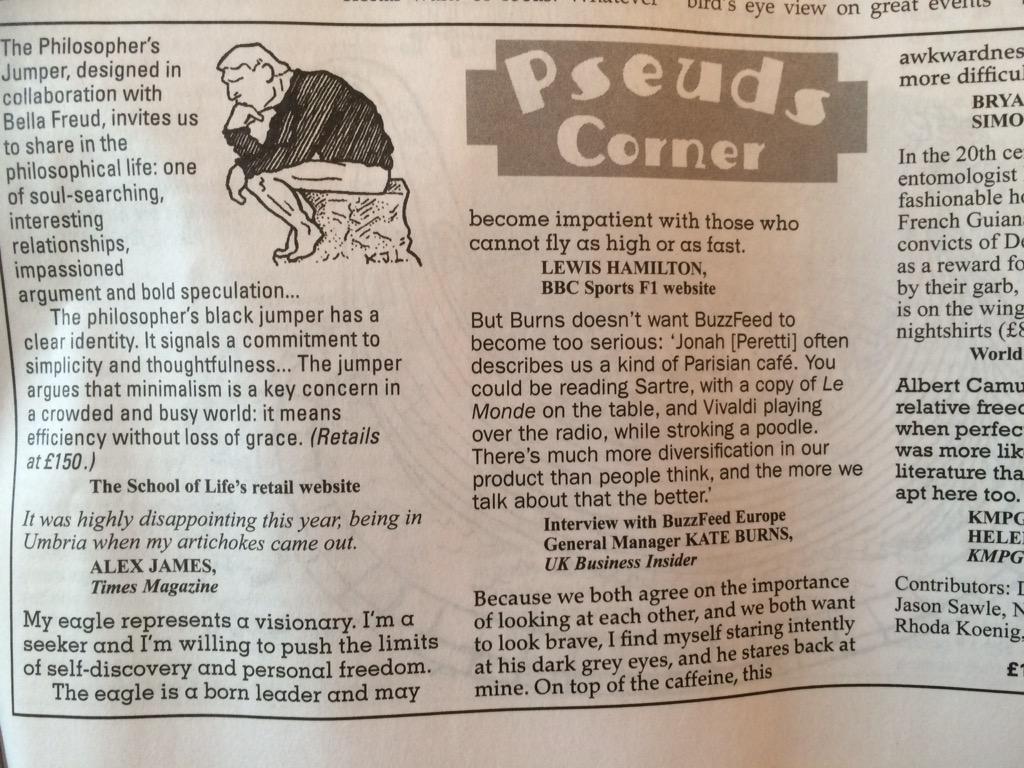
The English satirical magazine Private Eye has long published a column named Pseuds Corner where pretentious nonsense is reprinted in all its glory. For example:

“The sheer courage of these pieces is breathtaking. The space inside, the gap between the walls, narrows, widens, breathes in and out (if you can speak of massive iron “breathing”, which in Serra’s work you can) and eventually rewards you with an inner chamber, from which you have to follow the same route out each emphasizes the ancient Greek philosopher’s Zen-like adage: hodos ano kato mia kai hote, “the way up and the way down are one and the same.” A maze would be fussy; it would interfere with the stupendous directness and logic of Serra’s spatial language. Robert Hughes on the Richard Serra installation at the Bilbao Guggenheim.

Phew!

Well, I never cease to be amused by the vast volume of Pseuds’ Corner prose that the world of photography attracts. Here are some recent examples – the names of the authors and publications have been suppressed to protect the pretentious.

“After a small quantity of test rolls (about 25 in all), both my regular Tri-X, some Lucky 400 made in China and Fuji Acros my personal feeling is: If you already have a later version of the Summicron 50 (and who doesn’t) or a clean 50DR Summicron you would not see much difference on your negatives (from pictures taken with the lens under review).”

From a a self-proclaimed Leica “expert” whose claim to fame seems to be ownership of dozens, if not hundreds of lenses for his Leicas (such fame is certainly not based on the quality of his photographic output).

“As W became better known, he was forced to try to explain in words matters that he knew could not be explained at all, but that might with luck be demonstrated in pictures.”

From the introduction to a book of photographs of a vastly overrated machine gun shooter whose demise caused many a moist eye in the accounting department at Kodak.

“Dualities have always been a feature in M’s life and work. He speaks of a “dark Manichaean flavor” in his earlier urban subjects, but that is not an element in his landscape work.”

From the notes to a book of M’s landscape photographs which prove without a shadow of a doubt that he should have stuck to street shooting.

“E’s affection for photography began at the time when he was starting a new life of sobriety. It is almost as if photography, with its directness, truth, and poignancy, became symbolic of this new life.”

From the introduction to a book about a manic collector of seemingly every famous photograph under the sun.

“Michael works in a special place; on the edge of darkness and light. His images hold a mirror to each viewer’s soul and conscience.”

From the introduction to a book of photographs by a darling of the collector set who has basically taken the same photograph a thousand times over the past twenty years.

“For his simplicity and his unbridled passion for his art, for all that has gone before and for all kinds of other reasons, a lot of which have nothing to do with photography, but a lot to do with art, and for never knowing when to stop chasing rainbows, B is a hero to his own generation and beyond.”

Introduction to a book of photographs by a famous fashion photographer.

“Technical fetishism also has its theoretical counterpart, namely the art of photographing.”

Introduction to a book of one of the most famous street photographers.

* * * * *

I didn’t make these up. Honest. I just went to the largest photography books in my library. The larger the format of the book the more of this sort of clap-trap is to be found in its pages. That does not mean you should stop buying large format books, only that you should look at the pictures and disregard the turgid prose. And remember – no Pseud ever took a good picture.