Adding surround sound to a 2 channel system

A bit of gadgetry does it.

Topology – before and after:
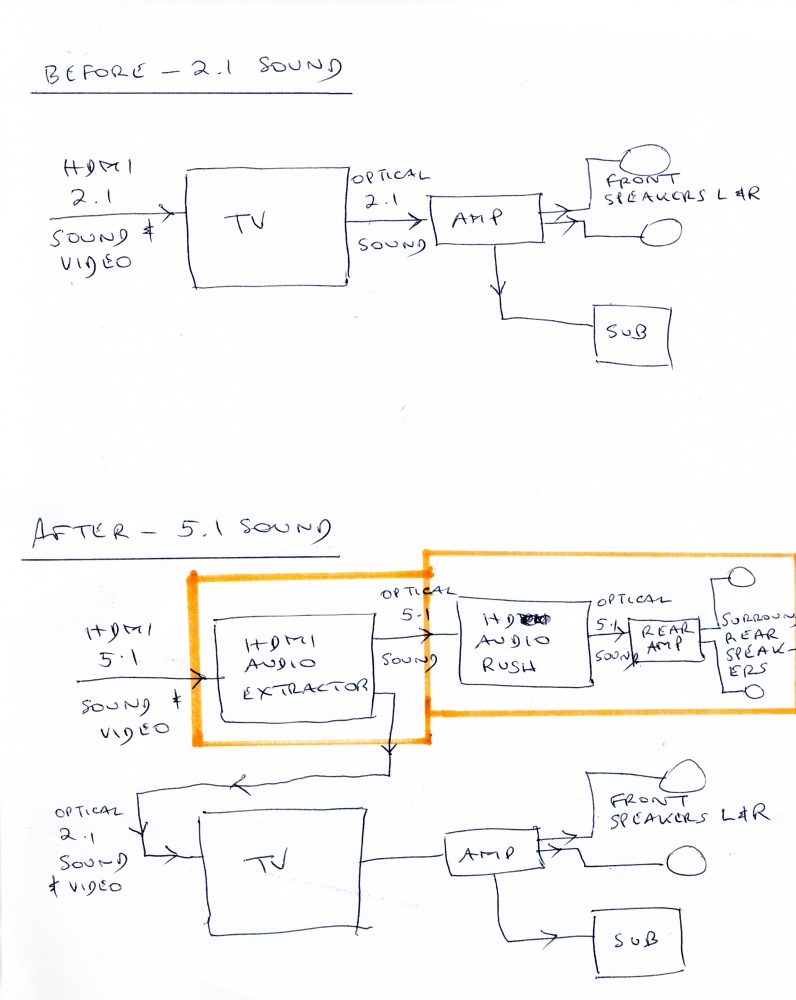

Topologies Before and After. The orange boxes contain added hardware.

The problem:

Many will find themselves in this situation. You have a high quality sound system as part of your home theater installation but it is limited to 2.1 channel sound, meaning 2 front speakers, left and right (the ‘2’) and a subwoofer for the low notes (the ‘.1’). You have spent an arm and a leg on the speakers and related amplifier because you also listen to high quality music so the amplifier and speaker set up must be really good, and that means costly. That’s illustrated in the ‘Before’ section of the above image.

Now you increasingly see that Netflix and other streaming services are advertising not just 4K video sources but that these are accompanied, as often as not, by 5.1 sound. The ‘5’ denotes the two front speakers, a center channel speaker and two rear speakers for the ambience effects of surround sound behind the listener’s head. You would like to add true surround sound to the rear speakers and maybe an added center channel speaker, but you sure as heck do not want to sell your high quality amplifier for a chintzy surround sound amplifier.

I set forth below how to do that for very modest outlay. The result is in the ‘After’ illustration, above.

Summary of the solution:

The goal is to deliver surround sound to two rear speakers. To accomplish this, in lieu of buying a surround sound amplifier, four pieces of hardware are required.

  • An extractor to break out the sound components from an HDMI source
  • A splitter to take the extracted sound feed and break it down to left and right rear channels
  • An amplifier to amplify the left and right rear channel feeds
  • Rear speakers

I address each in turn below.

The magic of HDMI:

Modern components invariable use HDMI cables for connectivity. An HDMI signal from your Apple TV/Apple TV 4K/Roku/Roku 4K streaming box (there are many other choices) uses an HDMI output which connects to your big screen TV. That HDMI cable carries 4K (or lower) video as well as 5 channel sound. We will want to split the sound and video components so that the selected additional sound channels (left rear/right rear and, optionally, center front) are separately available for amplification and routing. The ‘Before’ 2.1 topology does not use these three sound channels which are – invisibly to you – discarded.

Extracting 5 channel sound from the HDMI feed:
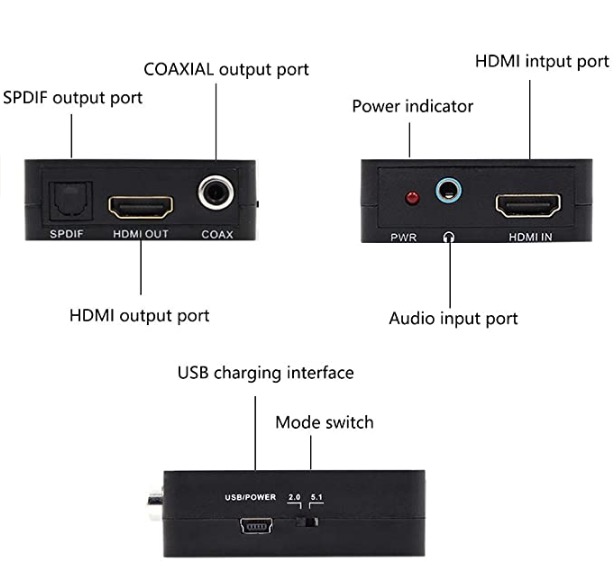

The HDMI Audio Extractor box.

First we need to extract the 5.1 sound feed from the HDMI sound + video feed coming out of your streaming box. This is done using an HDMI Audio Extractor box which comes in versions which passthrough both 4K video and the lower definition 1080p video. The 1080p version runs just $12 at Amazon while the 4K version retails for $20, so you might as well buy the 4K version in the event that an upgrade is contemplated down the road. Be sure to use HDMI 2.0 or 2.1 spec cables for HDMI as only these will preserve 4K video quality. The premium over the older HDMI 1.4 cables is trivial.

Now, instead of connecting your streaming box (Apple TV etc.) directly to your TV, you connect it to the HDMI Audio Extractor, and then connect an HDMI cable from this extractor to your TV. The extractor is smart. It delivers both video and two front channel sound to your TV but also has an optical (SPDIF) output which carries all five sound channels.

Splitting the 5 channel optical source into discrete channels:


The Analog Decoder/Converter Audio Rush box.
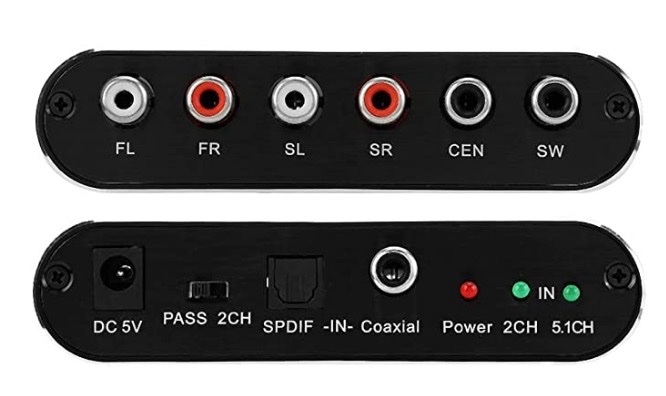

Outputs and Inputs. We will be using SL and SR outputs and the SPDIF (optical) input.

With a 5 channel high quality optical sound source now available at the outputs of the HDMI Audio Extractor box, we need to feed that, using an optical cable, to an HD Audio Rush box. This takes the optical feed and splits it into five discrete channels. The ones we want are the rear left and right and, optionally, the center front. Going by the fancy name of ‘SPDIF Coaxial DTS AC3 5.1 CH Audio DTS/AC-3 to 5.1 Analog Decoder Converter’ these can be found on eBay for all of $24. Amazon is asking $38 for the same hardware.

The optical cable from the HDMI Audio Extractor box (be sure to remove the small, protective plastic pips, or it will not fit) is connected to the optical SPDIF socket on the Audio Rush box and both boxes are switched to 5.1 sound or else 2 channel sound will be delivered to the front speakers only.

Amplifying the surround sound feed:
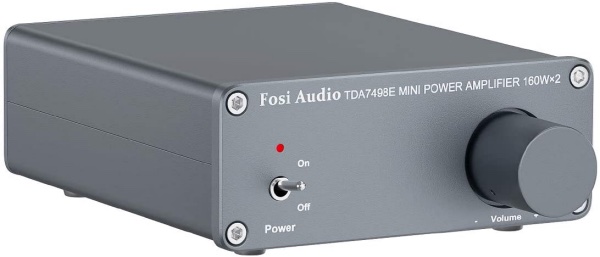

The amplifier for the rear surround speakers.

With sound feeds for the left rear and right rear channels at the outputs of the Audio Rush box, these have to be amplified, as they are low voltage ‘line level’.

My home came with ceiling speakers in three rooms and a jumble of unmarked wires emanating from the wall behind the TV. One of those rooms is the TV room where, as luck would have it, the ceiling speakers are behind the TV viewer. Perfect for surround sound. After blipping wire pairs with a 1.5 volt battery I determined which two pairs of wires were attached to the speakers in the TV room and terminated these with 2 pairs of banana plugs costing $9.

You may need to add free standing or ceiling mounted rear speakers, and you can either use regular unpowered ones, which will require an amplifier or powered ones which will require a mains connection and no amplifier. I prefer the amplified approach as it gets you rear speaker volume control at the TV set.

How powerful a rear amplifier you install depends on the efficiency of your rear speakers and the desired volume.

While my pre-installed ceiling speakers appear to be decent quality, you do not need costly, exotic amplification or high end speakers as the rear speakers’ job is to convey sound stage and ambience, not high fidelity.

After determining that mine were 8 ohm (less efficient than 4 ohm) and testing with my regular front amplifier I determined that a 2 x 160watt rear amplifier was called for.

Now, this is a very misleading specification as it refers to the maximum momentary power that the amplifier can deliver. RMS power is what should be quoted, but salesspeak sees to it that no such data are provided. I would guess the RMS (continuous maximum) power is more like 2 x 35 watts, which is fine for my installation. This ran me $75. (For the frugal, this amplifier can be found on eBay for as little as $46, but shipping from China).

The amplifier is connected to the Audio Rush box using cables terminated with RCA plugs, and the speakers are plugged into the amplifier, using banana plugs. The amplifier is a simple 2 channel device with its own volume control. It can be nestled close to the TV to make adjustment of the rear surround speakers’ volume easy. I find that setting the volume knob in the center of its range is optimal, which is pretty much how you want it with any amplifier.

Power supplies:

We have added three devices into the audio chain and each needs power. The HDMI 1080p Audio Extractor box and the Audio Rush box only need 5 volt power and each comes with a USB cable to provide this voltage. (The 4K version of the HDMI Audio Extractor comes with its own 5v power supply with a very short cable, but you can replace that with a USB power cable if preferred, at modest added cost). You can either plug those USB cables into a PC (I use a Mac Pro – with an added 4 outlet USB card – for internet access on the big screen) or use a power strip with built-in USB output sockets.

The power amplifier comes with its own 24 volt power supply brick which is plugged into a mains wall socket. The power needs of the amplifier dictate that you must use the provided power brick. USB power will not cut it.

Connecting cables:

You will need the following:

  • HDMI 2.0 or 2.1 cable to Audio extractor from video streamer (AppleTV, etc. )
  • Toslink optical fiber cable from Audio Extractor box to Audio Rush box – mine was included
  • 12 gauge or so twin pair wire from the Audio Rush box to the power amplifier
  • Amplifier to speakers – inexpensive speaker cable

Connectors:

Total outlay:

My total outlay was around $130 to which you will have to add the cost of rear speakers and an optional center front speaker. My rear speakers came with the home, mounted in the ceiling.

Test setup:
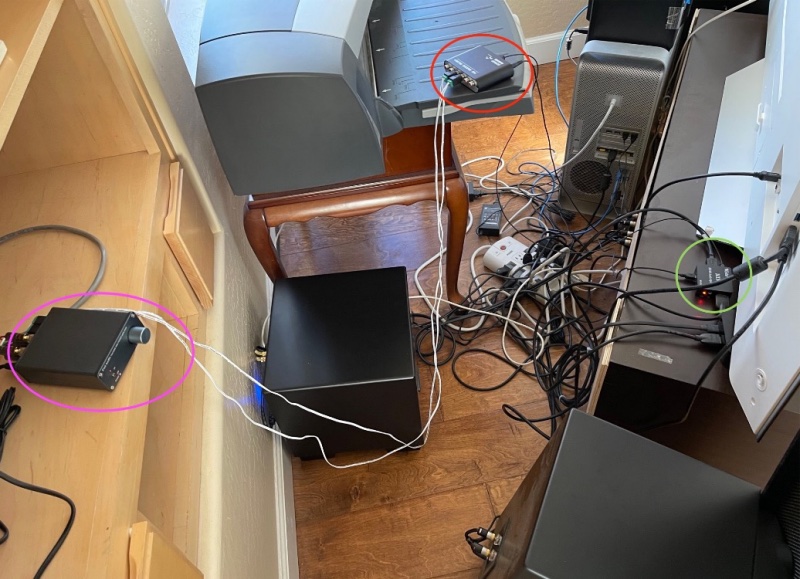

The components in place.

No it’s not pretty and, yes, I will clean things up, but you can see the three added components in the above image.

The Audio Extractor is circled in green and the Audio Rush box in red. These are ‘install and forget’ and can be placed out of sight. These two boxes are powered using (provided) USB cables plugged into the Mac Pro. The power amplifier is circled in mauve and can be placed in an easily accessible location to permit volume adjustment. It can be left on at all times as the power draw is low.

Adding additional feeds:

At this time I have one feed with surround sound added, the one from the Apple TV 4K streaming box. The TV has one other HDMI feed connected, that being from the Mac Pro which is a file server for stored movies and an internet browser. I will also be converting this to add surround sound which will necessitate the addition of a second Audio Extractor between the HDMI cable from the Mac Pro and the TV set. The optical cables from both Audio Extractors will go into a 2-into-1 optical connector/splitter ($10) and the single output optical cable will go to the Audio Rush box. Switching is done at the TV where HDMI outlets can be selected on the screen so no switches are required. You really do not want to have to mess with this once it’s all installed. The goal is to retain operational simplicity so that anyone can use the system.

More details on using more than one HDMI source appear in this follow-up article.

Overall user experience:

With a high quality 5.1 signal source you will not want to revert to 2.1 for movies. Try a good movie like Saving Private Ryan with its overwhelming images and sounds from the D Day landings. I asked my son for his preference and he chose Dunkirk which garnered not one but two Oscars for its magnificent sound track. We watched/listened last night and it was the closest you could get to the IMAX experience at home.

Hardware used:

Universal remote>

For an easy to program universal remote to go with all of the above, click here.
Intuit’s sloth

Just say ‘No’ to TurboTax.

For an index of all my Mac Pro articles, click here.

Like many readers of this journal I have been using TurboTax for Mac for aeons to prepare my taxes. The system works well in as much as anything can work well with the mess that is the Internal Revenue Code of the United States.

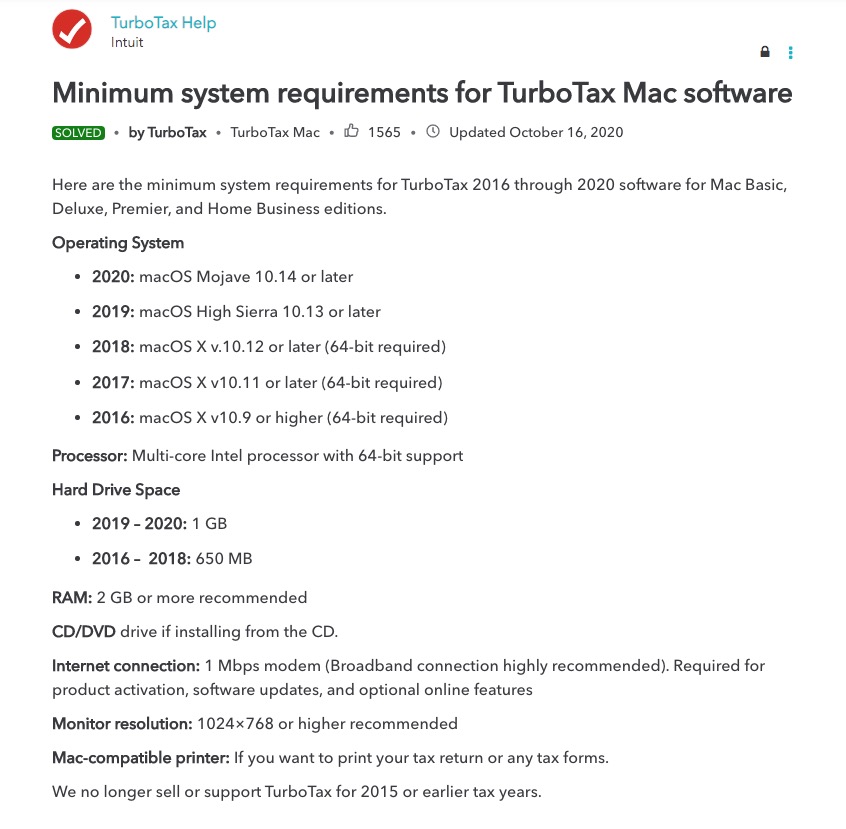
Now it so happens that I am happily running OS X High Sierra (10.13) on my 2010 Mac Pro, and Intuit, the maker of TurboTax has been making noises for a couple of years that I will soon have to upgrade to OS X Mojave (10.14) for their software to work. Intuit would have you believe that this is a change dictated by Apple and that no backward compatibility for TurboTax 2020 exists.


What Intuit demands for TT 2020..

But the snag is that I cannot run Mojave without tossing out my excellent Nvidia GTX980 graphics card, replacing it with an ATI Radeon offering, as Mojave will not run on Nvidia GPUs. And I do not wish to make that change as the GTX980 remains as capable today as it was 5 years ago when installed.

So I shopped around and determined that it’s Intuit’s sloth, not Apple’s requirements, which is the cause of TT 2020 not running on my High Sierra/GTX980 setup. HR Block is the other leading vendor of US tax preparation software and here are their system requirements:


HR Block’s 2020 tax prep software requirements.

So I spent $37.79 which got me the application, by download from Amazon, and this includes one State tax application. Intuit is asking much the same for their basic software version. Well, that and a new $250 GPU.

And guess what? I asked the HRB app to find my 2019 TT return and it was imported in seconds, and all numbers match. So now I’m ready to prepare my 2020 taxes using HRB’s software and the costly GTX980 can remain in place.

Sure, you say. You could always use Intuit’s online tax prep software which is machine independent. And you expect me to trust these people with my data? Uh huh.

Up periscope!

The future approaches.

This year or next will probably see the addition of an optical zoom lens to high end iPhones. I wrote “high end” as the change in Apple’s marketing strategy with the iPhone 12Pro and Pro Max is clear. They are distinguished from lower models by adding a longish lens (65mm on the Max) and, in the case of the Max, bigger sensors. And bigger margins, of course.

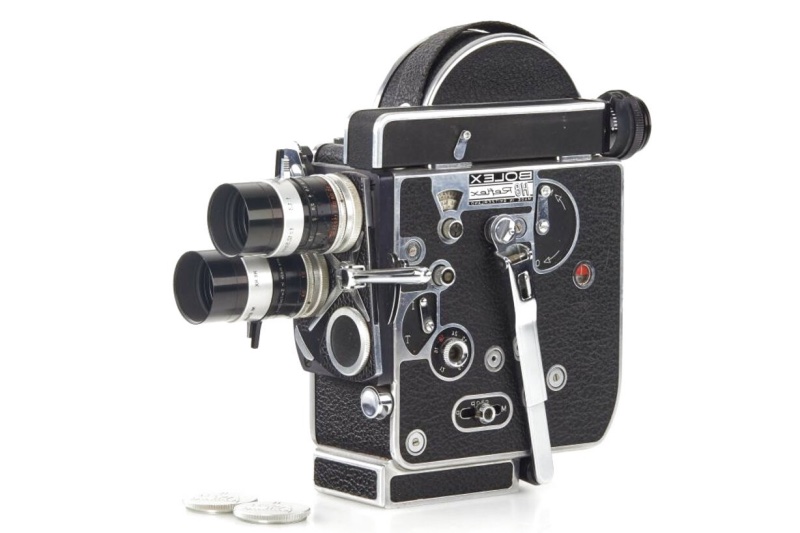
Rotating turret lenses in cine cameras have been around for decades:


The Bolex H16, originating in 1927, was last made in 2016 by the Swiss Paillard company.

Compared with zooms the lenses were lighter and faster. And mostly sharper, to boot.

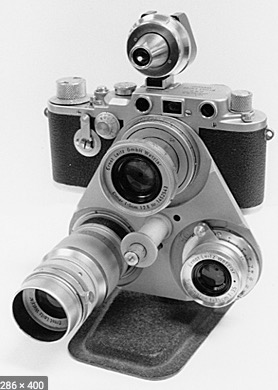
Never one to resist an opportunity to make yet another gadget, Leica went all out with a turret attachment for its 35mm film cameras, coming up with this monstrosity


The Leica turret attachment from the 1940s..

While you might argue that simply changing lenses would be easier, Leitz persisted with this nuttiness into the Leica M era which saw the old, slow screw mount give way to a fast bayonet variant, yet the turret remained available, now with bayonet mounts. The pocketable aspect of the small and elegant Leica body was rather lost in the process.

But zooms were the way of the future and while they came with limitations, they were a lot more appealing to the average consumer. 2002 saw the introduction of Minolta’s Dimage film camera with a periscope zoom, and it was a knockout.


The elegant Minolta Dimage of 2002.

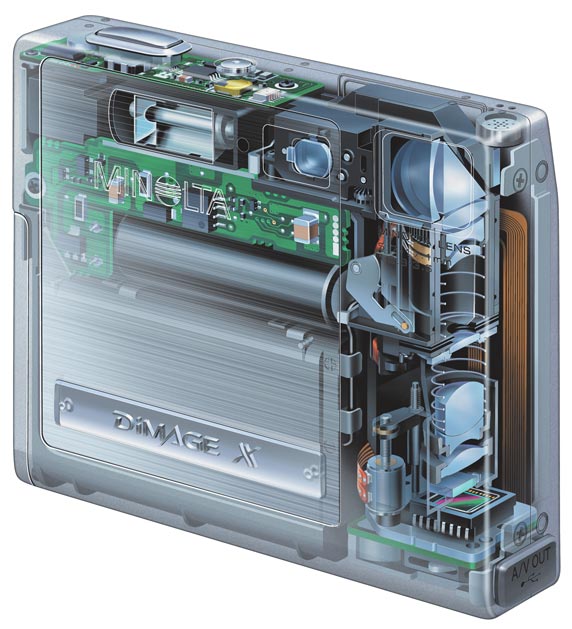
The periscope optical zoom, vertically oriented inside the case, saw light rays deflected through the associated right angle using a mirrored prism. This allowed the incorporation of an otherwise lengthy optical path within the tight confines of the body, a small 3.3″ x 2.8″ x 0.8″. For comparison, my iPhone 12Pro Max in its ‘bumper‘ measures 6.5″ x 3.1″ x 0.3″. You can read DPR’s 2002 review of this 2 megapixel digital masterpiece here.

This cutaway view shows how it worked:


Illustration of the ‘folded’ optical path.

While the Dimage sported a 37-111mm (3:1) zoom with modest aperture of f/2.8-3.6, I think we can expect a lot more from the iPhone 13 or 14. For this user a 28-200 (7:1) f/2 optic would be perfect, and leave the UWA lens as a separate choice. That makes the optical designer’s job easier and, let’s face it, you really do not need a zoom starting at 12mm given the relatively infrequent use of something so wide. Nor do you need a turret.

Once that iPhone Zoom hits the market the sole remaining users of traditional DSLRs or their mirrorless brothers will be press photographers and the fashion set, because both would be laughed off the set were they to be seen using an iPhone. And, of course, the few remaining nuts taking nature photographs because, you know, of the trillions of images already out there, all available for pennies from stock vendors, there must be something yet undiscovered. As for the camera divisions of Canon, Nikon, Sony et al, say goodbye.

The technology is out there. A 2019 Huawei cell phone uses it and you get free Chinese spying software as part of the deal. Wait for the real thing.

Bodyline

The greatest sport.

If no motors are allowed there is no question that test (international) cricket is the only game. The game requires physical skills of a high order, immense courage, guile, strategy, tactics …. and on occasion political malpractice. And the last intruded in the 1932-33 England tour of Australia which saw five test matches played by the two nations and was, with the possible exception of the 1936 Berlin summer Olympics, the most controversial encounter in modern sports memory. These were ‘timeless’ tests, meaning you played until there was a result or a draw. Typically that meant 5 days for each test, which is what current rules mandate. Modern rushed lives preclude the timeless test variant.

Jesse Owens, with his four Olympic golds in 1936, saw to it that Hitler’s white supremacy was dealt a body blow, even if the fight continues to the present day. But Test cricket between the two leading exponents of the game, England and Australia, was exclusively a white man’s sport, and it would be many years before the magnificent teams from the West Indies showed the white man who is who and what is what. In 1933 English teams were captained by prep school aristocrats with the occasional coal miner thrown in for luck. And it was one of each genre – the aristocratic Douglas Jardine, England’s captain, and a former Lancashire coal miner, Harold Larwood – who were the core of the drama. Jardine was the devil to Larwood’s hero.

Jardine brought to the game an intense dislike of Australians – likely driven by England’s many recent losses to the colonials – and an all out determination to do anything it took to win the series. And his secret weapon was the world’s most feared fast bowler, Harold Larwood. As a child Larwood had worked in the Nottinghamshire coal mines where he was a ‘pit pony’. Pit ponies were young children assigned the task of pushing coal laden railcars out of the mine and whatever you think of the related child labor laws of the time this hard graft gave Larwood one outstanding attribute. Massive upper body strength. Not tall for a fast bowler at 5′ 8″, Larwood perfected his skills playing for the county side and was chosen as one of the fast bowlers for the 1932-33 test series. His musculature saw to it that he was very fast indeed. And this is where the plot thickens.

There have been any number of statistical analyses which attempt to use mathematics to compare performances of the best players from disparate sports. No matter how it’s done the winner is always the same and he is Don Bradman, Australia’s ace batsman, who was pretty much guaranteed a score of 100 or more in any innings, regardless of the opposition. And while the equipment has not changed since then, cricket pitches have changed greatly, the modern glass smooth and level version putting the lumpy, uneven surface of the 1930s to shame. This made batting much harder back then yet, despite these challenges, Bradman’s star shone brightly. Jardine was only too aware that a winning strategy required something different or Bradman would simply dominate the game and Australia would win the series handily. So he came up with Bodyline, which required his fast bowlers to bowl fast and short aiming for the batsman’s head as often as not. The short deliveries – in cricket the ball almost always bounces before reaching the batsman – would rise fiercely off the sun baked surface of Australian pitches and, well, injuries resulted. Jardine had concocted this idea when Bradman had last played in England, astutely noticing that if the great man had a weakness then it was to short pitched deliveries aimed at his left (leg) side. So he conscripted Larwood in his plot and told him to bowl at the man. Larwood touched his cap in the approved manner, obeyed his captain’s orders and went at it. He was, after all, a team player, and it was simply not done to question the captain’s orders.

And Jardine’s strategy worked in spades. Of the five encounters, England won all but the second test by mostly huge margins. Australia’s sole win came in that test and it was the only one in which Bradman scored his usually expected century, scoring 103. And that was in his second innings, having been dismissed with the first ball he received in his first innings. Bradman was beaten and England came home victorious, but not before leaving carnage on the pitch and a major diplomatic incident between the two nations. By virtue of Larwood’s hostile deliveries, Australia’s captain Bill Woodfull, was felled by a blow to the heart. A man of great moral character, he refused to object, with the crowd in Adelaide on the verge of rioting. Woodfull was dismissed shortly after recovering from his injury. Most famously, when the England manager went to see him in the dressing room to offer his condolences, Woofdull replied “I do not want to see you, Mr. Warner. There are two teams out there. Only one is playing cricket and the other is not”. But Larwood was far from done, fracturing Bert Oldfield’s skull with a fast delivery putting him out of the game. Ironically, this was a regular delivery, not a Bodyline special. The crowd was now at fever pitch, not helped by repeated blows to the body of Australian batsman Bill Ponsford who had wisely been kitted out with (somewhat) protective layers of rubber and foam. The crowd was now screaming obscenities at the English team and the Australian authorities filed a formal protest on Sunday, the rest day in the middle of the test. This most certainly was not cricket. A 5.5 ounce leather covered cork and hard rubber projectile shot at the batsman with lethal intent would have required full body armor to withstand injury.

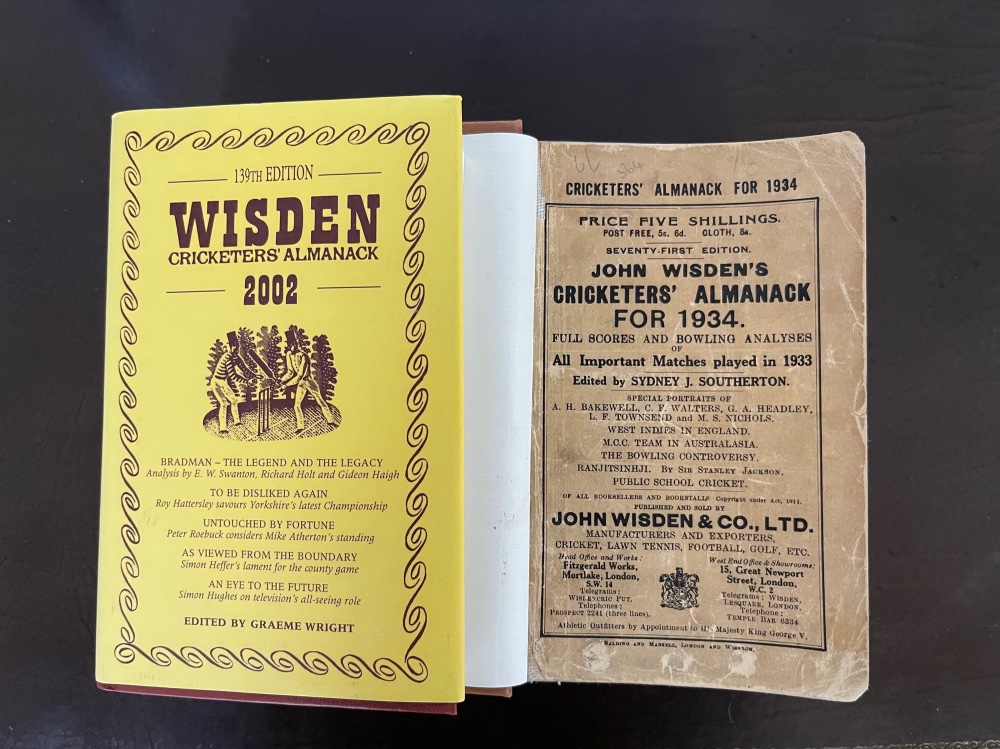
This is all documented in the 1934 Wisden, the annual almanac published since 1864. I have long owned the 2002 edition for it includes a moving set of obituaries for Donald Bradman. Now I own the 1934, a Christmas gift from my sister in West Sussex. The full text of the diplomatic cables is reprinted and it makes for fascinating reading.


The two Wisdens in my library.

I wrote that Larwood was a hero. He was. He obeyed his captain’s orders and was then forced to apologize by Jardine in a thoroughgoing act of treachery and cowardice by his captain. He never played for England again and after many more successful years in county cricket retired to Australia at the invitation of Jack Fingleton, one of the Australian batsmen in the 1932-33 side. The Australian people knew what had transpired between Larwood and Jardine and Larwood was met with a hero’s welcome on disembarking in the land which would become his home.

I shall be poring over the contents of the 1934 Wisden this Christmas Day. If there is a finer way to pass time I do not know of it. And it bears adding that to this day Australians style unsportsmanlike behavior as ‘Bodyline’.

King Cole

Words and music.

When I first moved to Manhattan in 1980, things looked pretty dire on the financial front. While I waited to close on my ‘luxury high rise’ co-op apartment (an L-shaped alcove studio with but 450 square feet of space which the realtor somehow managed to advertise as having 6 rooms) my temporary landlord made off with my deposit. Some $1,000 poorer and every penny deposited on the luxury high rise, I was down to my uppers. Dinner was at the McDonald’s I could see from the 14th floor window on 8th Avenue and the Citicorp branch next door was advertising 18% pass book savings rates, courtesy of the Idiot Carter.

But the stroll from 56th and 8th to Broadway and 57th was but two minutes and you could find me there every night at what had become my local free library. After the splendid repast at Mikey Dee’s, I would traipse round to Coliseum Books and enjoy a chapter of something favorite, no hassles involved. You see, I could afford nothing in the store.

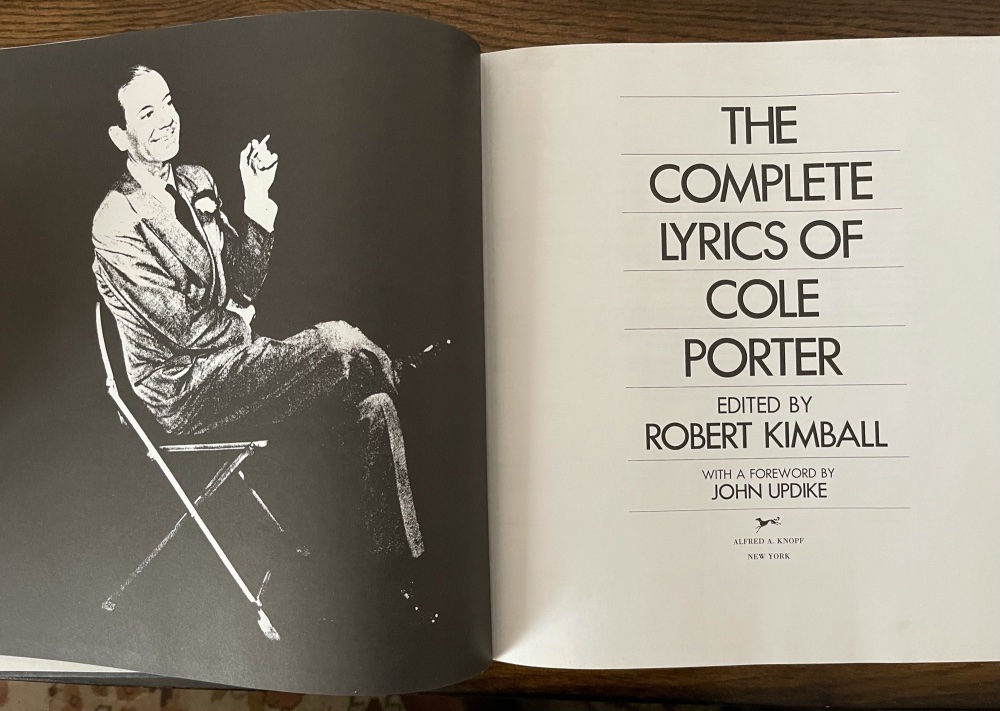
The all time favorite was this:


The master.

Fans of Gershwin may carp, but the reality is that George had to retain his brother Ira to write the lyrics. Cole Porter needed no such help. He wrote the words. And the music. And what words and music they were.

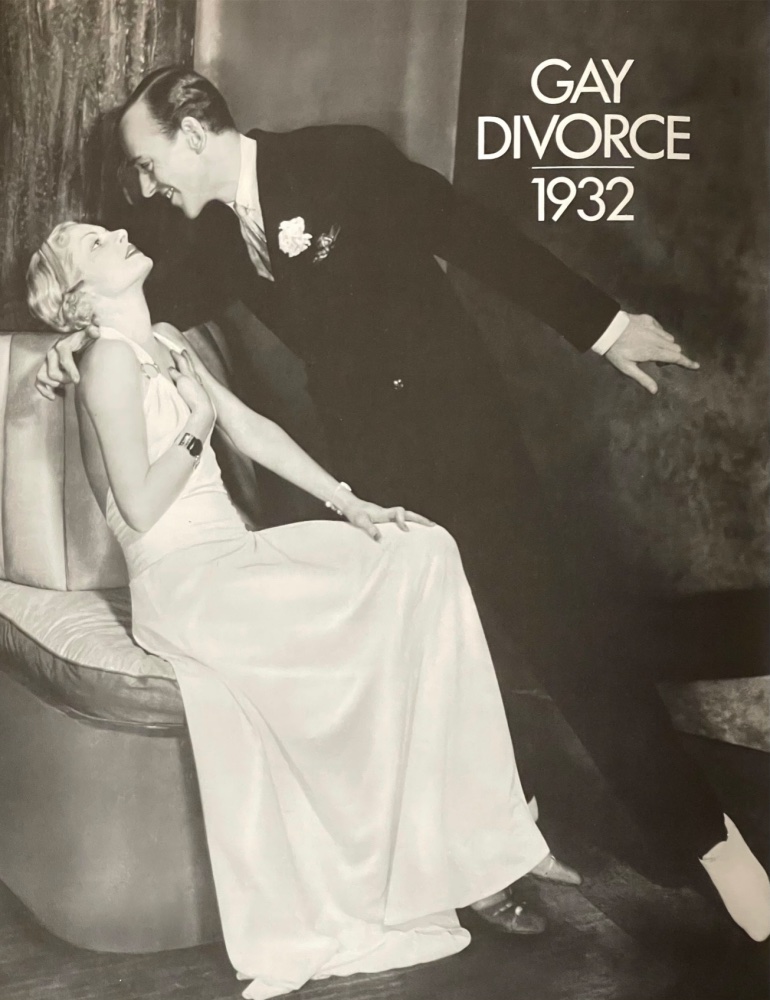
The large tome, available used though Amazon, is replete with period photographs, this one being one of the best:


Fred and Ginger.

And who could not thrill to the magic of Cole’s gorgeous word mastery?


You’re the top!
You’re the Coliseum
You’re the top!
You’re the Louvre Museum
You’re a melody from a symphony by Strauss
You’re a Bendel bonnet
A Shakespeare’s sonnet
You’re Mickey Mouse
You’re the Nile
You’re the Tower of Pisa
You’re the smile on the Mona Lisa
I’m a worthless check, a total wreck, a flop
But if, baby, I’m the bottom, you’re the top

The Henri Bendel store, repository of high fashion and kept women, was just across 57th between 5th and 6th Avenues. Sadly, both stores are gone but Cole Porter’s words and music will live forever.

Don’t make my mistake of waiting 40 years to buy this special book.