All posts by Thomas Pindelski

Nikon Magnifying Eyepiece

I can see!

The Nikon Magnifying Eyepiece, DK-17M, is one of those “Why didn’t I think of this before?” accessories for the D700 and similar bodies.

DK-17M top, and stock eyepiece, bottom.

The stock viewfinder magnification of the D700 is 0.72x, identical to the fabulous range/viewfinder in the Leica M2 which I used for many years. That’s OK, and a whole lot better than the ‘tunnel vision’ you tend to get with APS-C mirror reflex DSLRs (MFT EVFs are far superior in this regard) but it could be better. With lenses up to 90mm and f/2 or smaller the Leica is far easier to focus manually than the D700, thanks to the finest rangefinder focusing device conceived by man.

The DK-17M is a 1.2x magnifier, so the 0.72x stock magnification rises to 0.86x with this eyepiece fitted, which is close to the 0.91x Leica users enjoy with the Leica M3 body, one I used for over three decades. And that one, predating the M2 by some 5 years (1954), was even better than the one in the M2 (1959). It seems the intervening half century has seen little improvement in manual focusing aids.

Some user comments at B&H and Amazon state that the corners of the finder view are vignetted and that the data display at the base is obscured when the DK-17M is installed. I wear vision glasses (I have astigmatism and modest near sightedness) yet suffer neither problem. While not cheap at $38, there’s no way I’m removing this from my D700. It’s well made, uses glass not plastic, and the only thing you have to remember is that the eyepiece shutter must be closed for removal/installation. As you can see the DK-17M protrudes a little further from the body than the stock eyepiece, but that has no negative effect in practice. I have no need for a rubber eyecup as those interfere with viewfinding for spectacle wearers in my experience.

Like magnifiers exists for APS-C bodies, though I believe the model number is different. The DK-17M fits the D1, D2, D3 and D700 DSLRs and the F3HP, F4, F5 and F6 film bodies according to B&H. I am not sure but would be prepared to bet it fits the D4, D800 and D800E also.

To put the difference in perspective, the hardest to focus MF lens I own is the 500/8N Ai-S Nikkor Reflex. With the DK-17M fitted I can nail focus 7 times out of ten when focusing by eye then looking to the focus confirmation LED as a cross check. Without the DK-17M my success rate is at best 3 out of 10 with final focus dependent on the LED.

One alternative is to have an aftermarket focusing screen fitted but that does not pass the smell test for me. First, why would Nikon fit anything substandard to their best bodies, with years of experience in optical design? Second, many of the aftermarket screens use a split image center focusing device. The effective base length (a measure of sensitivity) of these, compared to the finders in rangefinder Leicas, is pathetic and falls as the aperture falls. Further, the split image prisms (or microprisms in variants) tend to black out at smaller apertures and will not work with a 500mm Reflex lens with its modest f/8 fixed aperture. Finally, aftermarket screens cost over $100, typically, for an uncertain outcome, plus cost of installation. DIY is for the brave only.

The DK-17M works, being in equal parts a focus and compositional aid. Even with AF lenses where no focus assistance is required, the enhanced view is a revelation. This accessory is highly recommended as long as you have no finder vignetting issues. The view through the eyepiece reminds me of nothing so much as my Leicaflex SL, which also happened to have the best microprism ever devised. But that’s another story.

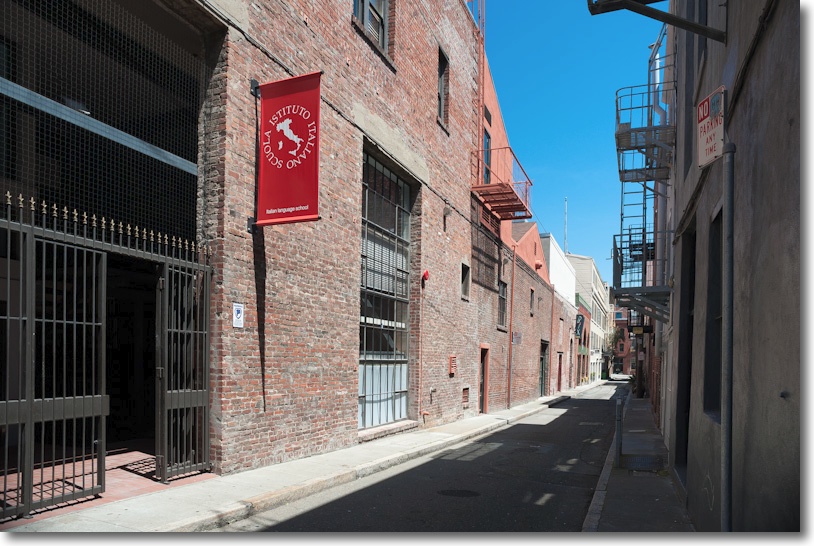
T. Brannan Street, SF yesterday. D700, 50mm f/2 Nikkor-H, DK-17 eyepiece. Click the picture.

The beautiful color rendering of this 40+ year old MF Nikon optic has to be seen to be believed. And you would have to try really hard to spend more than $50 on one, plus $30 for a CPU.

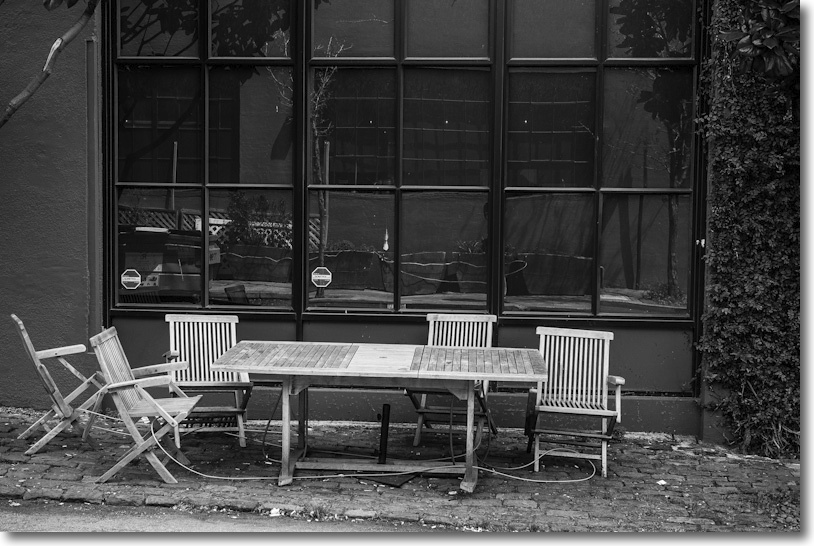
And, yes, look hard and that’s my ghostly reflection in the door ….

Me and T.

Photography in Mexico

MOMA SF show.

March 10 through July 8, 2012.

This show at MOMA in San Francisco contains exactly what it says. Work not so much by Mexican photographers but photographs taken in Mexico. As you can see, I took Winston, our ten year old, with me and he enjoyed it as much as I.

The early content – Paul Strand, Tina Modotti, Edward Weston, Manuel Alvarez Bravo – is the usual agglomeration of poor, dank, drab, awfully printed results, masquerading as classics. Some are so bad it’s almost impossible to make out anything. The content may be great. I have no way of telling.

The later work is fine, well printed and exhibited and the price of entry is rewarded by one extraordinary sequence by crime snapper Enrique Metinides. The best of the bunch I have left obscured by the patron below, because you really need to see it for yourself. What looks like a balletic sequence of bridge builders turns out to be cops rescuing a would be jumper. Beautiful, moving and extraordinary in every way.

Work by Enrique Metinides, . D700, 35-70 AF D.

The show is well laid out and the volume of content just right.

General view. D700, 35-70mm AF D. Click the picture.

Worth a visit. Be sure to check out Susan Meiselas’s work, which is a stand out.

Pearls among swine

A friend helps out.

There are some photo sites I simply refuse to read. They generally fall under the “Anything for a click through dollar” genus and place heavy focus on technique and hardware. The photography on display is invariably execrable and brand wars and pixel peeping are the order of the day. No piece of new hardware goes un-praised and is instantly acclaimed as obsoleting all that came before it, and the grasping acceptance of all those free manufacturers’ samples is always accompanied by a click through which makes these whores money, generally unknown to the reader. The long shadow of ethical behavior is a stranger to these venues.

And while these creations of quick buck artists seem to include the occasional gem among all the detritus, it’s more than I can do to make myself search out the diamonds in the rough. But some friends are more courageous, and one forwarded me a link the other day to a simply splendid piece of photography and writing by one of America’s Space Shuttle astronauts at a site I would never otherwise visit.

Click the picture for the article and be sure to check the author’s resumé at the end. How could anyone possibly improve on this record of intellect and service?

Click the picture.

DSLRs and wifi

Lamentable.

No sooner had my used Nikon D700 arrived in February than I got to setting up the annual studio session to take our boy’s birthday picture.

As Winston is getting pretty hip to photography, aged 10, I thought it would be fun to connect up the MacBook Air to the D700 and import the RAW pictures into Lightroom so that he could immediately see the results. It proved to be a remarkably effective setup, and the near-instant feedback clearly made him a better and more involved subject. After all, the attention span of a ten year old makes most high strung supermodels look like Job himself, by comparison. These were the very first snaps I made on the D700 and you can see the results here.

But what was wrong with this technology is that I still had to run wires between the camera and the laptop.

Now my studio flash is triggered wirelessly using a $20 remote trigger.

The D700 speaks to any number of satellites using a $105 GPS data logger and Bluetooth receiver, telling me the location of a snap within three feet or so.

I can trigger the D700 wirelessly from 100 feet or more away, using a radio transmitter costing all of $23.

My iPhone (camera? free) not only records GPS coordinates but can also send the pictures automatically to iCloud, whence they can be sent to all connected iDevices or Macs.

But try to get images out of the D700 or any other ‘serious’ camera for instant preview on an iPad and you are either broke or SOL.

Broke? Here are the Nikon and Canon options for users of serious gear:

Hose job by Nikon. Can you believe how clunky this is?

Rip-off by Canon. At least it’s not clunky, but forget using your battery pack.

No matter that any number of cheaper point-and-shoots can now accomplish the task for a fraction of those silly-priced gadgets, Nikon and Canon seem determined to sell a few to pros who can justify the cost, rather than millions to enthusiasts who would gladly pay $100-200 for the opportunity of sending snaps wirelessly to their iPad.

Well, someone at Nikon has woken up and the just announced prosumer D3200 APS-C body will accept a new gadget which is actually realistically priced. By the way, you can buy 4-5 D3200s for one D800:

Nikon wifi transmitter for the D3200.

But the good news stops there. One second looking at the following picture tells you the design is awful, sticking out the side where it’s an accident waiting to happen:

Nikon’s design catastrophe. The wifi transmitter installed. Ghastly red body is, mercifully, an option.

But wait, it gets worse. 75% of all tablets sold are iPads. The other 25% are bought by someone, I suppose, but I have yet to see one in use. And that minority runs the Android OS, in half a dozen different versions. Look at what any creative person uses and it’s a dollars-to-doughnuts bet that it will be a Mac and an iPad. So what does Nikon do? Why, release the wifi transmitter in an Android version only. Don’t ask me which version of Android because the press release is silent and don’t ask which wifi protocol because they say even less about that. Knowing the brains trust at Nikon it’s probably 802-11a which went out of use a decade ago. An iOS version? “Later this year” the geniuses in Kogaku aver. Do these people ever get out of the lab?

There is always the Eye-Fi solution I suppose. Coming only in slow, limited capacity SDHC cards, these have a weak wifi transmitter built in which sends your pictures to a remote server using your home wifi, for later retrieval. A local ad hoc (hotspot) network can only be used with the premium-priced X2 Eye-Fi card – $50-130 for 4-8gB. The speed is Class 6, which means 40x, compared to the 400X of a cheaper stock card which is ten times faster. You need ad hoc wifi for when you are not on your home wifi router and just want to send the snaps to the iPad in your backpack while in the middle of the tundra. User comments at Amazon.com suggest that the device is problematic and, of course, forget using it on a D700 which only takes CF cards. Convert using a CF-SDHC adapter? Fughedaboutit. Eye-Fi specifically advises against that and good luck finding a Type I adapter which is the only kind that fits the D700 if you do want to try. Finally, Eye-Fi cards do not work with RAW files, though in fairness, with an iPad, that’s hardly an issue as you want small JPGs for preview purposes.

What is called for is that the vibrant aftermarket, the same which gave me wireless strobe triggering, GPS and a wireless remote release, designs something for $50 which works with iOS, supporting a local ad hoc wifi connection to any device in range and working with any DSLR with a video socket, which is about all of them. I would set my camera to take low quality JPG + RAW files, transmitting the JPGs to my iPad or Mac of choice during the session. Now how hard can that really be? If I can get my GPS position within 36 inches just about anywhere on the planet for $104, why not a small wifi transmitter for a like sum? Hundreds of thousands of enthusiastic pro and prosumer Canon, Nikon and Sony DSLR users would beat a path to the maker’s door. Even if it only came in pink.