When you like to pay retail.
For all I know, the retail photography hardware business of Keeble and Shuchat (“Shuck-It”) on California Avenue in Palo Alto has been around for ever. I know I have been an occasional visitor for over two decades now, but it’s not because I like to pay full retail and it’s most certainly not because I like paying an additional 10% to be squandered by California’s politicians, in the guise of sales tax.
No. The only time I visit K&S is to make what I call a Desperation Purchase.
You know the sort of thing. It’s Friday evening, you have to dash off some big prints and, bother, but the printer just ran out of yellow ink. Amazon will not deliver until next Wednesday. Or that 18″x24″ paper of which you laid in a good supply from Atlex just seems to have mysteriously run out. And you absolutely must have those prints made by Sunday night.
That means a trip to K&S is called for. Gritting your teeth and grasping your credit card, you set off, assured of two things. One is that you will be totally hosed down on the cost. The other is that there’s a fair chance K&S might actually have what you need. After all, generations of wags have referred to the store – actually stores, as there are two opposite one another – as Kostyou and Suckit or some variation thereon. But when it’s Saturday or Sunday, they are the only game in town. Sure, there’s Adolf Gasser in SF, dead on its feet and seemingly going out of business for a decade now, and Kaufmanns on 25th Street in San Mateo for the develop and print set, but when you want pro choice, Kostyou & Suckit it is.
Two other parts to the ritual of visiting K&S involve visiting their large gallery above the ‘retail’ store (the one across the street is the ‘pro’ store) and checking out their Leica collection.
The visit to the gallery has but one goal, which is to fulfill the forlorn hope that the display of prints in there will have none of the following features:
- Monochrome
- Yosemite
- Big mats signed ‘3/500’ in pencil
Well, it’s been two decades now and I have yet to succeed. Quite why anyone bothers photographing Yosemite any more beats me, and why they do it in monochrome will remain one of the great mysteries of life. Buy an Adams poster, for God’s sake. Kitsch is cheaper that way and he was a better snapper than you. As for the mats – that’s all do do with being an ‘artist’. You couldn’t possibly understand.
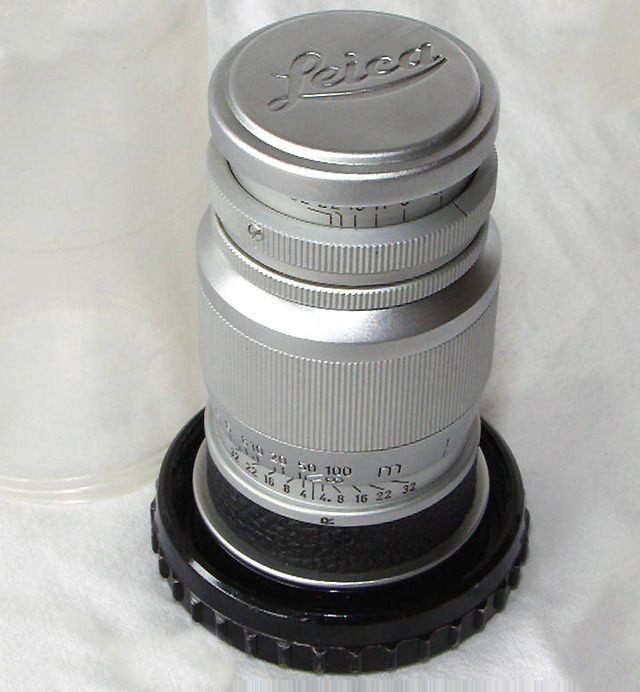
The other reason, checking out the Leica collection, never disappoints. K&S has but two things of real value – its buildings on prime real estate which they really should sell to a developer. And its Leica collection in the Processing shop above the retail store which is probably worth even more.
So while my latest trip this last Sunday complied with the routine – tired Yosemite pictures and a goggle at the Leicas – my real goal was to get some air. No, not the hot kind the sales clerks were busy spouting to prospects. People who shop here are either making a Desperation Purchase or are from the wilds of the Amazon and have yet to hear of the other Amazon. I didn’t need any hot air. I needed the compressed variety. Yes, another Mac hardware failure was forcing me to pony up at full retail. You see, one of the great features of the ventilation design of our MacMini – used as a TV server and DVD player – is its ability to suck up every mote of dust in the environment and deposit most of its catch on the laser beam sender in the DVD player. This means DVDs will not play and it happens every 4-6 months.
You have too options.
Open up the Mini, extricate the DVD mechanism and clean it. This is the Looney Option. Your chances of opening the Mini without major damage to it or yourself are slim. And the possibility you might actually reassemble the thing in working order slimmer still. Plus the visits to the nut house after doing this will cost you dearly.
The second is the Genius Option, so named because an Apple Store Genius clued me into it. You get a can of compressed air (no, not Contact Cleaner, guaranteed to destroy your laser sender, which is why Radio Shack would not be a good place to shop), stick the red wand in the spray orifice on the can, ram the wand into the DVD slot and blast around in all directions. Ten seconds later and your Mini is fine again …. for the next six months.
And that is what found me at K&S on a sunny Sunday afternoon, buying a can of compressed air. They had no fewer than four brands to choose from (premium air, regular air, discount air and the one I bought) on the basis that There’s One Born Every Minute and, air being air, I did the mental math and bought the one with the lowest unit cost. Even so, I felt I overpaid.
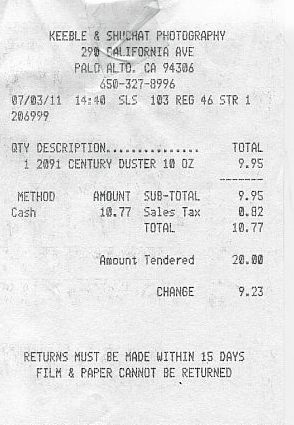
Enough compressed air for ten MacMini fixes.
And speaking of dusting off, the first thing you have to do when you make your way up the stairs to Processing is to dust off the lone sales clerk you will find there. It’s the same guy you saw 11 years ago when he joined from Adolf Gassers, which had started going out of business back then and is still working at it. You will find him asleep at his 11 year old iMac (the one with the mushroom base and screen-on-a-wand), dreaming of the old days when film was grainy and darkrooms were red. We get to chatting and he regales me with how some jerk at Stanford is teaching a summer photography class and has told all his students they must learn traditional ways and expose 50 rolls of TriX (fifty!) during the week. Must be on sales commission. Unfortunately, the class is massively oversubscribed so K&S has to go to Kodak for more after they run out. Of course Kodak, being a few weeks away from bankruptcy, doesn’t have anyone to answer the phone. We reminisce about the good old days, how these young people all want instant gratification rather than selective depth of field and generally bond while he loses his train of thought a couple of times.
Anyway, as I’m making my way out to get seriously depressed by the execrable black and whites (“All fiber paper, no RC here” I am told) in their gallery, the man shouts to me “Hey! I sold an enlarger yesterday!”. They have seven on display – six ‘new’ ones and a very used and very corroded pre-war Leitz Focomat IIa for which they are asking the silly sum of $700. “No kidding!” “Yup, had it here on display for 10 years. Sold it to some kid at that Stanford class for $160.” The others? They have been on display 10 years too. Look hard and you will see wear marks from all those years of dusting.
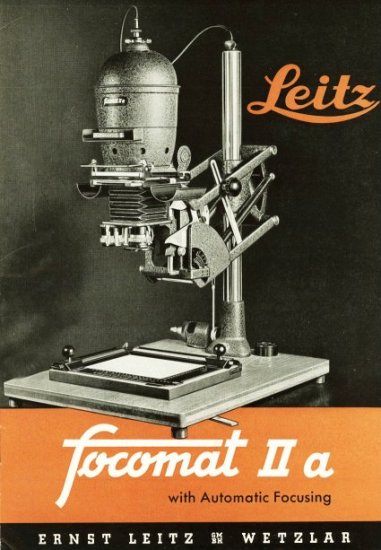
Leitz Focomat IIa – 60mm and 95mm lenses for 35mm and 6×6 film.
Well, never let it be said that a visit to K&S is not entertaining, perhaps the most amazing thing being that it’s still there. And it’s a great place for air – hot or compressed.