Category Archives: Photographs

Looking at pictures

You can’t beat natural light

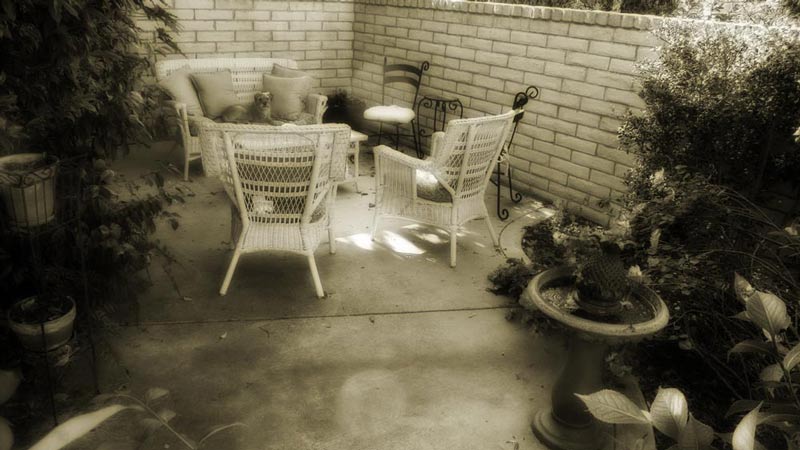
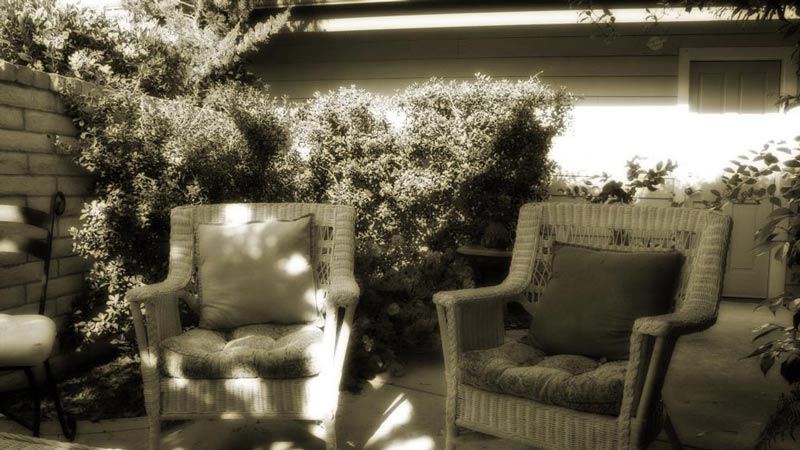
As we look forward to six dry months in central Caliornia, it’s nice to have a sheltered outdoor spot to look at pictures on those long, warm summer evenings.

This little walled patio on the north side of our home was a complete mess when we moved here a couple of years ago. As the US Government has yet to craft a method of taxing sweat equity, I set about fixing it up to make a pleasant enviroment to better enjoy the occasional book of pictures. The only taxes involved were iniquitous sales taxes which, wherever they may go rest assured it’s not to fix the local roads and freeways, which resemble those of a third world nation.

No matter. Get rid of the horrible hot tub that so spoiled this lovely spot, add a few rose bushes and magnolias, some mulch, a small fountain to set the tone and a few pieces of wicker furniture from the far east and you have the makings of a fine outdoor reading room. The tub was sold to a neighbor and the proceeds invested in what you see here. Throw in a Border Terrier and things are nigh perfect.

Yesterday evening I was leafing through Michael Kenna’s work in the beautifully printed ‘A Twenty Year Retrospective’ and couldn’t help but remark on how the prints looked so much better in the warm outdoor light. His photographs are reproduced in a gentle sepia which adds greatly to the overall feel. Kenna has a strong, consistent style and while the book credits him with works in many US public gallery collections, you would probably expect to find it on the wood panelled walls of classier business institutions like private banks and financial advisors.

Anyway, with all that sepia going on, I grabbed that little jewel, the Leica DP, and took a couple of snaps to illustrate this piece. A few seconds with Photoshop saw the RAW images converted to TIF files whence two more clicks saw monochrome conversion and sepia toning.

Not really luck

You make your luck. It doesn’t just find you.

I pride myself on knowing the charming town of Burlingame in the South Bay of San Francisco pretty well, so imagine my surprise the other day when a passer-by asked her for directions to the ‘English Village’.

It turns out that this is a collection of fifteen or so homes just around the corner from where she was at the time. Small homes, some 1500 square feet each, but each with an impeccable garden and lots of mock Tudor style.

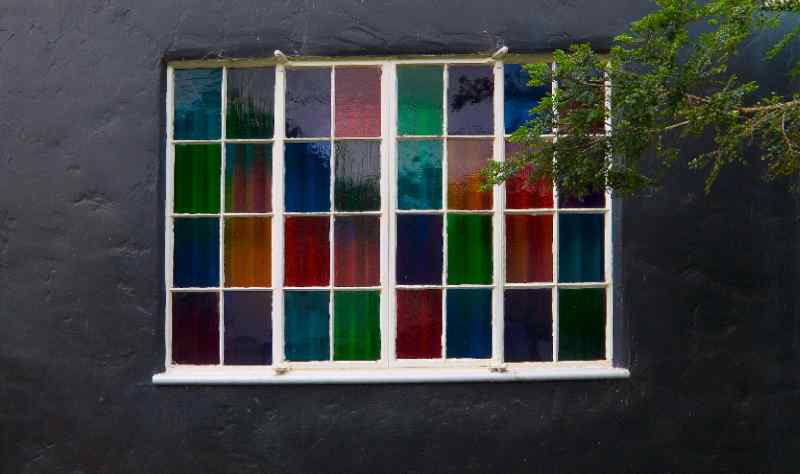
So it didn’t need much encouragement on my part to leash up that wild beast, Bertie the Border Terrrier, and ankle around to said location. And, it has to be admitted, the place oozed charm like a politician looking for campaign donations, albeit with a lot more class. Needless to say, that little gem the Leica DP was in my trouser pocket, so it was a moment’s work to catch some nice details:

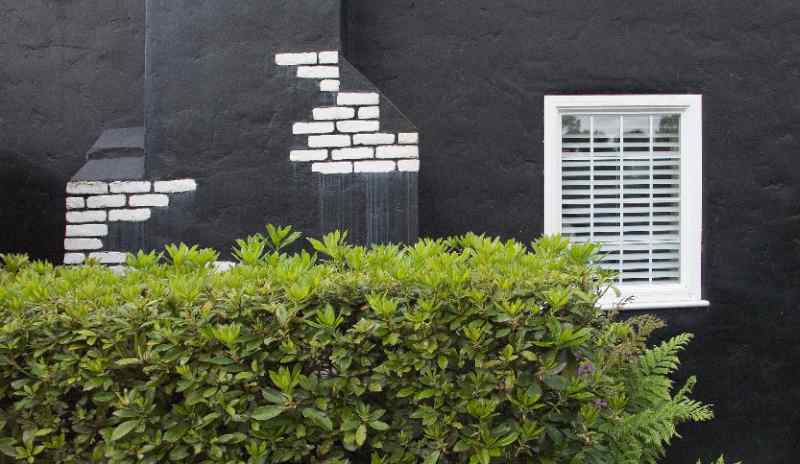
Round the corner and there’s another one:

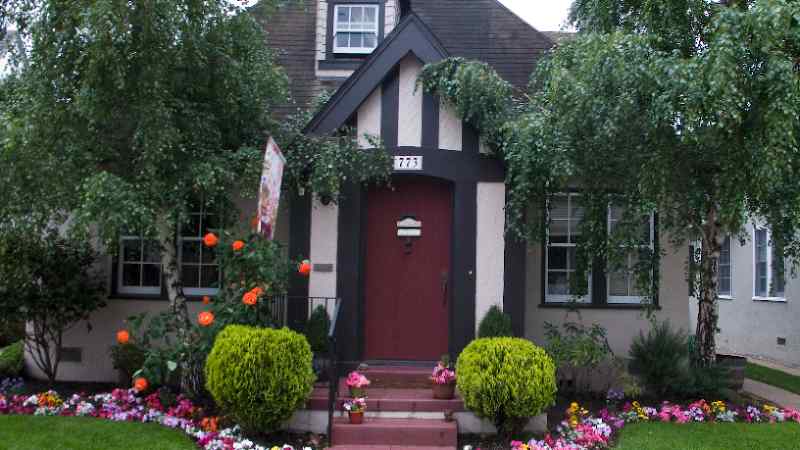
And a third:

The old admonition to Always Carry a Camera fell into disuse with this photographer as nothing this small was this good until now. Even the Leica rangefinder was not small enough to permit this cavalier attitude. Once you have one of these modern digital gems, however, there really is no excuse for not carrying it with you at all times.

Early photographic vision

Uccello and Carravaggio had it down 500 years ago

As a boy growing up in London I lose count of the number of visits I made to The National Gallery in London. Whether going through my Impressionist period, High Renaissance or early Renaissance, there was always something there to fascinate and to intrigue. While photography had always been my first love in the visual arts, I think I learned more about seeing from gazing at the art in this great collection than from any number of photography books.

Some of these experiences left deep impressions. When asked which of the works on display I liked most, nay, desired to possess, the choices narrow to a few. Titian’s ‘Noli Me Tangere’ (1512) (Do Not Touch Me) of course. I have always been captivated by the dynamic use of diagonals – Christ, Mary Magdalen, the tree, the lovely warm light, Christ’s daring near-nakedness. You can feel the motion as he grabs the shroud to prevent Mary pulling on it. It is hard to conceive of a more perfectly balanced composition and if you think you cannot get away, as a photographer, with lampposts growing out of people’s heads, well just look what Titian did with that tree!

I have always felt that The National Gallery has way over-restored its Titians to near-Cibachrome color intensity, and that clearly shows here, but the magic of the picture saves the day.

So when it comes to lessons in composition, just check a few Titians out.

Botticelli’s Portrait of a Young Man (1485) is simply arresting. It’s one of the smallest paintings on display at 16″ by 12″ – the size of a regular photographic print. But you walk into that gallery and there’s only one thing you can see. The certainty of the gaze, the confident bearing, the red cap accent, the somewhat rushed rendering of the tunic, all to good purpose. It places all the focus on the eyes. When I first saw this – I was probably fourteen at the time – I made such a bee line for the picture that I nearly knocked over one of London’s dowager ladies in my rush. It’s that good. I frequently fantasized about pinching this masterpiece – how hard would it be to make off with a 16″ by 12″ canvas, after all? To this day the use of daylight and the way shadows model the face leave anything Vermeer did with lighting in, well, the shade.

As a photographer it is simply impossible not to like Caravaggio. Versions of The Supper at Emmaus hang in both the National Gallery and the Louvre, the diners’ ragged clothing rendered just so, the worms in the fruit on the table and, of course, Caravaggio’s signature lighting. But great as that painting is, it is simply eclipsed by The Conversion of Saul (St. Paul). In London’s Swinging Sixties the 21mm lens on a 35mm camera was de rigeur for any self respecting trendie. You saw its abuse everywhere, especially on record sleeves of the more extreme rock groups. Wild perspective, severely receding lines, objects very close to the lens, distortion galore. Well just take a look at this. Caravaggio had the 21mm figured. What is breathtaking about this canvas is how little space he has worked in. Painted in 1601 the canvas is simply enormous – some 7 1/2 by 6 feet. In other words, the horse is rendered at almost life size. Why so large? Caravaggio was a student of perspective. He knew that viewers would get too close to the painting, but that, by doing so, the grandeur of his ultra-wide angled vision would be correctly rendered and the perspective distortion would disappear. And so it does. The painting is immensely involving. You are there. Like a movie in a theater compared to the same thing on television, you have to see this live. Not reproduced.

But easily the strangest use of perspective on view in The National Gallery belongs to a visionary whose work preceded that of all the above, none other than Paolo Uccello. In 1450 he painted three enormous panels depicting the battle at San Romano in which the Florentine army defeated Siena some twenty years earlier. The three panels are some 6 feet by 10 feet in size. One (the weakest, and that’s a cruel critique) hangs in The National Gallery. The others hang in the Louvre and the Uffizi. Fitting that three of the greatest masterpieces of the early Renaissance should hang in the three greatest Renaissance collections.

Appropriately, the best hangs in the Florentine collection, but look, if you gave me the one in London I would have no issues with finding wall space for it. I assert that there is more to be learned, as a photographer, from this one painting than from any number of academic studies on the use of perspective. By the time this painting was made, artists understood the rendering of perspective well. Uccello just chose to disregard the rules, dramatically foreshortening perspective, predating surrealism by some six hundred years. The repeating motif of the lances, the purposeful abuse of sizing (look how small the dead soldier in the left foreground is), the steep, tilted, climbing background with the horsemen rendered way too large, the detritus of battle painted in seemingly random perspective. It’s magic. Simply the greatest lesson in the (ab)use of perspective on canvas.

As photographers, we have a lot to learn from the masters.

And no, I harbored no fantasies about making off with the Uccello. It’s just too big to stash under a genuine English raincoat.

And now for some pictures

Which is what it’s all about.

All that cataloging in Aperture did have a bright side, specifically an opportunity to reacquaint myself with many pictures from days past. So after all this talk of cameras and printers and software in recent columns, I thought it might be nice to share some pictures with you.

As is the case, I suspect, with many photographers, I have perfect recall of the equipment and film used to take these, even though the stored files are silent, as it’s not something I routinely record. The digital age, of course, does this for you today.

So here goes – 15 snaps chosen at random and in no particular order.


South Uist, Outer Hebrides, 1977.
A rugged, lonely place.
Nikon F, 28mm Vivitar, TriX.


Tuileries Gardens, Paris, 1977.
A life begins, another draws to a close.
Leica M3, 35mm Summaron, TriX.


World Trade Centers, 1982.
Pentax ME Super, 40mm Pentax SMC, Kodachrome 64.


London, 2000.
Cabs old and new.
Leica M6, 35mm Asph Summicron, Kodachrome 64.


Tucson, Arizona.
A warm day!
Leica M6, 90mm Elmarit, Kodachrome 64.


Pebble Beach, California, 1987.
‘The Pirate’.
Leicaflex SL, 50mm Summicron-R. Kodachrome 64.


Tuileries Gardens, Paris, 1975.
What’s not to like about Paris?
Leica M3, 90mm Elmar, Kodachrome X.


Rodeo Drive, California, 1989.
Someone parked this huge ’60s wagon on this costliest of shopping destinations.
Leica M3, 50mm Summicron, Kodachrome 64.


Bermuda, 1999.
Land of sublime architecture.
Leica M6, 90mm Elmarit, Kodachrome 64.


Somewhere in Arizona, 1988.
Leicaflex SL, 50mm Summicron-R, Kodachrome 64.


Hong Kong, 1995.
Statues ready for illicit export.
Rollei 35, 40mm Tessar, Kodachrome 64.


Pismo Beach, California, 2004.
A lazy, sunny afternoon by the Pacific.
Leica M2, 35mm Asph Summicron, Kodak Gold 100.


Union Square, San Francisco, 1999.
A child’s wonder.
Leica M2, 35mm Asph Summicron, Kodak Gold 100.


Pasadena, California, 1988.
Gangster car.
Leica M3, 35mm Summicron, Kodachrome 64.


Santa Fe, New Mexico, 1995.
Rocking horses at an antique dealer’s.
Leica M2, 50mm Summicron, Kodachrome 64.