Just mind you don’t fall in the water.
Hearst Castle is the most popular tourist destination in central California so I took the precaution of booking a ticket in advance rather than be faced with a long wait for the tour bus which takes you some two thousand feet above sea level to Hearst’s opulent home. While I may have trashed Hearst for his part in dragging down the quality of journalism, a visit to his Castle on the central coast makes me feel a lot better about how he spent his money. As one of the tour guides pointed out, this magpie of a man expended some 78 of his 81 years collecting, starting with a trip to Europe aged three when he asked his mother why they couldn’t simply buy all the the things he liked. Got to like that!
While waiting for the bus – I chose Tour 2 which takes in the upper levels with all the living quarters, the kitchen and the two pools – I chanced on a fellow photographer using a pretty exotic looking Canon L lens finished in white enamel. Now I had seen these things at televised sports events but had never actually encountered someone actually using one, so my curiosity was piqued.
I confess to being in two minds about that red stripe that Canon places on its best glass. On the one hand it tells fellow photographers that you are serious (or maybe just seriously rich) about your images. On the other, it smacks vaguely of driving around in a Rolls Royce or Mercedes. Rather ostentatious and an invitation to thieves everywhere. Short of resorting to brush and paint, there’s really no simple way of blacking out the offending red stripe, unlike the ease with which electrician’s tape can be used to take out the obnoxious markings on the camera’s body.
Mick M. responded that the lens was a 70-200mm f/2.8 L zoom, and an impressive piece it is. Hard not to be noticed with all that white paint which, I suppose, must leave the nature photographer for ever seeking camouflage. Mick then opened his camera bag to disclose a veritable cornucopia of Canon L glass. Let’s see, there was a 24-70mm zoom, an 85mm f/1.2 portrait lens (yes, f/1.2!), an extender for the zoom and a strange looking duck with an enormous, bulbous front element. Proferring it, Mick explained this was a 14mm f/2.8 ultra wide angle. Not a fish eye. A genuine wide angle. This, I confess, had me greatly intrigued, and when Mick explained that his cameras were a 20D and 10D, the fact that these have small image sensors led me to pounce.
“Why not stick that wide on my 5D and see what 14mm really feels like?â€. It was the only trump card I held, what with the one body and just the 24-105 L on it.
What ensued was that the loudest sound to be heard in Hearst Castle’s parking lot was that of jaws dropping. Mick’s, when he held the camera up to his eye, and mine shortly after. Now I had used a 21mm Asph Elmarit on my Leica for many years, to the extent that in some ways it had become my standard lens. Despite the cheesy, distorting, plastic viewfinder it came with, the lens itself was seemingly perfect in every way. Sharp at all apertures, compact and distortion free, it left nothing to be desired optically. Point it into the sun and flare was noticeable by its absence. The Leica 21mm has moved on once I concluded that 24mm at the short end of the Canon’s zoom range was fine for my purposes, but not without a twang or two on the heartstrings. We had become firm friends.
I can only guess that there is some sort of macho rivalry between lens makers – maybe I should refer to them as programmers – when it comes to making the widest lenses. I checked B&H and Leica has a 15mm for their reflex camera (costing about as much as a new car, needless to add), Nikon has a 14mm, and the various after-market manufacturers have 14s and 15s aplenty. Given that all of these run $1000 or more, they can hardly be mass market items and about the only use I can envisage on a daily basis is for unscrupulous realtors looking to make interiors larger. “Here is the bathroom†instantly become “Here is the palatial bathroomâ€.
Nonetheless, the impact of the lens in the viewfinder was overwhelming, and framing with it, walking towards a subject, gave this user a distinct feeling of unsteadiness owing to the width of the field of view, far in excess of what the human eye perceives. To cut a long story short, Mick very generously offered me the use of the 14mm and I reciprocated with the use of my 5D into which he needed only place one of his digital film cards to have a go. I got first go and on arriving at Hearst’s home in the sky one of the first sights was the outdoor pool. The weather was just so, a wisp of a cloud or two in the sky and a pleasant mild day in California. How do people in the mid-west get through the winter?
Having a fair amount of experience with ultra-wide lenses I knew enough to avoid the bane of all these optics which is boring, extraneous foreground. You really have to get in close, so I proceeded to attack the pool with aplomb, forced to sight through the finder, never having used something this wide before. I can ‘think’ 21mm, but 14mm is like a scene from Hitchcock’s ‘Vertigo’ by comparison. And vertigo was the order of the day as I teetered on the edge of Hearst’s ten foot deep outdoor pool! Now you absolutely have to use the hood with this lens, if for no other reason than there is no way to protect the cyclopean front element with a filter. It is simply too bulbous. And here’s a snap of the pool taken with Mick’s lens.
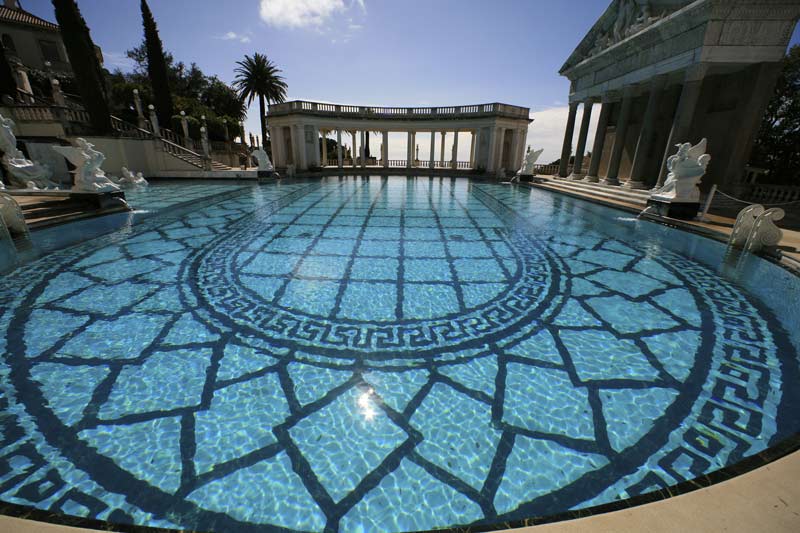
Though taken directly into the light, the lens seems flare free with just one small internal reflection visible in the picture. An extraordinary piece of design and execution. Will I be rushing out to buy one? No way. It’s the sort of thing I would use once a year and is inconsistent with my desire to minimize equipment, but thank you, Mick, for your generosity in allowing me to take a few pictures with this gorgeous bit o’ bottle.
If you would like to see a travelogue of a few more snaps from Hearst Castle, please click here.
And for a cheaper, wider, better lens than the 14mm, just click here.