Category Archives: Nikon bodies

About Nikon DSLRs

A tale of two sensors

‘Good enough’ is better than good enough.

A clear thinking friend of mine has a simple philosophy when it comes to consumer durable purchases, and he calls it the ‘good enough’ concept. If it’s good enough, forget spending the extra for the top of the line model, the one with the bells and whistles. The marginal return is …. marginal, the incremental cost ruinous and the depreciation far higher. (This reminds me of Lord Chesterfield on the subject of sex: “The pleasure momentary, one’s position ridiculous and the cost? Damnable.”)

And I’m here to declare that Micro Four-Thirds is more than ‘good enough’. My standard for comparison? The full frame sensor in my Nikon D3x, the MFT one being that in my Panny GX7. For all of you who prefer wasting your money see my my product review of the Leica M240. Be assured that I not only do not own two of these, I don’t even own one. Nor will that change.

Some recent sensor history. Panny started with a 12mp design in the ground breaking G1, upping it later to 16mp which my G3 enjoyed. The practical change was that whereas 13″ x 19″ nosey prints were easy with the G1, the easy size grew to 18″ x 24″ with the G3 and later bodies. Nosey? It’s when your viewer sticks his schnozzer in the print and you have to get the cotton balls out to clean the surface. In the GX7 they tweaked the software a bit and got the marketing boys to do some writing, but to all intents it’s much the same as the one in the G3 and others, which is to say very good indeed.


The fabulous Panasonic GX7 – the best street snapper ever made.

Nikon delegates sensor manufacture to Sony, claiming credit for the design (eh?) and perhaps the best full frame sensor they made for the money was the one in the D3/D700. The D3x doubled the pixels to 24mp, trading the increased resolution for more noise at higher ISOs, especially noticeable in the dark bits of the image. The D4’s sensor improved a bit more on the low pixel count one in the superb D700 and the one in the D800 blew everyone out of the water where they remain to this day. But that’s pixel peeper stuff. In the real world of large prints, it’s irrelevant.

Why do I say this? Because I constantly print my images for display in the moveable feast which is the wall displays at the old manse. Coming on a round of spring changes, I have had ample opportunity to tweak and print images at 13″ x 19″ and, better, at 18″ x 24″ from both the D3x full frame body and the GX7 MFT one. In both cases I am using my favored focal length of 35mm FFE. The exceptional Sigma 35mm f/1.4 behemoth on the no less porky D3x, and the magnificent Olympus Zuiko 17mm f/1.8 on the GX7, with AF speed which leaves FF lenses in the dust. I suppose the weight and bulk ratio is some 3:1, yet I enjoy both.

Were cameras dogs (Leica’s M would instantly qualify for inclusion in the latter species, a frou frou toy breed, fragility redefined, constantly in need of attention), then the big pro-body Nikon would be a Golden Retriever. Immensely dependable, lumbering and stolid, it will never let you down, can take a battering from the kids and still emerge with an all-weather smile on its face. And it keeps going longer than you can. The GX7 could scarcely be more different. It’s the terrier of the camera world. Small, fast, high-strung, sharp as a tack, it demands a little more care and attention in the relationship but rewards out of all proportion to its diminutive size. And it burns out (its battery) pretty fast.

Those printed images? I rattled off a handful of 18″ x 24″ on the ever dependable HP DesignJet 90 dye printer the other day and, blow me down, I simply could not tell which were taken on the Nikon compared with the Panny. We are talking nosey examination of micro detail here. Which is another way of saying that the Panny is ‘good enough’, for the Nikon is way better than almost anyone needs. And my rule of thumb has long been if it can print at 18″ x 24″ it can print at any size you want, as the viewer is forced further back as size increases, mitigating resolution loss.

Ah! you say. But no way the MFT system can match the big, fast zooms available to Nikon and Canon snappers, the classic 24-70mm and 70-200 f/2.8 fixed maximum aperture zooms and the like. Think again. Have you seen what Panny and Olympus has been up to recently? How about Panny’s 12-35mm f/2.8 zoom?

Panasonic 12-35mm f/2.8.

Or their 35-100 f/2.8?

Panasonic 35-100mm f/2.8.

Olympus has hardly been asleep, either. In addition to their wonderful 17mm and 45mm f/1.8 Zuikos which I use, there are such exciting conceptions like these:


The Zuiko 12mm f/2.


The Zuiko 75mm f/1.8.

And don’t even think of asking about size, weight and price, because that’s a losing proposition for the Big Boys.

Finally, modern MFT ‘pro’ bodies like the Olympus EM1 can offer all the framing rates and weather resistance you need, once again at a fraction of the price. And so can the tiny GX7 though no one will take you seriously. Which is possibly the best feature of all.

Do yourself a favor. Put the fun back in your snapping and pick up something which says Panasonic or Olympus on the body and whose lens detaches.

Early MF Nikkor lenses

Nikkors in a bunch.

Here is my completed ‘metal era’ user set. I have installed CPUs in each and all have been converted to Ai indexing for the modern DSLR.

The designs are much of a muchness here, sharing looks and ergonomics, with but two anomalies. The 24/2.8 uses a diamond patterned aperture ring rather than the scalloped standard, reflecting the presence of a Nikon Ai conversion kit. The 35/2 and 85/1.8 use the original factory aperture rings which came with fluted machining for some reason. Otherwise all lenses use scalloped focusing and aperture collars. The 24mm and 28mm are the only multi-coated optics here. Color rendering across the range is especially notable for its uniformity, and I have published lens correction profiles for each lens, available for free download here.

Average cost was $166 plus $30 for the CPU installed in each. The total spent would buy you one ‘pro’ grade plastic fantastic current lens and will leave you desperately searching for repair parts when the internal motors fail a few years hence.

Age in years in parentheses. Click any link for the related review.

Front row:

Rear row:

The only significant one missing from the era is the 35/1.4. I have the latest 35/1.4 Sigma which is superior to the Nikkor. Also, I have avoided the more pedestrian variants – 35/2.8, etc. – as the faster optics add optical quality and performance. I use no lens hood on the 20mm, where it is useless, or on the 55mm where it is redundant.


Data for the lenses shown.

Each is used extensively, each is a joy to hold and behold and each is wonderful in a special way. No hood on the 20mm (useless) or the 55mm (not required).

Does anyone need all of these? Of course not. Three at most will suit any particular snapping style. For me it would be the 20mm, the 35mm and the 85mm. Yet I adore what the 24 and 28mm can do, would miss the 50mm horribly, the 105mm is frequently just the ticket, as is the 135mm and who could live without that simply divine 200mm? I would, however, warn you never to get one of these, because once you do, you will sell the garbage that passes for your current set of lenses and start getting pre-Ai metal era Nikkors, from the good old days when men were men, closet doors remained firmly bolted and women were pregnant and in the kitchen.

All of these are abundantly available used – mine came from KEH and eBay over a two year period, CPU installation is easy on all but the 50mm optic, the 20mm requires that you fabricate an aperture follower, and handling, performance and build quality are the best anyone ever accomplished. None is collectible, so you will not be competing with white trash collectors for these, nor should you have any qualms about gluing on a CPU and removing the useless aperture claw from the bad old days of film. Manufacturers would have you believe that modern lens designs are specifically for the digital era and if you believe that you can drop me an email and bid on my bridge for sale in Brooklyn.

To see my snaps taken with all of these on the D700, D2x and D3x, simply enter “Nikkor”, the focal length and aperture in the Search box.

Nikkor 55mm f/3.5 Micro lens

A high definition macro lens.

Choices:

After the 50mm f/2 Nikkor, this is quite possibly one of the commonest Nikon lenses ever made. The 55mm f/3.5 Micro Nikkor is abundantly available in many variants:

  • Metal focus barrel, compensating aperture, pre-Ai
  • Metal focus barrel, non-compensating aperture, pre-Ai
  • Rubber focus barrel, pre-Ai
  • Rubber focus barrel, Ai
  • Rubber focus barrel, Ai, multi-coated

The later 55mm f/2.8 Ai-S MF optic is not recommended, owing to widespread reports of oil migrating from the focus mechanism to the aperture blades. Overhauling the lens to replace lubricants makes no economic sense owing to the high cost of labor. The even later 60mm f/2.8 versions, all AF, have the benefit of extending the focus range to life-size without the need to use an extension tube. But the construction quality of the 55mm f/3.5 was never equalled.

Ai conversion:

Spare no thought of destroying ‘collectible value’ by doing the Ai conversion. First, collectors are scum who serve only to drive up used gear costs. People who put gear in storage – be it camera or Ferrari – are beyond contempt in my book. Second, Nikon made hundreds of thousands of these lenses and you can always find any version in any condition on the used market, at very short notice. There is no such thing as a ‘collectible’ 55mm Micro Nikkor.


The rear of the lens is exceptionally well baffled.

This means that the usual work will have to be done to file away an arc of alloy to permit clearance of and proper engagement with the aperture follower on the Nikon’s body. Not doing this will damage your camera. This work has yet to be done in the above illustration.

The snag is that the aperture collar where the filing has to be done cannot be removed by simply removing the bayonet flange – the five slotted screws shown. No, removing the small radial aperture ring indexing screw does not help. Don’t bother trying. So to work around this, after removing the bayonet flange, I placed some heavy-duty tape over the rear of the lens and scribed around carefully with a sharp knife to produce a thoroughly sealed interior which resisted any ingress of metal filings.


With the bayonet flange removed, 3M clear Scotch tape is placed in position, ready for filing.

Be sure to keep the lens focused at its closest distance – the protruding rear element will otherwise contact the adhesive tape, a move not calculated to enhance definition. Filing can now proceed in the usual way, using my guide here. All filings are blasted away with compressed air after which the Scotch tape can be discarded and the bayonet flange replaced.

CPU installation is as easy as it gets. No changes are needed, the CPU simply being glued in place in the usual way as I indicate here.

In use:


Deeply recessed front element.

The front element of the Micro Nikkor is deeply recessed within the barrel, so it’s unlikely that adding a lens hood will make any difference to results. Some reports indicate that the Micro Nikkor has poor performance at infinity, only really coming into its own at 1:10 and greater reproduction ratios. I have no idea where these urban myths were perpetrated – perhaps the results of a bad sample or two? – but mine is tack sharp at all apertures and subject distances, with optimum resolution being at f/5.6 through f/11 in the center and f/8 through f/11 in the extreme corners. Minor diffraction resolution losses become apparent at f/16 and f/22, and by f/32 these are noticeable, so I would avoid using the smallest aperture.

I do not recommend using a protective UV filter. It will serve only to attract light reflections, especially as it will be situated a considerable distance from the front element.

The lens is very light and the focusing helicoid exceptionally well designed, so that there is no play in the barrel even with the lens fully extended at its closest focus distance.

f/3.5 is not especially fast so how is focusing? I use the focus confirmation display in the D3x and hitting the illuminated central LED is very sensitive, meaning focus is very accurate. The infinity setting is exceptional, as the combination of 55mm Micro Nikkor and D3x body can easily distinguish between 250 feet and infinity. For reference, the same focus module is used in the D700, D3 and D3s bodies. So even at close focus distances, getting critical focus is trivial, though a tripod is strongly recommended in the close-up range where even minor movement of the camera can significantly upset focus.

Lens correction profile:

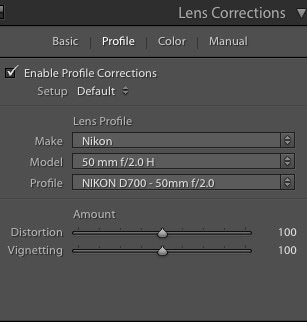
The lens is pretty close to perfect as is. There is very minor vignetting at f/3.5, and very low barrel distortion at all apertures. Chromatic aberration is almost non-existent. Nonetheless, I have made a lens correction profile which you can download here. This corrects these very minor aberrations, and if you add a CPU then you can have this profile automatically invoked and applied in Lightroom or Photoshop when downloading images from your camera’s storage card.


A CPU allows the correct profile to be automatically
loaded in Lightroom and Photoshop.

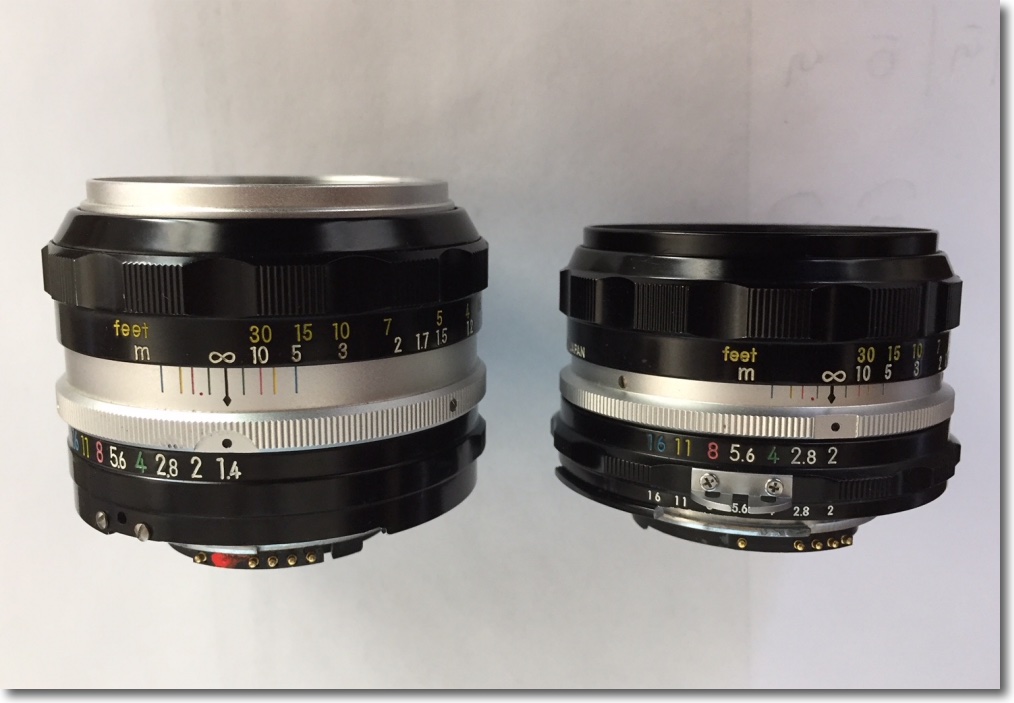
Comparison with the 50mm f/1.4 Nikkor:

The 50mm f/1.4 Nikkor of the same era is a firm favorite of mine and both optics are absolute classics from the period when Nikon’s mechanical and optical designs peaked. It’s hard to put in words the tactile pleasure of using these lenses. How do they compare? At f/3.5, f/5.6 and f/8 the Micro Nikkor has the edge in errr…. edge performance, but you would need to make a 40″ print to prove it. The 50mm of course opens up to F/1.4 and the Micro Nikkor goes down to 50% life-size, so it’s horses for courses. Neither will let you down.

The following images are of a 27x enlargement of the top right corner of the frame:

At 1:2 closest focus distance:

This image of a wristwatch was exposed at f/3.5, full aperture, at the closest focus distance:


Helicon Focus focus stacking of 14 images.


The 14 differentially focused images and the Helicon composite.

This gives you a sense of the maximum image size at the 1:2 closest focus distance. The image was created using Helicon Focus focus stacking software, and is a composite of no fewer than 14 differentially focused images, all taken at f/3.5. Because it takes a few seconds to take all the constituent images, refocusing a bit between each, I have removed the blur of the seconds hand using Photoshop.

The 55mm Micro Nikkor is recommended without reservation and at current market prices it’s almost offensively inexpensive.

Nikkor 20mm f/3.5 UD lens

Finally! Wide angle bliss.

I have been using the 20mm f/3.5 Ai-S Nikkor for a while now and it is both compact and optically excellent. But my first choice in a classic MF 20mm Nikkor was always the earlier UD of 1967. The snag is, it’s not easy to find a mint specimen.

The UD was a very special lens for its time. Until its creation, Nikon F owners made use of the mirror lock-up and separate optical finder needed to accommodate the 21mm design from Nikon’s rangefinder line. Hardly consonant with the SLR concept. Leica (with the 21mm Super Angulon for the original Leicaflex) and Zeiss (with the 21mm Biogon for the fabulous Contarex) adopted like strategies, mirror lock-up and all. All three came with the most awful, distorting viewfinders imaginable.

But the UD applied Nikon’s retrofocus research and resulted in a super-wide lens which needed no mirror lock-up or external finder. You saw through the pentaprism finder what the film would record. And it was massive, compared to their later 20mm designs – the 20mm f/4, f/3.5 and f/2.8, all MF and all excellent. Nikon lists the f/2.8 to this day.

So why bother spending all this time tracking down a pristine UD when all its successors are wonderful? Well, it’s that old fixation of mine. Metal. I believe lenses should be metal, not rubber or plastic mounted. I believe their ergonomics should fit the camera. And the D3x and D2x on which I use my lenses are very large bodies indeed. The 20mm Ai-S on the D3x is, frankly, rather dwarfed by the bulk of the body.

I searched some 18 months for a perfect UD specimen, being outbid several times on eBay as the UD seems to be attracting that vermin of the photography world, the gear collector. My sample, indistinguishable from new in every way, cost me $327 delivered, some $75 more than when I first started searching. By contrast, the Ai-S f/3.5 version can be had for maybe $250, or so. The CPU adds $30 and the Ai conversion requires a Dremel tool with a cut-off wheel, a small file and sweat equity.

Here’s the real thing:


D3x, 20mm f/3.5 UD Nikkor. Mine was made in September, 1973.
Production ceased in April, 1974.

Nikon pulled no punches here. This lens is simply outstanding optically and mechanically. Almost 50 years after it was designed it remains a bedrock of solidity and pure old-fashioned mechanical engineering. Handling, feel, balance on the big body – there’s no comparison with its smaller and lighter successors. No play, no wobble, just high integrity build and finish. A man’s lens. For sheer beauty of execution only the pre-Ai 200mm f/4 Nikkor-Q compares.

My example was pre-Ai, as were all 20mm UD Nikkors, so it necessitated Ai conversion. Forget about trying to find genuine Nikon factory conversion kits – they are rarer than hen’s teeth.


A factory modified UD Nikkor – note the protruding
ridge which abuts the aperture follower on the lens. Good
luck finding the modified aperture ring on the used market.

And conversion of this lens is tricky. Instead of just relieving the aperture ring to clear and activate the aperture follower on modern digital bodies, the lens has to have a protruding part attached to contact the follower, unlike other pre-Ai lenses. The easiest way to do this is to reverse the stock Nikon aperture claw, and cut off part of it until the dimensions are right. Nikon unwittingly provided just what’s needed for digital conversion, and the aperture claw I used has no purpose on modern Nikon DSLRs so its reuse has no negative effects. The modified, cut down claw will correctly contact the aperture follower as illustrated below.


The aperture follower. Very robust despite appearances,
the final thing is painted black to match the lens.


The aperture follower in use on the Nikon DSLR body.
Note the vacant claw retaining threaded hole to the right.

A note on ‘de-clawing’ the lens: Ordinarily, once I have converted an MF Nikkor to work on the modern Nikon DSLR, I remove the aperture claw on top of the aperture ring and store it. Because the two retaining screws are small and easily lost, I replace them in the vacant holes in the aperture ring, using a magentized screwdriver (any other way invites insanity). Do not replace the second claw retaining screw in the 20mm UD Nikkor (the other screw is used to retain the reversed claw). Doing so you will find that the screw countersinks too deeply into the innards of the lens and will prevent movement of the aperture ring.

The contrast in size with the later 20mm f/3.5 is striking:


The 1967 design pre-Ai UD and the 1977 design Ai-S.
No rubber or plastic on the UD.

The handling of the big UD on the large D3x and D2x bodies is ergonomic perfection.

How about resolution? At normal enlargement ratios neither lens will let you down in big prints. But the optical design philosophies could scarcely be more different. The UD is computed for maximum resolution at the center and hang the edges. Indeed, central resolution remains largely unchanged, and outstanding, at all apertures, being pretty much perfect by f/4.5. By contrast the Ai-S optic compromises central resolution, trading it for more even across-the-frame performance. The Ai-S never quite matches the UD in the center and the UD never quite matches the Ai-S in the corners. For reference, I have a 48″ x 36″ print made from a 20mm Ai-S image and it’s perfect at normal viewing distances, so it’s not as if any excuses need be made for the compact Ai-S variant of this lens.

Here are center comparisons at f/3.5 and f/8, UD on the left. I’m using my usual utility pole in the backyard, that exemplar of America’s infrastructure. The equivalent print sizes would be 40″ x 27″, something very few users will ever make, so if you think the UD’s edges are poor and the Ai-S’s center is so-so, bear in mind what you are looking at:


Centers at f/3.5.


Centers at f/8.

And here are the extreme corners:


Corners at f/3.5.


Corners at f/8.

I’ll trade central resolution for corner sharpness any day.

I used the same lens correction profile for the UD as for the Ai-S, after adding a CPU in the usual way. Comparison with the Ai-S showed almost exactly the same level of vignetting and optical errors, meaning wave/mustache distortion of straight lines at the edge. Both lenses cease vignetting by f/5.6.


UD at f/3.5 – no profile. Note wave form distortion
of top of fence and vignetting.


UD at f/3.5 with profile.

You can find the lens correction profile here and use of this profile corrects vignetting and renders straight lines straight, not wavy. Flare into the sun is almost identical, the Ai-S reproducing sharper magenta spots where the UD delivers one considerably smaller one, this despite the huge front element in the UD. In both cases flare spots are far less pronounced through f/5.6, becoming pretty objectionable by f/22 with the Ai-S, though easily corrected in post-processing. Contrast of the two lenses appears identical at all apertures.


The profile in use – Lightroom 5.


UD flare at f/22.


Ai-S flare at f/22.

The sun was just out of the frame in both images and no lens hoods were used. Both lenses have UV protective filters, which probably does not help matters. The UD is single coated, the Ai-S multicoated. The UD only shows a minor loss in definition from diffraction at f/22 – remarkable. To put this further in perspective, the UD is 1-2 stops sharper across the frame then the current 16-35mm AFS G zoom, which costs $1,300. So much for optical progress ….

If you have a big body Nikon and yearn for the days of mechanical engineering which Nikon has never surpassed, the 1967-74 UD Nikkor is for you.


The finished job. The red dot on the CPU serves as an alignment aid when mounting the lens.


Correct EXIF data in LR5, read from the CPU.


Winston hammers away at his latest Lego kit. D3x, 20mm UD Nikkor at f/4.

A few early snaps appear here.

Sigma 18-35mm f/1.8 APS-C zoom

An interesting innovation.

Sigma has just announced an 18-35mm zoom for APS-C sensor DSLRs with a fixed maximum aperture of a speedy f/1.8. It works out to 27-53mm full frame equivalent.

It’s no lightweight at 29 ounces – 5 ounces heavier than the stellar 35/1.4 – but the finish appears to be the same, meaning excellent. Like that prime, the new optic will be programmable using Sigma’s dock. I would guess pricing at $900 for the lens and under $100 for the dock. The lens comes in Sigma, Nikon and Canon mounts. I’m sure my D2x would love one, but I am very happy with the inexpensive 35/1.8 Nikkor G prime.

It’s good that an independent maker can challenge the big boys on both quality and price. It seems that true innovation is mostly coming from Sigma and Fuji today.

Sample images appear here.