Getting a jump on things
To read the whole series on the Panasonic G1, click here
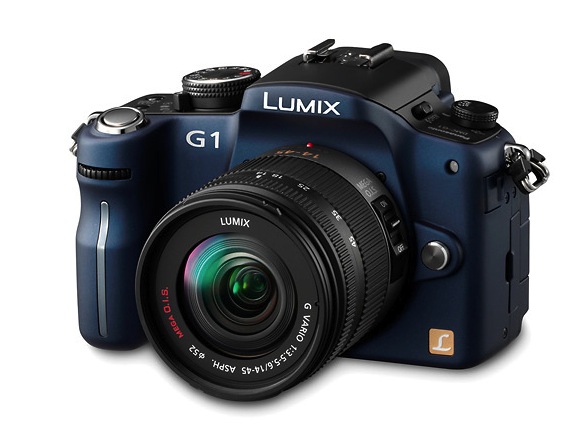
While I eagerly await the arrival of my Panasonic G1, I took a few moments to download the instruction book from the manufacturer’s web site.
With modern cameras more and more resembling computers, it makes sense to get a jump on things – the manual is no less than 167 pages long.
Here are some things I noticed:
- The functions of the cursor buttons on the back are completely different from those on my Panasonic LX-1
- There’s the equivalent of a ‘film plane’ mark on the top plate. Wonder who would ever need that?
- Panasonic does not list a wireless remote but aftermarket vendors on eBay sell them for under $40
- The LCD monitor can be turned ‘display in’ on the back of the camera – nice for protection and no distraction
- The charger connects to power using a cable – nice, as bulky chargers with pins on the body will often refuse to fit in tight places
- You can use the camera connected to the mains with a power cable
- SDHC cards up to 32gB are presently accepted
- A Custom Menu function allows you to limit LCD display to essential functions – that’s nice, given the sheer number of choices
- A World Time setting allows you to specify a second time zone
- Auto Review of pictures can be set to present everything magnified 4x
- There are seven brightness settings for the LCD monitor
- There’s a setting to automatically brighten the LCD in sunlight
- The swiveling LCD allows both landscape and portrait orientation of the camera at waist level
- There’s an EVF proximity sensor – like with the iPhone – which optionally switches off the LCD when the camera is raised to eye level
- The EVF has eyesight adjustment – hurrah!
- The battery is good for 330 minutes of continuous LCD use
- The digital zoom (ugh!) extends the 28-90mm lens to 55-178mm (full frame equivalents) by using 3.1 of the 12 million pixels
- One of the EVF display options allows all display clutter to disappear – ‘film mode’ with a dedicated top plate button. One of the first things I will set!
- There’s a small, built-in flash – useful for dynamic range enhancement (or limitation, more correctly) in bright sun
- The self timer has a three picture option
- The latest firmware upgrade, v. 1.2, claims to reduce noise at high ISO settings – I do not know with which version the camera ships
- There’s an option for 3 shot bracketing – just the thing for HDR photography
- Depressing the front dial allows switching between aperture and shutter priority auto exposure – this can be disabled
- A preview mode allows preview of the picture – here’s the wonder of an EVF – you can preview depth-of-field without the picture darkening. Is that magic or what? There’s a dedicated button for that on the lower right rear!
- There are three Custom Menu settings possible – hooray!
- You can choose three aspect ratios – 4:3, 3:2 (Leica) and 16:9 (widescreen)
- It looks like the 14-45mm kit lens has a non-rotating front element which will simplify use with a polarizing filter
- The screen can display up to 22 items of data – now do you see why I like the idea of switching all of this off?
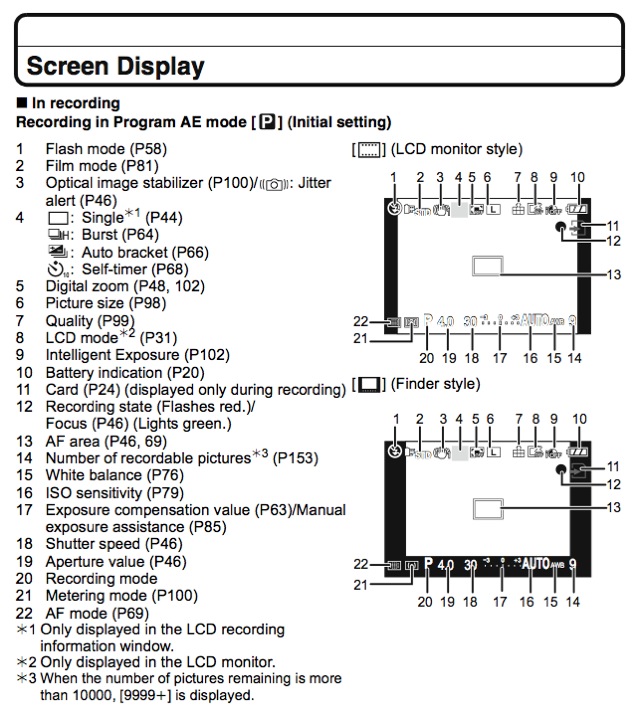
- A 4gB SDHC card will hold 185 pictures in RAW format at 4:3 aspect ratio. Which means that 1gB is fine for me.
- Panny has done a careless job of converting the manual to a PDF and several pages are missing including, most frustratingly, one of the index pages.
I prefer to use Lightroom 2 for all my processing (and simply plug the removed SDHC card into my iMac using a card reader) and have confirmed that the latest version of Adobe Camera Raw built in to LR 2.4 supports RAW files from the G1. It’s not that the software supplied by camera makers is bad – I have no idea – I simply refuse to learn yet another interface when I am so comfortable with Lightroom.
Anyway, there’s lots to look forward to and one reader has reported that the EVF is quite usable. This is the key to the whole design. Remember Panny’s first awful attempt at an EVF in the Panasonic L1? At least they made that body look more like a Leica M, but everything else was wrong. Interestingly, this time Panny has taken the conservative route of emulating the pentaprism hump common to all SLRs of the past 60 years even though none is needed – there is no glass pentaprism inside. Panny has also admitted that they could make the camera significantly smaller (here’s hoping!) but have refrained from doing so, probably for marketing reasons. Mysteriously, they are marketing this as a trade-up camera for the point-shoot-and-miss crowd whereas I regard it as possibly the first viable option for the disillusioned-Leica-rangefinder set.
Finally, I took a moment to compare the size and weight of the G1 with the long deceased Leica CL which I mentioned here. The M2 is also compared, because it is the single greatest body Leica ever made. I think you may agree this is instructive reading – all data exclude the lens and are in mm/grams:
Leica CL: 121 x 76 x 32 365 grams
Leica M2: 138 x 77 x 33.5 580 grams
Panny G1: 124 x 83.6 x 45.2 385 grams
Interesting, huh?
Now all I have to do is wait for the UPS man!
In the meanwhile, you can enjoy a really fact packed review by Matt Grayson in this video – note especially just how small that body appears in his hands: