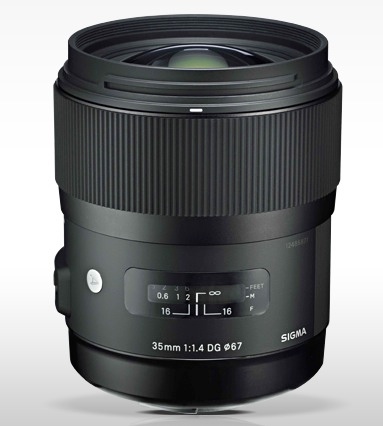
Not ready for prime time.
Part I is here.
I’m a street snapper. That means I have no use for focusing systems like LiveView which turn your DSLR into a capable, tripod-mounted field camera. You set it up, magnify the focus area and determine critical focus using MF on the LCD screen. This side-steps a host of variables relating to focus screen positioning, AF motor stepping and so on. I suspect it’s what most testers use when concluding that the Sigma is a stellar performer. But for street work, LiveView is anathema. You need something fast and unobtrusive, meaning viewfinder focus.
With this Sigma lens I have rarely seen such incredible resolution, regardless of aperture. And very few lenses, of the many I have used, compare when it comes to color rendering. In regard to these attributes, the comparable lenses are the 24-105mm Canon L (for color, resolution is just OK) on the 5D, the 35mm Asph Summicron-M used with Kodachrome film on a Leica M2 and the 16-35mm Nikkor AF-S I use currently. In the Lightroom Library view, images from these lenses, newly imported, simply pop with three-dimensional rendering and vibrant color.
But the 35mm Sigma I borrowed has one disqualifying fault. It simply cannot consistently focus the image correctly. It’s not a one-way deal where everything is back- or front-focused. That would be fine. Fine Tune would correct that. No, it is far worse and it’s not correctable. The AF focus errors this lens makes on my Nikon D3x are random.
The focus (!) here is on resolution of fine detail for the simple reason that you can more or less fix other errors in processing but you cannot put back lost resolution.
Here are two examples of how poorly the Sigma lens focuses, destroying resolution in the process.
In the first I focused on the head of the man on the left. I was seated, elbows on the table, no rush or stress. No question what I focused on. This was about as methodical as it gets. I used spot focus and recompose, as the subject was far enough away that recomposition would change the subject-to-camera distance by a negligible amount.

Now here is where the lens focused:

Nice, sharp wall.
The focus is a good two feet further away than required.
Another example. This snap of the two charming pups was focused on the right eye of the right pup:

This time the lens decided to focus on the nose of the pup instead of the eyes, 9″ closer than required.

Nice nose. Where it is sharp, the resolution is stunning.
Think those are bad? No, these were not at f/1.4. The first was at f/2, the second at f/4. f/4, and the lens missed focus by a country mile! Goodness, I can scale focus manually better than that.
I have many examples like this and the directional error is random. So I did the obvious thing and extended a ruler on the rug, the camera on a tripod and banged away at the target with the camera at 45 degrees, at a point 5 feet away. A typical street snapper’s working distance for a 35mm lens on FF. Yup, sure enough. The Sigma randomly front focused, back focused and occasionally nailed the focus. Sorry, for street work ‘occasionally’ does not cut it. There are enough variables driving failure without having to worry about your gear functioning properly.
In my street tests I used a variety of focus methods, Single Servo spot and recompose, Continuous 9, 21, 51 and 51 3-D matrix focus, and so on. And the most damning test of all is that my 85mm, f/1.8 AF-D Nikkor, yes the one with the ghastly plastic barrel and resolution to die for, discloses no autofocus variability errors at f/1.8. And that’s more demanding than 35mm at f/1.4. I did not use manual focus as it’s pointless to buy an AF lens to manually focus it in my kind of work.
Maybe all those testers singing the Sigma’s praises use LiveView on a tripod thus sidestepping the issues with the AF mechanism. Maybe mine was a stinker. A sample of one is not meaningful statistically. But the bottom line is the lens does not deliver. Well, it was a cheap $60 experiment. Thank goodness I did not buy this clunker.
Cross-check:
I also tried the lens on my D2x body with its APS-C sensor. The older CAM2000 focus module in the D2x (the D3 shares the CAM3500 with the D700 and D300) is of known accuracy, delivering perfectly focused results with the 85mm f/1.8 AFD at full aperture. The results with the Sigma lens were identical to those on the D2x body. Accurate focus is a matter of chance, with the lens getting it wrong some 50% of the time. Time and time again.
As further confirmation, I switched to the Nikkor 35mm f/1.4 AF-S G lens (of which more, later), and the Nikkor nails AF at f/1.4 at all distances every time using the same camera bodies. So there’s some grounds for concluding it’s not me at fault but Sigma’s AF mechanism.
LiveView + MF:
I tested focus accuracy using the D3x and LiveView, focusing on the LCD screen using a tripod, with the image magnified to the maximum. At f/1.4 DOF is very shallow making manual focusing pretty easy. Every image thus exposed was critically sharp at the point of focus, confirming that something is wrong in the AF mechanism in my sample of this lens. Too bad LiveView is useless for my purposes.
If you only ever use LiveView and manual focusing this is a great lens but you can buy the Samyang 35mm f/1.4 for a mere $500 or so, even less in alternatively branded guises. It’s reputed to have equal or better performance but deletes the Sigma’s AF.
Bokeh:
The out of focus bits which are meant to be out of focus? Suffice it to say that I prefer to look at the sharp bits, but here’s a snap with a detail section:


This was taken at f/2.
Here are some more:
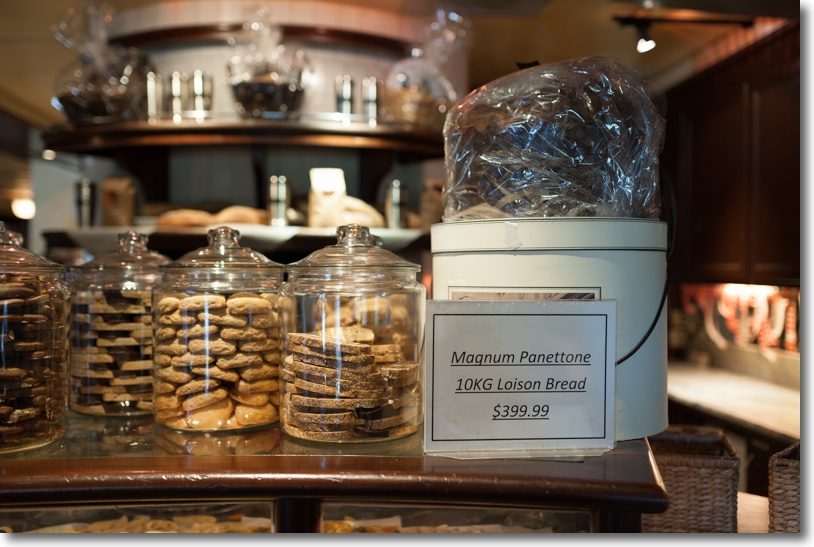
Lots of bread. At f/2.

Fancy cheese shop. Note the low halo effect around the light in the frame. At f/1.7.

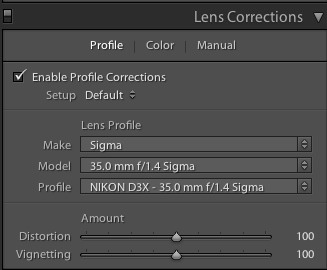
Reader. At f/1.4. My lens profile has removed vignetting.
Comparisons with the 35mm f/2 pre-Ai Nikkor-O 35mm f/2:
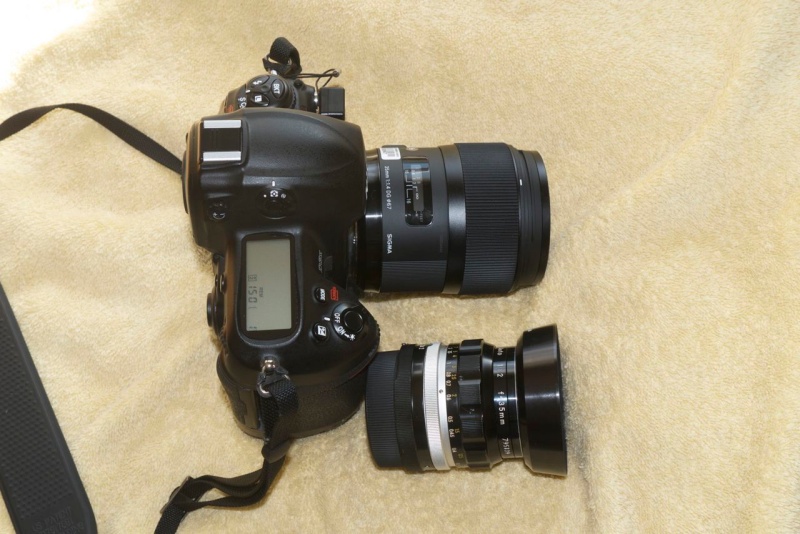
If you can get it to focus correctly, the Sigma has better resolution than the old Nikkor at f/2. ‘Better’ meaning that the difference starts to show in prints over 20″ in size. The Sigma at 665 grams is a monster compared to the 280 grams of the Nikkor. The Sigma renders colors better. In fact, it renders colors superbly, as well as any lens I have used. The Nikkor handles well and is a joy to use, despite the need to have to focus manually. Both lenses suffer from modest barrel distortion and significant vignetting wide open, these easily corrected with good lens profiles.
The one thing I really missed in the Sigma (apart from correct focus, that is) is the aperture ring. Like current Nikkor G lenses, you can only change the aperture using the control dial on the camera’s body. I unconsciously set the aperture on the Nikkor by feel, counting the clicks, without even looking at the lens. With the Sigma, I have to activate the camera with a first pressure on the shutter button then look at the LCD screen or through the finder – less suited to street work.
Is my lens an outlier?
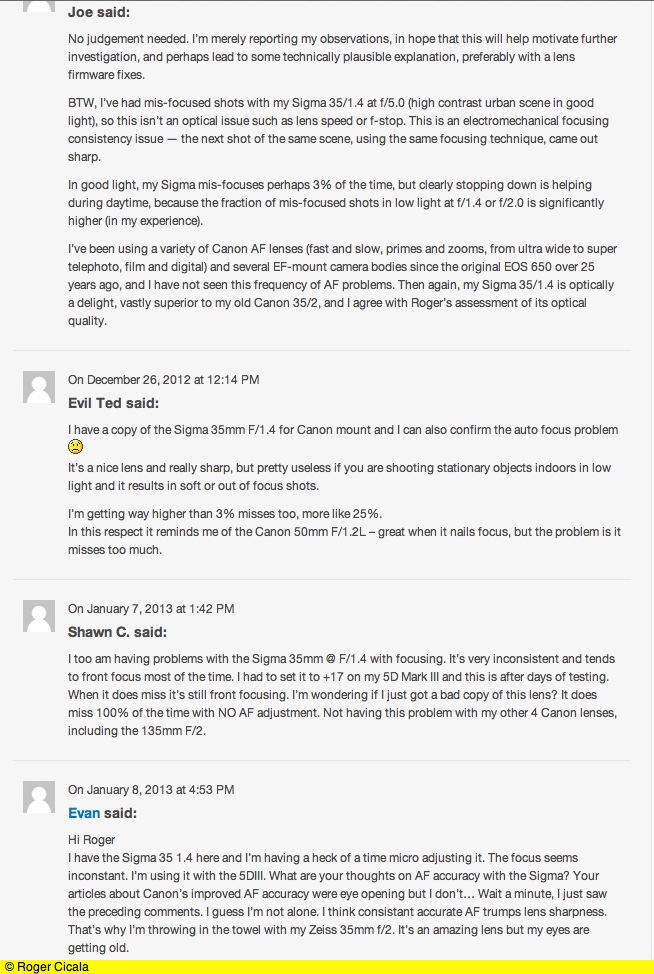
Check the comments on Roger Cicala’s blog. There are several along the same lines, identifying inconsistent autofocus. By the way, my rental was brand new, so it’s not as if the lens had been beaten up before I borrowed it.
Purchase risk:
This is a sample of one and no basis for extrapolating conclusions to the population as a whole. However, given Sigma’s poor record of quality control I would guess that the buyer is taking a significant risk on this optic. You might just get a superb one. But be prepared for disappointment and possibly multiple exchanges. Sure, the 35/1.4 Nikkor AF-S is twice as much so it comes down to two things. What is your time worth and how much do you care if you miss a great snap? I own many Nikkors, MF and AF, often bought very well used, and have yet to have any optical issues with these fine lenses, whether from the classic metal era or the modern plastic wonders. In fact the only issues I have had is creeping zoom collars on trombone zooms, easily remedied with a piece of electrician’s tape on the barrel.
My best guess as to what is wrong:
Sigma may have used a stepping motor with too few steps but I doubt that. The economic savings compared with the reputational risk, given Sigma’s new commitment to quality control, make no sense.
Sigma may have messed up the math which has the contrast detect function in the camera position the focusing mechanism just so. I doubt that, too. Many users are reporting stellar results with no AF issues and this would not explain the random focusing errors either side of correct focus.
So my best guess is that the AF mechanism is binding owing to poor assembly and that the lens is not making it to the peak contrast/best focus setting. If I am right, proper assembly and maybe tightened tolerances in a couple of key parts should do the trick. Sigma can sell these all day long for $100 more if that’s what it takes to tighten up (loosen?) assembly procedures.
A failure:
In conclusion, my borrowed sample of the lens was a tantalizing disappointment. The resolution, when properly focused, and the color rendering are both to die for. But if you can’t get a lens to focus properly it might as well be the bottom of a Coke bottle. And the Sigma simply cannot be trusted to nail focus consistently. It missed focus 50% of the time I used it, some 300 exposures. Thus my opinion of Sigma’s lenses – see Part I – remains sadly unchanged. If Sigma can fix what ails this lens’s electro-mechanics I’m a buyer for the truly outstanding optics.
Follow-up:
Recent comments on Roger Cicala’s blog:
As the lens shows such promise, despite it’s faulty AF mechanism, I wrote Sigma and received the reply below:
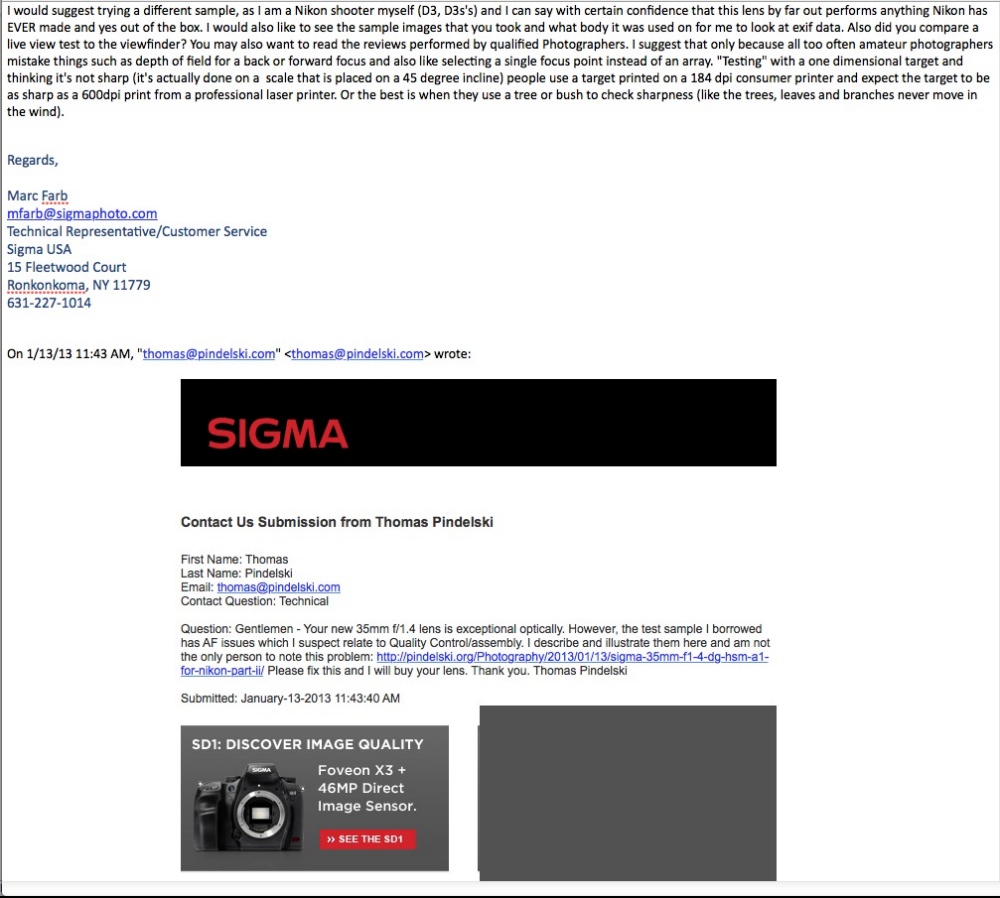
Now bear in mind I am not a professional, so my findings are likely irrelevant, as Marc Farb’s reply suggests.
I have written to Sigma referencing this post and have told them I am a buyer if they can fix the AF/QC issues. I also alerted their Marketing Manager of the abject rudeness of their purported technical support person, Marc Farb, who subsequently wrote me an even more ill informed note – if that is possible – explaining that “…. 98.6% of errors are the fault of amateur users”. Clearly an authority on the matter.
In fairness to Sigma, they replied in two days and offered me a new loaner by the end of January 2013 when new shipments arrive in the US. I also understand that Farb was reprimanded. Not a moment too soon. I have taken them up on their offer as I do believe my sample was a dud as regards AF, and the lens is so clearly better than the Nikkor 35/1.4, which I also tested, that I very much want to get a good one. I’ll update here once I have a good one.
Use of Nikon Capture NX2 software to determine focus point:
One chat board – I think it was DP Review, which has some of the lowest quality discussions on the web, replete with personal attacks – had the statement from one purported ‘expert’ that Nikon’s Capture NX2 app (free 60 day trial) could be used to determine the exact point the camera focused on. This is completely wrong. What Capture NX2 will show you is the focus sensor that was used to acquire AF. So if you use the central sensor for spot focus, all you will ever see is that sensor highlighted in the center of the displayed image if you toggle it On. Focus on the edge of the frame then recompose and you will not see what you focused on before recomposing. I know. I tested it. You will only see a central pair of square brackets telling you that the central focus sensor was used. Duh! Useless, in other words, to determine where the camera acquired focus. Useless for any purpose, really. In addition to this worthless ‘feature’, NX2 is some of the most ghastly processing software yet made. Stick to Lightroom and Photoshop. And avoid the DP Review chat fora like the plague.
Update: An update addressing quality control issues, and with results from the third copy of this lens which I tried, appears here.