At the ‘Flesh and Metal’ show, Stanford University.
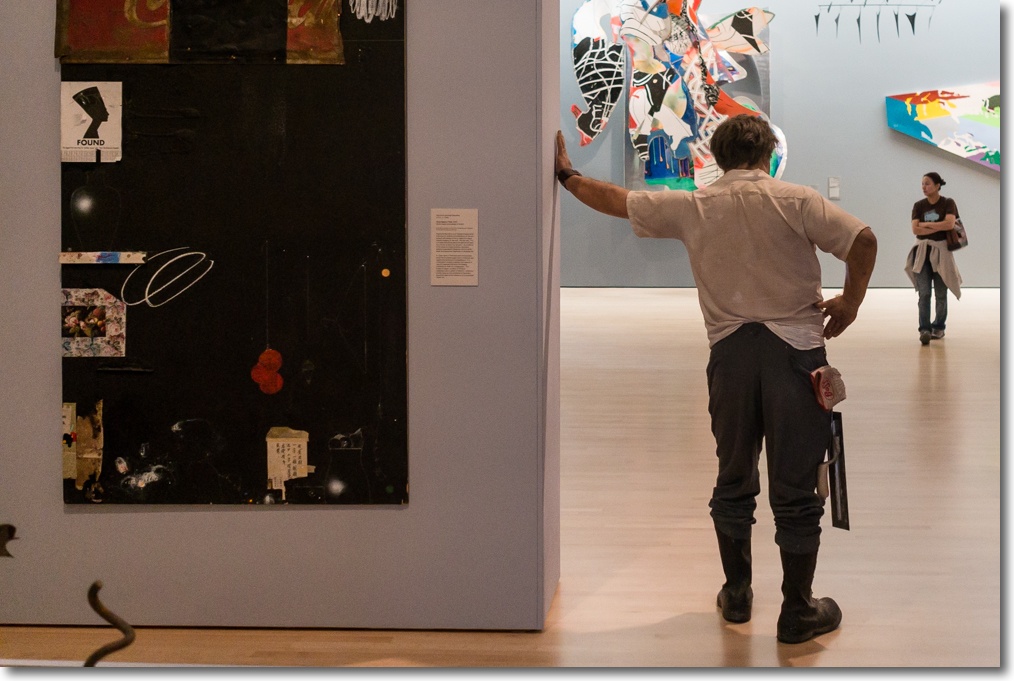
Panny GX7, 17mm Zuiko.
At the ‘Flesh and Metal’ show, Stanford University.
Panny GX7, 17mm Zuiko.
An interesting addition.
It’s not available in the US yet, though B&H already lists it:

The real comparison here for street snappers is the stellar Olympus 17mm f/1.8, which I have been using for a few months now. Regular readers will have noticed that the predominant gear byline for most of my recent street snaps published here is “Panny GX7, 17mm Zuiko” and the reasons are the same I noted in my original review. The fastest AF focus ever, unbelievable flare reistance into the sun, lovely color rendering and excellent optical quality at any aperture. The 17mm Zuiko is very much my “where have you been all my life?” lens.
So this new Panny-Leica optic has its work cut out in the competitive landscape. Fair, it’s a tad wider at 30mm FFE compared with 34mm FFE for the Oly and, truth be told, my brain is hard wired for 35mm after decades with a Leica M2 or M3 and a 35mm Summaron or Summicron attached.
But the point here is that it is heart warming to see so many lenses and makers in the MFT system – Panasonic, Olympus, Leica, Voigtländer with others like Bower/Rokinon joining the frey. And it’s ridiculous to argue that the $600 asked for the new 15mm optic is high. Have you priced Leica’s MF Summicron for the M body recently?
I was going to run a piece in late 2013 on the Panasonic GX7/Olympus Zuiko 17mm f/1.8 as the greatest street snapper combination yet, but decided to hold off until I had more experience with the outfit. Unless there is something very special indeed about the new Leica optic, expect to see that piece run in December, 2014.
Meanwhile, the hegemony enjoyed by Canon and Nikon in pro DSLR ‘flapping mirror/vast bulk and weight’ applications addresses an ever narrowing field of specialization. If you need very shallow depth of field and routinely print larger than 18″ x 24″, there’s still good reason to go with the big boys. But for everyone else, MFT solves. APS-C seems increasingly pointless to me – most of the bulk of FF and none of the pluses of MFT.
Conflicted advice? Hardly. I use a Nikon D3x/D2x and a host of legacy MF lenses, mainly because it’s fun and the investment is amortized. But light and jolly this gear is most certainly not.
A good year.
You can see my best snaps from 2013 in my static web site by clicking the image below. There are 96 images in all.

Here’s the metadata:

The lenses with no prefix are Nikkors or the Sigma 35/1.4. Except for the 16-35 and the 35/1.4, all are classics from the MF era, mostly around 40 years old.
Finally indexed.
Because they are so important a source of visual inspiration, I have indexed the articles here referring to movies.
You can access the index by clicking the drop down menu in the masthead, as illustrated below.

A man of the highest caliber.
Go to the web site of Walter Rosenblum and you will find this description in his bio:
“Walter Rosenblum has been a photographer for fifty years, as well as an important figure in the advancement of twentieth century photography. His early involvement with photography began when he was seventeen years old, when he joined the Photo League where he met Lewis Hine and studied with Paul Strand.
As a World War II U.S. Army combat photographer, Rosenblum landed in Normandy on D-Day morning. There, he joined the anti-tank battalion that drove through France, Germany and Austria; he took the first motion picture footage of the Dachau concentration camp. Rosenblum was one of the most decorated WWII photographers, receiving the Silver Star, Bronze Star, five battle stars, a Purple Heart and a Presidential Unit Citation. The Simon Weisenthal Center has honored him as a liberator of Dachau in WWII.”

Rosenblum’s street photography, frequently dealing with the poor, is exceptionally sensitive and introspective. As the son of immigrant parents brought up in a cold water apartment in the slums of the lower East side, it’s little wonder that he had empathy with the poor people whome he portrayed. The words ‘classical pictorial photojournalism’ come to mind as an apt description of his Å“uvre.
His book is available from Amazon – click the image below to go there:

The images are well printed, with satisfying richness. The book includes a fine history of social conscience photography from Jacob Riis and Lewis Hine through the FSA and Rosenblum, written by the photographer’s wife, Naomi Rosenblum.
Recommended for all fans of quality street photojournalism.
While the book is out of print, used copies remain available. My mint copy cost $50.
For more in this genre see also the work of Helen Levitt.