Nikkor-H 28mm f/3.5 lens

A lightweight 28mm.

This one seems to have slipped through the review mill, so here are the details.

Mine is the pre-Ai version of 1971 with the metal scalloped focus collar . It’s considerably smaller and lighter than its f/2 sibling and can often be found for around $40. My mint copy ran $63 delivered. Construction and engraving quality represent the very best Nikon ever accomplished. The lens is a fine match for lighter bodies; it tends to be a bit too small for best handling on the larger bodies with battery grips.

I removed the five slotted screws retaining the bayonet flange, removed the aperture ring and filed down the necessary relief to clear the aperture feeler on modern Nikons, making this into an Ai lens. You can see the relieved arc in the picture below.

CPU installation on this one is tricky as the rear baffle is sloped, for some reason. It has to be removed and cut back to create the plane perpendicular surface to which the CPU is glued.


CPU installed after the baffle was cut back.

As usual I have created a lens correction profile which you can download here.

This file includes three profiles, at f/3.5, f/5.6 and at f/8. LR and PS will use the closest match. The 28mm f/3.5 shows vignetting at f/3.5, disappearing by f/5.6 with very minor barrel distortion being corrected.

This profile is for the pre-Ai and Ai versions, which had 9 elements in 8 groups. I have not tested this profile with the later Ai-S lens, though it appears to have a similar optical design.

If you use a filter, make sure it’s a slim one. The correct hood is model HN-2. I use one with a standard slim Nikon 52mm UV filter.

As is common with pre-AiS lenses, the aperture stop down lever exhibits substantial non-linearity, as illustrated here so you really want to pass aperture control from the camera to the lens’s aperture collar to assure proper metering.

The lens is sharpest between f/5.6 and f/11 where it cedes nothing in definition to its far costlier sibling.

Pixel peeping the D2x

Quite exceptional.

The Sony designed sensor in the Nikon D2x has a couple of things going against it. The design is some 9-10 years old and the sensor is APS-C. Half the size of a full frame one. Total pixels are just over 12 mp.

I keep reading about how this sensor cannot handle ISO400 or anything faster and how limited it is when it comes to large prints, so I thought I would do a bit of pixel peeping at extreme magnification ratios.

Here’s the original image. It was taken using the 85mm f/1.8 AF-D lens in overcast light at ISO400 and 1/1000 second and f/2.8, using autofocus.


Funny hats. Market Street at the Embarcadero, San Francisco.

I exported the RAW original as a TIFF from LR to PS CS5 where all I did was to enlarge the image using the Image->Image Size->Bicubic Smoother telling it to shoot for a 60″ wide print. This takes out the jaggies which are just becoming visible at this huge size. Then back in LR I tweaked the sharpness sliders a bit until it looked good. The whole thing took seconds to do. I then magnified the PS processed image to an equivalent width of 80″ (that’s over 6.5 feet!) and took a screen shot which appears below:


Center section of an 80″ print.

Viewed at 2 feet from my 21″ display the image is perfect. Large areas of smooth tone are just beginning to show noise if you stick your nose in it.

Here are the PS CS5 settings:

The original Nikon RAW file of 20.2MB swells to 827MB after the PS step, giving even my nuclear powered Hackintosh pause for thought, meaning a second or two to pop up the greatly enlarged display image.

The sweet spot for this sensor is reputed to be the native ISO of 100, whereas the above is at ISO 400, so there’s s good deal more performance yet to be squeezed out for the most critical results. Further, the native ISO of that old sensor is also known for outstanding color rendering, matching the best that is available today. I must give that a shot one day.

Not half bad for an obsolete sensor and body with a middle of the road lens. Sure, the latest sensors have better dynamic range and can go to unheard of ISOs, but for my purposes there’s not an awful lot wrong with the D2x, a bargain if ever there was one. Now excuse me while I get the glue out and reattach a bit of the rubber covering which is coming off the body ….

Columns of the year 2012 – Part 1 of 3

Looking back.

It’s proving a bit of a mad dash for the finish line, but come December 31, 2012 I believe that the column count here for the year will be exactly 366. One a day, though if you go to the bottom of the page and click on ‘Archives’ you will see that August and September were dry months, so I have been in catch-up mode since. This has been a healthy thing to do as all of those ‘catch-up’ pieces had been swirling about in my noggin for quite a while so I am clearing the decks, so to speak.

I rambled back through the year and highlight below a few of the most enjoyable pieces, which I divide below into the three eponymous categories in the name of this journal. Photographs – my snaps, Photographers – about other workers in the field, and Photography – technical matters.

Photographs:

January 31 – The Abduction. This extraordinary ‘found image’, in the style of Marcel Duchamp almost, is so special that I would understand were you to accuse me of staging it. But no, that’s exactly how it was, waiting to be snapped on Osgood Place in lovely Jackson Square, San Francisco. It was so evocative that I took pen to paper and wrote a short story to go with it.

March 7 – The Nikkor 500mm f/8N AI Reflex lens is possibly one of Nikon’s most abused and ill-used optics. It is special in every way and I set out to show how to get the best out of it here. I was so irritated about the ineptness of users’ comments all over the web, reflecting nothing more than poor technique, that I really went to town on this one.

March 6 – A simple snap named Pachino brought with it a flood of imagination and memories, resulting in another short story to accompany the picture.

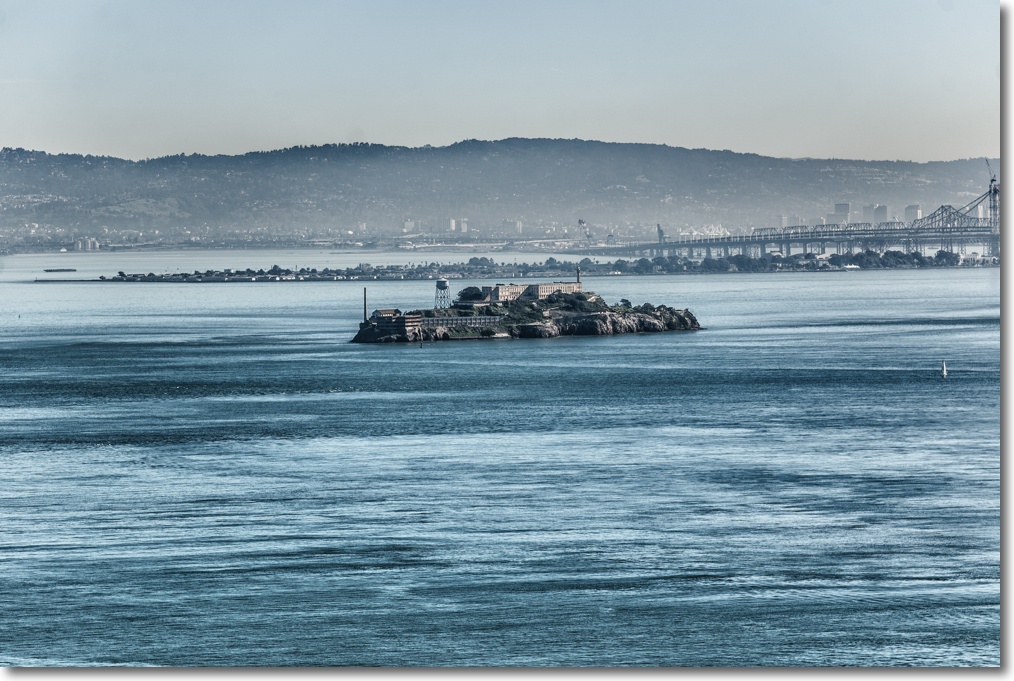
March 13 – Alcatraz was the destination for a day trip with my boy and it’s almost impossible to make bad pictures there, though I saw many giving it a good try.

March 24 – White Birches saw me reminiscing about my time with God. Seldom have I had so much fun writing a short story.

April 6 – Six in sixty and one-twenty saw a raw fecundity of output in two minutes with a very wide lens.

April 19 – A face at the window showed the benefits of carrying a light and inexpensive zoom along for the trip.

Photographers:

Feb 13 – Donald Jean shared his gorgeous Venetian photographs with readers. Thank you Donald for your outstanding photography.

March 21 – The NYT’s Lens blog did an arresting piece on 1950s images of dirigibles.

March 28 – Englishman Martin Parr cannot be accused of good taste, doing a number pretty much on anyone he photographs, with hard flash and poses which often ridicule. But this modern imitator of Wegee is worth a look.

April 22 – Photography in Mexico was an enthralling show at SF’s MOMA.

Photography:

January 2 – Fringale. At the conclusion of 2011 I made a commitment to share my dining places with readers who might be thinking of visiting the closest thing to Paris in America, San Francisco, a city I photograph weekly. Fringale was the first such in 2012, to be followed by many others.

January 15 – My Desk laid it all bare and disclosed the less than ordered work space in my home office. It doesn’t look much better today.

January 26 – Midnight in Paris is Woody Allen’s luminous tribute to the Paris of Gertrude Stein and nothing better was made for the cinema in 2012.

February 7 – Legacy Nikon lenses was a real Trojan Horse. Little did I suspect that this piece would take me on a tremendous odyssey of rediscovery of old MF Nikkors which I used in my youth, borrowed from my employer, Dixons, in the UK when I was still in short trousers. I ended the year owning all of the lenses in that piece and many more.

March 11 – The Nikon D700 and Geotagging was the tale of my determination to confer competent GPS data on my Nikon snaps. It proved successful and far lower cost and better designed than Nikon’s clunky solution.

March 17 – Adding a CPU to MF Nikkor lenses – Part II was the culmination of a massive technical exercise into ‘chipping’ old Nikkors. The benefits are huge, the costs minimal.

March 26 – ACR lens profiles saw me start publishing lens profiles for all the MF Nikkors I was acquiring. These have proved popular with old lens aficionados, looking to get the best out of their lenses.

AeriCam

A fascinating device.

Waiting at the traffic lights in San Francisco the other day, my eye was caught by this plaque so I quickly made a snap.

It turns out that AeriCam manufactures a state-of-the-art miniature helicopter which permits a movie camera or DSLR to be attached for aerial photography. It costs $12,000 ready to fly. They also manufacture a gimbal mount for an additional $2-3,000 which helps minimize vibration and the results are quite extraordinary in their smoothness and professional quality.

Results from their six bladed ‘hexacopter’ can be seen by clicking the image below.


San Francisco from the Bay Bridge. Click the image for the video.

If you can overlook the extraordinary car skills displayed by the driver, focus on the smoothness of the aerial shots. It’s not quite clear to me how one gets a video feed from the camera to the operator to permit accurate composition, but at $15,000 this device appears to be far cheaper than helicopter rental, and is available in moments to any cinematographer. The rather sparse web site refers to a ‘video transmitter’ so I assume that beams a live picture back to earth to the included ‘9″ SonyMonitor’. Bad weather? Put it back in the box and come back another day.

The recommended payload is 10lbs which will easily accommodate a big DSLR and lens. The device is GPS capable so programming locations should be easy. Order lead time is 6-8 weeks. American ingenuity at its best.

The biggest disappointment

Transbay.

Transbay is the largest public works project in San Francisco since the Golden Gate and Oakland Bay bridges were constructed in the Great Depression. It has been ongoing for a couple of years and will take at least a decade more to complete, culminating in a massive overground bus terminal, an underground rail terminal and half a dozen 40+ story skyscrapers. Occupying several city blocks on the east of San Francisco bounded by the business district to the north, it is heavy construction redefined.

So naturally I wanted to be a part of that.

Early in the year I approached the bureaucrats managing the project explaining that I wanted to document the people and construction at no charge, as a gift to the people of San Francisco. The City’s efforts in this direction are beyond pathetic, comprised of one very poor quality webcam placed atop an adjacent tall building. They have no official photographer and no plans to retain one. A priceless historical document will never be created owing to this short sightedness.

I was asked to submit a portfolio of my snaps of the city of San Francisco, which I did and they said they liked.

I then pushed for closure but heard nothing for months. Finally, a liaison officer (those who can, do; those who cannot do, teach; and those who can do neither, liaise) contacted me with a raft of concerns.

Q. It will cost the city money.
A. No I will do everything no charge.

Q. We think you want to make money from this.
A. No, It’s not for profit. I would like to hold an exhibition and publish a book, and the City can have all proceeds from those efforts.

Q. We will have to assign a chaperone to you when on the project which will cost us money.
A. I will pay the chaperone’s wages.

Q. We are concerned about liability if you get hurt.
A. At my cost I will have my attorney draw up a complete waiver, indemnifying the City of any costs in the event I am injured or killed.

Q. We are concerned you will not spend time on this work.
A. I will commit two days a week for the next ten years to this effort.

Q. We will need to vet your work.
A. All work will be provided to you for screening before any reproduction.

Q. How will you start?
A. I propose to hang 20 30″ x 40″ studio portraits of the hardhats on the project around the periphery of the site for all passersby to enjoy. At my cost.

Well this sort of crap went on for several months until these people finally agreed to meet and confer. My many requests to attend the meeting were not responded to and finally I got a blank rejection.

“We think your safety would be threatened” despite all the commitments and indemnities I had offered. The bottom line is that there was no benefit for these losers from retaining me and screw the people of San Francisco.

So I wrote to the Mayor of the City of San Francisco. No reply.

Then I wrote to the Congressman for the Transbay District. No reply.

Finally I wrote to my Senator. Like you expect my elected official to actually respond? How big exactly was my campaign donation?

So the idea died and with it the City has lost the opportunity to gain a priceless historical document.

Unconscionable.

Meanwhile, here are some snaps from around the periphery of the project which I took in 2011 and early 2012 while the above nonsense was going on. For obvious reasons, my interest in taking any more has fallen to zero. And as you can see, these jerks are buying Chinese pipe at the taxpayer’s expense. Like America no longer makes steel pipes?


Pipe from China.


Theodolite.


Transbay cop.


Banksy has some fun.


Crane and thieves.


Hard hat directs passerby.


Rabbit ears.


I beams.


Crane and glass.


The temporary bus terminal.


Steel inventory.


The crane at least is American.

Snapped mostly on the Panny G3 and Nikon D700.