A follow up.
HackPro builder FU Steve set forth how to build a high performance desktop computer running Snow Leopard for less than one third of the cost of a comparable MacPro here. His intent was to craft a cool running machine for reliable photo processing. That’s cool as in temperature not cool as in Apple Hype. The two are diametrically opposed concepts. In the event, his HackPro turned out to be exceptionally speedy – see his benchmarks at the end of this piece. I asked him for his thoughts on obsolescence with specific attention to the HackPro. Here they are.
* * * * *
It may seem premature to address the HackPro’s obsolescence, but I always like to think ahead.
In terms of life expectancy, the video card is one of the best there is – it’s now rebranded as the GT150 but that’s the same as the nVidia 9800GTX+. You can get versions with 1024mB but I don’t know how that would make any difference for Lightroom and Photoshop users. GPU development has hit a wall and the one I used should last quite a while.
The RAM is DDR2 800mHz. The mobo will support up to DDR2 1333mHz, so lots of room for upgrades if it makes sense and when the price falls. Meanwhile, 800mHz/DDR2 offers the optimal price/performance mix.
The CPU is the 2.83gHz Intel Core2 Quad Q9550 at $220. You can upgrade to the 3.0gHz for $340 – lots more for little more. Alternatively, you can crank up what you have to 3.4gHz (or more) and simply add a bigger cooler for $30 – there’s lots of room in the box for one and there’s a large community of users doing this reliably. I have not bothered with any overclocking tests as what I have is fast enough. Current CPU designs are peaking as the 45nM component separation is getting close to the wavelength of the electromagnetic spectrum, which limits further size reduction. Heat management will improve with the newer Nehalem CPU but it’s not an issue in the HackPro, only in laptops.
The motherboard uses the Intel 775 socket, meaning you cannot fit the latest Nehalem Intel CPU (i7 socket). The Nehalem’s advantage is better multi-threading but while Lightroom can run in 64-bit mode it does a poor job of using all four cores; until that’s fixed by Adobe the Core2 Quad will be far better than the software I’m asking it to run. If I get the craving for an i7 for some reason, the motherboard will have to be changed. $140 + CPU cost. Easy to do but makes no sense today for the applications I use. Even Apple’s Final Cut Pro for professional video editing and Photoshop CS4 are still only 32-bit applications, so software has a lot of catching up to do before today’s quad core CPU designs are over the hill.
The display is independent and you can use/spend what you want. The Dell 2209 I use may hold value well as it has no competition at its price and attracts users with specific needs – meaning photographers who cannot tolerate color shifts as the viewing angle changes. Its IPS panel is the best display technology there is and there are no signs of new revolutionary designs on the horizon.
The Snow Leopard OS seems very robust and as it’s an enhancement to Leopard and not a new design, you would expect that. That very fact tells you that the rate of improvement in Apple’s operating systems has slowed dramatically. There’s not a whole lot that needs improving. Subsequent releases seem to be minor bug fixes and when 10.6.2 comes out (imminent) you will be able to run the new Apple Magic Mouse with its touch sensitive surface if that’s your thing. There is no Magic Mouse driver in 10.6.1 though the newly introduced iMacs have it installed.
Blu-Ray will fail, in my opinion and my HackPro has none. Too costly, needs new, expensive gear to exploit fully (big screens, etc.) and introduced right into the teeth of a shot economy. Sales remain flat despite the failure of its only competitor HD DVD. Plus Blu-Ray’s huge file sizes with the US’s slow broadband invalidate the format for transmission. Still, I expect Apple to add it shortly (Yuppie and Joe Sixpack demand) and once the drivers become available you can simply install a Blu-Ray drive in the HackPro in one of the 5 1/2″ front bays (3 remain available). The cost is closing in on $100.
The HDDs are traditional 3.5″ SATA 7200 rpm with a 32mB cache, a technology that shows signs of peaking. There are 10,000 and 15,000 rpm designs available but they are smaller in capacity and run hot. I question their life expectancy. On the other hand, flash drives will come to the fore over the next few years and I expect we will all be using 1tB flash HDDs in a decade, costing under $100 and the size of a postage stamp. They will run cooler, though HDD heat is not of concern in the capacious Antec case. Meanwhile, their prime use is as a boot drive in 32mB or 64mB sizes at under $200, where they are affordable, but it’s hard to see the need for a fast boot if you never switch your machine off. I leave mine on all the time, arguing that thermal cycling from switching on and off is far more destructive to life expectancy than a permanently ‘on’ state. Think light bulbs.
Wireless 802/11n can be added for $50-125 but I see no pressing need for it in a desk top computer unless you cannot easily run a broadband cable to the case. I have no wiring issues so I did not bother with wireless. Not really an obsolescence issue.
Windows 7 has, as even members of obscure Amazonian pygmy tribes know, just been announced and is opening to favorable reviews from every magazine which derives advertising revenue from Microsoft. Time will tell if it is fast and robust (there’s zero basis for trusting MSFT on anything given the company’s record) but in the spirit of keeping an open mind, let’s assume it offers things you cannot live without. Well, it’s a moment’s work to partition the HDDs into two partitions, one with Snow Leopard, the other with Windows 7. You can then choose whether to boot from one or the other. Alternatively, you can use Apple’s Boot Camp to accomplish the same (one advantage of using Boot Camp may be the ability to see data across the partitions – Windows files from the Mac side and vice versa, but I have no idea if this works) or, smarter, use Parallels or VMWare ($50 or so + Windows 7 + applications) in your existing partition to load Windows in its own window without the need to reboot, if the performance drag is acceptable. I used Parallels on my dying iMac with Windows XP for a while and it works fine if not very quickly. Maybe, in the interest of keeping Windows as remote as possible from your safe OS X environment, it’s best to load it on a separate drive and boot from that.
Finally, resale value. The picture is very bright here. My cost, excluding peripherals, is $815, which gets me the case ($100), CPU ($220), GPU ($120), RAM ($100), motherboard ($130), DVD burner ($30), Card Reader ($15) and HDD ($100). A like configuration from Apple, Dell or HP runs $3-5,000 using the exact same parts. I can sell the machine as either an OS X or Windows box, or both, focusing on its top-of-the-line components. I should get a good price even three years hence, and have no need to sell my monitor and peripherals. Or if I upgrade piecemeal, I can simply sell the components for even better prices.
What about the greatest threat of all? Say Apple decides to make future Snow Leopard revisions run only on Macs? Well, they have a lamentable history of failure in this regard. Take the iPhone. Try as they might, the hacker community breaks each attempt within days of introduction. It’s a red rag to a set of very smart and dedicated bulls. And let’s say they succeed. Heck, I would be happy running the HackPro on Tiger, let alone Leopard or Snow Leopard. These upgrades really do very little for a working still photographer. Arguably the only value added by Leopard compared with its Tiger predecessor was the Time Machine backup utility which makes for seamless file backup. Other than that it’s a lot of fluff. Lightroom can run in 64-bit mode fine in Leopard and does not need Snow Leopard to do so.
But I don’t think Apple will do something so foolish. First, desktops are a falling part of their profit picture as Apple is rapidly becoming a cell phone company. It’s where the money is and in the iPhone they have a superb product with no real competition. Second, the Hackintosh adds value to Apple rather than taking it away. Most Hackintosh builders either could never afford a Mac or are simply making something not available from Apple – a reliable desktop with low entry and repair costs. Many Hackintosh builders are future Apple customers, so it’s foolish to write them off, and most – like me – still buy the OS where otherwise there would be no sale. And, in the grand scheme of things, sales lost to the Hackintosh are a rounding error to Apple. How many people can be bothered to a make the modest effort involved in building the best desktop for photographers on the planet, especially when uninformed comments on chat boards policed by Apple zealots consistently proclaim that the Hackintosh is junk? Still, I do love those fools as they just help my Apple stock position along!
Before I show you the comparative performance data from Geekbench, it’s worth adding a few words about the extraordinary degree of failsafe redundancy built into my HackPro. The following functions are duplicated so if one fails, I simply switch to the other and all have been tested:
- Dual BIOS on the motherboard
- BIOS level and application level CPU high temperature warning buzzers
- Dual video card outlet sockets
- Dual video card motherboard sockets
- Matched memory pairs allow the system to run with 4gB almost as well as with 8gB should some memory fail
- Dual case fans – if one fails the system temperature rises just 10F
- Dual boot drives – my 1tB internal drive has a matched one in the case which is fully bootable and is backed up daily. Further I run Time Machine on an external drive which is kept in a remote location.
- Finally – dual monitors – I bought two of the Dells!
I don’t recall seeing the word ‘redundancy’ in any Mac specs. Maybe you have.
Here are the data comparisons:
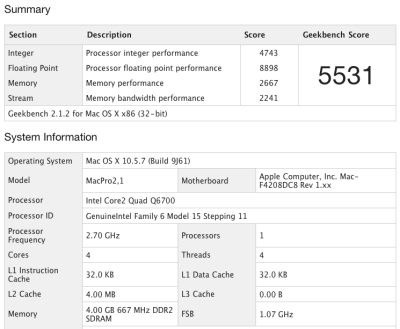
MacPro with 2.66gHz Core2 Quad Nehalem
and 4 gB RAM rated by Geekbench in 32-bit mode
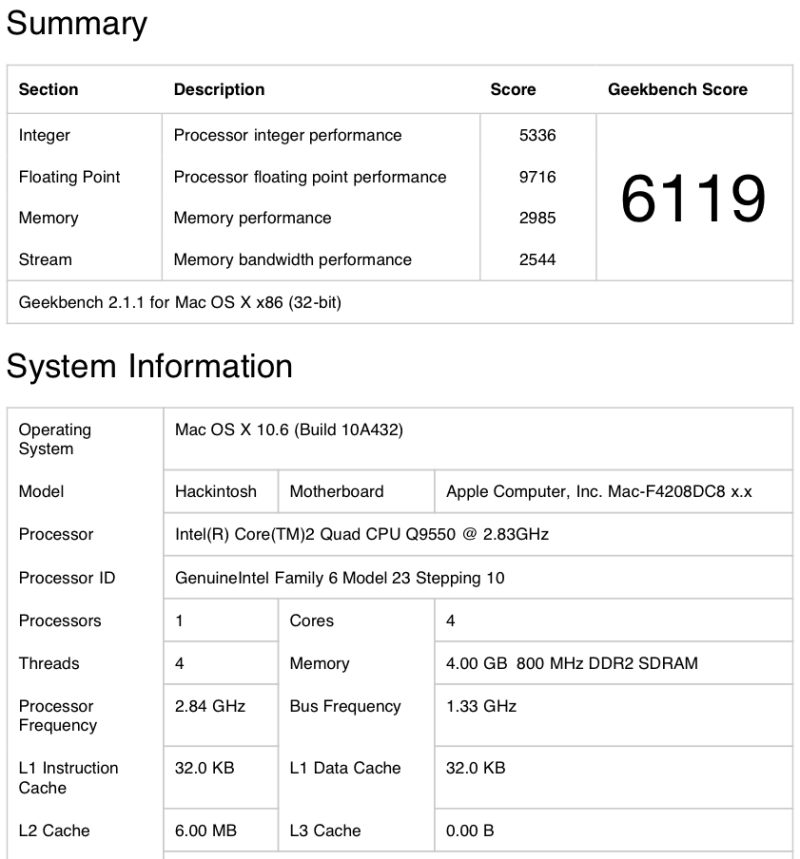
FU Steve’s HackPro with 2.83gHz Core2 Quad Yorkfield
and 4gB RAM rated by Geekbench in 32-bit mode
By the way, the just introduced 27″ iMac (C2D) scores 4650 on Geekbench, making the HackPro 25% faster than Apple’s latest offering.
Finally, a few words on opportunity cost. Many comments on chat boards addressing the economics of constructing a Hackintosh wrongly attribute high opportunity cost to the process, arguing that time spent in research, procurement, construction and testing makes the whole thing uneconomical. This is not a correct understanding of opportunity cost. Time spent only has economic opportunity cost if it displaces time which could have been spent on activities providing a positive income stream. In the event, the Hackintosh builder is using time which would likely have been spent in such unproductive activities as watching sports or playing computer games or whatever. In that sense, the time invested in the Hackintosh is free and the true economic cost is purely that of the components used.
* * * * *
Thank you, FU Steve.
Only a fool would make long life claims for a computer but I think FU has constructed something with a decent life expectancy at very modest cost and with exceptionally low repair costs. Using the MacPro (an excellent machine) as a reference, the rate of change in its components has been positively glacial in the past couple of years, suggesting most of the technologies used are very much at the point of diminishing returns. The retail technology business is focusing much more on smartphones, handheld devices and small laptops. FU’s HackPro should last a while. The HackPro is the Elitist’s choice. The Macpro is for the snob.