Cheap scans

Archive those attic snaps.

The New York Pravda may well have its editorial head stuck where the sun never shines, but now and then they have a useful photography piece, such as this one (account needed) on scanning all those old snaps in brown paper bags in the attic.

The service they profile, ScanMyPhotos is inexpensive and worth looking into, the point being that all those memories in the shoebox in the attic are probably not backed up.

It seems to me that even digiphobes would appreciate that a scan of precious, decaying originals makes sense. Of course, you also need a back-up drive as your hard drive will fail sooner or later. Mercifully, digital storage is becoming insanely inexpensive. Some prefer to upload their scans to a file sharing service, though I fail to see why that should be any more secure (how do you know they back-up properly? Recall the recent fiasco with lost emails when Apple’s poorly debugged MobileMe debuted?)

Another 10 years?

The law of diminishing returns kicks in.

A couple of years ago I wrote, with something approaching amazement, about the longevity of the Epson 1270 ink jet printer, dubbing it a Ten Year Digital Device. Indeed, that printer’s current owner will testify to the Epson’s longevity having just picked up a prize for one of his pictures printed on it. Sure, the nozzles clog if you don’t use it frequently and the inks fade in bright sun, but the quality of the prints cannot be disputed.
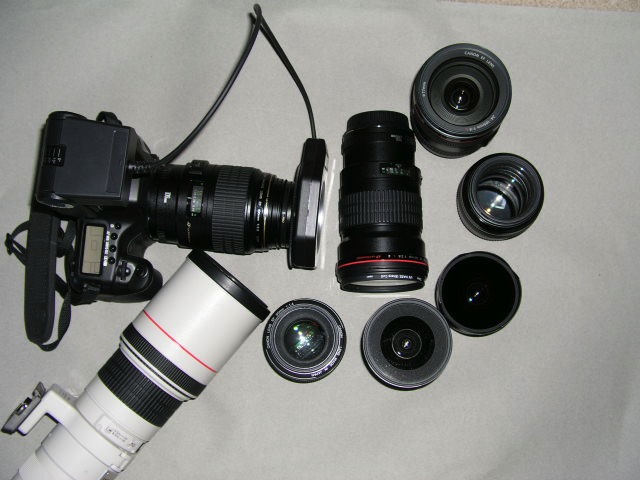

Canon 5D and friends. A ten year kit?

All of which prompts the question whether the Canon 5D has a similar life expectancy. Sure, it remains a current model and certainly it is not as fast or as slick as newer offerings from DSLR makers. It coasts along at a modest three frames/second, has no dust removal and lacks silly features like live previews. Now given that 3 fps is meaningless to me as I take one picture at a time and avoid sports photography, I can only question who really needs the insane framing rates available today, sports and fashion snappers apart? Live previews are a solution looking for a problem with DSLRs but, yes, dust removal from the sensor would be nice to have. But I can live without it, just as I learned to live with the 1270’s clogging nozzles.

Wear is not an issue for me. After 30 months with the 5D it reports that I am on frame 6,873. That figures to some 25,000 frames over ten years, well below the 100,000 life expectancy of the 5D’s shutter.

Definition is not an issue. The law of diminishing returns suggests that all those latest pixel-heavy sensors are running into noise issues, and that the modest 12.8 megapixels of the 5D make for a perfect compromise between definition and noise.

Sensor size is an issue. I like what I have. As I want my 20mm lens to be 20mm, not the 32mm that I would get with a cropped sensor, and I like the depth of field a standard lens offers on the big sensor, my alternatives are limited to full frame cameras of which there are but two from each of Nikon and Canon. It’s clear we will have more large sensor DSLRs (Sony is rumored to be releasing one soon) and choice is always a good thing but the bottom line is that the images from the 5D’s sensor are so crisp, noise free and well defined that trading for more pixels or a medium format sensor make no sense.

Build quality is fine, too. Doubtless the big Canon and Nikon offerings are tougher but I’m an amateur snapper, for heaven’s sake, and not a photojournalist in a war zone.

Lens choice is fine and will only get better. A really good 20mm would be nice, Canon’s wide primes being less than thrilling unless you get the ridiculously bulky and expensive ‘L’ variants. Unless Canon does something truly dumb – like changing the lens mount – I am set.

Dynamic range, the biggest bugaboo of digital cameras (as in they have too little), is something I have worked around. Under-expose 1/2-1 stop and bring things back as needed in Lightroom, and all is well. Further, there will have to be some serious breakthroughs in sensor technology before DSLRs start exhibiting enhanced dynamic range. So for now I watch the highlights and let the shadows look after themselves at the exposure stage. Much as in the Kodachrome days….

Given that digital was a joke ten years ago and has now plateaued at a level significantly higher than film, it’s foolish to try to predict what will be on offer ten years hence. That plateau was reached a few years back by the Canon 1Ds Mark I and the 5D. So until some shattering new technology comes along that offers the image quality of the 5D in a package half the size, weight and noise – and I’m not holding my breath – I’m going to stick my neck out and suggest that maybe the Canon 5D really is a ten year digital device. That’s assuming I am not completely gaga 7 years hence and can still lift a camera to eye level without wetting myself. No calling that one.


Large prints on canvas

Up to 86″ a side!

I came across this site while looking for a large print service.

They certainly use the right printers and fade free inks as this excerpt from their FAQ states:

“What kind of equipment are you using to print on canvas?

Photogonia uses state of the art printers like HP DESIGNJET 5500 series and EPSON STYLUS PRO 9800. These large format printers deliver high quality print jobs that fit the high standards that Photogonia sets for our products.

What kind of Ink are you using?

PhotoGonia uses ONLY original factory Inks like HP 83 UV Ink Cartridges for our HP printers and 8-color Epson Ultra Chrome K3â„¢ Ink For our Epson printers. PhotoGonia doesn’t use refills, third party Ink or generic Ink. ”

A 40″ x 30″ ‘gallery wrap’ canvas (the printed edges are stretched over the frame) is $322.50, shipped. Not cheap, but the alternative of buying an ultra-wide carriage printer for one or two prints a year is hardly a viable choice. For that matter, unless you regularly make large prints, this sort of service makes sense for any photographer limited by the 13″ carriage width common on home ink jet printers.

Real Chicago

Book review.

One of the reasons I so like Chicago is that I have never had to visit it in the winter. Add the fact that is is the quintessential American city, has mid-west standards and values, not to mention America’s finest architecture, and you have a place well worth visiting. No one who has lived there could remotely think of New York, by contrast, as anything but a European city.

The title of this book says it all. Divided into decade chapters from the forties to the nineties, it comes as no surprise that the best work here is in the first two chapters. When you realize that five frames per second is discounted as slow in the world of modern DSLRs, think about the working stiff with his Crown Graphic and a couple of film holders. He generally had but one chance to capture the decisive moment, and you see lots of that in this book. Something about these old pictures speaks differently, too. Maybe its their dignity, grace and composition. They move you in the way modern photojournalism seldom does.

My remaindered copy cost all of $15 and I recommend you add this book to your photo library.

And if you think I have glossed over the decades of machine politics and corruption in America’s second city well, I learned everything I ever needed about Chicago’s law enforcement from the succinct words of the humorist P. G. Wodehouse. “At least when you buy a Chicago cop, they stay bought”. Honor and integrity. Got to love that in your local police force.

You can see my library of photography books by clicking here.

For a fabulous evocation of what the city must have been like in the early post war years, click here.

Ring flash

An awful lot to like.

The ring flash I have been using on the 5D with the 100mm Canon macro lens is proving to be a real joy. It’s pretty much set and forget. All I do is adjust ISO to procure an f/11 aperture with the camera on shutter priority and 1/200th (the fastest sync speed) and the circuitry in the flash takes care of balancing natural and artificial light. In use I simply leave the flash switched on all day – battery drain is only significant when recharging as opposed to maintaing a charged state. My current set of four alkaline AA batteries has lasted for some 16 hours and two hundred or so snaps, and shows no sign of dying.

F/11? That, I find, gives the best balance of definition and depth of field. Smaller apertures introduce diffraction and definition begins to fall – that’s physics, not Canon. Wider apertures at close distances result in very shallow depth of field – appropriate for plane, perpendicular surfaces only. ISO seems to end up in the range 100 to 400, which is the sweet spot for the 5D’s sensor. Nice!

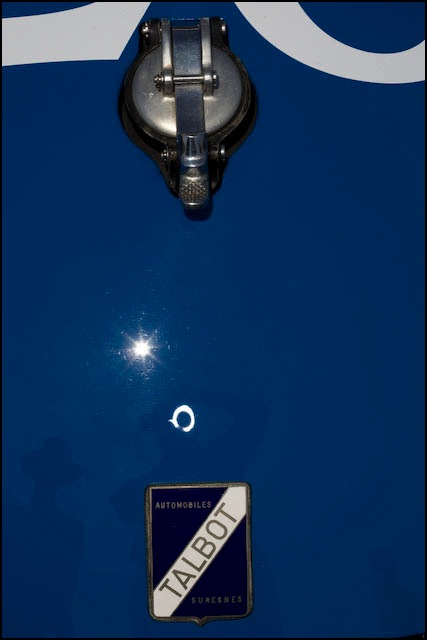
Reflections of the tube in the ring flash can be an issue – though the sort seen here just enhances the sense of curves.

Occasionally, with reflective subjects, you get a nasty image of the flash tube reflected in the subject, like so:


Note reflections from the sun and the ring flash

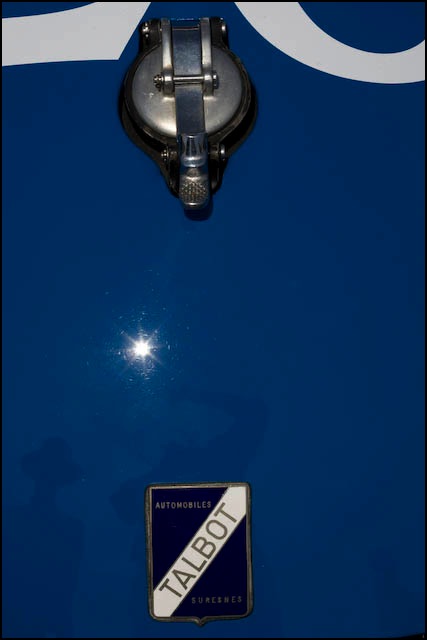
I do not know whether the enhanced localised processing controls in Lightroom 2.0 could fix this – I”m still on 1.4.x and await 2.1, presumably suitably debugged. In the meanwhile, it’s back to that old dog Photoshop (Lightroom has a direct export and save function) and a few seconds with the Magic Eraser:


After using the Magic Eraser in PS CS2

That’s more like it. French Racing Blue never looked better. The wide brimmed individual on the left is none other than famed racing driver and backdrop man, Franklin Rudolph.