Photography books and wine

Sampling books is much like drinking wine.

I make it a habit, as summer approaches, to pick a photography book from the bookcase for relaxation on the patio in the afternoon. What struck me as rather funny the other day is that I found myself perusing the shelves much as a wine drinker might select a wine for dinner. Now it’s true that I grow Zinfandel grapes, but I rarely drink wine. Just not my thing, even if the grapes make for prize winning wines. So I really cannot pontificate how a wine drinker makes his choices as I have little idea, but I found that I was consciously thinking what genre and emotional pallette I wanted when it came to book selection.

With the perfume of jasmine in the home, thanks to the lovely plants on the patio, I migrated to a book of flower pictures. Plus I’m getting into the whole macro thing.

And a fine choice it was, with no hangover.

If you would like to see my complete library of photo books, click here.

By the way, I never buy new photo books, only remaindered ones. No idea where they got the pricing data but I seem to recall paying well under $20 for this one.


Star jasmine on the patio. 5D, 100mm Canon macro, ring flash, 1/45, f/19, ISO 200

Shutterfly

You can’t beat a print.

My first computer, bought in 1981, came with a 3 inch monochrome cathode ray tube screen which was nearly impossible to read. Not that it mattered as you couldn’t display pictures on it in any case. After many unhappy years with PCs, with screens growing to 15 inch (and still huge CRT boxes) 2000 saw the first of many Macs join the household. The screen was 17 inch, crystal clear and made for a photographer. Currently, my MacBook uses a Samsung 21.6 inch screen when at home and it’s the best photo processing hardware I have used so far.

One day I would love to make that screen into a 30 inch Apple Cinema Display (there are only so many trendy movies to watch and each just raises desire with all those huge screens on show) but the ridiculous cost lets “I should” wait upon “Don’t be silly”. It also amuses me no end how the happening set always use Apples on the big screen while the losers in government stick with PCs. That’s a good thing. A cheap government computer beats a costly one and any government that locks up daily is doing its job in this voter’s eyes, regardless of party. Ironman anyone?

Yet now that my screen is larger than any of the many photography books in my library, I still prefer to luxuriate in the pages of a book to looking at the screen, no matter its size. Maybe having grown up without computers, and with lots of books, has prevented me from fully accepting a screen as the display medium of choice; what’s more, I like the look and feel of a book when it comes to looking at pictures. Plus you can read when you shave – try that with a computer!

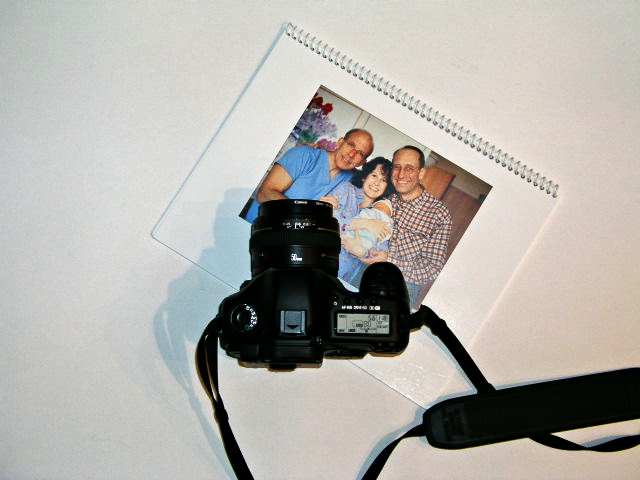
All of which reminds me why I so much like Shutterfly and what it does for my snaps. Every now and then I put out a calendar showing our son’s growth and interests. It goes to relatives and invariably ends up on a wall somewhere.


The bald one’s the surgeon, if you must know

Having used the service since it started a few years ago, I can only sing its praises. An intuitive user interface, easy upload and arrangement of your snaps and a beautifully printed calendar in your hands in a few days, all at reasonable cost. What’s not to like?

And a printed picture beats a screen anyday.

Snap! $1.3 billion.

A costly picture.

So the Mars lander only ran $467mm. However, the previous two crashed at a combined cost of $900mm, so I suppose this first snap from the Mars lander is the most expensive picture ever:

Why search for signs of life on Mars when the need for some in Washington is greater?

Sigma DP1 – pass

Much anticipation leads to a failed product.

My primary interest in the Sigma DP1 was as a street shooter – meaning minimal shutter lag.

Well, I’m afraid they blew it, as the always objective DP Review reports.

Looks like I will be sticking with the Panasonic LX-1 for now.

What a disappointment.

Still, it never hurts to be curious:


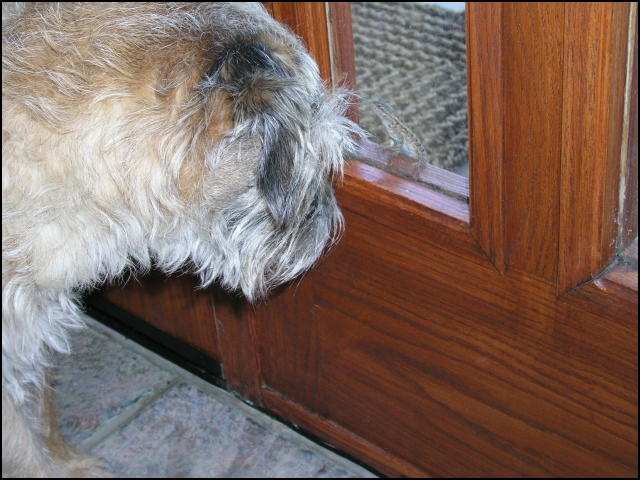
Bert the Border Terrier checks out Mr. Lizard.

Let there be light

No half measures here!

My preliminary ramblings about the Canon 100mm macro focused largely on ergonomics with a quick peek at image quality.

One of the advantages of the 100mm focal length is the doubled – compared with a 50mm – subject to camera distance, making lighting issues easier. But I decided I wasn’t about to do things half way, so I checked into ring light flashes for the 5D. Well, Canon wants over $400 for theirs to which all I could politely say was “No thank you”.

So a quick visit to that repository of thieves, cutthroats and crooks known as ePrey was called for and, lo and behold, simply dozens of ring flashes were on sale. After weeding through the offerings I finally found one which used a real flash tube (rather than poncy, underpowered, LEDs) and, best of all, mated with the ETTL circuitry in the 5D to make just about everything automatic.
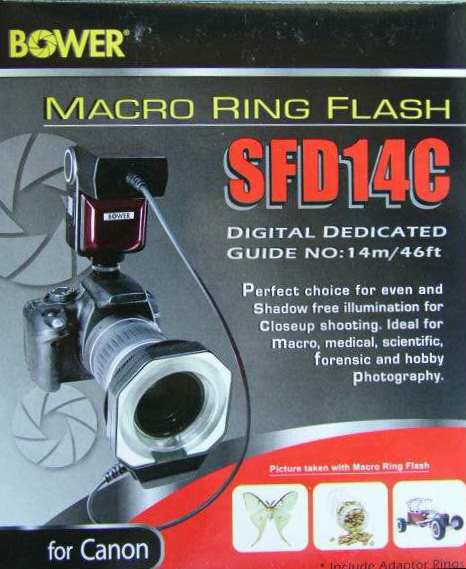
$120 and a few days later UPS dropped it off. It comes with three adapter rings, the 58mm one of which fits the 100mm Macro. Look closely and you can see there’s a real flash tube in there:

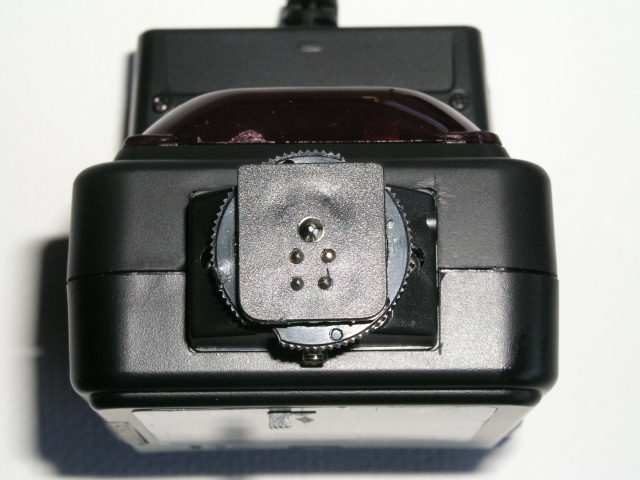
The body takes four AA cells and looks suspiciously like the body of a Vivitar 283 flash gun. Recycling time is 3 seconds with fresh alkaline batteries. The foot has a nice screw retainer and you can see the contacts for ETTL in the base:
Here’s how the whole thing looks on the 5D – the power supply and tube are incredibly light, weighing less than the lens itself.
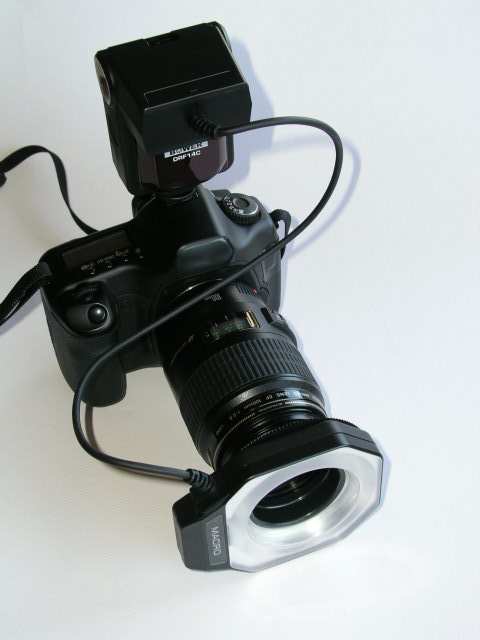
Once the base ring, which rotates freely on the flash tube body, is threaded onto the lens, the tube assembly is free to rotate and, if you think about it, that’s no problem. The base ring has nice, coarse serrations for a proper grip and protrudes just above the body of the flash tube – nice.

Use is simplicity itself. ETTL balances exposure between flash and camera automatically, the lighting is shadowless, and all you have to do is frame and press the button. If the flash is in range the green LED on the rear illuminates after the picture is taken to show all is well. It would have been nice if it did this with the first pressure on the shutter release, but, heck, ‘film’ is cheap in the digital age, no?

Suffice it to say that the whole thing works perfectly out of the box, at one quarter of the price of the Canon branded device. OK, so the finish is more GM than Toyota, but at that price, who cares?

And because even our six year old could take sharp snaps with this little combo, here’s one which mixes sharp and blurred, courtesy of ETTL, which has mixed flash and regular light by using a slow shutter speed, adding blur to a subject swaying in the wind. Choice of a low ISO setting compounds the blur.


5D, 100mm Macro, ring flash, 1/100, f/6.7, ISO 100

More later.