Another unnecessary solution

A fool and his money are easily parted

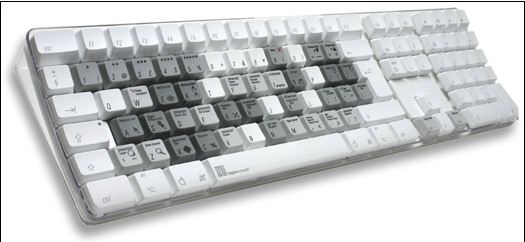
No sooner do I go on about Solutions looking for Problems than along comes this dusie (that’s short for Duesenberg, if you really care) from Logitech, a company which actually makes some fairly decent peripherals for iPods and the like:

Yes, it’s none other than the Logitech Aperture Keyboard, which gets my first annual SLOP (Solution Looking for a Problem) award. As you will see, the pristine clarity of Apple’s keyboard has been obliterated with what can only be droppings from a passing bird, purportedly in the interest of helping you remember which key does what in Aperture.

Now, given that the hot keys I use for Aperture are limited to a handful – Z for Zoom, H for HUD, ~ for the Loupe being the dominant ones – you expect me to buy this excresence because I struggle remembering three keys? Probably ideal for all those US public school graduates who never got to the Reading part of the syllabus (you know them – they are the ones with risk free government jobs and inflation-weighted pensions which we all pay for), preferring instead to listen to their iPods.

Let’s see, what could you do with $99? How about driving 1,000 miles in search of that great picture instead? Put it towards a proper tripod so that you can finally see what your lens can do? Make a few big prints for friends?

Nah. Get that keyboard instead. Guaranteed to make you a better photographer.

Mounting hell

Will this ever end?

Having made the thirty framed prints for my one man show in April, it remained to make another twenty or so for unmounted display in the saw horses provided by the gallery.

A day of cranking away on the Hewlett Packard DesignJet printer and the content was ready.

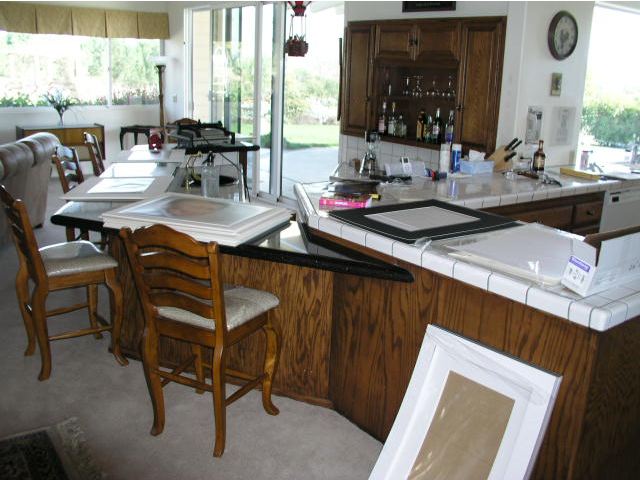
So, yet another big box of mounts and mats arrives from the fine folks at Documounts, and out comes the sharp knife for trimming the mounting tissue to size, the press for mounting the prints, the glassine bags for storing the completed ‘sandwich’ and before you know it the place looks pretty much shot:

I had the idea of attaching a Certificate of Authenticity to each print as these are limited to 25 each, and it looks like this:

So that means messing about with spray-on glue and the attendant isssues that poses – mostly trying not to pass out from the awful smell of the stuff.

I mention all of this because if you think making a Book is tough, you should try having your own show of Really Large Prints. And yes, ever willing to participate in the pretentiousness of others, all my prints are dutifully described as Giclée in the accompanying brochure.

Solutions looking for problems

They abound.

A few dollars having been made the past week in the market, I rewarded myself at a newly opened local family restaurant named Applebees, a nationwide chain whose stock trades publicly. What has all this to do with photography, you ask? Bear with me.

The enthusiastic young order-taker (‘waiter’ would be overstating things in this case) produced a PDA from his pocket and started tapping out my order. I asked to see it and saw that it was a color display device with a touch-screen, activated with a stylus, much like a Palm PDA. (Remember those?).

“How well does it work?” I asked.

“It’s just horrible,” came the quick response, “try to find anything in the sub-menus when people ask you to add this, hold that, and it’s hopeless; still it uses WiFi to communicate to the kitchen!”

And, sure enough, my burger and fries were delivered to the table next to me, though my order was stock – ‘hold nothing’. Maybe Applebees, one of the many US businesses justifiably under attack from private capital, would do well to revert to pen and paper for order taking? Can you imagine the arcane BS that was used by some finance guru to sell this silly idea to the management of this chain? Or worse, the lack of common sense displayed by those same people in accepting this nonsense and blowing shareholders’ money on it?

But look, the California sun was doing its thing, the almonds are in flower everywhere, the birds putting out a few bars now and then and, well, even this minor hiccup in the road of life could not upset one of my mien. Plus, as I mentioned, it had been a good week in the market.

However, this little episode started me thinking about how often engineers and marketers (OK, probably marketers) find solutions to non-existent problems. And when it comes to photography, there are more examples than you can shake a stick at.

Some are easy targets, of course. Digitalia sees to that.

  • LCD screens replacing viewfinders. You cannot see them in bright light, you cannot hold the camera against your forehead for steadiness and you have little idea of what you are photographing. Daguerre had a better idea of what he was pointing his camera at 150 years ago.
  • A seeming average of five billion useless menu items on the average DSLR camera when all you need is RAW or Jpg, ISO and …. well, that’s about it. And both can be moved to mechanical dials human beings can understand.
  • Camera straps, of course. I have yet to encounter a good OEM camera strap, but boy, the ones that the manufacturers of digital wonders emblazon with their names sure look nice, huh? Then again, if you are sufficiently insecure to emblazon the rear window of your car with the name of the university you attended, I guess I can understand that. You need one of those straps.
  • Face recognition technology. You mean you haven’t even the meanest intelligence to learn to pre-focus on the face of the key person in a group? This is reminiscent of that awful 1980s manifestation, the Kodak Photo Spot. You go to the Grand Canyon to commune with nature and what do you find? A placard saying “Stand here and press the button. Brought to you by Kodak.” Only in America.
  • 99% of the menu selections in Photoshop.
  • Cameras so small that regular humans cannot make out what all those buttons are for. They look chic, though.
  • Camera cases. When I was a lad these were laughingly called ERCs – Ever Ready Cases. They were about as ready as our government.
  • Lens hoods in the age of multicoated optics. A fool and his money are easily parted. $50 for a two cent plastic moulding.
  • The DSLR. 95% of its users probably distribute their content on the web, where they would have been almost as well served, definition wise, by a $199 point-and-shoot. Heck, lots of lousy drivers own Porsches, too.

So now I don’t feel so bad about that ordering experience, even if the hamburger confirmed that someone needs to speak to Applebees’ CEO with a baseball bat.

And the burger at McDonald’s, at 50% of the cost, is way better, too, by the way. Then again, I do own the stock ….
Sigma DP1 – update

Finally, someone gets it.

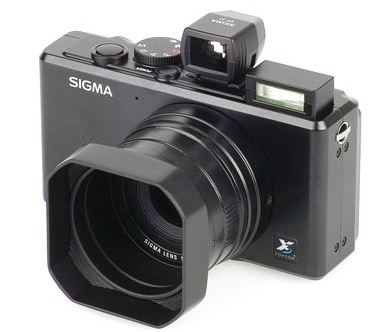
I wrote hopefully about Sigma’s upcoming fixed focal length digital point-and-shoot here.

Well, Sigma has now released the camera and, guess what?

Yes, that’s an accessory shoe complete with a Sigma optical viewfinder on top. Oh! joy, oh! bliss, an optical viewfinder makes all that silly squinting at the screen and holding the camera at arm’s length unnecessary. Someone at Sigma must actually have used this camera before releasing it.

Now the lens remains at a modest f/4, but the fabulous Foveon three layer sensor will go a long way to keeping noise low (it uses relatively large sensor elements – a good thing, just like with Canon’s 5D), so I’m hoping the high ISO performance of this little gem will not be a compromised as in my Panasonic Lumix LX1 which I had to submit to the ignominy of a glued-on finder – click on ‘Leica DP’ in the left hand column for more. At 8 ozs in weight, this is a pretty solid sounding package. The fixed focal length lens? A dream for street snappers – it’s like a 25mm wide angle (assuming a 1.5x APS sensor factor) on a 35mm full frame camera. But Sigma, please, take a look at Leica’s hoods for their wide angles and do a bit of design ‘borrowing’ – it’s OK, Leica won’t sue you, they are broke….

It will be interesting to read the reviews – I am especially interested in the quality of the lens and praying that shutter lag is in Leica rangefinder territory rather than in the miserable world of point-and-shoots from everyone else. If those two measure up well, the Panasonic LX1 may find itself moving on….

One thing which has so changed with all these new camera makers is that loyalty to any one brand really makes no sense and the next great innovation is more likely than not to come from someone else.

High contrast scenes

Underexpose then adjust.

After working with a few digital sensors – from cheap and nasty ones in point-and-shoots through the best on the market, the one in the Canon 5D, the thing they have in common is that highlights burn out very easily and are mostly impossible to fully recover in the displayed or printed image.

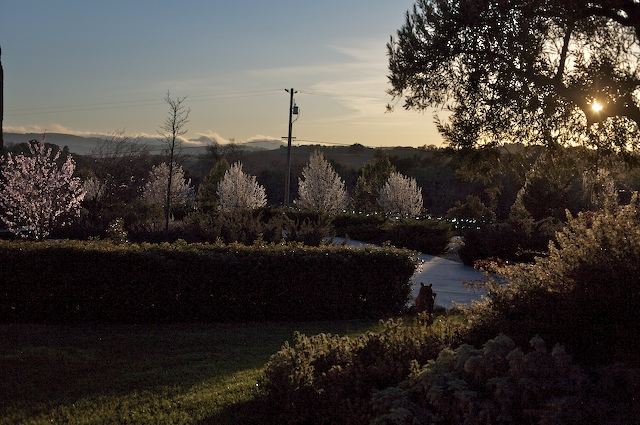
Case in point. This snap of the first sign of spring here in central California was originally exposed for the shadows, meaning about 1/400th @ f/4, ISO 250. That’s because I automatically tend to meter for the shadows, and that approach with a subject like this is all wrong. Recalling this, I metered on the sky instead and retook the snap, which resulted in some three stops less exposure – 1/3000 @ f/4.


First signs of spring. Canon 5D, 50mm lens

The original is dark and muddy, so much so that one’s first inclination on importing it into Aperture is to delete the image. But wait. As this was exposed in RAW format, we can do a lot of image manipulation without hurting quality, aided by that awesome, grain free sensor in the 5D. A simple (and substantial) tweak of the Shadows slider in the image HUD in Aperture brings up the shadows and cherry trees nicely, while preserving the tone of the sky. By contrast, the version exposed for the shadows has highlights so blown out that it’s past saving.