Robert Capa

Blood and Champagne – book review

I recall approaching this book with the thought that Capa was not really a very good photographer. I came away thinking otherwise, realizing that what makes a war photograph ‘good’ is not beautiful composition or perfect lighting or wonderful technique. No, the act of being there and recording the moment is what makes a war photograph good and no one bested Capa at that.

This book does not include any of Capa’s pictures, being an unauthorized biography. No problem. Just go to the Magnum Photos web site to see hundreds of examples of his work. Alex Kershaw does a fine job of writing a gripping narrative which at the same time is well researched. While the book could do with fewer asterisked footnotes, the quality of research is never in doubt and the writing never dry or academic.

Capa, the man, clearly suffered from what we would now call an addictive personality. His determination to be at the latest war front speaks to his addiction to adrenaline. In between, there was the incessant gambling, the boozing and the women. The gambling nearly bankrupted the agency he founded with Cartier-Bresson, Chim Seymour and George Rodger, Magnum Photos. The boozing was tediously incessant. The women ranged from Ingrid Bergman to Parisian streetwalkers.

Yet what a life the man lead. From the Spanish revolution, where he was in the thick of the action on the Republican side, to the D-Day landings on murderous Omaha Beach, to Viet Nam which took his life, he swallowed his fear and waded into the front lines of action. Kershaw forthrightly addresses the question of whether the famous picture of the Spanish Republican soldier at the moment of death was faked, coming away uncertain. I think it was, having seen some purported contacts of the film roll years ago in a reputable British photography magazine which showed the soldier ‘dying’ half a dozen times in succession, but it’s hardly likely that Magnum, or whoever owns the negatives, is going to release them if that is the case. No matter. One or two fakes in a life as prolific as Capa’s can be forgiven.

He also recounts at considerable length the D-Day story, where Capa went in with the first wave on June 6, 1944, carrying two Contax cameras and a Rolleiflex, taking but 79 pictures. Not surprising he took so few. Capa was a studied photographer who knew not to waste film and knew even better that the goriest images would never pass muster with the censor at Life, whose audience was Middle Americans who wanted their war sanitized. Kershaw relates how a darkroom technician fried the films when drying them, leaving but 11 frames useable, 9 of which were published. To Life’s eternal discredit, the magazine blamed Capa in print, saying the majority of pictures were too blurred to reproduce.

Later, having taken the required five training jumps, Capa parachuted in, yes parachuted in, with the 17th Airborne over Wesel on the Dutch border, in March 1945. Stunning courage. He was armed with his cameras and a spare pair of underpants into which he admitted having to change upon landing!

That his life ended in 1954 at the age of 41 is hardly surprising. First, he was feeling pressure from up-and-comers David Douglas Duncan and Larry Burrows. That meant just one more war. Second, he was, as ever, broke and in need of money. Third, his unwavering dedication to being in the front lines meant that sooner or later the inevitable would happen. So Capa, his best work done, trod on that fatal land mine.

“It’s not enough to have talent”, Kershaw quotes Capa as saying, “You also have to be Hungarian”.

This is a gripping story. The book is available from Amazon.
Noise

Shutters are all over the board

Over the years I have owned cameras from across the noise spectrum, by which I mean the noise the shutter makes when it’s tripped has varied from near silence to cacophonous. From a gentle whisper to a metalllic explosion.

For the most part, it’s fair to assume most photographers would agree that noise is not a good thing. Not only does it distract and cause vibration, there’s something just wrong about it. It’s in our genetic make-up. Why do you think the costliest real estate is invariably in the quietest locations, be it Fifth Avenue mansions with one foot thick stone walls or the sweeping estates of the Bel Air with the nearest neighbor hundreds of yards distant?

Silence, then, is a premium priced attribute, yet that fact seems to have escaped many camera manufacturers. Thinking back, the large Pentax 6×7 I owned years ago had the most wonderful lenses, yet the only truly sharp results I obtained from it were when it was used with a studio flash, with which it unfortunately synchronized at very low speeds. The problem was that tripping the shutter set off an explosion so loud, that people a hundred yards distant would duck for cover wondering which cowboy had come to town, guns blazing. So nice as that big negative was, and it fit 16″ x 20″ paper near perfectly, the camera had to go. The ten explosions a roll plus the onset of carpal tunnel from trying to hold this beast to eye level, not to mention hearing problems, were simply too much.

My large format gear is at the other end of the noise spectrum. In fact the lens shutters are so nearly totally silent, an illusion enhanced by the distance of the shutter from the operator and the huge space between lens and film which acts as a baffle, that sometimes I wish the shutters were a tad louder. Take the time I was photographing by a waterfall. Did that shutter trip or not? In other words, a crucial element essential in the design of all machines, feedback to the operator, is missing. It’s the same problem that makes using a silent keyboard so difficult.

Engineers will point out that noise is not just sound. Rather, it’s a collection of sounds of varying frequency, volume and duration all mixed together. So while I have no idea what the optimal mix is, I do know that higher frequencies are not a good thing as they tend to amplify the apparent noise too much. On the other hand, too much low frequency sound, is just as bad. As it takes far more energy to generate a loud low frequency sound than a loud one of high pitch – compare a cello or double bass to a violin – too much of the low stuff means something is moving hard and fast. Like a mirror thudding into a frame, protected only by a strip of neoprene. That spells vibration.

The second noisiest camera I ever owned was the Rollei 6003 medium format single lens reflex. What with the large instant return mirror, the electrical diaphragm and the motor yanking the film to the next frame, you could not be inconspicuous using one of these beasts. Rollei must have done something right with damping and vibration control, however, as even images at 1/15th or 1/8th second on a solid tripod showed no blurring from camera movement. And as a studio camera par excellence there’s an argument to be made in favor of noise as the subject knows that the picture has been taken. There’s that feedback thing again.

The Nikon F wasn’t bad. Like everything else about the camera, the noise was purposeful. No nonsense. “Built to last” was the thought that came to mind when operating this brute of a camera. The Leicaflex SL that succeeded it in my tool kit gave the exact opposite impression. Tinny, limp-wristed, you always wondered how long things would last before the next trip to the repair shop. Quite a contrast to the magnificent solidity of the lenses.

The screw thread Leicas rangefinder were always far noisier than you expected. While their “clack” was not that obtrusive, it hardly meshed with the Leica’s reputation as a stealth camera. The M3 and its successors were superior, though I always wished they were quieter, especially with that irritating shutter bounce on 1/15th and 1/30th, which every mechanical shutter M has had. The best in this regard was the M6 I used for several years which had a zinc top plate replacing the brass in the M2 and M3. Brass is ideal for chrome plating, but my M6 was black, so zinc was used as a cost saving. That camera had a beautiful shutter sound, sadly not matched by its build quality which was dramatically inferior to the M2 and M3. Plus the quick jam loading system was an absolute catastrophe – you had to crimp the film end to ensure it did not slip out of the stines meant to grasp it. So the M6 moved on, but not on account of its shutter sound. With any mechanical Leica M (I have not used the electronic M7) you get wonderful tactile feedback from the shutter release, to the extent that you know exactly how much pressure is needed to trip the shutter. Worth its weight in gold, whether on the street or in the studio.

The Canon EOS 5D is nothing to get excited about either way. The timbre of the noise is not objectionable, the volume is middle of the road, but you are going to be noticed when you press the button. For an electrical release, feedback is not bad. The first pressure to lock in focus and exposure is easily distinguished from the second which releases the shutter. There’s not that progressive feel of the Leica M’s shutter release, but it’s a worthy effort.

Setting aside the minority audience for large format cameras, the two quietest shutters I have used were from opposite camps. The one on the Rollei 3.5F was purely mechanical and wonderfully quiet. Feedback was not the greatest, not helped by the awkward location of the button, but it was a joy to use and hear.

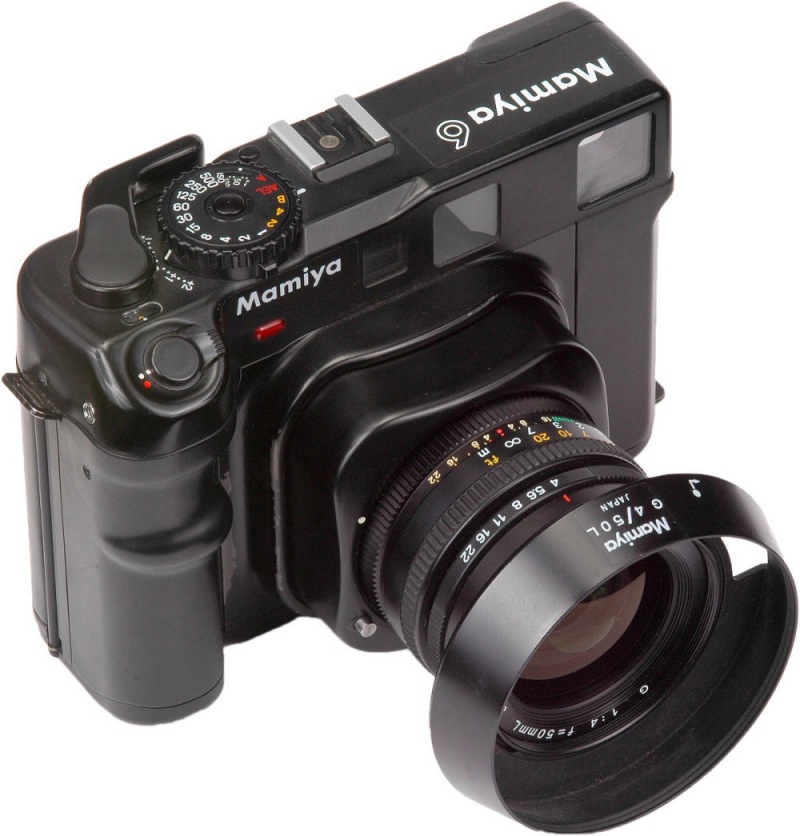
The other was in the Mamiya 6, also a medium format camera. This one is purely electronic, the shutter release is actually an electrical switch, with all the challenges that poses for feedback design. Owing to an absence of a flapping mirror and the use of between the lens shutters, the camera was simply wonderfully quiet and what you did hear was just right.


Mamiya 6. Noise? Just right.

Before closing, I have to say a word about the shutter in my Olympus 5050Z point and shoot. Near silent, Olympus felt obliged to add an option of an electronically generated shutter sound. This emanates from the camera’s speaker after the shutter is pressed. Unfortnately, it comes so late that it’s tomorrow by the time you hear it. Add the huge shutter lag and you have an example of how to get it dead wrong. Needless to add, the shutter release button has such poor resistance design that accidental exposures become the order of the day. At least you can switch off the electronic shutter noise.

So, camera designers, in my next camera I would like the sound of the Mamiya 6 with the tactile feedback of a Leica M2 or M3, with some of the overtones from the M6 for reassurance. The gun makers can use the Pentax 6×7 and Rollei 6003 as reference for their latest efforts. And the people at Olympus have some learning to do.

Tony Ray Jones

A Day Off – book review

The charm of the pictures in this wonderful book, published in 1974, is in marked contrast to the sheer nastiness of much of Robert Frank’s work in ‘The Americans’.

Ray-Jones was an Englishman who studied in America and apprenticed with Avedon, amongst others, so he was culturally well balanced. This picture book is about the fabled British ‘Day Off,’ which as often as not saw the resolute vacationer at the seaside in a raincoat, earnestly hoping for that one ray of sun.

What so contrasts this book with ‘The Americans’ is that where Frank sees nastiness, greed and despair in Americans, Ray-Jones sees nothing but charm and a wonderful quirkiness in the British, all nicely garnished with a sprinkling of levity. A light touch. The view, if you like, of a fellow traveller rather than that of a xenophobic critic.

All social classes are pictured here, from the wonderfully aristocratic boys at Eton School, the couple on the cover relaxing between acts of a Mozart opera at Glyndebourne, cows and all, participants in innumerable summer carnivals with all their eccentricity on display or the seaside shots which absolutely make the book.

This volume of photographs seems to be out of print but most of the pictures here can be found in current offerings of Ray-Jones’s work. So sad that he died at the age of thirty, in 1972.

Highly recommended. While the printing in my paperback edition is muddy and too contrasty, none of that detracts from the wonderful pictures.

Breaking up

35mm film just does not cut it for big prints.

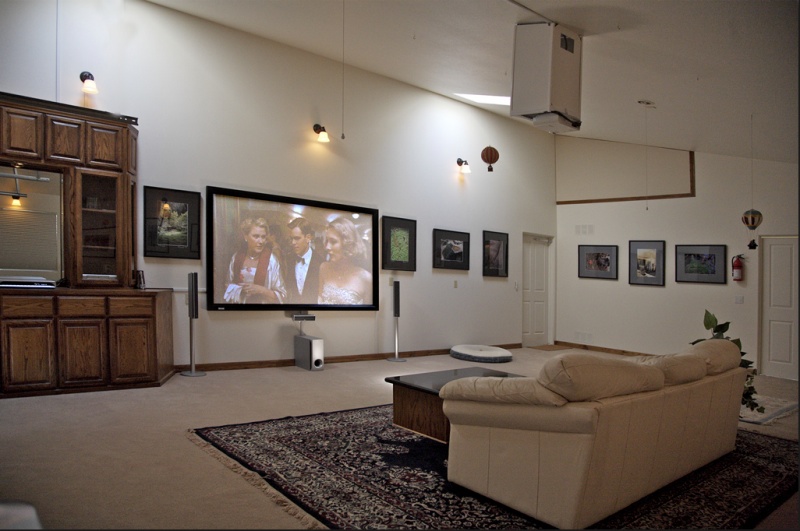
I finally finished framing the last of the fifteen photographs for the walls of the home theater – a converted garage, I should add, lest you think I have hit the jackpot. A large room, some 700 square feet, it offers lots of wall space even after the big screen installation. All of these are 13” x 19” ink jet dye prints made on the fine Espon 1270, with the delays in framing resulting solely from the incompetence of the local art store (Michaels) which stated they could not get me more 22” or 28” frame pieces because it’s a popular size. No kidding. So I finally ordered the remaining ones from Documounts, an estimable business that wanted my money and charged half as much. They also provided all the mats and boards for the pictures and a local glazier cut the glass to fit. All told, a 22” x 28” mounted, matted and framed print, with a nice ebonized ash frame, ran some $60, or one third of the amount charged by the main street framing place.

So there I was last night wondering which movie to watch, while debating the day’s events with that vicious guard dog and breed standard, Bert the Border Terrier, seen above. The goal of the picture project, I reminded Bertram, was that all the snaps must have been taken within the last twelve months. No recycled inventory of past successes. Change or die. And, in the event, every last one of these snaps was taken within a few miles of our home in central coastal California. There are traditional landscapes, strange surreal beach scenes, and the occasional peeling old wall sign. Acting as tour guide for Bertie, whose attention was enhanced by the promise of a cookie, I recited the story of each for him.

By the by, I found myself thinking about the equipment used to take these pictures. First, the realization dawned that almost every last piece of ‘front end’ gear used has now been sold, given the compelling advantages of the full frame sensor in the digital Canon EOS 5D at these print sizes. Second, of the fifteen pictures, eight were taken on medium format, six on large format (4” x 5”) and just one on 35mm.

Now it wasn’t planned that way. What ended up on the walls had to have visual merit, but it also had to be critically sharp. The reason is that viewers do not respect the rule book that says you should step back when looking at a large photograph. Not a bit of it. The larger the picture, the closer they seem to want to get. Now each of these film originals had been accorded the highest quality processing. The negatives were correctly exposed, film was developed by a great pro lab in Santa Barbara (one of the few that does not play a game of soccer on the beach with your wet negatives) and the originals had been scanned on the highest quality dedicated scanners at 2400 dpi (large format) to 4000 dpi (medium format and 35mm). No grain or dirt reduction software was used to preserve definition. These technologies may be smart, but there’s a trade off. Post processing was done on my iMac G5 whose screen has been colorimetrically (or whatever you call it) balanced using a Monaco EZ Color Optix thingummyjig. You know, the puck you dangle on your screen to measure colors while mumbling incantations to various deities. Bottom line? Color on the screen matches color on the print.

The result is that you cannot tell the large format prints from the medium format ones, but you most certainly can tell the one done on 35mm. Not that there’s anything wrong with the definition in the latter. Using a well calibrated Leica M2 and a 35mm Asph Summicron, that original had, without a doubt, the benefit of the best performing camera/lens combination ever. The Summicron lens is simply breathtaking in its ability to resolve fine detail with great contrast. No, it’s the film that damns the print. You see, if you adopt the ‘stick your nose in the print’ viewing method, the 35mm original clearly shows the film beginning to break up at this print size. There is a hint of grain and, in landscape pictures with much fine filigree detail, that’s a no-no.

Which leads to the inevitable conclusion that for large prints, which are my goal, abandoning 35mm was the right thing to do. Up to 8” x 10”, decent technique and a top class scanner, meaning a dedicated film scanner not some cheesy flatbed, will get you fine prints from 35mm. Anything larger, forget it. Or, if you like the 35mm format with all its advantages of lens choices and compactness, well, Canon has a digital camera for you. By comparison with 35mm film, the full frame digital prints I have made recently are simply night and day when it comes to resolution and detail, and my technique remains unchanged.

The only way around this issue for ‘35mm film only’ photographers is to make sure you don’t show your work head to head with medium format or full frame digital. If you do, all your protestations about making great big prints from a small negative will be so much dross. If, on the other hand, your goal is display on a computer monitor, well, a Holga will do.

Speaking of which, if you like Holga-sized pictures, you can view the ones in my home theater here.

Robert Frank

A man with an agenda – book review

When this book was originally published in France (shock news) in 1958 , it would more appropriately have been titled ‘The Ugly Americans’, for Frank never misses an opportunity to show the very worst of America, whether making statements about race (the white man having his shoes polished by the black in a men’s lavatory), toil (the workers slaving away in the mass production factory), crass commercialism (fully half of all the pictures here) or poverty (most of the rest). Nowehere is the nobility, generosity and selflessness of the great American spirit to be found.

So from that perspective, one might well regard The Americans as the ultimate hatchet job, where the victims praise the results which ridicule them.

Nonetheless, there is a lot to praise here. Yes, the photography is stark and the printing depressingly dark, at least in my paperback edition. However, Frank has an uncanny ability to spot the incongrous in daily life (who can forget his surreal picture of the boy with the Sousa horn?) and captures, again and again, that same Decisive Moment which so eluded Cartier-Bresson in his American pictures. And while it may be hard to set aside the prejudiced sociological criticism in this collection of pictures (the handful of images of affluent citizens clearly has an axe to grind), the result is a truly fine collection of what any picture book should be about. Great photographs.

Unsurprisingly, The Americans remains in print to this day. Every photographer’s library should have a copy. Just take the left wing focus with a pinch of salt.