A break in the storm

More than just a rainbow

Name any of the world’s great democracies and the chances are that you will find its happy residents indulging in the cocktail hour before dinner. America, Britain, France, German, Australia, Brazil – all favor this pastime which many regard, myself included, as the very touchstone of civilization.

Then look at those dour nations who struggle with the very idea of ‘one man, one vote’; God forbid ‘one woman, one vote’ for many do not even allow women the freedom of the ballot box. The Saudis? They don’t drink. The Russians? They do nothing but drink. The North Koreans? Please….

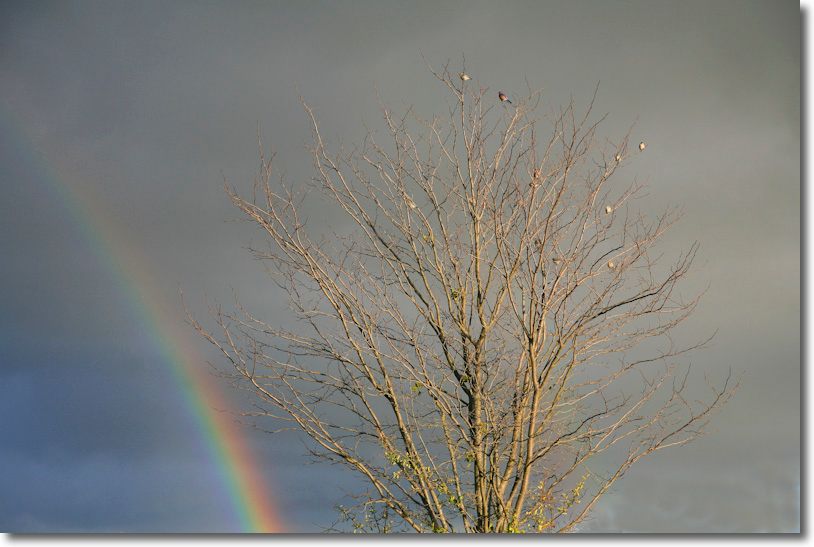
So after a day of truly wretched weather which saw thunder showers every few minutes interspersed with brief rays of sunshine, the thought of the daily libation was very much on my mind as I made my way to the freezer with its gin every bit as cold as the glass next to the bottle. Just before opening the refrigerator I glanced to my left and there it was. A superb rainbow gracing the old estate – clear sky to its left and threatening clouds on the right. Now you should know I’m pretty much blind without my glasses but that didn’t stop me from rushing to the office to grab the 5D, nearly damaging myself on that insouciant boulevardier Bertie the Border Terrier en route, and exiting stage left at a rate of knots that would have given pause to the staunchest of Olympic competitors.

Forget the old wives’ tale that landscapes are a stationary subject. Not a bit of it. Give the elements five seconds and, likely as not, the effect is gone. So throwing caution to the winds I banged off a couple of snaps even though what I saw through the viewfinder was mostly a ghastly blur, trusting to the gods and the Canon’s automation to get things more or less right.

I rushed back in at scarcely lower a pace and placed the card in the reader. Locating my glasses gave confirmation that all was right with the technology from Canon HQ, but when I loaded the picture into Photoshop and snapped it up to 100% original size (that’s some 30″ x 45″ on a print with the 5D’s full frame sensor) it became clear that the otherwise denuded tree on the right was replete with more birds than you could shake a stick at. The small picture here scarcely does it justice but a few moments later as I sipped the soothing elixir, the magic lighting long gone, I could not but help reflect on this wonderful bit of serendipity.
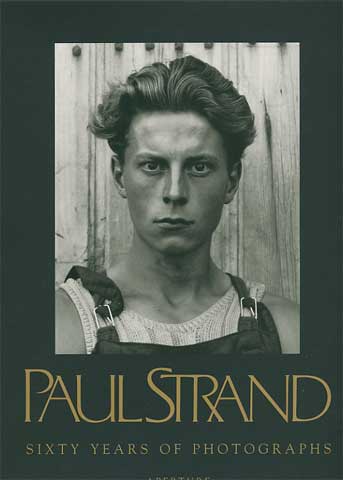
Paul Strand

Book review

Sorry, I just don’t get it.

For some forty years I have been trying to like Strand’s work without success. Frankly, based on the evidence of this Aperture book, his output reeks of stunning mediocrity and, if the prints in this volume are a guide, he was a wretched printer to boot. Ansel Adams, at least, knew how to print.

The sheer pretentiousness of the narrative here, where it is expected that the reader will nod in breathless agreement at the genius of the photographs, is best typified by the way Strand’s street portraits are extolled for his use of a right angle lens to avoid detection. His well known ‘Blind Woman’ is singled out as a prime example of this approach. For heaven’s sake, the woman is BLIND. Why the subterfuge? He could have stuck his plate camera in her face and the result would have been no better, nor the photographer any more detected by the subject.

As for the argument that has it that technical limitations of the time explain the poor quality of the prints (or is it because of one of those hallowed rare metal printing processes where the resulting grime is meant to be admired?) that also fails to pass muster. Julia Margaret Cameron, a technically challenged photographer if ever there was one, was turning out superior work some 50 years earlier.

Pseudo intellectualism at its worst. If you an uncritical admirer of the New York Times, buy this book. Otherwise save your $50.

After the Purge

Equipment then and now.

I took a few moments to take stock of how my equipment has changed over the past quarter as a result of the move to full frame digital.

Before:
3 Leicas (IIIG, M2, M3)
1 Leicaflex SL for long lenses
1 Bessa T for the 21mm Elmarit
21, 35, 50 (3), 90 (2) and 135mm Leica M lenses
200 and 400mm Leica Telyt lenses
Rollei 3.5F
Rollei 6003
40, 80, 150 and 350mm Rollei lenses
Rollei extension tubes
Mamiya 6MF when I didn’t want to drag the Rollei about
50, 75 and 150mm Mamiya lenses
Crown Graphic 4” x 5” with 90, 150 and 210mm lenses
Canon 4000 35mm scanner
Nikon 8000 medium format scanner
Epson 2450 large format scanner
HP DJ90 large format printer

After:
Canon EOS5D
24-105mm Canon lens
1 Leica M3
35, 50 and 90mm Leica M lenses
200 and 400mm Leica Telyt lenses adapted to the Canon
Crown Graphic 4” x 5” with 90, 150 and 210mm lenses
Epson 2450 large format scanner
HP DJ90 large format printer

Quite a reduction in clutter! The original goal, recall, was to get medium format quality without the bulk and complexity. The 5D came though with flying colors on that front, equalling or exceeding medium format quality at 30″ print sizes, while making pictures possible that would never have been taken on film, thanks to Image Stabilization and a sensor which renders grain free ISO 400 images.

Now I’m keeping the Leica M3. Not rational, I know, but it has been a dear friend for more than thirty years and we are not ready to part company. Yet. However, it seems appropriate to focus on the need for the 4″ x 5″ gear. If you can actually expose the film in this beast, large sharp prints are trivial, owing to the enormous size of the negative.

So I compared 30” prints from both and, interestingly, there was little to choose. It seems easier to get a broad dynamic range from negative film than from digital, the latter needing more attention to exposure. Like using slide film. My large format Kodak VC160 negatives are scanned at 2400 dpi on a well tuned Epson 2450 flat bed scanner, using Silverfast Ai software. Doubtless drum scans would be even better but after waiting for two weeks for the film to be processed, I’m not about to wait two more for the scans.

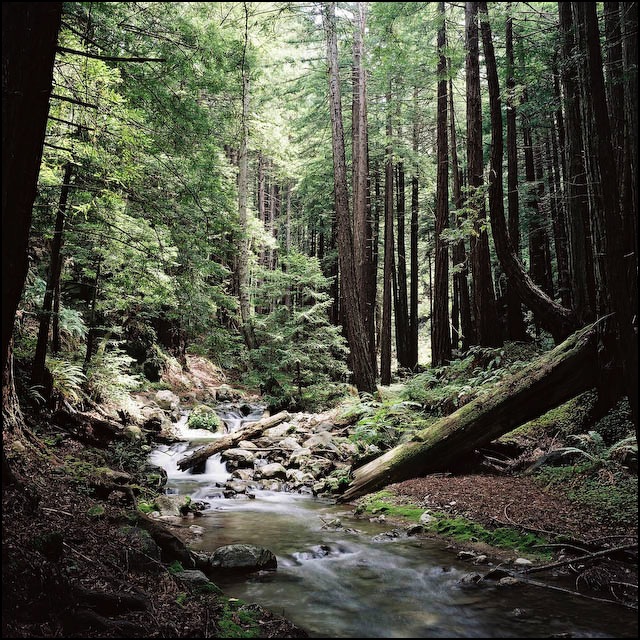
For what are very similar scenes, the technical details could hardly be more different. Here’s the 4″ x 5″ picture:

This was taken using a 210mm Rodenstock Sironar lens, probably 4-8 seconds at f/22. A massive Linhof tripod was used for stability. That lens is similar to a 75mm on 35mm. Setup time to take the picture was some five minutes. Processing was by Calypso Labs in California – an outfit that literally needs to clean up its act, judging from the amount of dust on the negative. The scan on the Epson took approximately 20 minutes. The file is 250 mB (!). Unsharp masking in Photoshop was 45/1/0 – in other words not a lot.

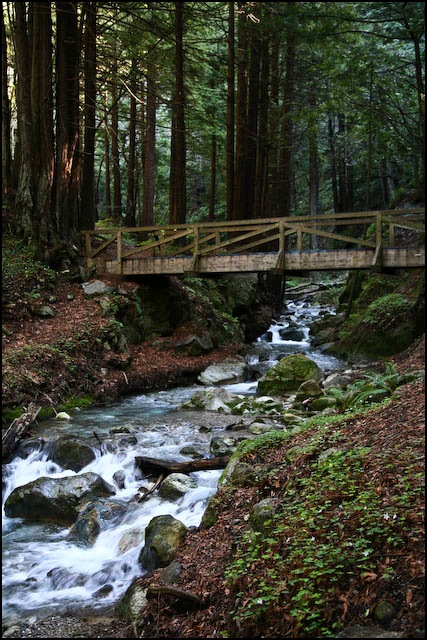
Now compare this with the Canon EOS 5D snap taken a week later.

Here I can disclose the technical details with certainty – they are part and parcel of the file. The shutter speed was 1/15th with the camera hand held on a monopod. ISO was set to 400 to allow a faster shutter speed. That’s a nice attribute of the Canon – ISO is used to control shutter speed. Up to ISO 800 grain is simply not an issue. The lens was fully opened at f/4 at a focal length of 40mm. Setup time was maybe 10 seconds. So the lighting was identical – 1/15 @ f/4 @ ISO 400 is nearly the same as 4 seconds @f/22 @ ISO 160. The original most certainly did not need any dust retouched, and I did not have to wait weeks for the negative to come back. The file size is 73 mB. USM in Photoshop was 250/3.2/0 – much more than with film and reflecting Canon’s own recommendation that the user starts at 300/0.3/0 to overcome the softening effect of the anti-aliasing filter in the camera.

So as a landscape camera the 5D excels. Meanwhile the Crown Graphic is on probation. There will be rare occasions where something larger than 30″ x 40″ may be called for (I cannot immediately recall ever having made a larger print) in which case a drum scan and a professional printing house would be required, with goodness knows how long a lead time. That is, of course, if color film in this size is still made when the need arises.

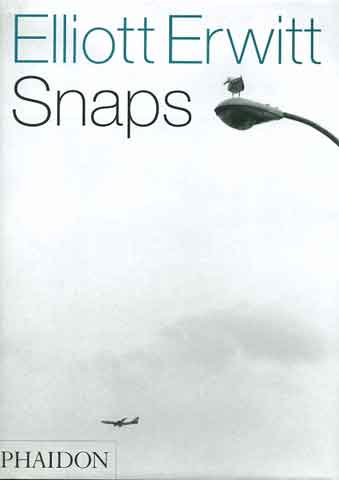
Elliott Erwitt

Snaps – book review. Simply the funniest photographer ever.

Elliott Erwitt takes funny pictures. You could just write that and know all you need to about this compilation of a lifetime’s worth of humor.

For life without Erwitt would be a sadder place indeed – like going to New York and finding that Zabars is no more. Or passing through Los Angeles and discovering that the Atlas Sausage Shop is out of Kielbasa. Or visiting any Young’s pub in England only to find the beer is now served cold.

No matter that most of Erwitt’s pictures are posed. Unlike frauds like Capa’s dying Spanish soldier (the contact sheet has him managing to die six times in quick succession) or Smith’s Minamata child in her mother’s arms (carefully posed with artificial light under the guise of street reportage), or Thomas Hoepker’s execrable 9/11 money making fraud, Erwitt makes no pretense about his light hearted work and just lets you enjoy it.

And it is much harder to be a great comedian than a great dramatist, whether your chosen outlet is acting or photogaphy.

The only thing wrong with this book is that it has too many pictures in it. You really must savor a few at a time to avoid overload. And, mercifully, the narrative is a scant four of the five hundred and forty three pages.

Buy the hard back version. You will wear out the paperback in no time.

This is the work of a great photographer.

Bill Brandt

Photographs – book review.

If your library of photography books is to contain only a handful of tomes, then someting showcasing Bill Brandt’s work has to be on the short list.

Brandt may be one of the very few exceptions who proves that monochrome can be more powerful than color, for his is strictly a black and white vision of the world.

And what a vision it is. None of the work is derivative in any way, Frequently, the images are breathtakingly original. Whether it’s his landscapes, or gritty scenes of coal miners or fabulous distorted nudes (sadly there are too few of these here), the viewer looks on in wonder at how one man could have done so much that was new. New and, let it be quickly added, horribly good.

Who can forget his portrait of a troubled Peter Sellers, taken between scenes for one of the Pink Panther comedies? Or his haunting image of Francis Bacon on Primrose Hill. His picture of Sir Kenneth and Lady Clarke, the spouse looking up at her esteemed husband with awe and respect (both well deserved in Sir Kenneth’s case), is charming for its lack of nastiness, which would have been an easy and cheap shot in the lovely home occupied by the couple.

His landscapes are no less moving. See the shot of Skye with the gull’s nest in the foreground. An image that hints at the best the surrealists did. Then turn to ‘The Man Who Found Himself Alone in London’ taken in a 1947 smog, an affliction which London continued to suffer until the mid-1960s, when clear air laws finally allowed one to breathe easily. Timeless.

We are taught to adulate the landscapes of Ansel Adams which, by comparison, are little more than picture postcards, albeit ones snapped by a supremely competent darkroom technician.

Buy this, or any, book about Brandt and you will have one of the shining exemplars of the greatest photography of our time.