Category Archives: Hardware

Stuff

Time for a Canon 5D upgrade

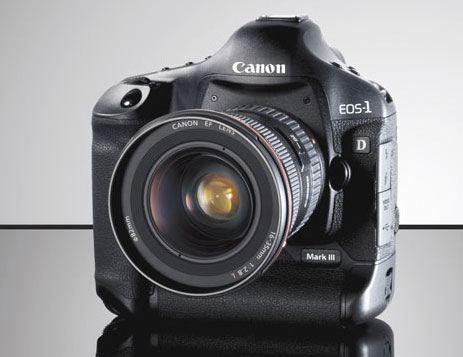
Canon releases the 10 fps EOS -1D Mark 111.

Canon’s announcement of a new 1D Mark III, a 1.3x cropped sensor professional grade camera begs the question when the 5D Mk II will become available.

There’s not a lot wrong with the 5D. What the camera does need is dust removal for the sensor (for whatever reason, the 5D seems especially prone to attracting dust to its sensor) and an LCD screen that can actually be read outdoors. The 5D does not need a larger screen or one with more definition. Rather, it needs a legible screen. And you can forget live preview (something Canon added to the Mark III, allowing screen ‘chimping’ before the picture is taken – pros need this feature? Really?). Just make the bloody thing useable outdoors.

Still, with the 5D’s price as firm as it is – probably the result of robust demand and no full frame competition at this price – I’m not holding my breath for an upgrade any time soon. That still leaves us with the best full frame digital camera (the only one, in fact) available at an (almost) reasonable price.

Cheap and good

You don’t have to pay ridiculous Leica prices for Leica quality.

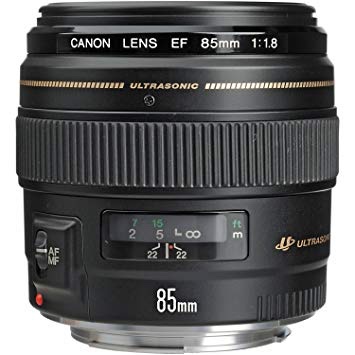
All the talk in yesterday’s column about Canon’s superb 85mm f/1.8 lens got me to thinking about how lens technologies have changed in the fifty or so years since the Canon was first designed – good designs do not die!

Multicoating was added maybe twenty years ago, brass gave way to alloys and then machined focusing helixes gave way to nylon gears and miniscule stepper motors in the lens mount. Materials got lighter and cheap aspherical surfaces (resulting from casting rather than polishing) became the norm is more specialized lenses. Exotic high diffraction glasses of yesteryear became commonplace.

So how is the user experience when comparing what I think is the finest portrait lenses ever made, the 90mm Leica Apo-Summicron Aspherical with the much less costly Canon at not much more than one eighth of the cost!

You would think the handling experience of the Leica optic on an M body would blow anything out of the water, and you would be close. The compact lines and very short throw of the focus collar on the Apo make for a sweet handling lens. All Leica Ms handle the 90mm focal length well when it comes to viewfinding, the result being that the M with the Apo is a sweet package.

Now the Canon is light for its bulk which surfaces the old prejudice that it cannot be durable. Time will tell. A surprising benefit of this bulk is that the camera and lens are very comfortable to hold, especially when oriented vertically which is the norm for most portrait pictures. Hand held the Canon has it all over the Leica in this orientation. Add the vertical grip and things probably improve further.

Then it comes to focusing and here, again, the conclusion is surprising. Nothing beats a Leica M3 rangefinder for manual focusing in the poor light of a studio environment. Nothing except for the 85mm Canon on a 5D with focusing on the central rectangle only. The old trick of focusing on the eyes then quickly recomposing was simple enough with the M3. With the 5D it’s a dream. Camera up, part depress the shutter button, recompose, click. Takes about a half second once you get into it. And it’s so dead right every time you begin to wonder how you lived without it. Depth of field is a scarcity in the portrait studio so focusing errors are cruelly revealed. Especially when you like to make 18” x 24” prints like I do.

So the new world of electronics and micromotors and LEDs and contrast sensors and on and on really has left the old world of mechanical-everything behind. Charming as that world seems, it no longer offers the best tool for the job.

Full aperture

f/1.4 is fast!

I have never owned a lens faster than f/2.

That said, the f/2s I have owned have invariably said ‘Leica Summicron’ on them, whether 35mm, 50mm or 90mm. Which is sort of like saying that all your sports cars have been Porsches, meaning the best of breed. At 90mm, that was an apochromatic, aspherical element lens and suffice it to say that the aperture ring on this lens only did two things – it changed the amount of light striking the film and it changed the depth of field. Definition at any aperture was the same, which is to say superb.

So I got to thinking what something faster might be like. Now f/1 is available from Leica only, and that means a second mortgage, so forget it. The f/1.2 lenses out there from Japanese makers have generally poor reputations, being more exercises in marketing, or keeping up with the Joneses if you prefer, so they are of no interest to me. But guess what? Canon just happens to make an f/1.4 for very little money and it’s auto-everything and a nice match for the 5D body. Plus, having grown up with film Leicas, I simply like the 50mm focal length.

So a couple of clicks on the B&H web site and the 50mm Canon f/1.4 was on my doorstep.
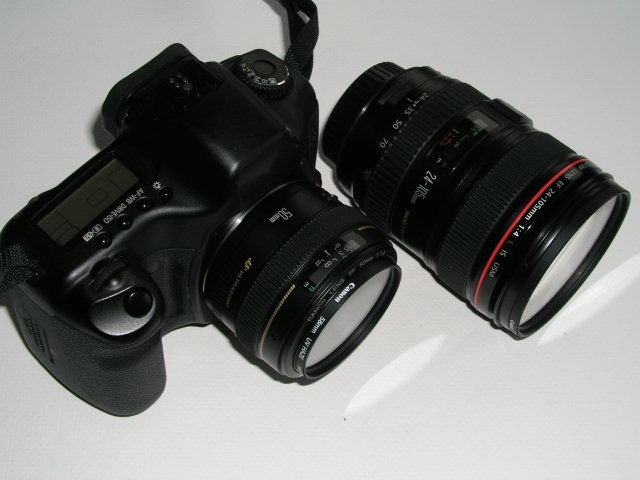
Much smaller than the ‘standard’ 24-105mm f/4 L zoom

The lens is well made, if not as solid as the ‘L’, meaning the extending focusing mount has a bit of play at the closest focus distance. Auto focus is every bit as fast as the ‘L’ and, strangely, the viewfinder image does not appear much brighter than with the f/4 L – certainly not three stops (8x) brighter. Naturally, as a fixed focus 50mm, it is much smaller and lighter than the L and the absence of Image Stabilization further reduces bulk and weight. The feel, with the lens on the 5D body, is just right – a smaller lens would not feel as good in the hand. The focus ring, if you elect auto-focus override, is a bit blah – it’s geared down approximately 2:1, making for slow manual focusing.

Surfing the web, comments about this lens vary from ecstatic to disappointed, the latter writers damning the optic for soft images at full aperture. How much of this is poor Canon quality control (how much can you expect for $300, after all?) and how much is poor technique I have no idea, but my first ever f/1.4 snap suggests this is a special piece of glass.
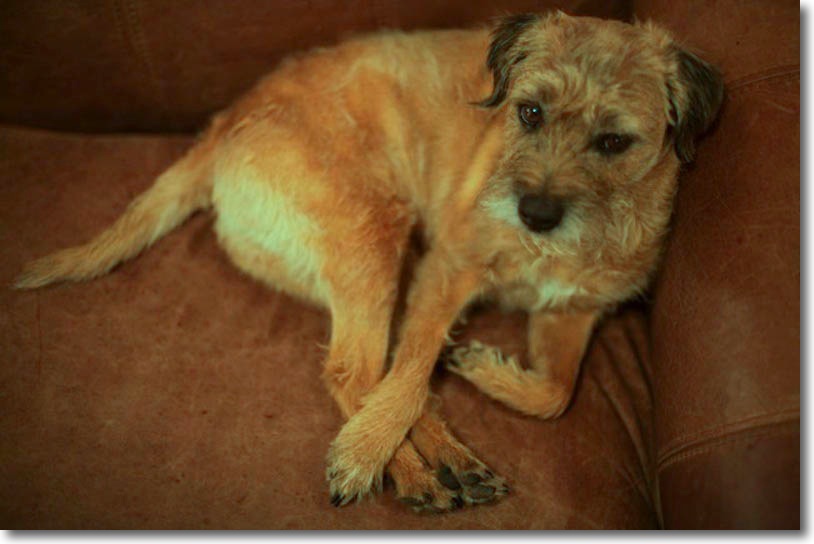
A long-suffering Bert the Border Terrier poses for Canon’s wonder lens

At any rational enlargement ratio, the above snap shows critical sharpness on the right front nails and the eye, which is how I wanted it. The nose, the crowning glory of the Border Terrier, is clearly unsharp, being a few inches closer to the lens.

I took three precautions to avoid definition robbing issues. First, I used a reasonably fast shutter speed of 1/60th second. Second, in the very low lighting in which this was taken, I cranked up the ISO on the 5D to 800, knowing that grain would simply not be an issue with the 5D’s sensor. The aperture was, of course, f/1.4. Finally, and I suspect most importantly, I used Canon’s spot focusing center rectangle to place focus where I wanted it, using a partially depressed shutter buttton to lock in the selected focus point. I wonder whether many users are using the default multi-point focusing feature of Canon’s DSLRs and ending up with the wrong focus point being selected? How on earth can the camera know what you want to focus on using this technology? Optimal auto-focusing depends on a focus point with contrast and detail, as those variables drive auto-focus accuracy. Point your auto-focus camera at a white wall and just watch the mechanism hopelessly try to establish optimal focus. Selecting the nails on Bert’s right front paw satisfied the dictates for accurate focus.

So this inexpensive optic seems like a nice addition to the 5D and some more extended work will disclose whether my first positive experience is borne out over the longer term. If not, I’ll just sell the lens for eighty cents on the dollar and put the loss down as the small cost of a worthwhile experiment.
Bigger and faster

A 2 gB CF card joins the Canon 5D.

When I first got my Canon EOS 5D I opted for two of SanDisk’s fastest 1 gB cards, the so called Extreme III, costing $103 each in February, 2006.

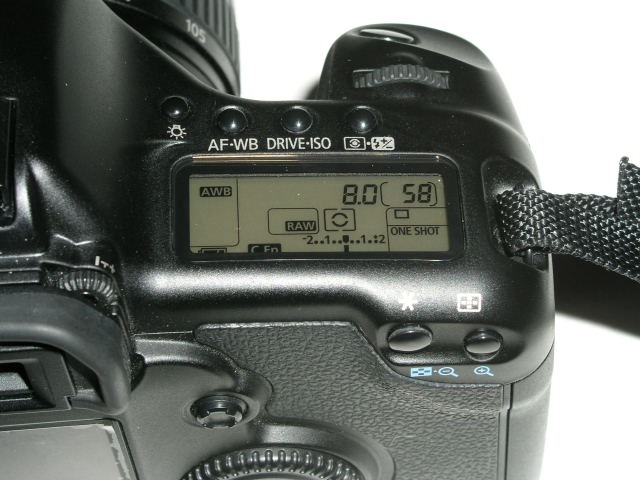
As digital tends to result in more pictures being taken, and as I shoot only in RAW on the 5D, given the ease of processing RAW images in Apple’s Aperture, I found myself running out of space on these cards more frequently than I like. Each holds 58 RAW images.

CF card prices continue to come down apace in price so I have added one 2 gB Extreme IV card, $91.95 after rebate to my CF card collection. Twice as much storage for less than a 1 gB card just 9 months earlier!

SanDisk claims the Extreme III can write data at no less than 20mB per second; by comparison, the Extreme IV is rated at ‘up to 40 mB per second’. Now ‘up to’ probably is some sort of ideal scenario and I have no idea if the card is faster as, with the 5D’s huge internal buffer I don’t need to care, but there’s no denying the capacity increase.


With an empty 1 gB card


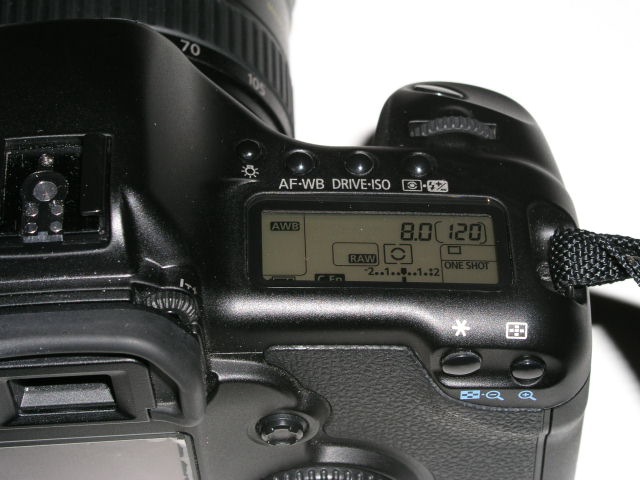
With an empty 2 gB card

Now 120 photographs in one session is a lot for this photographer, but not having to change cards in ‘mid roll’ is one less thing to worry about. Further, these cards are so reliable in use that I am far less concerned about data loss than when I first got the 5D – the argument being that it’s better to store images over several cards to reduce loss if a card goes bad.

The largest card on the SanDisk web site is a 16 mB Extreme III which would store no fewer than 960 (!) RAW images, albeit at a punitive cost in excess of $1,000. Which, I suppose, means it will be $200 in twelve months’ time. Maybe I will be writing this piece again in a year, extolling the virtues of a thousand image card….

A tale of two lenses

Some empirical tests deliver surprising results.

Being the ‘serious’ photographer in the family, the sad responsibility of selling off everyone’s film cameras naturally falls on my shoulders as we all move on to the world of digital picture taking.

I made mention of my mother-in-law’s magnificent Kodak Medalist II earlier, at which time I also sold her film Canon Rebel, together with its cheesy 28-80mm ‘kit’ lens.

Years earlier I had bought the same Rebel but got so tired of the execrable quality of the kit lens that we sold it and replaced it with a better 28-105mm f/3.5-4.5 Canon with improved optical and mechanical quality. When she decided to upgrade to the digital Rebel, we did the same, buying the pricey EF-S 17-85mm f/4-5.6 IS in lieu of the 18-55mm f/3.5-5.6 non-IS kit lens. A wise decision once you have handled the latter.

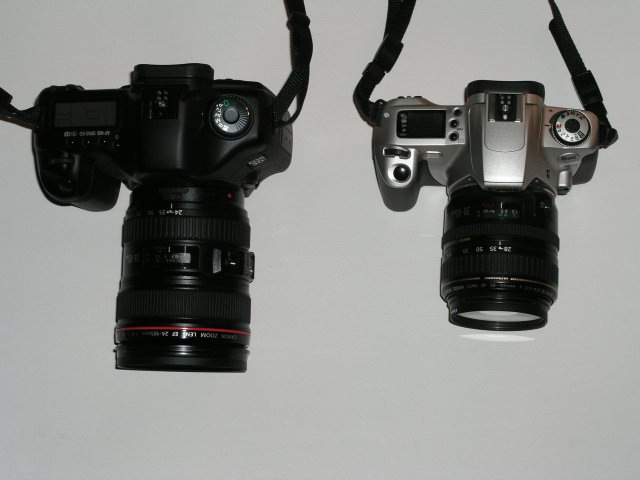
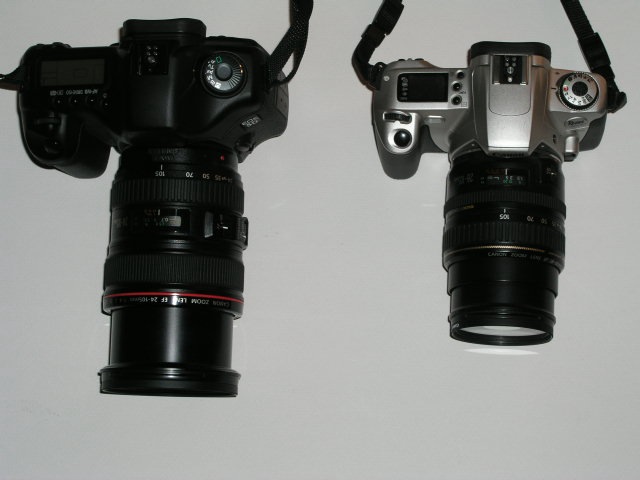
Anyway, I finally decided to sell the film Rebel and I dutifully listed it for sale. However, as the lens will cover a full 35mm frame I spent a few moments taking some pictures with it side by side with the costly 24-105mm f/4 L lens, both on my Canon 5D. You can get some sense of the relative sizes of the lenses here:


Both lenses at their shortest focal lengths


Both lenses fully extended

I took pictures at full aperture and f/8 with both, at 28mm, 50mm and the 105mm maximum.

Looking at the results, I must confess any differences are more imagined than real, and I know my 24-105mm L is good for enlargements to any size any rational user would want.

The L lens adds an Image Stabilizer, goes wider at a very handy 24mm, has lots of metal, very smooth controls no wobble anywhere plus …. lots of weight and bulk. By contrast, the 28-105mm lens is very light, although the mount is metal, has a horribly raspy, grabby zoom ring and the lens barrel wobbles about merrily when fully extended. Both have autofocus with the L marginally faster, but not enough to make any practical difference. Oh! and yes, before I forget, the L is $1,300 and the other is $230.

Now we may have been lucky and got a really good example of the cheaper lens, but based on this little exercise, I would recommend it without hesitation for anyone looking for light weight, fine resolution and a nice broad zoom range good for 95% of anything a regular photographer might need. You might not want to bash it about too much or expect it to last to the next millenium but, then again, you would also save a lot on chiropractor bills, not to mention over $1,000 on the lens.