Category Archives: Hardware

Stuff

A predictable disappointment

The Panasonic Lumix L1 is a catastrophe

Much as I predicted a couple of months back the Panasonic Lumix L1 which has just hit the market is nothing short of a catastrophe as photographic tools go. This is Panasonic’s first attempt at a DSLR with removable lenses so you would think it should be good. For $2,000 you get what sounds like a nice Leica lens and decent manual controls. You also get about the worst viewfinder possible and no image buffer, meaning that shooting in RAW demands a five second pause between pictures while the camera saves the image direct to the card.

A remarkably objective review by Michael Reichmann – remarkable as he admits the camera was a loaner so you would think he would make nice – confirms my earlier conjecture that the use of the lousy viewfinder from the Olympus Evolt E-330 would make the L1 a lousy camera, and adds the killer point about the absence of the RAW buffer. Thank you for your candor, Mr. Reichmann.

Sure, Panasonic seems to have cured the worst of its noise problems in the images, but that’s hardly much use when you can barely see what the devil you are photographing in the first place.

I have not used the L1 and am not about to. Suffice it to say that he compares the viewfinder unfavorably to the one in the Canon Rebel 350. That I have used and must say the viewfinder in the Rebel is underwhelming to the point of mediocrity, as the image is so small. At least it’s bright. The 5D is fine, just like a regular SLR if not Leica bright, so you can see where I am coming from. Then again, at $3,000 the 5D had better be good.

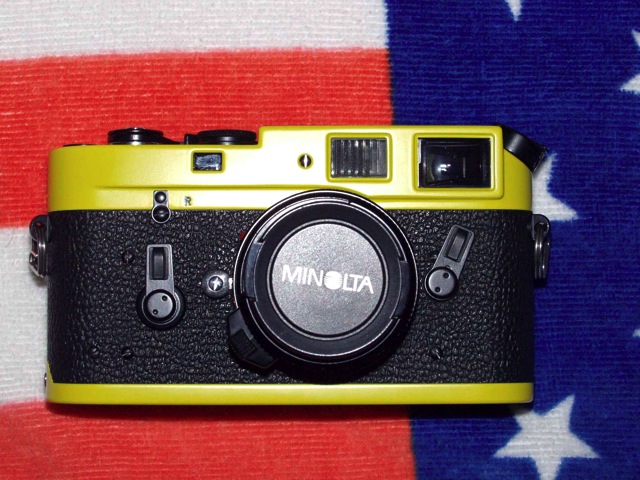
Leave this camera to the Leica fetishists who will buy it because it looks like a Leica M rangefinder which, I suppose, is about as bad a reason to buy a camera as I can think of.

Update as of November 11, 2006: I retract what I wrote about Reichmann’s apparent objectivity, above. Please read the following journal entry.

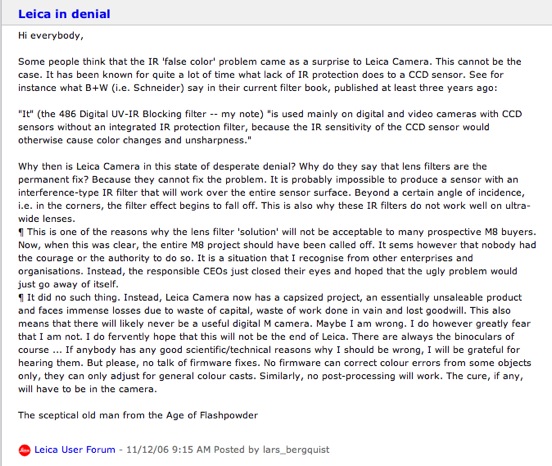
I like Leicas as much as the next man….

…but I know disinformation when I see it.

Can you believe this guy?

How many more people are going to buy into this ‘Freedom Train’ disinformation? This appalling apologia has now been around for some fifty years.

This is the same Leica company that gave us the Luftwaffe Leica, provided optics for Panzer tanks and most certainly did not depart Wetzlar for moral shores in 1939. Nor did it look to leave during the largest military build up the world has seen in the period 1933-39, being a major supplier of optics to their government. It’s not like they had no warning….

“Boy, oh boy, Ernst. Did you see the P&L this quarter? Are those Wehrmacht orders something, or what?”

I would have posted this comment in this writer’s web site but, predictably, comments are not possible. Why would they be when you write naïve nonsense like this?

Mr. ‘Conscientious’ should find his conscience and question what he reads before repeating it as fact. That’s the sort of ‘reporting’ you find in most of today’s newspapers. Until you learn to question what you read, Mr. C, please stick to photography.

But of course we know that the Leitz company did not collaborate with the Nazis, they were only following orders and they really love their country, etc., etc. As this advertisement from the November 1942 edition of Foto Beobachter confirms – a perfect match for that Luftwaffe Leica:

Look, Leicas are nice, but let’s not deny history.

Canon EOS 5D firmware update

Version 1.1.0 is now available.

You can download it from Canon here.

This fixes the following:

1. Enhancement of direct printing with specific printers.
2. Correction of the communication errors that occurred when shooting with EOS 5D and EOS Capture software after shooting about 138 shots.
3. Correction of the phenomenon (their word; what they mean is ‘error’) in which the flash mode settings are changed from E-TTL to M (Manual) when EOS 5D is used in combination with Speedlite Transmitter ST-E2 and Speedlite 580EX.

Of these #2 is probably of most interest. I wrote about Canon’s Capture software here. I haven’t actually taken 139 shots in a row using Capture – indeed, that’s unlikely to happen any time soon – but it always pays to keep current on these things.

I have installed the upgrade on my 5D and it seems fine.

So you thought f/1.4 was fast?

How about f/0.85 back in 1934?

‘Glamor’ lenses for 35mm cameras, the ones with bragging power, have either entailed large apertures or extreme length.

On the extreme length end, it was rather like the cubic capacity of motorcycles. Once you hit the magic thousand, you had bragging rights. So when Vincent motorcycles (then known as HRD) came out with its magnificent Series A twin in 1936, it was a ‘thousand’ (actually 998 ccs) that graced the frame and made it the talk of the town. On the lens front, thousand mm lenses have been around for ever, even if they were never priced at amounts the amateur could afford. No, you had to use someone else’s money to buy a Zeiss Mirotar 1000mm mirror lens for your Contarex back in the sixties. That or choose between a car and that lens. Nikon already had lenses of this length and greater. Canon had a 1200mm ages ago and it was a regular refractive rather than mirror optic, some 853mm long. That’s almost three feet! Get one of these and you could say yours was longer than anyone else’s with little fear of contradiction.

The Canon 1200mm f/8 telephoto lens

Quite how you were meant to keep this monster steady unless your tripod was built like the Maginot Line is unclear to me, but hey!, you were the big guy on the block so who cared? Sure, Nikon had the 2000mm mirror lens, weighing in at 40 lbs. but, let’s face it, it was barely two feet long so the only bragging rights it conferred was how long it took you to recover from the hernia induced by lifting it on your tripod. Or, for that matter, from lifting the tripod sans lens if it was one sturdy enough.

The Nikon 2000mm f/11 mirror lens

So long was long and nowadays these monsters are as passÄ— as bell bottoms and wide flower ties. Reminders of silly one upmanship and passing fads. The longest Nikon and Canon lenses I can find in the B&H catalog are 1000mm (a mirror lens with a modest f/11 aperture) and 600mm (with a whopping f/4 maximum), respectively.

But for the average man in the street, fast was always more intriguing than long. If his ship came in, a nice 50mm f/1.4 was more likely to grace his camera than a 2000mm f/11. Heck, you could actually use the thing. Indeed, even before WW2, Leica and Zeiss offered f/1.5 50mm lenses. Back as far as 1925 Erich Salomon was taking his great candids with an Ermanox 4.5 x 6cm plate camera fitted with an f/1.8 lens. So speed goes back a few years. Once modern anti-reflective coatings started to be used about 1942 (wars and technological progress being synonymous) these lenses began to transmit something close to their stated apertures. Later Leica gave the world the Summilux, an f/1.4, originally a 50mm and later joined by 35mm and 75mm versions. All superb.

In 1953 Zunow came out with an SLR, largely made of pure cheddar with an f/1.1 lens. Four were sold and have never been heard of since. I recall seeing one and that lens was certainly impressive to look at. In 1956 Nikon equalled them with an f/1.1 for its screw thread Leica clones.

So in 1961, not to be outdone, Canon came up with the 50mm f/0.95 for its Canon 7 rangefinder cameras which used a Leica thread mount. So large was the lens it had a separate external bayonet mount to fit around the standard mount on the camera body. User comment suggests this was truly one of the worst lenses of all time but, what the hell, it was under f/1.0! “Brighter than the human eye” the advertisements screamed. I’ll bet it sold a lot of Canon 7 bodies with f/1.8 lenses. You could always say you could get three faster lenses in case of need – f/1.4, f/1.2 and this worthless wonder.

The Canon 50mm f/0.95 lens. Like most marketing exercises, fast and worthless.

By the way, Canon tried again with a 50mm f/1 lens in their ‘L’ line early in the 21st century. Testifying to the poor performance of that lens, suggesting Canon had learned little from their prior experience, that lens was discontinued a couple of years ago and now has, you guessed it, collectible status. Must make for a nice paperweight, I suppose.

Leitz’s approach was different. The German character, not renowned for its sense of humor, reckoned that anything faster than f/1.4 actually had to be capable of taking sharp pictures, so they took it in baby steps, first coming up with the f/1.2 Noctilux with its exotic and costly aspherical element. Needless to say, the lens was superb and the limited production run of some 2,000 has ensured its collectible value. Meaning, sadly, hardly anyone uses one of these any more, most rotting in some collector’s cage.

It took Leica another 10 years to work out how to do it with spherical glasses and how to make it faster, and the f/1.0 Noctilux was born in 1976. It remains in production to this day and is probably the first useable f/1.0 lens for a 35mm camera ever made.

But Leitz always were horrible at marketing. Had they but searched their long and distinguished history, they would have found this and it was made in 1934 with an aperture of f/0.85! Or maybe they knew and were embarassed that 42 years later they could only manage f/1.0?

The Leitz 75mm f/0.85 Summar. From Theo Scheerer’s ‘The Leica and the Leica System’, Fountain Press, 1962

And you thought f/1.4 was fast?

By the way, want a $300 f/0.70 lens which will blow any of the above away for definition? Simple. Place that inexpensive Canon 50mm f/1.4 on your EOS 5D, set the speed to 1600 ISO and enjoy finer grain than TriX film at 400 ISO. Two stops gained from f/1.4 make it an f/0.70 with the depth of field and definition of an f/1.4. So Canon finally made a decent sub-f/1.0 lens, by virtue of that wonderful full frame sensor in the 5D!

A great Quick Release tripod attachment

A fine QR head system that can only have been designed by a photographer.

A few years ago the very idea of a tripod was anathema to this photographer. Sure, I knew about them and tended to regard them with emotions somewhere between pity and contempt. As a Leica using street photographer there was no way on this God’s earth I was going to use a tripod. Lenses longer than 90mm simply did not compute and TriX, pushed if necessary to 800ASA, and those wonderful, fast Leica lenses, all suggested a tripod was – well, just not done.

Then, as my interests graduated to include landscapes and longer lenses, the tripod once more reared its ugly head, so a few years ago I picked up a nice old Linhof for a few dollars. The good thing about this tripod is that the legs are cantilevered, meaning extra bracing with little increase in weight. The bad was that it came with a pan and tilt head which has to be one of the worst designs of all time. The scale markings are never visible when needed, they are not calibrated, and the locking knobs are so small and inaccessible that they represent nothing so much as an accident waiting to happen. A few dollars later and a nice, if well used, Leitz ball and socket head graced the top of the Linhof’s center column.

I came across that genuinely rotten pan and tilt head the other day when first dipping a toe in the waters of Virtual Reality photography. Since that first encouraging experiment, I have decided to invest in a proper panorama head with a rotating base and nodal point correction, so this time it really is curtains for that pan and tilt head. I have yet to find any use for this wretched design in the field of still photography. A ball and socket head is not only easier to use, when it comes to turning the camera through a right angle there’s simply no contest.

Enough grumbling. When I got sort of serious about tripod use I realized all that screwing the camera on and off the tripod was just so much waste of time, not to mention the risk factor of dropping the camera while messing about with the locking knob. So I searched around only to be astounded at the ridiculously high prices asked for most quick release devices, many tailored to a specific manufacturer’s tripod line. Finally I tracked down an importer of Sima products who did a nice resin QR base with small and light plates which attached to the camera’s base. These worked OK, though truth be told they were somewhat overpowered by larger cameras and lenses. After the effort of selling all my medium format gear and replacing it with the Canon EOS 5D, I decided to rethink the QR issue, especially now that the camera body whose life depended on the QR head ran some $3,000! A good used Leica M2 or M3 body at $1,000 is no joke, but we are talking the price of three of these in that full frame digital wonder that is Canon’s claim to the Greatest Camera on Earth.

What finally forced me to get my act together was the enthusisam I feel for Virtual Reality photography. Given that this requires a tripod to be lugged to the venue of choice and much mounting and unmounting of camera, panorama head, etc., I did some serious research and came up with a very reasonably priced range of quick release tripod adjuncts from Manfrotto (imported by Bogen to the US). So while waiting for the three week backlog on the panorama head of choice to clear (more about this later) I procured a handful of Manfrotto’s best and have to say I am delighted with both the quality, the ergonomics and the price. That’s a combination I have yet to encounter in a woman. Whenever the first two factors are just so, you can bet the third is out of sight.

Here’s the #3299 base ($28) with the included camera plate. The base has an ingenious safety lock which has to be released to permit the large lever to move which, in turn, releases the camera plate. The metal used is a light alloy, more than up to the job. It’s the sort of pot metal used in low stress car components like door handles on German cars or just about anywhere in the case Italian automobiles. Manfrotto is, come to think of it, an Italian company.

For a fairly heavy camera like the 5D you really want to avoid torquing sheer hell out of the attaching bolt in the interest of the camera’s safety. Even though the camera plate has a substantial rubber platform, a long heavy lens with no tripod socket of its own (like Canon’s 200mm f/2.8 ‘L’ say), with the camera oriented vertically is going to need more fastening torque than I am comfortable with. Manfrotto thought of that when they designed the #3157NR plate ($12) (11/2008 update: the plate is now named the 200PLARCH-14RC2, is identical and now costs $19 from Amazon – it now comes properly assembled for use with the 5D and no messing with the circlip is required) :

Note the finger hold which precludes the need for a screwdriver when attaching the plate to the base of the camera. The essence of this plate is that it has a small lip which abuts the base of the camera, replacing torque with physical restraint, as shown in the following snap:

Depending on the design of your camera you may have to remove a small retaining circlip (E clip) for the bolt and flip the head around as I had to do this with the 5D which requires the lip abuts the rear of the camera. On others it may have to go towards the front, which is how it is shipped. No big deal, and clearly explained in the excellent instructions. While the camera plate does block access to the small battery compartment for the camera’s clock, in practice that has only to be accessed every five years or so, so it’s hardly an issue.

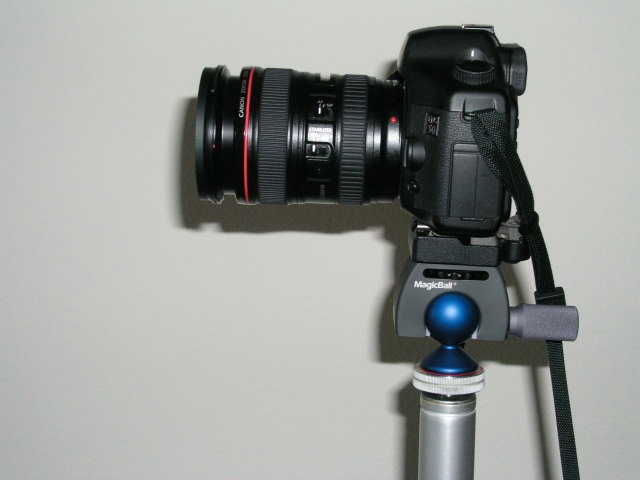
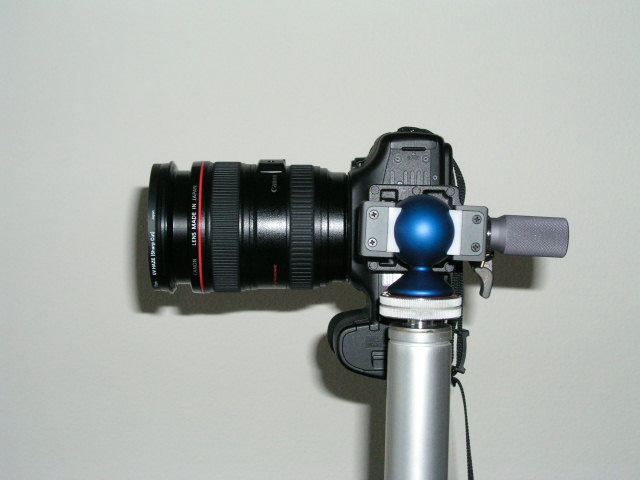
Here’s the whole thing mounted on my Linhof with its Leitz ball head:

In this underside view, with the camera oriented for portraits, you can see the small brass quick release lever – note the unrestricted access to the main battery compartment:

To attach the camera, you simply place the base plate with camera attached, front tilted slightly forward, into the tripod base. As you level the camera into the tripod base the camera plate depresses a small brass button in the tripod base which in turn releases the lever and locks the camera in place. You then rotate the brass safety lever which has the effect of locking the release lever in place. On one of the two tripod bases I bought the big lever would not click all the way home without manual assistance but after a few mount/dismount cycles all was well. Nonetheless, I would suggest you press the big lever home just in case, to ensure all is tight. Then operate the brass safety lock.

To remove the camera, release the safety lock and pull back on the big lever.

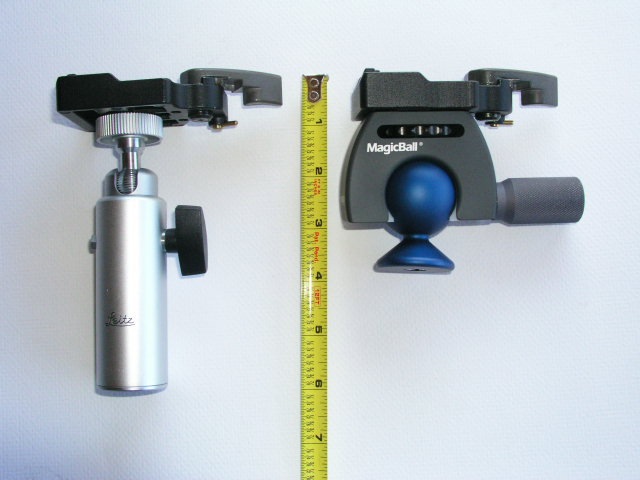
How does it compare size wise with the little Sima? See for yourself:

The overall size of the tripod base is much the same but the surface area of the camera plate is maybe twice the size. And no screwdriver is needed unlike with the Sima. The whole assembly is very rigid, even with a really heavy camera like the Crown Graphic with a heavy telephoto lens extended all the way.

If you are buying one of these, do realize that the tripod base comes with one plate (no lip) so buy additional plates as needed for your equipment. I used the two flat plates for my 4″ x 5″ Crown Graphic where the lip would not work owing to the large flat mounting surfaces involved; the Crown takes one plate either side so it can be switched effortlessly from landscape to portrait mode. One of the tripod plates went on the Linhof tripod, the other on the Manfrotto monopod. And lest you think that small Leitz ball head can’t handle it, let me assure you these things were probably used to raise the Golden Gate Bridge during construction. Doesn’t have to be big to be strong, and you can pick these up for some $100 used, which is a lot less than the going rate for all those exotic ball heads on the market. I mean, really. $750 for a ball head? That is God’s way of telling you that you have too much money.