Why the world needs more Jonathan Ive-like engineers – or Leica M2 viewfinders.
As this is a very long entry, in the true ergonomic spirit here’s a sound file of this piece that you can listen to or move to your iPod for use in the car, precluding the need to read and maximizing the use of your time. It’s just over thirteen minutes in length.
When I graduated top of my class from University College London’s engineering school in 1973, not least of the classes I look back on with unalloyed joy was the one taught by Professor Alec Rodger. Already an old man, Rodger was the dean of occupational psychology – what we now call ergonomics – in the United Kingdom. His pioneering work on man-machine interfaces in WWII and subsequent studies of men in confined areas (he had himself locked in hard-core Brixton prison for six months to study the inmates!) made him the number one man in the field on the other side of the Atlantic.
I contemplated ergonomics as a career but there was no money to be made at it in a country that regarded engineers with disdain trending to dislike, and accorded the same status (and pay) to a laborer bashing in railroad ties as to the guy designing turbines for Rolls Royce aircraft engines. So I took the easy way out and became a finance guy. Do what you have to do for a living and enjoy your hobbies in your spare time.
Ergonomics are very much on my mind as I design the new eBook I am working on with a fellow photographer. The look and feel of the screens, the colors used, the menu system – all vital to an enjoyable reading experience. As if taking the pictures for the book was not hard enough….
Which segues naturally into some of the lousy ergonomics of things that plague us daily.
Ever tried to open a Coke can without getting sprayed?
Ever tried to work that remote with dozens of rarely used buttons in the dark?
Ever locked yourself out of your car?
Struggled to get a lid off a jar?
Tried to open the new box of breakfast cereal and actually get the re-closeable slot to work?
Been deafened by your electric shaver?
Scalded yourself on the water from the hot tap?
Of course you have. All examples of bad ergonomic design.
I was reminded of these frustrations when reading about Jonathan Ive. Most have never heard of him. Yet when I tell you he has been the designer of the exteriors of most Apple products for two decades, aided by his famously obsessive boss, Steve Jobs, I think you will agree that Ive – a self-effacing publicity-shy Englishman – is the greatest ergonomic engineer of modern times. The original, fun iMac with its translucent colored casing, the G4 iMac with the ‘screen on a stick’, the iPod with the inspired click wheel, and, coming soon, the iPhone which will finally make a cell phone easy to use, well, you get the idea. He has also attacked the remote control with Front Row, using a screen and a simple remote to control your gear.
All of this naturally got me thinking about ergonomics and cameras. As with other areas of design, there’s more bad than good, but here is a short list of stand-outs – good and bad – that I have encountered over the past few decades of taking pictures. My comments are focused on the simple desire that the machine that is the camera offers as little interference with the job of taking pictures as is possible through good ergonomic design.
First, some real stinkers.
The advance lever on the Leicaflex SL. Unless you have fingers like ET, there is no way you are going to advance the film with one clean stroke at eye level. First, the stroke is way too long. Second, the lever, if released, will fly back to a flush position with the top plate as the detent is too weak. And finally, in doing so, it will whack you in the eye. A clear stinker amongst stinkers.
The baseplate on the Leica M. First, the tripod bush is at the extreme edge rather than in line with the lens. Second, when you are snapping away in the rice paddies of Cambodia or wherever, and run out of film, you have to find somewhere to put the removable baseplate while you futz with the removable take-up spool and try to thread the new film into that horror. Then grasping the baseplate by its thin edges, you try to place it over the end peg before swinging it shut. You would think that after 50 years (the first M came out in the early-1950s) they would have learned to get this right. But no. Not a bit of it. What do you get when you shell out megabucks on the new Leica M8 digital? Why, a removable baseplate of course! You have to remove it to get at the card or battery. OK, so they got the tripod bush moved, but someone at Leica needs to have a discussion with a baseball bat-wielding user.
The removable back on the Nikon F. Nikon stole this one from Zeiss and its famed line of Contax and Contarex cameras. The sole purpose, best as I can tell, was to make the Leica M user feel good as every Nikon F user was dropping his baseplate in the mud of some war torn location.
Jump to the twenty-first century and nothing changes. Or maybe it does – for the worse.
Has anyone at Canon actually tried to use the LCD screen on the 5D in daylight? They might like to try, as it’s simply useless. Anything more than room lighting and it washes out. Not so great when you are trying to make some change in its interminable menus – another ergonomic disaster. And, adding insult to injury, there’s a dumb on-off switch which has two ‘on’ positions just to keep you confused (the second allows exposure compensation to be set but you would never work that out from the instruction book) and a myriad of small, confusingly labeled buttons to get in the way of picture-taking. Oh! and lest I forget, strap lugs so poorly designed that you wonder why they bothered, unless they were trying to match the design of the equally inept, not to mention gauche, camera strap provided with the 5D.
The advent of digital cameras has seen some new lows in ergonomics. In a flashback to the days of hi-fi, manufacturers have decided to compete on who has the most menu options. What they should be doing is competing on the basis of who has least. And what’s with the trend to getting rid of viewfinders and replacing them with unreadable screens? You either glue one on or snap away not knowing what the devil you are pointing the camera at; which, I suppose, may be appropriate for the majority of users. You see them everywhere, holding the camera at arm’s length (great for shake reduction) squinting away, trying to make sense of it all. Add interminable shutter lag on most of these cameras and you have nothing so much as a costly paperweight. Heck, suddenly that Nikon F back doesn’t seem so bad.
So what about the great things, the things Alec Rodger and Jonathan Ive would have been proud of?

The superbly designed Leica M2 range/viewfinder
Simply no question about #1, which I contend was the single greatest step in camera design before Kodak came up with the cassette loading Instamatic. The Leica M2 range/viewfinder. Not, not the M3 with its ever-present, clunky 50mm frame. And nothing from the M4 or later with multiple frames appearing at one time. Ergonomics 101. Never confuse the user with choices. No, the M2 got it so spectacularly right that it ranks as Number One in my book of ergonomic achievements. First, you only see the frame you are using. Sure you can switch in others temporarily, but they mercifully disappear when you let go of the toggle lever. Second, the frame lines are thin and unobtrusive. Third, they are almost electric in the way the are seemingly projected on the subject. Fourth, they move automatically towards the lens as focus distance falls, correcting parallax. Fifth – and this should probably be first – is that magnificent rangefinder. Its sharp edges allow focus by looking for broken lines at the periphery and its bright center allows normal coincident image focusing. Genius. Ive would be proud.
Leica got it ever so right again with the wind on lever to advance the film. From the early double stroke version in the first M3s (dictated by the belief that too rapid film advance would cause electrostatic sparks owing to the early glass pressure plate which held the film flat) to the later single stroke which still permitted a multi-stroke ratcheting action (something the Leicaflex SL sorely needs) it was almost perfect, and certainly beautiful to look at. Leitz’s design studies showed that, much as Ive does today, they had tried dozens of different designs before settling on the final one. Later, with the M4 they made it even better by adding a swiveling plastic tip. The looks were gone and the tip has been known to break off, but the feel was as right as it gets. No ET fingers needed, either.
Contax made a huge advance in the late 1930s with the integrated range/viewfinder in the Contax II and later cameras. The rangefinder patch lacked the sharp outline of the Leica M, so only coincident image focusing was possible, and there were no brightline frames, but it was a miracle of optical engineering for the time.
Leica M rangefinder bodies and the Pentax Spotmatic, an early TTL metering SLR, share the prize for how the camera feels in the hands, even if the Pentax’s lovely to behold advance lever had too long a throw. Both fit the hands just so – small hands, large hands, it makes no difference. The sheer sensuality of the fit is a master stroke of ergonomics.
When it comes to focusing lenses, many have tried to fix the problem of having to grip the focus ring from below; for the rangefinder user this is mandated as he must avoid blocking the finder window, and all users benefit from the enhanced stability conferred by a below-the-lens focus grip. Tell that to the poor folks trying to see their digital LCD screens at arm’s length. Leitz had some nice efforts with their 50mm and wider lenses where they fitted a small tab, the idea being that the user would grasp the camera firmly with both hands and focus with an extended left index finger under the lens. Of course, many users didn’t get it and you still see them focusing their 35mm lenses – which lack a conventional focus collar – by gingerly grasping the little lever with a detached right hand….
Zeiss tried a transversely mounted focus ring on some of their exotic lenses for the Contarex (much as they tried the focus wheel on the earlier Contax), but it was a gimmick slated to fail. The user needed a third hand to make sense of the arrangement. Leica made a magnificent effort with their long follow-focus lenses – first the 400mm and 560mm f/5.6 Telyts and later the more compact f/6.8 variants. Focusing is by a trombone action with a release button operated by the left thumb. Remarkably effective as long as you keep the trombone properly lubricated to avoid stiction. Once autofocus came along the need for any attention to manual focusing pretty much fell by the wayside, though some smart DSLR makers allow manual override by providing a traditional focus collar. Very nice to have. The one on my 200mm f/2.8 Canon ‘L’ lens is a joy to use, by way of example, and comes in very handy with moving subjects. Too bad they got rid of the built-in lens hood.
And speaking of lens hoods, well, they are largely obsoleted by modern lens coatings and rarely well executed in any case. Once again, Leitz with its inverted, funky looking hoods for the 50mm and shorter lenses made a good go of it, even if the hood could no longer be reversed on the lens for compact storage, but whoever designed the monstrosity that masquerades as a hood for the magnificent, compact 21mm f/2.8 Asph Elmarit, should be shot. The one for the 35mm Asph Summicron, by contrast, is a wonder to use and behold. Whether it’s actually of any use I’m not so sure.
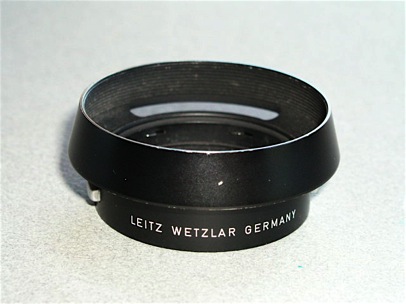
The best lens hood ever – for the Leitz 35mm and 50mm lenses
So there are a few thoughts on ergonomics.