Where not to go
It’s no great secret that newsprint is dead. Within a decade even the most powerful print media – WSJ, NYT, etc. – will have ceased publication using forests of trees. eInk technology (like in the Kindle) will add color and someone will design a two button interface almost as simple as a book. All those enviroloonies should be required to help capitalize the related R&D as they do want to save trees, no? And the advent of color will also dramatically reduce the price of art books – when the screen is transilluminated and has superior definition to traditional printing on reflective materials – what’s not to like?
Which brings me to the curious case of MacWorld magazine. ‘Curious’ because it begs the question why this trashy publication survives. When I got our first Mac a decade ago a relative gave me a subscription to this rag and it helped get me into the Mac ecosystem. That was ages ago and, like a fool, I still pay for a print subscription. At least until this one expires, that is.
This is simply the very worst place to go for objective advice about Macs. The magazine started life 25 years ago with funding from Apple. If you are not already holding your nose, you should be. Now purportedly independent, it is a sycophant’s dream for anyone getting a paycheck from 1 Infinite Loop. You see, they have yet to see an Apple product they do not like. Read any of their reviews and you will quickly realize that these are little more than regurgitated press releases.
Two cases in point. The other day they had a laudatory piece on Apple’s Time Capsule back-up hardware. Only thing they forgot to mention is that you cannot boot from the TC. So what are you going to do when your Mac’s drive crashes? Pull out the original OS X discs? Try and access TC that way? Do you even know how risky and time consuming this is? It’s not called Time Capsule for nothing. As a disaster recovery tool it is almost completely useless. But it ranks a rave review from MacWorld. No mention of the booting issue, of course.
Or their piece today on external hard drives. Without so much as opening the box they laud the overpriced LaCie Rugged. I own one and yes, I have dismantled it. Not from idle curiosity but because the bottom-of-the-line Western Digital drive inside failed just after the warranty expired (good business design, if you ask me). The full scope of the ‘rugged’ moniker was then exposed. The ‘ruggedness’ is comprised of four rubber strips inside, purportedly cushioning the drive from the case. Laugh – I did when I opened the case. And, of course, a 2mm thick jolly colored rubber covering on the case. Did MacWorld open the case? Did MacWorld try dropping the drive on a hard floor? Did MacWorld refuse advertising dollars from LaCie? Well, you can figure out the answers to those questions. (Hint: Not a ‘Yes’ in sight). So for a 2mm thick casing of rubber and four rubber bumpers (aggregate cost: 2 cents) LaCie gets $160 for something you can build yourself for $85; $70 for the drive and $15 for a self-powered USB enclosure. The assembly skill is especially low – even a GM production line worker could do it, although it will take you 2 minutes, while his union will make sure it takes an hour.
Let me illustrate. The drive is a 2.5″ SATA notebook drive – available for $70 in a 320gB size. The enclosure is a $15 2.5″ SATA enclosure from Tiger Direct. That price includes a leatherette case and a nice long USB connection cable with a pass-through connector to permit ganging. Why, they even provide the two screws and the screwdriver you will use to secure the drive in the case.
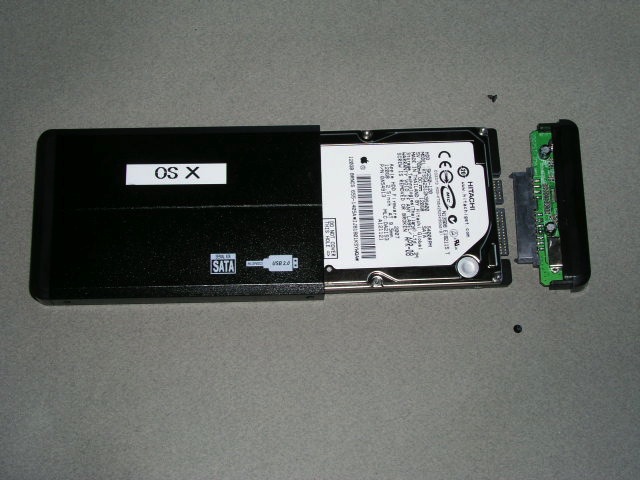
Detailed assembly instructions. Free screwdriver not shown.
Did you get that?
Oh! you want to add the ‘Rugged’ feature? Heck, blow $5 on some foam rubber and do 10 drives while you are at it.
MacWorld is a great place if you want to read Apple advertising and pay for it.
However, for objective comment just check in with the Apple Discussions section of Apple.com and see just how flawed many of Apple’s much hyped products are – like Time Capsule (worthless if your internal drive fails), Back To My Mac (terminally faulty), Airport Extreme wireless routing (the signal fluctuates for unknown reasons at anything over 10 feet from the router), glossy screens (useless for real users), dying Firewire (too bad about all those FW drives you bought), perennially ‘new’ connectors which obsolete your peripherals – and this is from Apple’s own site, for goodness sake.
Skeptical? Here’s today’s front page from just the Time Capsule ‘Discussion’ – a lot of comments and views for a device that ‘just works’, no?
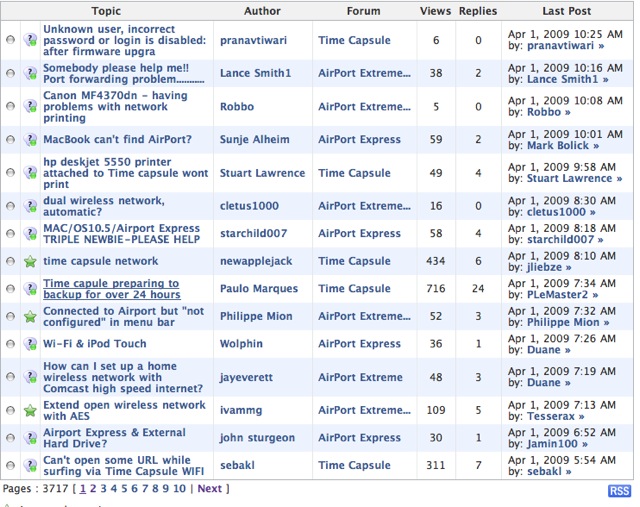
It just works, right?
And that’s after Apple’s (very active) censorship of its Discussions forum.
Before you even think about any major software upgrade (OS X upgrades and security upgrades have been the worst in this regard), wait a month, read Apple’s Discussions, then decide whether to risk it. I have long adopted this approach and it has saved me countless hours of repair otherwise caused by Apple’s policy of releasing buggy software and having unpaid users test it for them – a practice Microsoft perfected years ago. You have already paid a 30% premium for the Mac; it’s nice that critical user feedback is free and that you don’t have to pay advertisers posing as journalists at MacWorld for it. Just let the first implementers serve as your reviewer of choice.
MacWorld magazine and its staff of shills is a much overdue entrant to this journal’s Hall of Shame.