Category Archives: Photography

Mirror slap in the Canon 5D

Does it matter

Hot on the tail of yesterday’s gripping piece extolling the virtues of camera supports, whether monopods or tripods, it ocurred to me to make one more experiment to see if the slapping rise of the mirror in the 5D has any effects at longer shutter speeds. To magnify things further, I placed the 200mm f/2.8 Canon L lens on the camera and mounted the latter on my super sturdy Linhop S168 tripod. You can see the cantilever braces between the legs and center column here – note the latter is retracted for maximum stability.

My mechanics professor would be pleased with those cantilevers and I, as a photographer, think it’s the only way to make a tripod sturdy without excessive weight. He used to lecture extensively on Euler struts and how light and strong could live together with proper design – someone at Linhof was listening. Leonhard Euler, who died in 1783, got it right first time around and his math is taught to all budding mechanical and civil engineers to this day.

I chose a different picture in the book, just for fun, as no benefit accrues from using the same one. To take human shake out of the equation I released the shutter using Canon’s plug-in and wildly overpriced RS-80N3 wired remote control. Cable Release to you and me.

All pictures of the target were processed in Aperture.

I once more used 1/8th at f/5.6; 1/8th is very slow (like 1/2 second with a 50mm lens) but not so slow that any vibration from mirror slap becomes too low a percentage of the exposure time, if you get my drift. In other words, any camera vibration will be a significant component of the total exposure time.

Here’s the full frame snap – once focus was set I switched to manual focus to prevent any changes:

The enlargement ratio in the following snaps would yield a 40″ x 27″ print. No sharpening has been added.

Here’s the result with normal mirror operation:

While the difference is not great, the picture taken with mirror lock-up is a tad sharper – look at the contrast of the lettering.

And here’s the one with the mirror locked up using Custom Function #12 in the Canon’s menu system:

By the way, the anti-aliasing of the image in the 5D dictates that sharpening be used for best results. In the following rendition of the ‘no mirror’ snap, above, I have used Aperture’s Edge Sharpen with the variables for Intensity/Edges/Falloff at 0.70/0.22/0.57 – slightly more modest than the defaults of 0.81/0.22/0.69 suggested by Apple’s settings. As you can see, the absence of grain (at ISO 160, as before) and high resolution from the superb Canon 200mm lens makes 40″ prints from the 5D a piece of cake. You are looking at a JPG conversion from Aperture. In reality, a print from the RAW file will be sharper with no artifacts.

Maybe a ‘Medium Format is Dead’ piece is required to go along with ‘Black and White is Dead’ and ‘Film is Dead’?

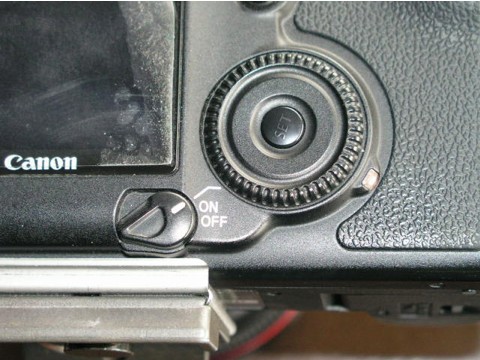
Now Canon, when the 5D Mark II is released, can you please assign the mirror lock-up feature to a mechanical button, the sort humans like, rather than to a blasted choice in the myriad selection of Custom Functions on that silly little LCD screen? The fact that the latter is unreadable by landscape photographers outdoors does little to help, in addition to the insane complexity of actually finding the function.

Shake a Leg

The monopod wins for cost-benefit every time

A recent discussion with a friend somehow made its way around to monopods.

“My dear chap”, quoth I, “the single greatest bargain in the photographic world is the Manfrotto/Bogen Monopod. $30 and it’s yours.”

My buddy, a technical sort, felt it necessary to check my ramblings, and came up with this on the estimable B&H web site:

OK, so the price has gone up since I bought mine 15 years ago (a modest annual inflation rate of 2.3%), but the device remains unchanged. It has only three sections, cam locks and a screw top head. You provide the ball and socket head of your choice. It always rides in the trunk of my car, outfitted with a Leitz head and a Manfrotto QR plate – the easier it is to use the more likely it is to be used. If the cam locks loosen, as happened with mine, a metric socket and a few seconds of work allows the lock nuts to be snugged up and function restored.

So does it make a difference?

Nothing like an academic test. Here’s the target I used – a charming book titled “Cakes and Ale – The Golden Age of English Feasting”; just the thing for one who denies the bad reputation of English cooking and likes nothing so much as a good Shepherd’s Pie. Or Fish and Chips.

To make things fair I used manual exposure – ISO 160 resulted in 1/8th (good for blur!) at f/5.6 (good for definition). The lens was a non-IS 50mm Canon EF f/1.4, which I know to be superb. In each case – hand held, monopod, tripod – I took three snaps.

The enlargement is 15.8x, meaning a (rounded) 120″ x 80″ (yes, you read that right) print from a 1″ x 1.5″ original.

Here’s an enlargement of the hand held one, best of three:

Not so good, and really not usable.

Here’s the best of three on the monopod:

A whole lot better – marginaly usable in an 18″ x 24″ big print – one sixth the size of what you see here for the full frame.

Now here’s the tripod version – any one of three is the same:

So I learned a couple of lessons from this quick experiment:

  • A monopod makes a huge difference (though I already knew that)
  • A tripod – a really good one with a braced column – is the only way to go (I got my dream Linhof 20 years ago)
  • You can’t hold a 50mm lens steady at 1/8 second
  • Taking three pictures with a monopod rather than one makes a significant difference to your chances of success – the best was way better than the worst. Now that was a real surprise.

The tripod used was a braced center column, alloy Linhof model from the 1970s going by the moniker of S168 (the maximum height, column retracted, in centimetres, or 5′ 6″). I used a Novoflex magic ball head with a Manfrotto QR plate and released the shutter by hand. Delayed action, mirror lock-up and a cable release would all likely help matters.

Those lusting after a Canon 5D should note the absence of grain above ….

And here’s what that Manfrotto monopod delivers in the real world:


Hearst Castle from one mile away, Canon 5D, Leitz Telyt 400 mm, Manfrotto 3016 monopod and QR plate, Leitz B&S head

Go where the money is

Economics 101 and Photoshop CS3

Well, the glowing reviews are coming in from the big magazines extolling the genius of Photoshop CS3.

So, what are you going to do? Trash your biggest advertiser? I don’t think so.

Heads up, class, for Dr. Pindelski’s Three Rules of Economics:

  • All control drives up price
  • A fool and his money are easily parted
  • When wondering about decision making, always go where the money is

I have been using Photoshop CS3 in beta form for some four months now so let me write in clear, unconflicted language.

This remains the hardest to use, worst user interface, clunkiest photography software available. Rather than improve on previous versions it just gets worse. The menu structure is so poorly organized we now have new options like “Show all menu items” in drop down lists of umpteen selections! Just try to find something basic like Image->Contrast/Brightness without this option.

Increasingly, real world photographers – those who prefer to take pictures rather than process them – are adopting user friendly products like Aperture and Lightroom. For the average person who does not need a zillion variables applied to his snaps, CS3 is simply God’s way of telling you that you have too much money, time or both.

You probably do not need a 5D

Just an expensive way of publishing on Flickr?

Yesterday I wrote about my fifteen months with Canon’s 5D camera, explaining how, for the most part, it is just right for my needs. These focus largely on the making of large prints for display in the home or in exhibitions. The large, grain free sensor in the 5D makes all that possible. Nay, easy.

But the chances are that you do not need the 5D in the sense that I do.

From a pricing perspective, Canon positioned this camera above its semi-professional 30D but well below the full frame sensor 1D, which is more than twice as costly. The latter, with its heavy duty execution and very fast motor drive is probably just the ticket for hard working professionals, banging away thousands of snaps weekly in weather where a sealed body makes sense. Now the 5D has neither the rugedness or fast frame rate of the top of the line model, and is poorly sealed from the elements. It also has quite a few less pixels in the sensor, though many experts seem to be of the opinion that the 5D’s sensor makes a better compromise between pixel count and print quality. We are probably splitting hairs here.

So the 5D would appear to be the advanced amateur’s tool of choice; one definiton of ‘amateur’ being one who pays for his own equipment or does not generate a significant revenue stream from his photography. I have no doubt that thousands of weddings have been recorded using this tool, for very modest pay.

But wait a minute. You can get as good an 8″ x 10″ print – which is ‘large’ for most consumers – from a 5 mp point-and-shoot. How many of us have 18″ x 24″ wedding snaps on the wall, after all? You want shooting speed, no shutter lag and interchangeable lenses? You may get a pretty lousy viewfinder with the cropped frame Canon consumer SLR bodies but get a Nikon D80 or D200 and you get a proper viewfinder at half the price of a 5D. So now you have a fast camera with a great lens range at much less than the 5D.

Why pay more?

There is only one reason I can see, which is that you consistently want to make prints with medium format definition and detail. And those prints have to be big, meaning 12″ or more on the short dimension. That’s right about where cropped sensor originals begin to suffer when enlarged.

Now let’s face it. How many photographers, in a digital age, make prints, let alone big prints? I have no idea but would guess it’s under 1%. Most of us, of course, display our work on the web, whether in web sites or through picture sharing networks like Flickr.

So I checked my web site. Most of the snaps are 7″ x 5″ on my 17″ diagonal screen, whose display area is 14.5″ x 9″. By the time you add navigation controls, headers and menus, there’s a lot less than that available for display, unless you like things crowded. The typical file size of these web pictures is 100-200 kilobytes. A one megapixel point-and-shoot, in other words, is more than adequate to provide decent detail in this display medium.

So unless you just like the 5D for unrelated emotional reasons, or just have a bonus burning a hole in your pocket, save your money and go with one of the many cropped sensor alternatives at a far more reasonable price. Otherwise it’s rather like driving a Porsche to get the groceries. Nice, but hardly necessary.

Canon 5D in use

15 months later

Click on my profile and you will see that the revenue I generate from this journal is zero. Zilch. Nothing. No ads, no banners, no conflicts of interest. When I write that something is good, it’s based in actual experience, not desire to generate click-through dollars. If the modest revenue I forego is the cost of full disclosure, well, it’s worth every penny. When I write that it’s bad, well, that’s because it is.


My outfit today. 5D, 24-105mm f/4 L, 200mm f/2.8, 85mm f/1.8, 50mm f/1.4, 15mm fisheye, aftermarket strap

So, some 15 months after buying my Canon 5D, what is good and what is bad? Recalling the original reasons for purchase, the primary drivers were to replace my bulky, clunky, heavy medium format gear, primarily used for landscape photography. Rollei SLR, Rollei TLR, Mamya 6 rangefinder. That the 5D accomplished with ease. A related benefit was that the body ended up replacing all my 35mm equipment as well, as the trade-offs against the rangefinder Leicas I had been using for 35 years worked well for me.

So let’s get the bad things, the design errors and compromises, out of the way first.

  • The LCD screen is unusable in sunlight. If you need to change most settings, find a shady spot.
  • The camera is bulky – you think twice before taking it with you, compared to four times with film-based medium format gear.
  • The sensor attracts dust quicker than socialism attract losers.
  • The viewfinder readouts are useless in bright sun. So try to change ISO (which is meant to be visible in the finder and the top panel) and you have to once again resort to that shady spot.
  • The egonomics are so-so. The camera feels great in my (largish) hands but the plethora of small buttons is an abomination. Canon needs, as a minimum, to move ISO (a very frequently used control with the grainless 5D sensor) to a good old-fashioned, click stopped dial visible to all, not some minute set of digits on a useless LCD screen or a hard to read panel on top.
  • It could be quieter, though it’s a church mouse compared to a Nikon F, say.
  • The less said about the factory strap, the better.
  • Matrix focusing is a problem looking for a problem. Inept at best. I use the center rectangle focus area only.
  • Garish product names on the camera – black electrician’s tape fixed that.
  • The price remains far too high, owing to the absence of competition.
  • IS in selected lenses only, rather than in the body, where it belongs.
  • Not as well made as the early Leica M2/3/4, but what is?

A long list, written by a grumbler obsessed with the man-machine interface.

But there’s lots of good things, several probably unique.

  • It does not use film. No more processing scratches, endless scanning, the nightmare of waiting for results.
  • That magnificent, grain free, sensor. Use RAW and the dynamic range is comparable to the best film can offer, so long as you expose for the highlights, not the shadows. The sensor has a nasty tendency, seemingly common in digital, to burn out highlights.
  • 18″ x 24″ prints on my HP DJ90 easily equal anything the best medium format gear had to offer, and with a far greater success rate. Compared to 35mm film there is simply no contest.
  • Critically accurate auto focusing with that central rectangle, superior to anything a well tuned optical rangefinder can offer.
  • Outstanding, definition improving, IS in the 24-105mm Canon lens (the only IS lens I own, so I cannot speak for others). Worth two shutter speeds.
  • Small file sizes – some 12mb if you use RAW.
  • Nice, large CF cards for image storage – something this human being can easily grasp. By contrast the SD cards used by many are simply too physically small to be handled with ease, even if their storage capacities are comparable.
  • Dirt cheap, superb lenses (and that goes for the ‘L’ and non-‘L’ ones in my little outfit) – that is for someone coming from the Rollei SLR and Leica rangefinder worlds. Optically good enough that the price premium for German lenses no longer makes sense.
  • Replaces both medium format and 35mm film gear, with a huge attendant reduction in bulk and weight.
  • Excellent selection of metering modes includes a really accurate spot metering variant.
  • Breathtakingly fast autofocus with my five Canon lenses. Beyond anything you could possibly accomplish with any manually focussed camera. With the 200mm f/2.8 you have a camera whose optical qualities surpass even those of my old Leicaflex SL and the magnificent Leica Apo-Telyt-R 180mm, f/3.4 lens.
  • Excellent battery life – easing the worries that the prospect of dead batteries brings.
  • Free, if you sell all that Leica gear to Japanese collectors like I did.

Would I buy it again today at the US price of $3,799 with the 24-105mm ‘L’? That’s some 13% less than I paid fifteen months ago. Yes, but I would still grumble at the price. With the 30D body selling for $1,600, compared to the $2,800 for the 5D, the $1,200 premium is simply too high for the sole distinguishing factor of a full frame sensor. At $2,000-$2,200 the price smells about right, and it would quickly get there were someone at Pentax, Nikon, Olympus or Sony to pull their finger out and offer a full frame competitor.