Skrebneski – Portraits

A flashback.

An email from a friend had me rushing to my bookshelves – sadly now dispersed over three rooms owing to their seemingly organic growth – in search of my Victor Skrebneski picture book. “You have to look at these” was the general thrust and, in fairness, I had probably not looked at ‘Victor Skrebneski – Portraits, A Matter of Record’, for ten years. Used copies can be had for a trivial sum on the web.

The only snag was that I couldn’t find the book. Whereas my own pictures are ordered in studied manner, my workshop tools each have an allocated space, DVDs reflect a near manic filing method replete with bar codes and scanners, when it comes to picture books my approach is one of sheer chaos. By design.

The goal is simple. By adopting a random approach to arranging these, the sole determinant of position being whether the height of the book will fit the shelf, the experience of looking, of searching, of surprise, is enormously heightened. The trade off is that if you tell me to find a book by, say, Minor White or Cecil Beaton, well, prepare yourself for a wait as the chances are that I will not have the faintest idea of its location.

Not that I mind being asked. Not at all. Because you can bet that in the frenzied search I will come across several other long lost friends that deserve an airing.

Victor, Victor, Victor, where on earth are you?

My first pass was a goose egg. No Skrebneski to be found in the ancestral manse.

Tried again the next day. Now I remember. The book was huge. Not huge in the sense of the modern novel or biography, whose quality is invariably in inverse proportion to the quality of its content. No, huge in the sense of big. Not thick. Big.

So I reset the grey matter to search for Big, which helped not one whit. There are lots of Big photography books. Lots of tall shelves to accommodate them. But persistence won the day and there it was, Skrebneski’s book of portraits of famous people.

To this day the photographer makes his home in Chicago, that haven of civilization in the culturally arid desert that is the mid-west. True, the climate is abominable, but all these famous people must have made the pilgrimage to Skrebneski’s studio for a reason, and it was clearly not for the weather.

Now if you usually think of fashion photographers as purveyors of candy and fantasy, I agree. However, Skrebneski’s portraits are on a higher level.

The reason is, of course, self evident once you peruse his work. ‘Portraits’ is a collection of his ‘black-turtle-neck-dark-lighting-period’, for lack of a better cliché, and one of the most amazing aspects of the pictures is that in many you can see the subjects’ eyes …. but you cannot see their eyes. Meaning they are lost in unlit sockets. Somehow this conspires to make them more dramatic, conferring a sense of ‘Guess Who I Am?” on the portrait.

The strong sense of déjà vu is fomented by the fact that I was a young man growing up as a photographer when these were taken. I can recognize fully half of the subjects today, the book having been published in 1978. It’s no accident that the index is not referenced, so you have to follow along diligently, flipping back and forth, if you want to put a name to a strange face. Skrebneski is playing along with his style which is, once again, “Who Am I?”

Let’s see. An Audrey Hepburn, her face in such extreme close-up that you cannot recognize her.

That iconic image of Miss Blow Up, V. Redgrave. Every red blooded male recognizes that one.

Orson Welles, haughty, threatening, mischievous.

Diana Ross at the top of her game. Gorgeous, powerful.

Karen Graham. The Estee Lauder Woman. So used to the lens she seems almost bored. Wow!

Brooks McCormick Jr. and his threatening German Shepherd. (Have you noticed that nearly all the killer dogs have German names – Rottweiler, Doberman, German Shepherd, Weimaraner?)

Georg Solti. A wonderfully warm man whose orchestral rehearsals I used to attend frequently when a student. The price of concert tickets was beyond me back then.

The ageless Patrick Lichfield, society photographer with great hair.

An ice cold Hubert de Givenchy followed by the radiant warmth of Oscar de la Renta. Personalities displayed in their couture.

Cliff Robertson looking for all the world like Francis Bacon. Probably those unlit eyes remind me of Bill Brandt‘s work.

Irving and Mary Lazar. The cold eyes of the one and the almost equally cold eyes of the other. Not people to mess with.

Truman Capote looking …. well, like Truman Capote.

And finally, Fernando Bujones. When I saw Bujones dance Giselle the ‘Bujonistas’, as the press dubbed his followers, were whooping and hollering. So naturally I joined in, and what are you going to do Lincoln Center? Arrest us?

I have named but a few. It’s a book worth tracking down.
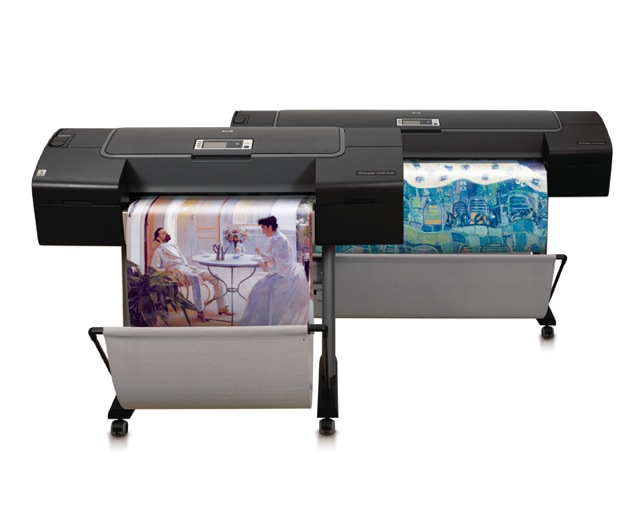
HP DesignJet Z photo printer

Brought to you despite the Board of Directors.

If you have been following the financial news recently, you could be excused for thinking the Board of Hewlett Packard couldn’t organize a booze-up in a brewery. Depsite the twits in the corner office, the great engineers at HP continue to make innovative products. The most recent announcement is the HP DesignJet Z photo printer.

Long time readers of this journal will know how pleased I am with my HP DesignJet 90, which will make up to 18″ wide prints using fade-resistant inks. Having made some forty 13″ x 19″ and 18″ x 24″ prints in aggregate over the past six months on mine, ink levels remain astonishingly high – if those meters are linear this has to be one of the most economical printers available. Three cartridges are still showing full, the other three three-quarters full. Print quality is as good as it gets.

The new floor standing DesignJet Z comes in 24″ and 44″ widths and is focused on extreme color accuracy, courtesy of a built-in Gretag/Macbeth/X-rite spectrophotometer to automate paper profiling and ICC profile generation. I use an external version of the X-Rite to profile my screen and then adjust the ICC profile manually for the paper used with HP’s provided tools, as I explained in my review. Well, now the need for tortuous manual ICC paper profiling is gone. You can get some idea of HP’s target market by looking at the picture above – that looks like a photograph of a Tissot painting in the printer on the left.

These are not cheap. The base 24″ model will sell for $3,400, compared to $1,300 for the six ink 24″ DJ130. The price of the new printer compares favorably with that of the 24″ Epson 7800 at $3,000. The new DesignJet will come in eight or twelve (!) ink models, so you can see how totally focused HP is on color fidelity. As a point of reference, my six ink DJ90 goes to 18″ wide and sells for $1,050. This will be a great machine to fool all those Label Drinkers. Just tell them the print was made using traditional darkroom techniques, just like Ansel Adams used.

Which just goes to show that no matter how disfunctional your Board of Directors may be, you can’t kee a good engineer down.

Cameras and boat anchors

Kodak managed both in one go.

A friend is cleaning house and came across several cameras from the dark ages. A couple which needed a mechanic’s attention went to a nerdy friend (who could not take a good picture to save his life), the one with the micro-tool kit. The other two came my way for auction on eBay, where they will be listed this weekend.

One is prosaic. A 35mm Canon Rebel. The plastic content in this electronic wonder is so high that when I first took it out of the box it almost flew out of my hand. It’s that light. Both the camera and date-imprint batteries were shot so I replaced them (have you priced lithium batteries recently? Phew!) and ran a roll of Kodak Gold 200, provided by aforesaid m-i-l, through it and thence to WalMart for a CD ‘print’. All seems well and despite being made from the purest cheddar, the camera showed itself to be remarkably effective. Autofocus is snappy and exposure automation just so. I went through this little routine to maintain my standing as one of the three honest sellers on eBay. You know how that goes. When I say ‘works perfectly’ I have to first know that is true. It’s a nice piece but strictly a throw away camera in the sense that there is no heirloom value or exquisite engineering to ponder. In that respect it resembles most of its digital successors.

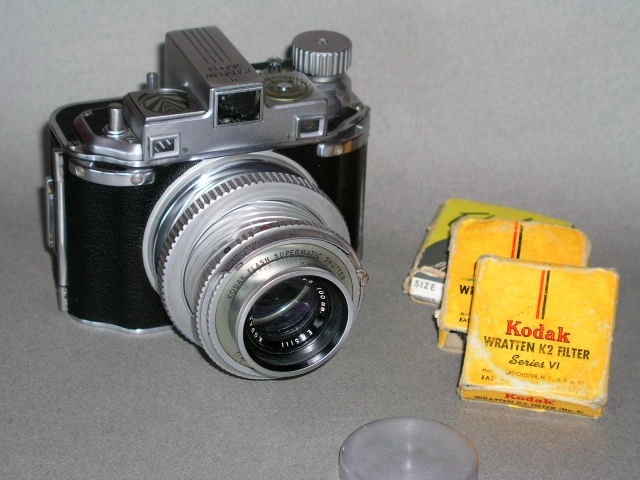
The other, however, is something quite special. Going by the splendid name of Kodak Medalist II, it’s no exaggeration to say that this tool, nay, weapon, competes with San Francisco’s Golden Gate Bridge for uncompromising solidity. The American military was winding down when Eastman Kodak unleashed this beast on the world in 1946 and I suppose there must have been lots of aircraft grade alloys lying around ready to be recast into more peaceful tools.

The Medalist II (if it competed anywhere, it was in weightlifting where that Medal was earned) takes eight pictures on now defunct 620 film, sized 2 1/4″ x 3 1/4″. Technicians exist to convert it to 120 if needed, but to my utter amazement, B&H still lists 620 flm in several flavors, including Ektachrome, Portra, Tri-X, T-Max 100 and 400, Plus-X (!) and Fuji Velvia! Anyway, this camera makes a big negative.

What’s so unusual about handling this boat anchor, excuse me, camera, is the contrast it presents with my experiences in medium format. Heck, my first medium format camera was a Kodak – I was seven and it was a Kodak Brownie …. yes, you guessed it, 620. One speed (‘clack’) and three apertures, comprised of a drilled disc which was shifted using a lever, but it was as cool as it gets if you ask me. After that I proceeded to twin lens Rolleis, the massive and infinitely capable Rollei 6003 SLR and the sweet Mamiya 6. But none of those could pass the test the Medalist would discharge with aplomb.

It’s the Korean War. You are a Life photographer. The picture you just took of the North Korean terrorist aggressor may be your last because he is armed and you are not. But, his gun jams. With lightning thinking, you whip off the little bugger’s helmet and administer a fatal blow with the Medalist, doing the fallen enemy justice with one more exposure carefully focused on his cracked skull. Now you simply could not do that with the effete Rollei twin lens reflex or anything else in that format. Not until the Nikon F arrived, in time to document America’s first defeat, was there a camera of comparable heft.

Let me illustrate.

First there’s a double helical focusing mount which would do the Ferrari engineers proud. Is that beautiful or what?

A touch of lubricant on the alloy surfaces and all is sweetness and light.

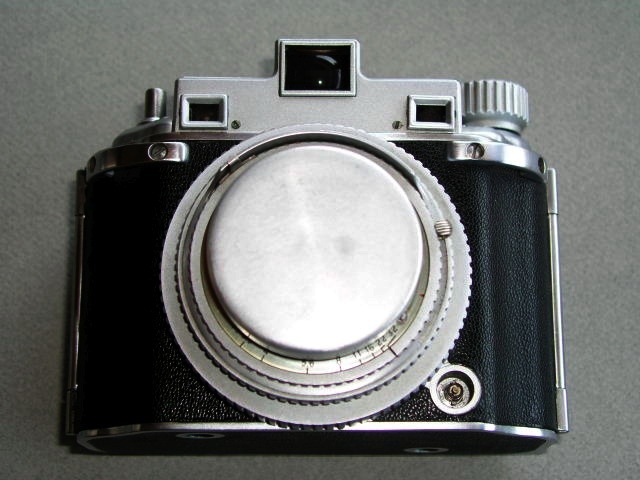
Then how about the rangefinder which is surprisingly accurate?

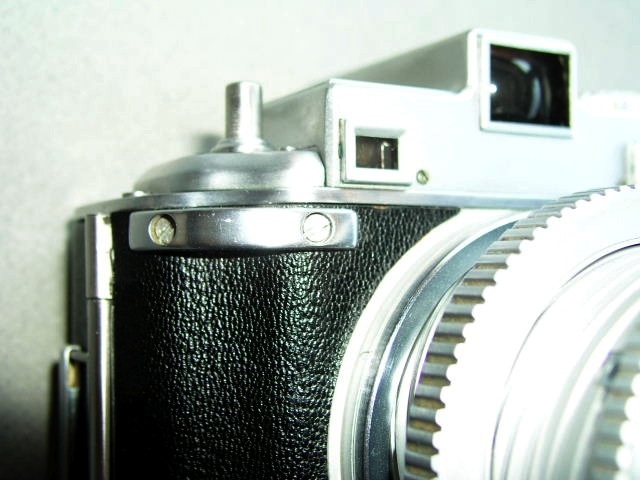
And then the strap lugs, a design borrowed from the chaps who forged the Golden Gate.

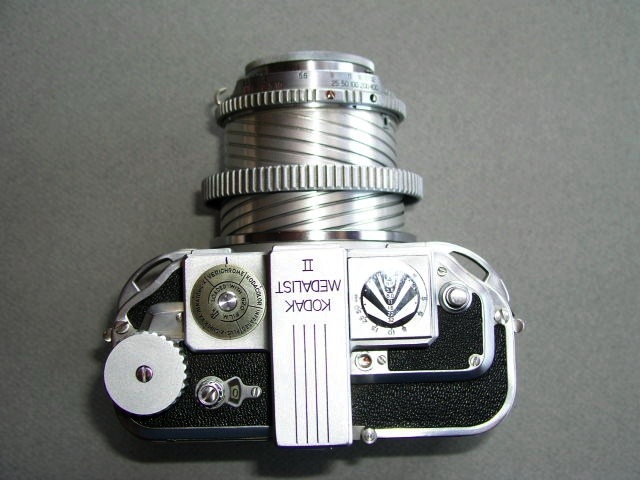
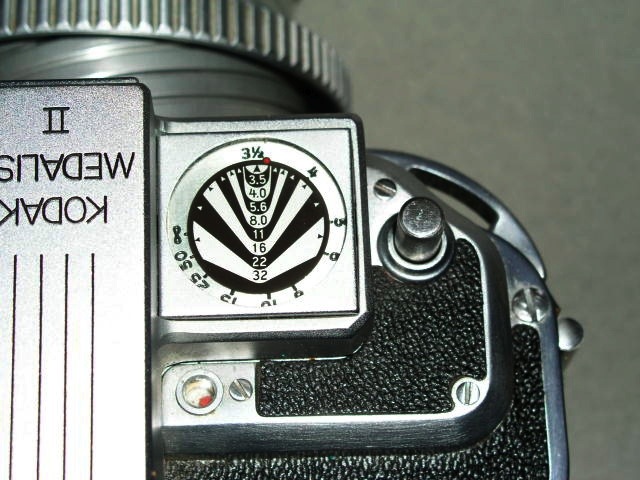
And that neat distance and depth-of-field scale on the top plate:

Granted, the engraving quality would drive the boys at Zeiss and Leitz to the men’s room, but heck, it’s easier to clean blood and guts from than the chic stuff they made in Germany.

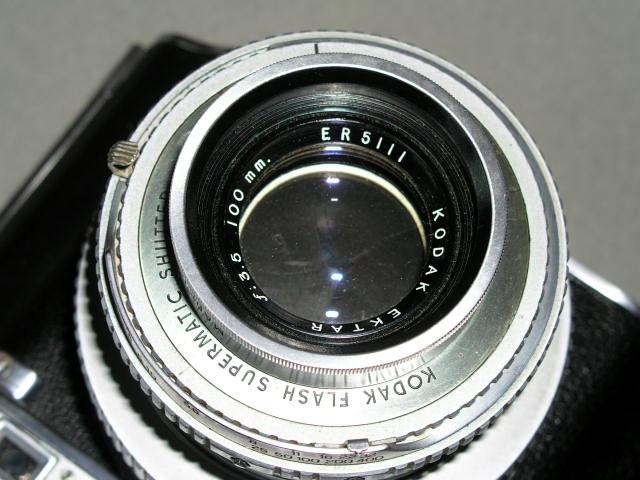
And lest you think that all this mass hides a lousy lens, think again. The five element, coated Ektar is not to be sneezed at.

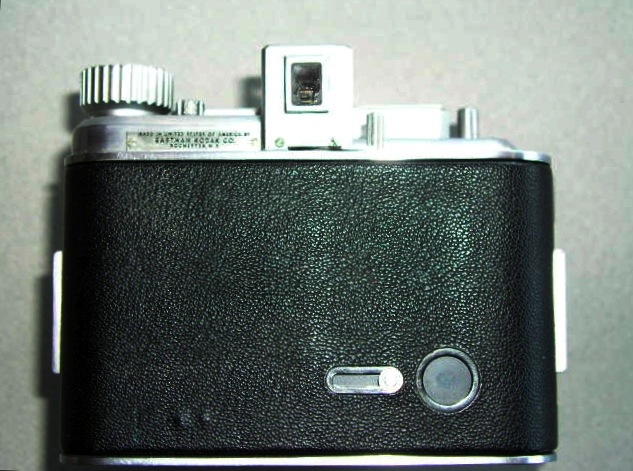
As for the camera back, remember those magnificent tailgates that Detroit gave the world in its station wagons? The ones that would swing to the side or swivel down? Well, Kodak was there first for they designed a camera back that could be swung left or right, depending on which catches you released, or removed all together for cleaning. Just the thing after whacking that twit from Pyongyang. Too bad the Nikon F designers weren’t watching.

And don’t be fooled by that little red window with the sprung cover. Its sole purpose is to key the first frame; thereafter, the internal toothed shaft counts exposures automatically using a shutter interlock to preclude double exposures. You still have to cock the shutter manually, but intentional double exposures are delegated to a separate lever to the right of the eyepiece. Nothing wrong there.

OK, so the Medalist is no Leica M, trading mass for class, but my goodness, what a magnificent showpiece.

Now, Kodak, how about recreating some of this design genius in your contemporary wares. Surely, all the great industrial designers do not reside at Apple?

Label drinkers

The world is full of them.

A friend was visiting the other day and, once that most important of hours came to pass, namely the Cocktail Hour, I did the dutiful thing and prepared a couple of martinis. My avocation is for the gin martini, having come of age in Britain, but my friend preferred one made with vodka. No problem.

Well, once the magic libation began to take effect, he complimented me grandly on the magnificent drink and enquired of the name of the vodka maker.

“Why, Belvedere, of course” quoth I, “Is there anything else?”. This stuff sells for megabucks, by the way.

“But of course”, responded my guest, “I can always tell the great vodkas”.

Suffice it to say that what he was drinking was bottom shelf Gordon’s, ($10 the bottle), the vermouth made by Gallo ($2.99).

My friend, you see, is a Label Drinker.

They are everywhere.

In the sound reproduction world fortunes have been made by peddling ordinary copper wire advertised as ‘Oxygen free with all molecules aligned’ at twenty times the price of the stuff at Home Depot. The Label Drinker can hear the difference, you see, between HD speaker cable and the $50 a foot exotic which, he knows, at that price has to be good. Put a blindfold on him and things don’t look so good of course.

In wine, the Label Drinker is everywhere. Here in the States, John Q Public has wisened up and is buying Two Buck Chuck from Trader Joe’s, realising that he gets 95% of the flavor and 100% of the alcohol that the $30 variety sells for. The grapes from my vineyard go into a $38 a bottle wine, if you must know, and I wouldn’t be caught dead paying that sort of amount for a bottle of Zinfandel, pride of authorship notwithstanding. Mercifully, TBC is rarely available in Zinfandel.

Cars specialize in LDs. The Ferrari must be better at four times the price of the Corvette. Even if the latter is faster, stops better, uses less fuel, is dirt cheap to maintain, and on and on.

And in better sushi bars in America what do you see the Japanese ordering? Why, Coors of course. None of that mass market Kirin garbage when you are abroad.

In photography, the Label Drinker has several sub-species.

The most comical, of course, is the Leica fetishist. He thinks nothing of paying a $150 premium for a Leica DLux-2, which is nothing more than a Panasonic Lumix LX1 with a red Leica logo. $150 for a logo. A fool and his money are easily parted. Go Leica!

A more modern manifestation is the film Luddite. Like the guy who will tell you that LPs sound far better than CDs (he can usually pass the blind test as all the clicks, pops and scratches readily distinguish vinyl from CDs), this type of Label Drinker will swear up and down that nothing, but nothing, matches the tonal range, depth, emotion, blah, blah, blah, of film. But of course.

Which brings me to another recent LD episode. I was showing a bunch of 13″ x 19″ prints to another friend the other day. I like to keep a collection lying around to try them on viewers. Only snag was, this viewer was also a photographer. Of the Old School. You know what that means. “So what did you take these on?” he asked, trying to appear as cool and disinterested as possible. “Why, on 4″ x 5″ film of course”, I replied. “Can you even imagine using anything else for landscapes”. “Absolutely not”, he agreed, a flush coming to his cheeks, as he warmed to his subject. “I use it myself. Nothing beats the tonal range, does it?” Don’t even think of getting this fellow onto the subject of the superiority of monochrome over color. Life’s too short, bores too long.


A bunch of prints….

I have yet to summon up the courage to admit to my lie and tell this Label Drinker that everyone of the dozen or so pictures was taken on the Canon 5D. Not a piece of film in sight. And even had they been on film, they would have been digitised at some point though scanning. How else to print them?

But let’s not be too harsh on Label Drinkers. They can make us a lot of money while providing much innocent fun along the way. My exhibition prints, you understand, are always taken on film.

Postscript: For confirmation from no less august a source than the Wall Street Journal, download their piece on the same topic – which addresses the topic of fake expertise when it comes to wine – by clicking here.

How to run a photo business

One gets it. The other? Oh! well.

I’ve mentioned before that the greatest photographic companies of the twenty-first century will not have their roots in photography. As Kodak, Fuji, Minolta, Leica and Konica all die on the vine, new entrants like Samsung, Casio, Sony and Epson take their place.

And by any standards, two of the outstanding ‘new’ photography companies are Apple and Hewlett Packard. The former makes great enabling technology, both hardware and software, to make the photographer’s life an easy one. The latter makes some great digital cameras and drop dead fantastic printers like the DesignJet series (click ‘Printing’ in the left column for more).

Both companies have great chief executives – the one a driven visionary, the other an outstanding operator.

Yet what a contrast in governance. Whereas you never hear of Apple’s board, the one at HP takes the prize for The Gang That Couldn’t Shoot Straight.

Apple cleverly includes a former vice president of the US (you know, the guy who discovered the internet). Politicians are cheap and this one isn’t going to get in anyone’s way as he eyes the White House yet again, right after he fixes global warming. Plus you get all those sales to fellow travellers. The others – there are only six in addition to Steve Jobs – are the CEO of a clothes manufacturer (what?), the CEO of a genetics company (double what?), two techies (it’s lost on no one that the latest addition is the CEO of Google – now that’s a money making opportunity, no?) and a brilliant financier to give some gloss to the whole thing. In other words, Apple doesn’t let the Board of Directors get in the way of business. Clearly, Jobs is managing these not-so-cool dudes right, judging by the complete absence of boardroom leaks. Heck, he probably doesn’t tell them about the next great thing until it’s on the market….

Now look at HP. You cannot but help look at them, for they make the headlines daily. Here the board numbers no fewer than nine (and falling rapidly, thank goodness – it was an unmanageable eleven in May), including the CEO. This is the same board, recall, that gave us a predecessor CEO who had two goals in mind. Maximizing the number of glossy covers she made and maximizing time on her bottom in the corporate jet. Unfortunately, she also minimized shareholder wealth. Now why the new CEO simply didn’t fire the lot when he came in beats me. Not like he didn’t have the opportunity. So now HP is lost in umpteen investigations of how it tapped telephones to trace endless boardroom leaks and is mightily distracted from making the shareholders money. Every schmuck lawyer, in our out of government, is all over this like slime on a …. well, lawyer. And this board is a real dusie, as former NYC mayor Ed Koch might remark. A couple of women whose qualifications seem quite irrelevant to the job, and at least one of whom might end up in the Federal pokey for her part in a small matter of phone tapping. Time will tell. And six guys, some of whom cannot keep their mouths shut. You want to be on a board where one of your fellow directors is tapping your phone? How badly do you need the fees and free dinners?

And that’s bad for photographers because, despite having a board room full of dopes, HP – to borrow from Apple – makes some insanely great products.

Still, I suppose there’s always Samsung waiting to take its place.