A first HDR experiment

A ten stop light range is tamed.

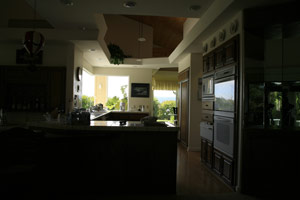
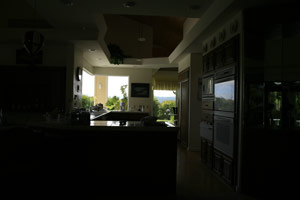
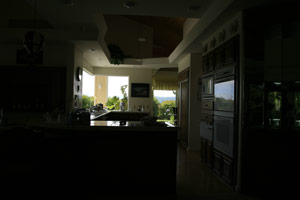
Following on from yesterday’s column, here are the first results of trying the Photomatix HDR + Tone Mapping sofware, using five pictures taken with the 5D on a tripod, set at highest quality JPG and at ISO 200. I took the precaution of saving the camera variables (ISO, metering pattern, non-auto white balance, JPG fine) under the Custom dial setting, so I now only have to set the dial to ‘C’ with no risk of forgetting anything. The scene is of our kitchen with very bright sunlight outside. I measured a 10 stop range from the dark oak on the bar to the sky outside.

Here are the five source images, all one stop apart:


Here is the result after processing the images with Photomatix – it took the application 90 seconds to combine the files on my iMac G5, 2 gHz, 2 gB:

Canon EOS 5D, ISO 200, JPG Fine, tripod. Photomatix software.

Now I have to try this in the real world. Seems like one of the local church interiors would be a good place to start.

High Dynamic Range photography

Not quite as new as it sounds, but much easier today.

Stumbling the ten yards down the main drag from bedroom to office this morning, I tripped on not one but two border terriers. Which is strange as, last I checked, the Pindelski estate was the proud owner of just one of these fine beasts. So either there was some serious hanky panky in the night or something else was afoot.

Now, come to think of it, yesterday was Friday night and it happened to coincide with a presentation of Steve McQueen’s superb film, Le Mans, on the big screen. Anytime one sees a brute Porsche 917 race the gorgeous Ferrari 512 is an occasion for some serious medication to calm the nerves and suffice it to say that the gin martinis were flowing freely.

Which probably accounts for the presence of that second border terrier this morning.

Sitting down at the computer and erasing all those email suggestions that I could not possibly satisfy my woman without a horse’s dose of Viagra, my first reaction was to do something more exciting like paying the bills, but I gave one of the HDR links in a clean email a passing click only to come across this page from Photomatix. When the first thing I saw was their exhortation ‘Increase the Dynamic Range of your Photographs’ I wondered whether this was some sort of spam, and that in fact this was yet another attempt to sell me performance enhancing chemicals. Look, I know I grew up in England where the average male prefers a hot water bottle to a cuddle with his girlfriend, but this was going a bit too far.

Anyway, I scrolled the little wheel on my Genuine Apple Mighty Mouse down the Photomatix page and, well, saw a revelation. What their application does far better than Photoshop can (no surprise there) is to combine three photographs, identical except as to exposure, to create a result with huge dynamic range. You now see the highlight and shadow details that were missing before. The revelatory aspect of this is that the Photomatix software does this with one click, even working on RAW files. All the photographer has to do is take three exposures, 2 stops under, correct and 2 stops over, then let the software work its magic.

Not that this is all that new. Unknown to me I have been an HDR devotee for most of my photographic life. With black and white prints it meant overerexposing, underdeveloping, then printing on a contrasty grade of paper with lots of burning in using the hands over the easel. Then for a long time, having migrated to color film, it was either displaying the slide on a screen using a projector, which confers tremendous dynamic range, or living with prints which either opted for burned out highlights or dungeon dark shadows. Once those slides could be affordably scanned in the 1990s they took on a new lease of life as dynamic range could be restored to some extent with software. Plus, while a computer screen cannot compare to a projected image for dynamic range, it’s a lot better than a print in this regard. The way I would do it is to simply use the Highlight-Shadow slider in PS, later the far better one in Aperture, and bring back the details. For example, take these two snaps of a shaving shop on St. James’s Street in London, taken in 2000 on Kodak Gold 100 negative film:
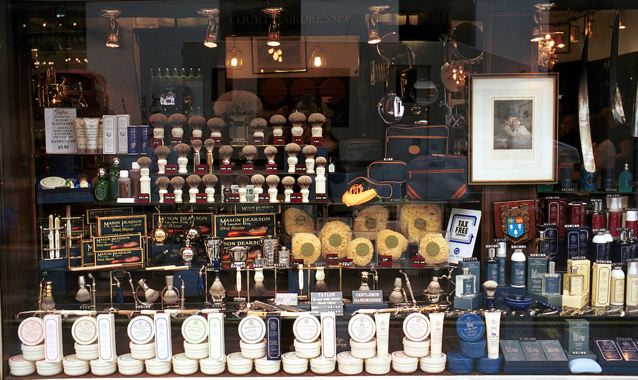
The original, scanned using a Nikon Coolscan scanner.

With Highlight-Shadow correction applied using Aperture.

There’s life in those old pictures yet!

With more recent pictures, taken using RAW in the 5D, the manipulation range is far greater. In this example, I underexposed by a couple of stops to preserve details in the exterior, then corrected exposure and used the Highlight-Shadow slider in Aperture to balance interior and exterior lighting. The Aperture RAW converter was used.
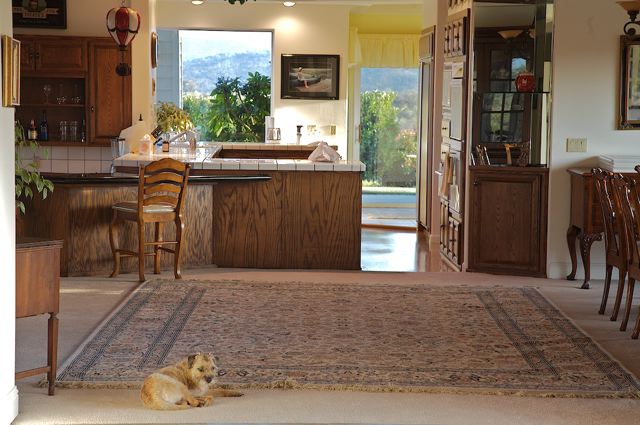
This suggests that, if I do indeed have two border terriers, one was away at the time this was snapped.

So maybe HDR isn’t so new after all. Indeed, look at what chaps like Canaletto did when lazing around Venice trying to make some coin from his oils:
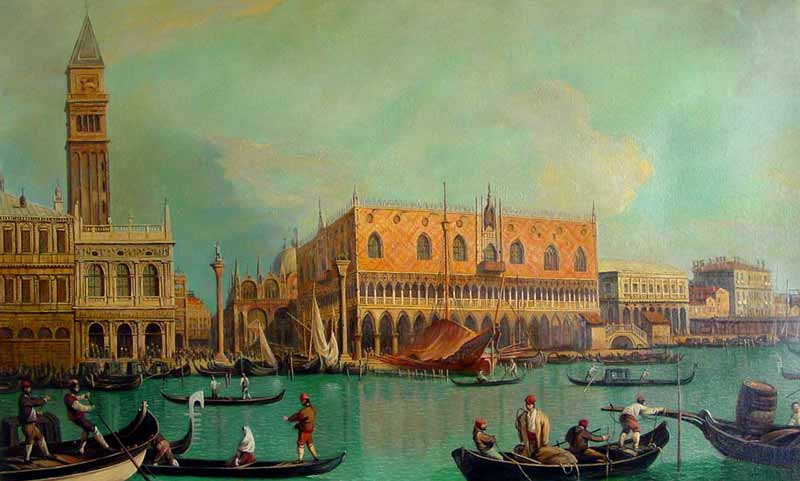
Canaletto has a go at the Grand Canal
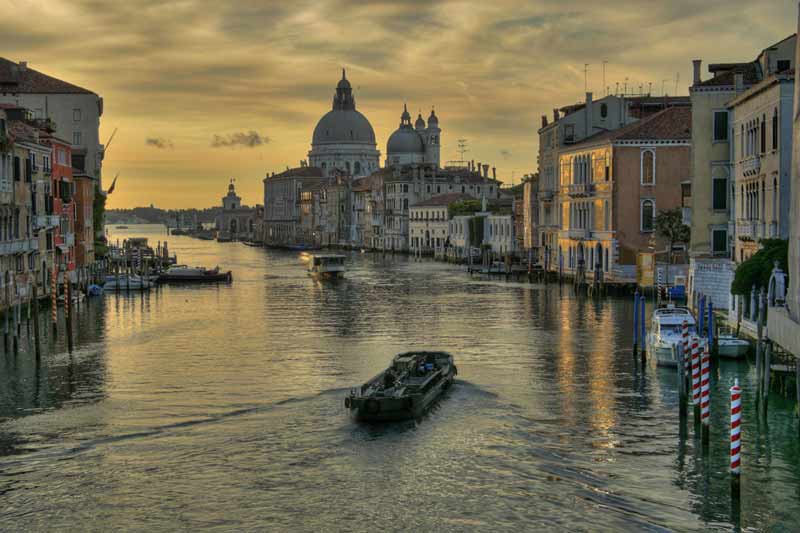
A latter day Canaletto from the Photomatix web site.

It’s little wonder that modern HDR photographs tend to look like oil pantings, as they recreate the great dynamic range that the old masters were creating intuitively. I sort of doubt that Pope Julius II would have ponied up the lira had the ceiling of the Sisitne Chapel been delivered with blown out highlights.
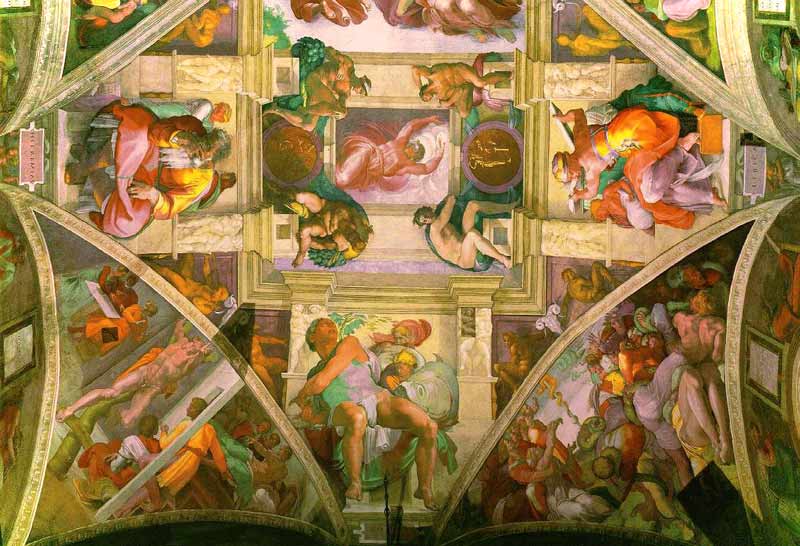
Michelangelo. The Sistine Chapel, 1512.

So Michelangelo was into HDR some 500 years ago. Clearly, he did not use Windows or he would never have finished the job.

In my early experiments with Virtual Reality photography, I mentioned the challenge posed when it came to correct exposure. To permit seamless stitching of the panorama, the camera has to be set on one fixed, manual exposure while all the pictures are taken. To do otherwise is to ask for trouble. The issue, of course, is that means the likely huge dynamic range of a panorama will results in exposure problems in some of the frames. Now it seems that the automated approach offered by products like Photomatix would cure that. True, you have to take at least three pictures for each frame and there’s a little more work to do in assembling the panorama, but cameras like the 5D allow automatic bracketing at two stop intervals – press the button in burst mode and the camera takes three pictures in one second.

So now it looks like my return trip to the redwoods will call for some burst mode under and over photography. More when I have the pano head in my hands. Which probably means my own head will be in my hands shortly thereafter.

By the way, here’s another picture where I used HDR. I wanted a picture of our home theater in daylight, to show the environment and photographs on the walls, but I also wanted the screen filled with a movie picture.

The Home Theater. Canon EOS 5D, 24-105 at 24mm, PS CS2, RAW

I simply exposed for the room, reckoning the fabulous sensor in the 5D would preserve data for the screen image, even if it would be washed out. After converting the RAW file to PSD in ACR, I used the Lasso tool freehand to highlight the screen area then used Levels to bring back the detail. Hey presto!
Redwoods redux

The next trip will be to take VR panoramas.

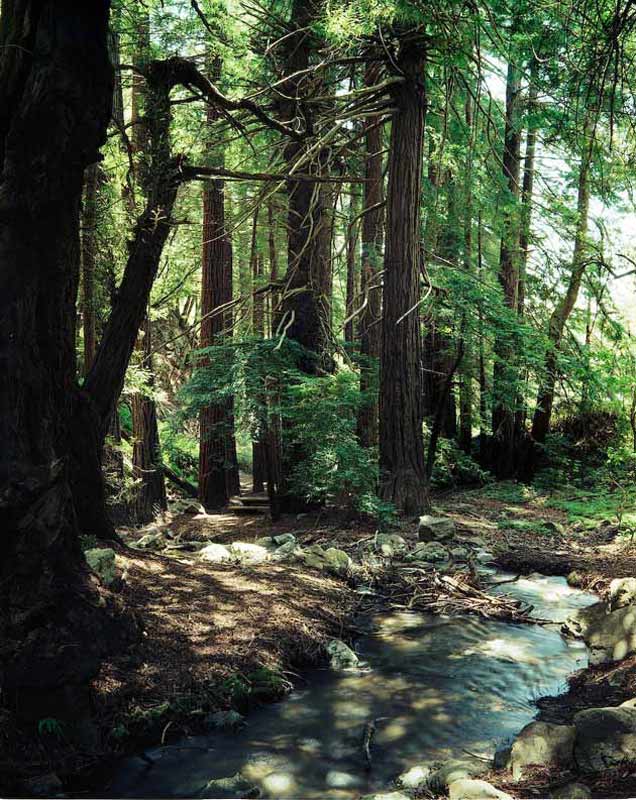
While I wait for my panorama head to be delivered, there’s a three week waiting list, here’s the first venue I will be visiting for some ‘serious’ virtual reality panoramas:


Redwoods. Crown Graphic 4″ x 5″, Kodak VC160.

I’m hoping that a 180 x 360 degree panorama, where you will be able to mouse up, down and all around, will finally convey the sheer size of these magnificent California redwoods, something I have never done to my satisfaction with regular still pictures. No, I will not be using a film camera….

You can read more about Virtual Reality photography here.

One of the best practitioners of the genre is a fine French Photographer named Eric Rougier and I urge you to visit his web site and enjoy the many panoramas there. To really see what VR is all about, just take a look at the interior of Notre Dame in Rougier’s magnificent interactive panorama.

So you thought f/1.4 was fast?

How about f/0.85 back in 1934?

‘Glamor’ lenses for 35mm cameras, the ones with bragging power, have either entailed large apertures or extreme length.

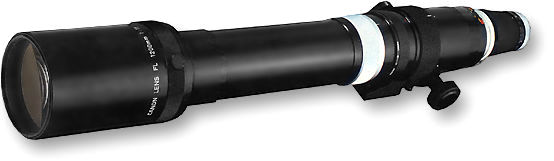
On the extreme length end, it was rather like the cubic capacity of motorcycles. Once you hit the magic thousand, you had bragging rights. So when Vincent motorcycles (then known as HRD) came out with its magnificent Series A twin in 1936, it was a ‘thousand’ (actually 998 ccs) that graced the frame and made it the talk of the town. On the lens front, thousand mm lenses have been around for ever, even if they were never priced at amounts the amateur could afford. No, you had to use someone else’s money to buy a Zeiss Mirotar 1000mm mirror lens for your Contarex back in the sixties. That or choose between a car and that lens. Nikon already had lenses of this length and greater. Canon had a 1200mm ages ago and it was a regular refractive rather than mirror optic, some 853mm long. That’s almost three feet! Get one of these and you could say yours was longer than anyone else’s with little fear of contradiction.

The Canon 1200mm f/8 telephoto lens

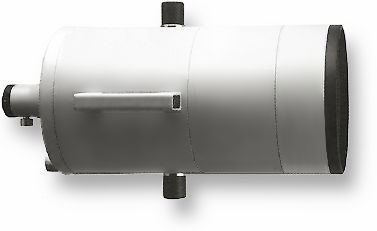
Quite how you were meant to keep this monster steady unless your tripod was built like the Maginot Line is unclear to me, but hey!, you were the big guy on the block so who cared? Sure, Nikon had the 2000mm mirror lens, weighing in at 40 lbs. but, let’s face it, it was barely two feet long so the only bragging rights it conferred was how long it took you to recover from the hernia induced by lifting it on your tripod. Or, for that matter, from lifting the tripod sans lens if it was one sturdy enough.

The Nikon 2000mm f/11 mirror lens

So long was long and nowadays these monsters are as passÄ— as bell bottoms and wide flower ties. Reminders of silly one upmanship and passing fads. The longest Nikon and Canon lenses I can find in the B&H catalog are 1000mm (a mirror lens with a modest f/11 aperture) and 600mm (with a whopping f/4 maximum), respectively.

But for the average man in the street, fast was always more intriguing than long. If his ship came in, a nice 50mm f/1.4 was more likely to grace his camera than a 2000mm f/11. Heck, you could actually use the thing. Indeed, even before WW2, Leica and Zeiss offered f/1.5 50mm lenses. Back as far as 1925 Erich Salomon was taking his great candids with an Ermanox 4.5 x 6cm plate camera fitted with an f/1.8 lens. So speed goes back a few years. Once modern anti-reflective coatings started to be used about 1942 (wars and technological progress being synonymous) these lenses began to transmit something close to their stated apertures. Later Leica gave the world the Summilux, an f/1.4, originally a 50mm and later joined by 35mm and 75mm versions. All superb.

In 1953 Zunow came out with an SLR, largely made of pure cheddar with an f/1.1 lens. Four were sold and have never been heard of since. I recall seeing one and that lens was certainly impressive to look at. In 1956 Nikon equalled them with an f/1.1 for its screw thread Leica clones.

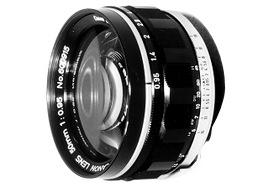
So in 1961, not to be outdone, Canon came up with the 50mm f/0.95 for its Canon 7 rangefinder cameras which used a Leica thread mount. So large was the lens it had a separate external bayonet mount to fit around the standard mount on the camera body. User comment suggests this was truly one of the worst lenses of all time but, what the hell, it was under f/1.0! “Brighter than the human eye” the advertisements screamed. I’ll bet it sold a lot of Canon 7 bodies with f/1.8 lenses. You could always say you could get three faster lenses in case of need – f/1.4, f/1.2 and this worthless wonder.

The Canon 50mm f/0.95 lens. Like most marketing exercises, fast and worthless.

By the way, Canon tried again with a 50mm f/1 lens in their ‘L’ line early in the 21st century. Testifying to the poor performance of that lens, suggesting Canon had learned little from their prior experience, that lens was discontinued a couple of years ago and now has, you guessed it, collectible status. Must make for a nice paperweight, I suppose.

Leitz’s approach was different. The German character, not renowned for its sense of humor, reckoned that anything faster than f/1.4 actually had to be capable of taking sharp pictures, so they took it in baby steps, first coming up with the f/1.2 Noctilux with its exotic and costly aspherical element. Needless to say, the lens was superb and the limited production run of some 2,000 has ensured its collectible value. Meaning, sadly, hardly anyone uses one of these any more, most rotting in some collector’s cage.

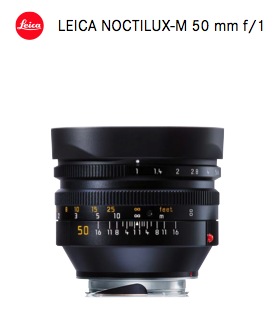
It took Leica another 10 years to work out how to do it with spherical glasses and how to make it faster, and the f/1.0 Noctilux was born in 1976. It remains in production to this day and is probably the first useable f/1.0 lens for a 35mm camera ever made.

But Leitz always were horrible at marketing. Had they but searched their long and distinguished history, they would have found this and it was made in 1934 with an aperture of f/0.85! Or maybe they knew and were embarassed that 42 years later they could only manage f/1.0?

The Leitz 75mm f/0.85 Summar. From Theo Scheerer’s ‘The Leica and the Leica System’, Fountain Press, 1962

And you thought f/1.4 was fast?

By the way, want a $300 f/0.70 lens which will blow any of the above away for definition? Simple. Place that inexpensive Canon 50mm f/1.4 on your EOS 5D, set the speed to 1600 ISO and enjoy finer grain than TriX film at 400 ISO. Two stops gained from f/1.4 make it an f/0.70 with the depth of field and definition of an f/1.4. So Canon finally made a decent sub-f/1.0 lens, by virtue of that wonderful full frame sensor in the 5D!

Jack Dykinga – nature photographer

A master of the modern Western US landscape photograph.

If Eliot Porter’s nature photography appeals to the romantic side of one’s personality, Jack Dykinga’s appeals to the other extreme. A more formal, studied approach. Classical, if you like. That sounds boring on paper but the reality is that his work is astonishing. Whereas with Porter’s work the reaction tends to be “Hmmm, I need to think about that” with Dykinga it’s a more simple “Wow!”.

As is often the case in aesthetic matters, I chanced on his work by accident. It was 1983 and I was half way though my six year stint in New York City. The excitement I had first felt for the city was increasingly turning to dismay. Corruption, dirt and congestion. I reckoned I could get the same in Los Angeles and at least have good weather thrown in at no additional cost. So somewhere about that time I began thinking of going west.

Now there’s a lot that is good about Manhattan. Museums and art galleries everywhere. Restaurants of all ethnicities easily found. Central Park. Carnegie Hall. The Met. Broadway. Wall Street. Street photography opportunities to die for (sadly, literally true in the early 1980s, far better now) and those mom and pop grocery stores (mom and pop being Vietnamese or Korean) open 24/365, seemingly on every street corner.

But one of the best things about the City is the large selection of book stores, both traditional brick and mortar establishments, and the street vendors, just like in Paris. So it was some time around 1983 that I came across a magazine named Arizona Highways at just one of those places. Large format, slim and with no advertising, the photography, limited to Arizona, was stunning. There are no advertisements as the magazine is bankrolled by none other than the State of Arizona, or at least its taxpayers. To cut a long story short, it was there I first encountered the work of Jack Dykinga.

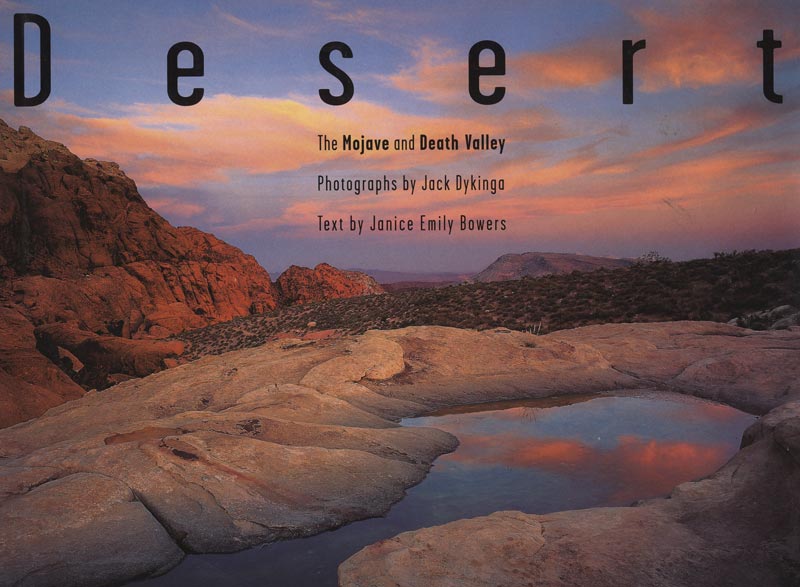
Best as I can tell, Dykinga still works with large format film and I was prompted to write this entry after pulling his book ‘Desert: The Mojave and Death Valley’ from the bookshelf the other day. If Arizona Highways was one reason I moved to the great landscape of the American West in 1987, then Dykinga’s photography was the catalyst.

In the winter of 1997-98 the heavy rains brought by the El Nino weather system produced a tremendous flowering of desert plants in the Mojave, and Dykinga was there to capture it. While large format is not necessary for the modest size of the book – some 10″ x 11″ in size – the photographs are simply magic. Far more than record pictures, Dykinga takes extraordinary pains over composition, thinking nothing of being up with the birds or going to sleep when the owls are coming to.

Thanks to the phenomenon that affects all photography books, you do not have to pay the $49.50 I did back in March, 2003 when this was published, as Amazon will sell you a new hardcover copy for the grand sum of $19.98. Add a fine and relevant text (rare attributes those, in photography books) by Janice Emily Bowers, and you have a treasure. I would spill the beans and tell you all about ‘The Racetrack’ but that section of the book is so extraordinary, so simply unbelievable, that I am going to keep mum and suggest you send some money to Amazon and find out for yourself. You will not believe your eyes.

And supporting a hard working photographer makes far more sense than throwing more money into the corporate coffers of Nicansonypan for the latest gadget. You can see Dykinga’s work on his web site. It does not do his work justice. Buy the book.